The Blind Man

by Gustav Klimt

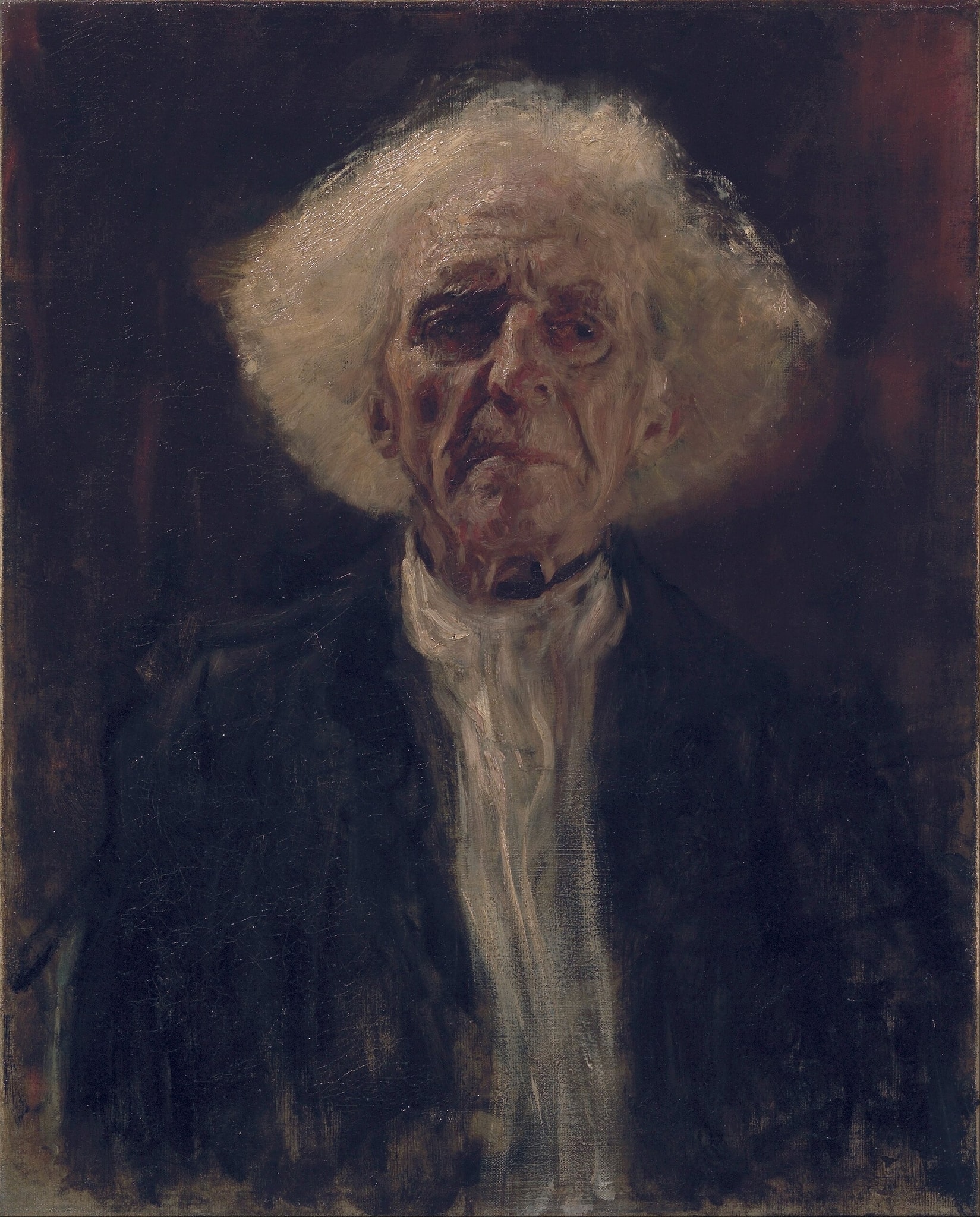
Gustav Klimt’s The Blind Man confronts the viewer with a monumental head and torso emerging from a near-black field, where chiaroscuro, tactile paint, and an occluded gaze redirect attention from sight to touch and memory. The dissolving white collar and scumbled halo of hair make the figure feel carved from darkness, asserting dignity without sentiment and turning blindness into a form of inward presence [1].
💰

Market Value

$14-23 million

How much is The Blind Man worth?

Study Print Studio

Create a personal study print

Build a companion study sheet around the part of this painting that speaks to you most. Choose a detail, shape an interpretation, and walk away with something personal and display-worthy.

Fast Facts

Year
c. 1896
Medium
Oil on canvas
Dimensions
66 × 53 cm
Location
Leopold Museum, Vienna
See all Gustav Klimt paintings in Vienna
The Blind Man by Gustav Klimt (c. 1896) featuring Occluded gaze (shadowed eyes), Encroaching dark field (chiaroscuro void), Scumbled halo of hair, Dissolving white collar

Click on any numbered symbol to learn more about its meaning

Meaning & Symbolism

The canvas stages a confrontation between a human head and an encroaching void. Klimt sets the sitter’s face in a field of brown-black where only the forehead’s chalky planes, the cheek’s creased parchment, and the softly dragged white collar catch light. The eyes sink into a coagulated shadow, refusing the viewer’s grasp; the mouth is set, the brow ridged. These decisions are not descriptive flourishes but structural claims: the occluded gaze forecloses portrait reciprocity, while the thick, earthy strokes that gouge the wrinkles and scumble the wiry hair substitute tactility for visibility. The white collar is not a crisp accessory but a vertical smear, dissolving into the coat—an assertion that costume and ground are secondary to the experience of a body weathered by time. Such handling aligns with the Leopold Museum’s account of Klimt’s deliberate play of stark light and dark to isolate the head and bust, a strategy he explored in related old-man studies of the mid‑1890s 1. The result is a presence that feels almost sculptural, a relic hewn out of paint rather than a society likeness. Blindness, here, functions less as deficiency than as metaphor. Around 1900, European art and letters often framed blindness as a sign of inner vision—a redirection from the optical to the mnemonic and affective 5. Klimt leverages that topos without props or anecdote: the engulfing dark reads as both studio ground and existential surround; the lost gaze turns attention to the sensorial surface of the flesh; the frontal pose grants the figure monumental dignity rather than pity. Because the painting was shown at the 1st Secession Exhibition and reproduced in Ver Sacrum, Klimt and his peers evidently understood this austere study as congruent with their program to renew Austrian art—not through ornament yet, but through a modern psychology of presence 13. Situated circa 1896, the work belongs to Klimt’s transitional moment from Ringstrasse Historicism toward Secessionist ambitions; its sober palette, old-masterish darkness, and empirical modeling engage established portrait conventions even as they bend them toward phenomenological questions: What remains when the world cannot be seen? What kind of image honors that interiority? Scholarship locates the painting among autonomous character heads rather than commissions, a categorization reinforced by the absence of setting and the dissolution of costume 12. Understanding why The Blind Man is important also involves material and documentary stakes. The Leopold Museum’s record and provenance dossier anchor the painting’s data—medium, dimensions, and exhibition history—and even register later debates over a visible signature, subsequently retouched out at the museum’s request, underscoring the institution’s commitment to source‑based integrity 12. Yet those archival intricacies do not distract from the picture’s core proposition. Before gold leaf and mosaic patterning became Klimt’s hallmark, he had already framed human vulnerability and mortality with conceptual force. In The Blind Man, vision is internalized, the body bears history in its furrows, and paint becomes a medium of truth-telling. That is the canvas’s enduring claim: a modern portrait can forgo spectacle and still speak—powerfully—about what it means to see.

Explore Deeper with AI

Ask questions about The Blind Man

Popular questions:

Powered by AI • Get instant insights about this artwork

💬 Ask questions about this artwork!

Interpretations

Reception as Program: Secession Context

Shown at the 1st Secession Exhibition and reproduced in Ver Sacrum, this austere head functioned as an early programmatic statement: modern portraiture could renounce ornament yet still pursue a new psychology of presence 13. Rather than court bourgeois likeness, Klimt offers a concentrated study stripped of attributes, aligning with Secession strategies to challenge academic decorum through format and display. The Ver Sacrum reproduction disseminated the image as an emblem of concise, anti-spectacular modernity, placing tactile facture and chiaroscuro at the movement’s rhetorical front. In this lens, The Blind Man was not marginal to the Secession’s debut; it helped define the group’s claim that radical renewal could be achieved through perceptual rigor and affective intensity, not only through decorative excess.

Source: Leopold Museum; Ver Sacrum (Vienna Secession)

Authorship on Trial: The Signature Controversy

The painting’s modern career includes a rare, instructive case of curatorial authorship in action. Early reproductions show no signature; later photographs record one; in 1999 the mark was overpainted at Rudolf Leopold’s request as likely spurious, with the intervention documented as reversible 2. This dossier-centered narrative reframes the canvas as a site where material evidence, institutional ethics, and historiography intersect. Rather than destabilizing the work’s status, the transparency of these records models a research-driven standard for authenticity in fin‑de‑siècle art. The episode sharpens the viewing stakes: when an image is intentionally austere, even a signature can skew reception toward commodity value; removing it (responsibly, and documented) reasserts the primacy of form, facture, and presence over market legibility.

Source: Leopold Museum (Provenance Dossier)

Haptic Modernism: Seeing by Touch

Klimt’s substitution of the optical for the haptic—creased skin, wiry hair, a smeared collar—anticipates discourses on embodied spectatorship at Vienna 1900, where facture and dark grounds retooled portraiture’s address 46. The occluded eyes deny reciprocity, compelling the viewer to read surface as sensation rather than likeness. In this account, the canvas stages an experiment in “haptic visuality,” using chiaroscuro and scumble to convert light into touch. Such handling aligns with fin‑de‑siècle revivals of old-master technique while reassigning function: not to mimic depth, but to manifest a perceiving body in paint. The result is a phenomenological portrait—one that privileges the lived body’s textures over narrative props, marking a crucial hinge before Klimt’s famous ornamental phases.

Source: MoMA (Vienna 1900); Prestel (Klimt early techniques)

Blindness, trope and counter‑trope

Around 1900, European culture cast blindness as inner vision; Klimt engages this topos while withholding pity through frontality and scale 15. A disability‑studies lens complicates the metaphor: equating blindness with spiritual profundity can erase lived experience, yet here the denial of eye contact resists voyeuristic scrutiny and redirects attention to embodied surface—wrinkles, pores, hair. The work neither sentimentalizes nor pathologizes; it recalibrates portrait exchange by making the viewer labor across matter rather than gaze. This counters period stereotypes that used blindness as moral allegory, proposing instead a dignified, sensorially rich presence. The figure’s isolation is not social erasure; it is a strategy to protect interiority within the modern image.

Source: Leopold Museum; Oxford Academic (cultural history of blindness)

Old-Master Dialogue, Modern Aim

The bust-length head against darkness evokes Baroque character studies—Rembrandtian chiaroscuro and the revival of “old master” effects central to fin‑de‑siècle portraiture 4. Yet Klimt repurposes these signs of tradition toward modern stakes: the suppression of setting, the dissolution of costume edges, and the sculptural head pivot from genealogical homage to inquiries into presence and perception. Where the Baroque often sought dramatic narrative or theological charge, Klimt leverages similar means to ask what an image retains when vision itself is destabilized. The historical citation thus becomes technique-as-argument: a classicizing envelope serves a distinctly modern phenomenological project, anticipating the Secession’s bid to reinvent Viennese painting from the inside out.

Source: MoMA (Vienna 1900); Prestel (Klimt’s 1890s shift)

Label Wars: Historicism vs. Symbolism

The holding museum classifies the work as Historicism, emphasizing sober palette, empirical modeling, and training-lineage; broader Klimt narratives file the 1890s under emergent Symbolism 17. Reading the canvas through this tension is productive: its old-masterish chiaroscuro and studio study format anchor it in academic portrait practice, while title and handling open to symbolic registers (inwardness, isolation). Rather than forcing a single taxonomy, the painting exemplifies a hinge object—technically anchored in the academy, conceptually migrating toward Secessionist concerns. This duality clarifies why the piece could headline the Secession’s first show: it mediates between tradition and allegorical modernity without resorting to overt iconographic programs or later decorative surface.

Source: Leopold Museum; Encyclopaedia Britannica

Related Themes

About Gustav Klimt

Gustav Klimt (1862–1918), co-founder of the Vienna Secession, pivoted from controversial public commissions to a decorative-symbolist language in his Golden Period. Drawing on Byzantine mosaics and modern design, he fused opulent surfaces with psychological intensity. By 1908–09, he transformed scandal into canon, and The Kiss became Vienna’s emblem of modern love.
View all works by Gustav Klimt

More by Gustav Klimt

Portrait of Adele Bloch-Bauer I by Gustav Klimt

Portrait of Adele Bloch-Bauer I

Gustav Klimt (1907)

Gustav Klimt’s Portrait of Adele Bloch-Bauer I stages its sitter as a <strong>secular icon</strong>—a living presence suspended in a field of gold that converts space into <strong>pattern and power</strong>. The naturalistic face and hands emerge from a reliquary-like cascade of eyes, triangles, and tesserae, turning light, ornament, and status into the painting’s true subjects <sup>[1]</sup><sup>[2]</sup>.

Sunflower by Gustav Klimt

Sunflower

Gustav Klimt (1907/1908)

Gustav Klimt’s Sunflower turns a single bloom into a <strong>monumental, figure-like presence</strong>. A tapering stack of broad, drooping leaves rises from a <strong>mosaic-like carpet of round blossoms</strong>, crowned by a gold-flecked disc that glows against a cool, stippled field. The work fuses <strong>portrait, icon, and landscape</strong> into one emblem of vitality and quiet sanctity <sup>[1]</sup><sup>[2]</sup>.

Cottage Garden with Sunflowers by Gustav Klimt

Cottage Garden with Sunflowers

Gustav Klimt (1906–1907 (signed 1907))

Cottage Garden with Sunflowers is a square, horizonless field of blooms where a vertical column of <strong>sunflowers</strong> anchors an all-over weave of color and pattern. Klimt fuses <strong>ornament and nature</strong>, turning a humble Litzlberg cottage plot into a radiant matrix of cyclical life and renewal <sup>[1]</sup><sup>[4]</sup><sup>[5]</sup>.

The Kiss by Gustav Klimt

The Kiss

Gustav Klimt (1908 (completed 1909))

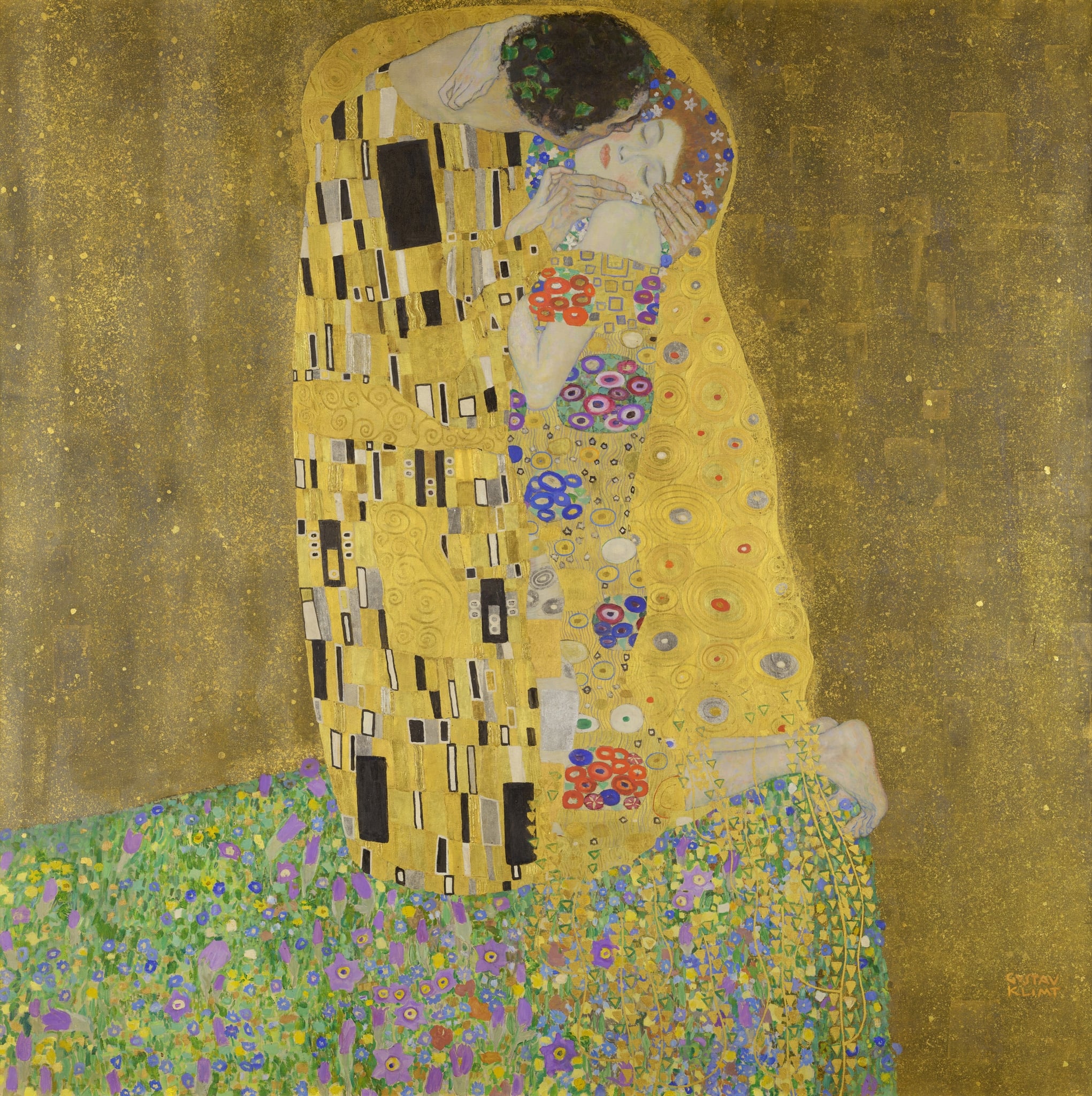
The Kiss stages human love as a <strong>sacred union</strong>, fusing two figures into a single, gold-clad form against a timeless field. Klimt opposes <strong>masculine geometry</strong> (black-and-white rectangles) to <strong>feminine organic rhythm</strong> (spirals, circles, flowers), then resolves them in radiant harmony <sup>[1]</sup><sup>[2]</sup>.
The Tree of Life by Gustav Klimt

The Tree of Life

Gustav Klimt (1910–1911 (design; mosaic installed 1911))

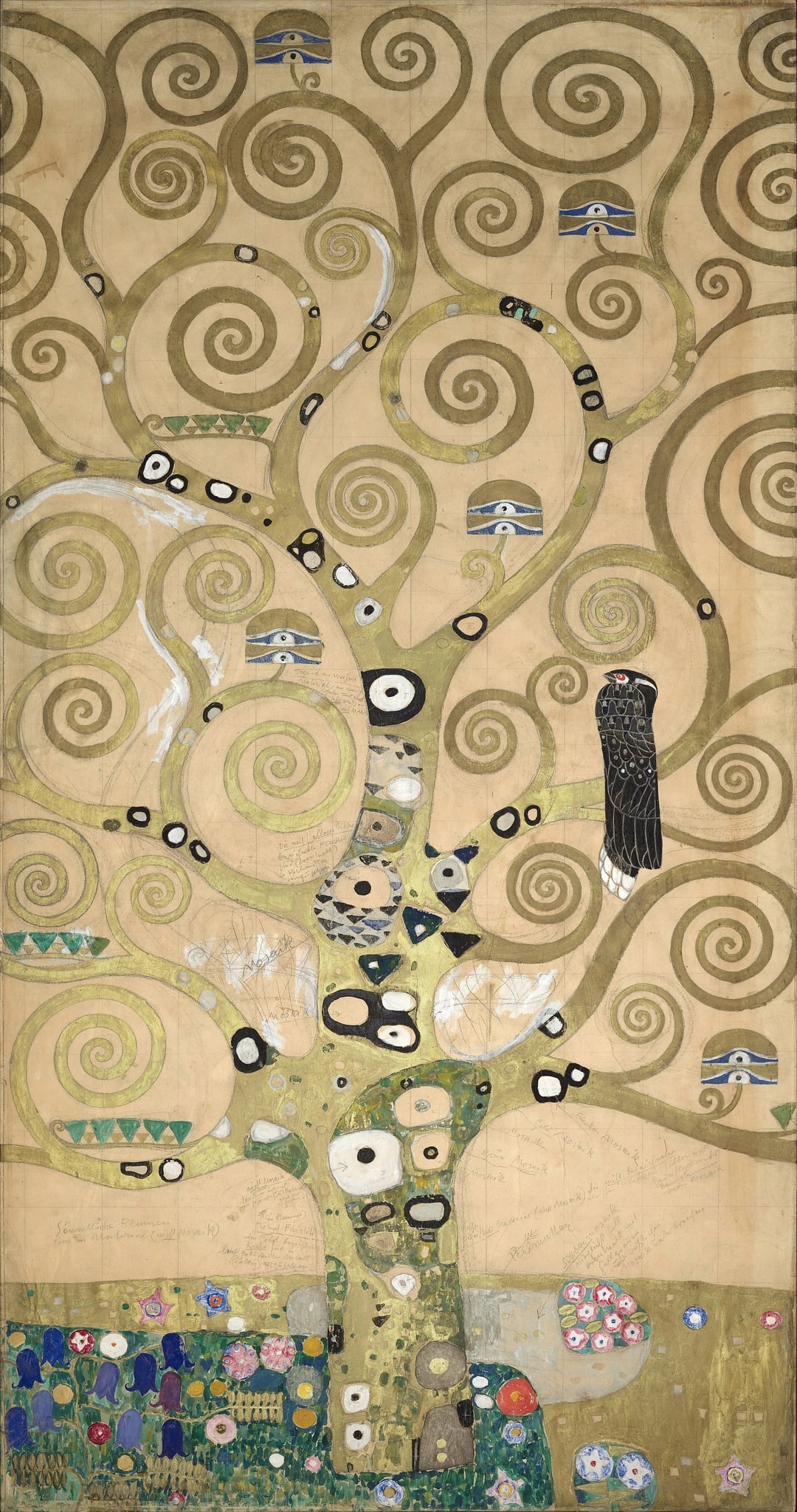
Gustav Klimt’s The Tree of Life crystallizes a <strong>cosmological axis</strong> in a gilded ornamental language: a rooted trunk erupts into <strong>endless spirals</strong>, embedded with <strong>eye-like rosettes</strong> and shadowed by a black, red‑eyed bird. Designed as part of the Stoclet dining‑room frieze, it fuses <strong>symbolism and luxury materials</strong> to link earthly abundance with timeless transcendence <sup>[1]</sup><sup>[2]</sup>.
The Kiss (Lovers) by Gustav Klimt

The Kiss (Lovers)

Gustav Klimt (1907–1908 (Belvedere lists 1908/09))

The Kiss (Lovers) crystallizes Klimt’s <strong>Golden Period</strong> ideal: erotic union staged as a sacred vision. Two bodies fuse beneath a single golden mantle, poised on a flowered ledge at the brink of the unknown, where <strong>pattern becomes symbol</strong> and intimacy becomes icon.