Adam and Eve

by Gustav Klimt

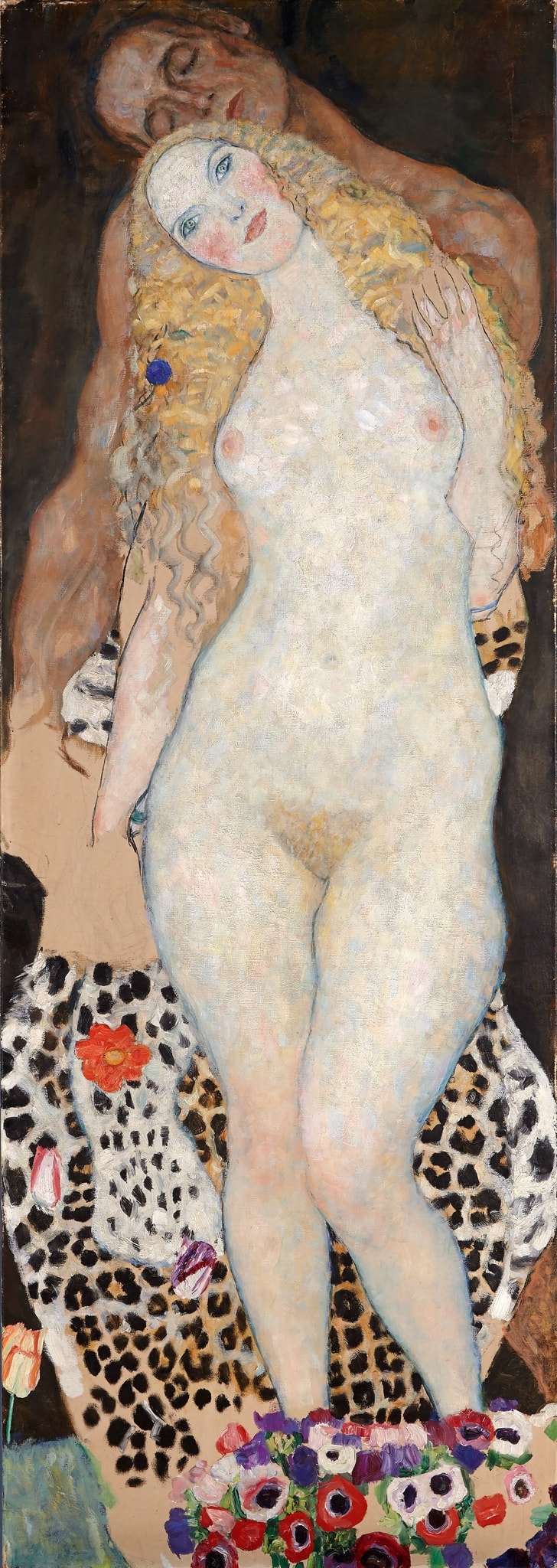
Gustav Klimt’s Adam and Eve recasts the biblical pair as a sensual, timeless allegory rather than a didactic tale. Eve’s luminous, opalescent body and direct gaze dominate, while Adam recedes in shadow, enfolding her amid a leopard pelt and a carpet of anemones that signal erotic vitality and fertility [2][3].
💰

Market Value

$10-40 million

How much is Adam and Eve worth?

Study Print Studio

Create a personal study print

Build a companion study sheet around the part of this painting that speaks to you most. Choose a detail, shape an interpretation, and walk away with something personal and display-worthy.

Fast Facts

Year
1916–1918 (unfinished)
Medium
Oil on canvas
Dimensions
approx. 173 × 60 cm
Location
Österreichische Galerie Belvedere (Belvedere Museum), Vienna
See all Gustav Klimt paintings in Vienna
Adam and Eve by Gustav Klimt (1916–1918 (unfinished)) featuring Eve’s luminous body, Adam in shadow (eyes closed), Leopard pelt, Anemone bouquet

Click on any numbered symbol to learn more about its meaning

Meaning & Symbolism

Klimt stages a reversal of biblical hierarchy by making Eve the visual and symbolic axis of the work. Her pale, pearlescent skin, modeled with milky whites tinged by cool blues and warm yellows, radiates against Adam’s bronzed, shadowed body, which drapes around her like a protective envelope 23. The tall, narrow format thrusts her forward; her hips and abdomen are rendered with archaizing fullness, recalling prehistoric fertility figurines and positioning her as a timeless mother of life, not a specific sinner of the Fall 2. Her face, turned outward with a calm, dreamy insistence, confers agency: she meets the viewer rather than the man behind her. The tiny blue flower pinned in her cascading hair punctuates that self-possession, a quiet sign of awakening rather than a coded emblem; Klimt lets the psychology of her posture carry meaning instead of iconographic props 23. Adam, by contrast, closes his eyes, his features dissolving toward the background. This near-merger with darkness allows a reading of night (Adam) and day (Eve), a polarity that heightens Eve’s radiance and suggests a cosmological balance embedded in the first couple 3. Around them, Klimt arrays emblems of erotic power and fertility that displace moralizing with vitality. The leopard pelt cradling their bodies—linked by scholars to Dionysian maenads—signals untamed sensuality and instinct, a primal energy that sloughs off Edenic innocence even without the serpent’s intervention 23. At Eve’s feet, a dense bouquet of anemone-like flowers blooms as a bright, painterly band, a sign of fecundity and nature’s abundance that pushes the image from mythic past into immediate, sensuous presence 2. The tactile contrasts—cool, shimmering flesh; rough, spotted hide; thickly laid floral impastos—create a surface drama where decorative pattern becomes destiny: the lovers are held in a web of textures that foretell the fall into knowledge as a voluntary embrace of life’s generative force rather than a singular transgression 23. Klimt’s late style sharpens this philosophical pivot. The unfinished passages expose underlayers and revisions, evidence of a searching process in his final years that traded golden ornament for painterly nuance while keeping Symbolism’s allegorical charge 13. The absence of explicit narrative cues is not omission but strategy: by stripping the scene of apple and serpent, Klimt redefines temptation as interior—Eve’s serene self-acceptance and Adam’s yielding posture rehearse the moment not of sin, but of becoming 23. Read this way, the composition can also evoke the instant of Eve’s emergence from Adam—the forward surge of her body as daybreak from night—so that creation and desire coincide 3. In Adam and Eve, Klimt fuses biblical origin, pagan eroticism, and modern psychology into a single, vertical current flowing through Eve’s body. That current, framed by the leopard skin and crowned by flowers, turns the couple into an image of life-force rather than fallenness, a culminating statement of Klimt’s belief that beauty, eros, and art are inseparable modes of truth 23.

Explore Deeper with AI

Ask questions about Adam and Eve

Popular questions:

Powered by AI • Get instant insights about this artwork

💬 Ask questions about this artwork!

Interpretations

Formal Analysis

Klimt’s tall, attenuated format acts like a visual lever: Eve’s pale, opalescent modeling advances, while Adam’s bronzed mass dilates into shadow, creating a figure–ground oscillation that reads as day encroaching on night 12. The surface is a theater of contrasts—silky flesh, spotted pelt, thick floral impasto—where tactile dissonance carries narrative load in lieu of props. Crucially, the canvas is partly unresolved: sketched passages and chromatic underlayers register a late-style method that privileges painterly nuance over gilded planar ornament 13. This incompletion is not a deficit but a formal strategy: Klimt stages meaning within the very act of making, letting joins, overpaints, and value shifts speak to emergence and becoming. The result is a vertical current of looking—up the floral bank, across the feline hide, into Eve’s gaze—that synchronizes composition with concept 123.

Source: Belvedere (Franz Smola); Belvedere, Lady with Fan; Encyclopaedia Britannica

Symbolic Reading (Pagan Syncretism)

The leopard pelt, associated with Dionysian maenads, injects ritual wildness and ecstatic abandon into a biblical subject, displacing Edenic innocence with a pagan economy of eros and potency 1. At Eve’s feet, a band of anemone-like flowers acts as a fecund threshold between myth and sensuous present, a chromatic rite of spring that secularizes the Fall into flowering life 1. Without serpent or apple, symbolism migrates from icon to atmosphere: pelt-as-aura, bloom-as-threshold, skin-as-halo. This syncretism—Judeo-Christian origin story charged by Greco-Roman ecstatic codes—typifies Klimt’s late allegorical language, where mythic systems cohabit and amplify one another rather than cancel out 12. The tableau reads as a liturgy of vitality, in which sacred transgression becomes sanctioned creativity, and desire is figured as the world’s generative syntax 12.

Source: Belvedere (Franz Smola); Encyclopaedia Britannica

Historical Context (Vienna, 1916–1918)

Painted in Klimt’s Hietzing studio during the closing years of World War I, Adam and Eve preserves the fin-de-siècle sensual-introspective ethos in a wartime milieu that saw European art fracture toward Expressionism and the avant-garde 53. The picture’s unfinished state—Klimt died in 1918—folds biography into form, aligning the work with other late canvases that reveal process as content 3. Rather than pivot to polemic or rupture, Klimt consolidates a Viennese modernism of inward allegory, erotic charge, and ornamental intelligence, now translated into painterly nuance rather than gold-ground splendor 3. In this light, Adam and Eve is both coda and bridge: a last testament to Secessionist symbolism and a document of late-style searching under historical pressure, where continuity itself becomes a stance amid war’s dislocations 53.

Source: El País (Belvedere exhibition context); Belvedere, Lady with Fan

Gender & Gaze (Feminist Lens)

Klimt reverses biblical hierarchy by centering Eve’s body and gaze: she looks outward with composed insistence while Adam’s features dissolve into darkness, a choreography that redistributes power from patriarchal narrative to feminine agency 21. Her archaizing hips and abdomen index fertility idols, but the key modern turn is psychological: she is not a cipher of blame but a subject who meets the viewer, rendering desire as self-possession rather than seduction-as-fall 12. The small blue flower functions less as emblem than punctuation for autonomy, avoiding iconographic traps that historically objectified Eve. In this reading, Klimt reformulates the “first woman” as author rather than allegory—her luminosity is not temptation’s lure but the phenomenology of presence, a claim on looking that undoes the old didactic script 12.

Source: Encyclopaedia Britannica; Belvedere (Franz Smola)

Psychological/Cosmological Interpretation

The work sustains a dual register: as psychology, it stages interior temptation—Eve’s serene self-acceptance and Adam’s yielding—without narrative props; as cosmology, it aligns the couple to day (Eve) and night (Adam), a polarity of visibility and withdrawal 12. This doubleness reframes the Fall as an initiation into consciousness: a movement from shadowed undifferentiation toward radiant self-awareness. The forward thrust of Eve’s body can be read as the moment of emergence, a becoming that fuses creation and desire into the same temporal beat 2. By letting tonal contrast and posture carry meaning, Klimt models a Symbolist psychology where light behaves like thought, darkness like dream, and eros like the engine that converts one into the other 12.

Source: Belvedere (Franz Smola); Encyclopaedia Britannica

Related Themes

About Gustav Klimt

Gustav Klimt (1862–1918), co-founder of the Vienna Secession, pivoted from controversial public commissions to a decorative-symbolist language in his Golden Period. Drawing on Byzantine mosaics and modern design, he fused opulent surfaces with psychological intensity. By 1908–09, he transformed scandal into canon, and The Kiss became Vienna’s emblem of modern love.
View all works by Gustav Klimt

More by Gustav Klimt

Portrait of Adele Bloch-Bauer I by Gustav Klimt

Portrait of Adele Bloch-Bauer I

Gustav Klimt (1907)

Gustav Klimt’s Portrait of Adele Bloch-Bauer I stages its sitter as a <strong>secular icon</strong>—a living presence suspended in a field of gold that converts space into <strong>pattern and power</strong>. The naturalistic face and hands emerge from a reliquary-like cascade of eyes, triangles, and tesserae, turning light, ornament, and status into the painting’s true subjects <sup>[1]</sup><sup>[2]</sup>.

Sunflower by Gustav Klimt

Sunflower

Gustav Klimt (1907/1908)

Gustav Klimt’s Sunflower turns a single bloom into a <strong>monumental, figure-like presence</strong>. A tapering stack of broad, drooping leaves rises from a <strong>mosaic-like carpet of round blossoms</strong>, crowned by a gold-flecked disc that glows against a cool, stippled field. The work fuses <strong>portrait, icon, and landscape</strong> into one emblem of vitality and quiet sanctity <sup>[1]</sup><sup>[2]</sup>.

Cottage Garden with Sunflowers by Gustav Klimt

Cottage Garden with Sunflowers

Gustav Klimt (1906–1907 (signed 1907))

Cottage Garden with Sunflowers is a square, horizonless field of blooms where a vertical column of <strong>sunflowers</strong> anchors an all-over weave of color and pattern. Klimt fuses <strong>ornament and nature</strong>, turning a humble Litzlberg cottage plot into a radiant matrix of cyclical life and renewal <sup>[1]</sup><sup>[4]</sup><sup>[5]</sup>.

The Kiss by Gustav Klimt

The Kiss

Gustav Klimt (1908 (completed 1909))

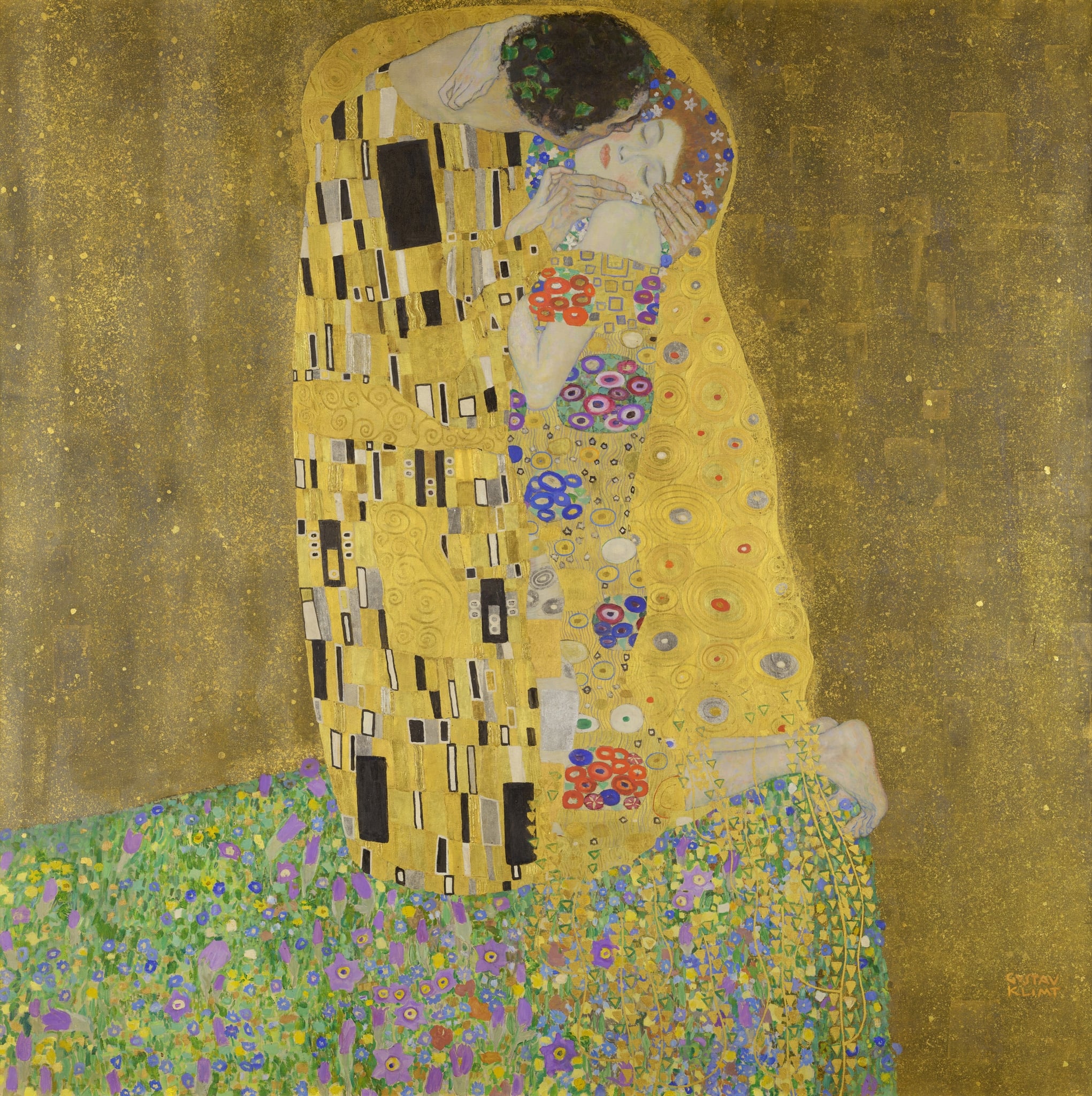
The Kiss stages human love as a <strong>sacred union</strong>, fusing two figures into a single, gold-clad form against a timeless field. Klimt opposes <strong>masculine geometry</strong> (black-and-white rectangles) to <strong>feminine organic rhythm</strong> (spirals, circles, flowers), then resolves them in radiant harmony <sup>[1]</sup><sup>[2]</sup>.
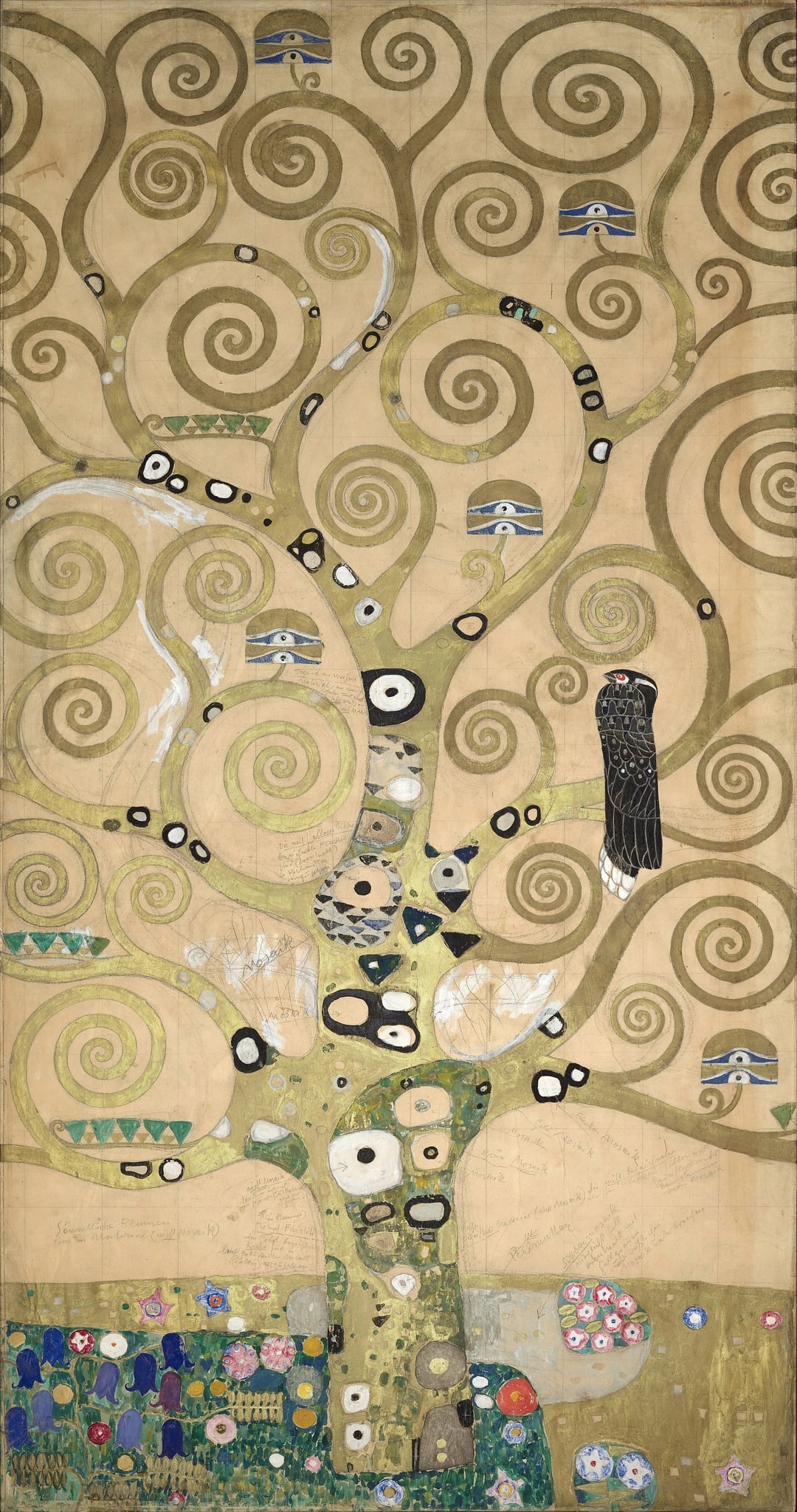
The Tree of Life by Gustav Klimt

The Tree of Life

Gustav Klimt (1910–1911 (design; mosaic installed 1911))

Gustav Klimt’s The Tree of Life crystallizes a <strong>cosmological axis</strong> in a gilded ornamental language: a rooted trunk erupts into <strong>endless spirals</strong>, embedded with <strong>eye-like rosettes</strong> and shadowed by a black, red‑eyed bird. Designed as part of the Stoclet dining‑room frieze, it fuses <strong>symbolism and luxury materials</strong> to link earthly abundance with timeless transcendence <sup>[1]</sup><sup>[2]</sup>.
The Kiss (Lovers) by Gustav Klimt

The Kiss (Lovers)

Gustav Klimt (1907–1908 (Belvedere lists 1908/09))

The Kiss (Lovers) crystallizes Klimt’s <strong>Golden Period</strong> ideal: erotic union staged as a sacred vision. Two bodies fuse beneath a single golden mantle, poised on a flowered ledge at the brink of the unknown, where <strong>pattern becomes symbol</strong> and intimacy becomes icon.