How Much Is Adam and Eve Worth?
Last updated: March 16, 2026
Quick Facts
- Methodology
- comparable analysis
'Adam and Eve' (c.1916–18) by Gustav Klimt is museum‑held (Österreichische Galerie Belvedere), unfinished, and has no recorded public sale. If hypothetically offered on the open market, a reasoned valuation band is approximately USD 10–40 million, subject to substantial caveats about condition/finish, deaccessionability, and buyer competition.
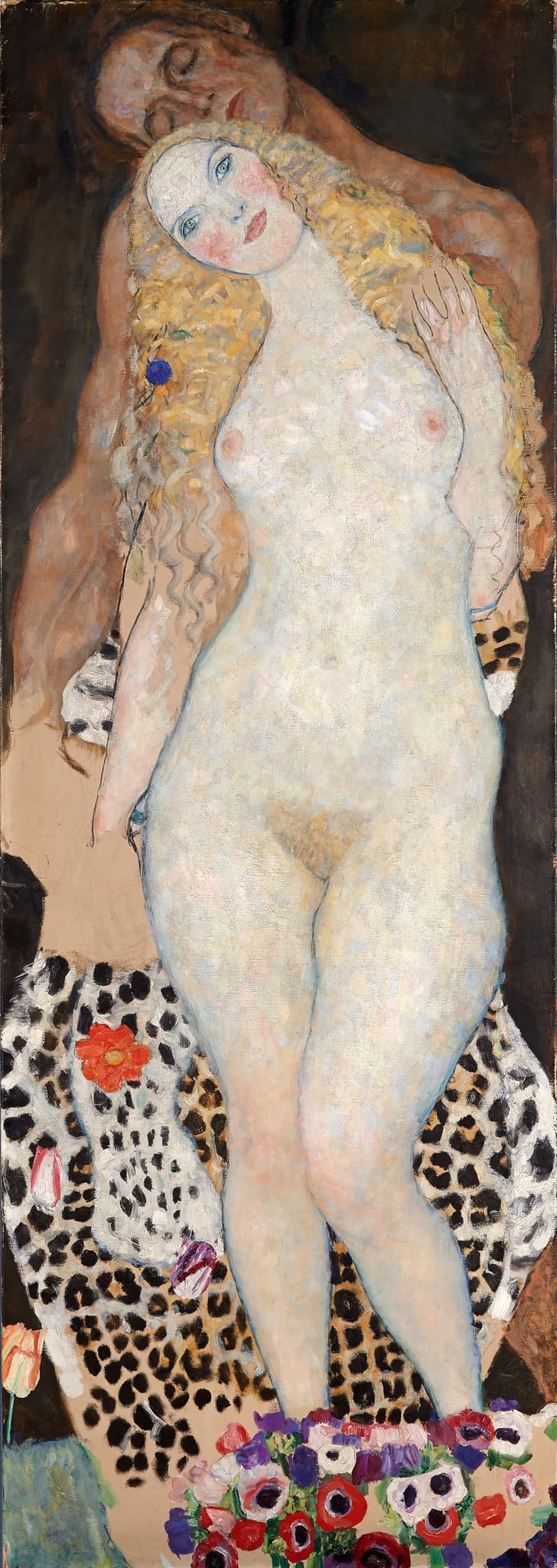
Adam and Eve
Gustav Klimt, 1916–1918 (unfinished) • Oil on canvas
Read full analysis of Adam and Eve →Valuation Analysis
Valuation conclusion: 'Adam and Eve' (c.1916–18) is an unfinished oil by Gustav Klimt currently in the Österreichische Galerie Belvedere; there is no record of a public sale and the work is effectively off‑market [1]. Given its institutional ownership and incomplete state, the painting would typically trade at a material discount to Klimt’s finished masterpieces and should be valued hypothetically rather than as a transactable market lot.
Comparables and market context: Recent auction results for finished late Klimt canvases establish the artist's upper market ceiling; high‑profile sales have reached high eight and nine figures, demonstrating strong buyer appetite for canonical, fully finished works [2]. Those transactions set a useful upper bound but are not direct comparables because they were finished, often portrait‑based works with exceptional provenance. For a museum‑held, unfinished late canvas, the market allocates a substantial discount relative to those benchmarks.
Why USD 10–40 million: Applying customary market discounts for unfinished and institutional works — while recognizing the premium that strong museum provenance might support if a sale were possible — leads to a realistic hypothetical band of roughly USD 10 million on the downside (limited finish, condition problems, weak buyer competition) to USD 40 million on the upside (near‑complete pictorial state, robust interest from major collectors/institutions, clear deaccession pathway). The midpoint reflects the most likely scenario assuming normal market liquidity and no legal impediment to sale.
Key sensitivities and risk: The valuation is highly sensitive to three items: the degree of autograph finish (near‑finished vs. sketch‑state), the conservation/condition report (significant restoration lowers value materially), and deaccession or export constraints under Austrian law or donor terms (which could prevent a sale or deter international bidders). Exhibition and publication history would also improve market confidence and could raise realizable value.
Practical next steps: This is a hypothetical market opinion. To refine into a formal appraisal one should obtain the Belvedere accession/provenance file, high‑resolution images and a current conservation report, clarification of any legal/deaccession constraints, and confidential pre‑sale market checks with major auction‑house specialists. Absent those materials, USD 10–40 million represents a reasoned, conservative estimate grounded in comparable finished Klimt sales and standard market discounts for unfinished museum works.
Key Valuation Factors
Art Historical Significance
Medium ImpactAs a late and unfinished Klimt composition, 'Adam and Eve' has clear art‑historical and scholarly interest: it contributes to understanding Klimt's late iconography, studio practice, and technique. For curators and academics the work is an important document of the artist’s final years and can play a valuable role in exhibitions and scholarship. However, within the market hierarchy of Klimt pictures it is not a canonical masterpiece with broad name recognition that drives the very highest private and auction prices. That distinction reduces its speculative appeal to private collectors, so art‑historical importance supports value but only at a medium level relative to Klimt’s top‑tier finished works.
Market Demand and Comparables
High ImpactGustav Klimt is a blue‑chip market name and finished prime works have commanded very high prices at major houses, demonstrating an active buyer pool and high ceiling. Comparable sales of late‑period Klimts and major landscape/portrait examples set the upper bound for the artist’s market. For 'Adam and Eve' these comparables are instructive in establishing potential upside, but because the work is unfinished and museum‑held, demand will be more selective and buyers will apply a discount. Nevertheless, strong underlying demand for Klimt means that the painting's market floor would likely be substantially higher than for many non‑Klimt Symbolist works, hence a high impact on valuation.
Condition and Degree of Finish
High ImpactThe painting’s physical state and how 'finished' it appears are pivotal. Collectors and institutions pay premiums for autograph, fully resolved works; conversely, sketchlike or demonstrably incomplete canvases generally attract lower prices and a narrower bidder pool. Conservation issues such as flaking, previous restorations, relining, or unstable ground can materially reduce marketability and require discounting. If 'Adam and Eve' is largely pictorially resolved and structurally sound, it could approach the higher end of the band; if it is fragmentary or requires major conservation, price sensitivity increases and value could fall toward the low end.
Provenance and Museum Ownership
High ImpactBelvedere ownership confers authoritative provenance, institutional credibility, and exhibition history — all positive signals for buyers. Museum provenance can support premium pricing if the work is offered with full institutional documentation. However, institutional ownership also creates practical barriers: deaccession policies, donor restrictions, and reputational considerations typically complicate or prevent sale, which can reduce buyer appetite and liquidity. Thus museum ownership is a mixed factor: very positive for authenticity and scholarly value but constraining for marketability, and therefore it has a high impact on the valuation outcome.
Legal, Deaccession and Export Constraints
Medium ImpactAustrian cultural‑property rules, museum deaccession protocols, and any donor‑imposed conditions can materially restrict the ability to sell or to export a painting. If legal limitations or covenants prevent sale, market value is moot; if sale is permitted, regulatory requirements and public scrutiny can narrow the buyer pool and reduce competitive tension, depressing price. Even when sale is legally possible, potential buyers will price in the cost, delay, and reputational risk associated with deaccession. This factor is medium impact in most scenarios but can become decisive if restrictions are absolute.
Sale History
Adam and Eve has never been sold at public auction.
Gustav Klimt's Market
Gustav Klimt is a prominent blue‑chip artist in the global market. Finished canonical works — notably major portraits and symbolist compositions — have achieved exceptional auction and private sale prices, driven by scarcity and sustained collector demand. Supply of museum‑quality Klimts is limited, and items that are autograph, complete, and with strong provenance routinely access the market’s upper tiers. However, value differentiation within Klimt’s oeuvre is large: finished masterpieces command outsized premiums while unfinished or mid‑tier works sell at materially lower levels. Condition, completeness and provenance therefore determine whether a work will reach the market’s highest price bands.
Comparable Sales
Portrait of Elisabeth Lederer
Gustav Klimt
Top-tier Klimt portrait and the artist's present auction high; demonstrates collector willingness to pay nine-figure sums for finished, canonical Klimt portraits (sets the upper market ceiling).
$236.4M
2025, Sotheby's New York
Dame mit Fächer (Lady with a Fan)
Gustav Klimt
Late-period finished masterpiece (c.1917–18), closely contemporaneous with Adam and Eve; useful for comparing late Klimt market interest and the premium for finished, iconic works from the same period.
$108.4M
2023, Sotheby's London
~$115.0M adjusted
Birch Forest
Gustav Klimt
Major Klimt landscape sold from a high-profile private collection; shows strong market demand for important finished Klimt works outside portraiture and helps define the high end for significant finished canvases.
$104.6M
2022, Christie's New York (Paul G. Allen sale)
~$114.8M adjusted
Current Market Trends
The high‑end market for established modern masters remains robust, with strong demand for scarcity, museum‑quality provenance, and canonical works. Recent record sales for Klimt and some contemporaries have raised price expectations, but macroeconomic volatility and liquidity cycles can compress buyer pools at the top. Interest is concentrated on finished, museum‑quality pieces; unfinished or institutionally held works are treated more conservatively by buyers, yielding narrower demand and greater price sensitivity.
Study print
Study this painting as a print
Pair the full artwork with a museum-style study sheet focused on one meaningful detail.
Sources
- Österreichische Galerie Belvedere — print catalogue entry for 'Adam und Eva'
- Sotheby's press release / coverage — Gustav Klimt 'Dame mit Fächer' (Lady with a Fan) and related market reporting
- Christie's — Paul G. Allen collection sale results (including Klimt 'Birch Forest')
- Klimt Database — catalogue and late works overview (entry summary)
- Sotheby's coverage — Historic night and major Klimt sale reporting (context for market ceiling)