Auditorium of the Old Burgtheater

by Gustav Klimt

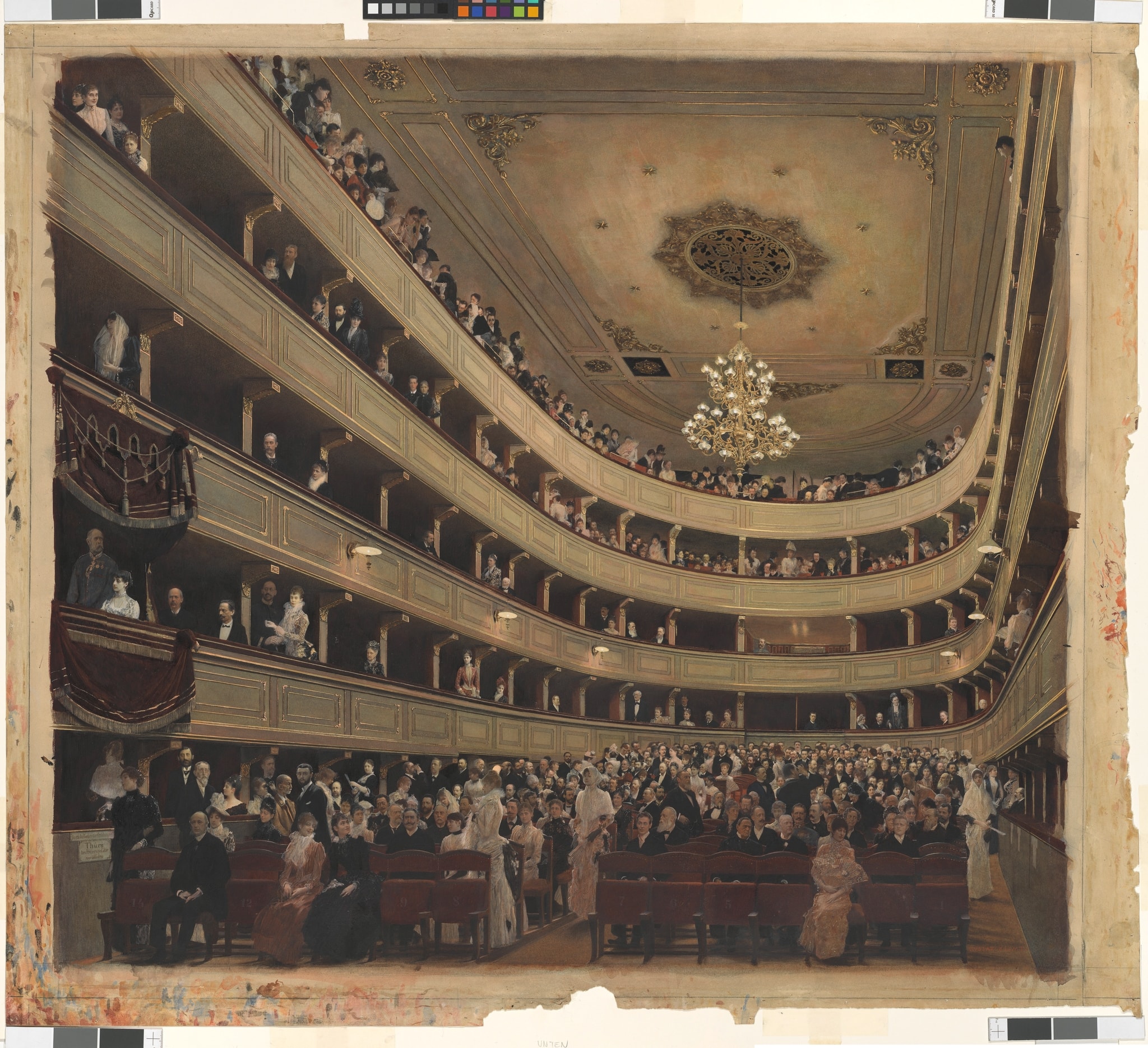
Auditorium of the Old Burgtheater turns the stage around: the audience becomes the show beneath a glowing chandelier and sweeping tiers. Klimt fuses hundreds of individualized faces into a single, wave‑like body of spectators, lit by gaslight and framed by gilded medallions. The result is a civic mirror—Vienna watching itself—at the very moment its old theater was disappearing.

Study Print Studio

Create a personal study print

Build a companion study sheet around the part of this painting that speaks to you most. Choose a detail, shape an interpretation, and walk away with something personal and display-worthy.

Fast Facts

Year
1888–1889
Medium
Gouache on paper
Dimensions
91.2 × 103 cm
Location
Wien Museum, Vienna
See all Gustav Klimt paintings in Vienna
Auditorium of the Old Burgtheater by Gustav Klimt (1888–1889) featuring Central chandelier, Sweeping stacked balconies, Parquet block (front-row tribunal), Opera glasses

Click on any numbered symbol to learn more about its meaning

Meaning & Symbolism

Klimt’s decisive move is to occupy the performer’s space and turn outward. From that stage‑bound vantage, the parquet fills like a dark tide of coats and silk, while four stacked balconies sweep upward in a single curve toward a central chandelier. The composition eliminates the play entirely, insisting that the true event is the public’s self‑display. Dozens of figures tilt opera glasses; others lean over railings, craning to see and be seen. The architecture—its gilt ceiling medallions, bracket lamps, and repeating box apertures—functions as a social machine that orders bodies, distributes privilege, and floods all ranks with the same gaslit sheen 12. The chandelier’s glow binds the tiers in a common atmosphere, yet the parquet’s dense, front‑facing block reads as institutional power; the upper boxes register more intimate vignettes of flirtation, gossip, and conspicuous presence. In this way the painting stages reciprocal spectatorship: the crowd absorbs the performer’s gaze while performing for itself. As a civic commission executed on the eve of demolition, the work is a monument to urban memory as much as to art. The City of Vienna tasked Klimt to capture the auditorium “authentically and correctly,” and he responded with meticulous portraiture—hundreds of distinct heads, postures, and garments—built from on‑site drawings and photographic aids 123. Period viewers praised its compelling realism; modern readers sense a deliberate, almost montage‑like construction in the way discrete figure‑clusters tessellate along the curve of boxes 2. That doubleness is the point: the image is both record and performance, documentary and staged. It argues that public life in late‑Habsburg Vienna is produced by mediation—by optics, vantage, and framing—no less than by the bodies present. The slight vertigo of the oblique ceiling and receding tiers underscores the intoxication and pressure of visibility; the parquet’s frontal rank of solemn faces becomes a tribunal of taste, while the topmost balcony dissolves into an abstract band of ovals, a visual metaphor for the crowd as social organism 12. Placed within Klimt’s career, the sheet is a summation of his Ringstrasse academicism and a prelude to the Secession. Its ornamental ceiling plates and crystalline chandelier anticipate, in embryo, the artist’s later fascination with radiant, gold‑toned surfaces, even as the handling remains resolutely naturalist 12. Why Auditorium of the Old Burgtheater is important is thus twofold: it preserves, with near‑forensic care, the image of a lost cultural space at the hinge of Vienna’s modernization, and it advances a modern thesis that public identity is theatrical—constructed through collective looking under a shared, civic light 123. The painting’s impact was immediate, winning high honors and consolidating Klimt’s public stature, the platform from which his radical turn at the end of the decade became possible 4.

Explore Deeper with AI

Ask questions about Auditorium of the Old Burgtheater

Popular questions:

Powered by AI • Get instant insights about this artwork

💬 Ask questions about this artwork!

Interpretations

Media Archaeology: Optics, Photos, and the Assembled Crowd

Beyond verisimilitude, Klimt’s method foregrounds a 19th‑century media stack—on‑site sketches, photographic aids, and later assembly—yielding a picture that is at once indexical and composite. Period viewers praised its “compelling realism,” yet modern readers perceive a calibrated, near‑cinematic montage effect in the tessellated clusters along the boxes. The subsequent publication of a "Personenspiegel" to identify sitters extends the work’s life as a reproducible, nameable archive, revealing how photography and print culture stabilize social identity in circulation. The painting thus materializes a key urban-modern paradox: images both document and produce publics, turning spectators into legible data under shared light. Klimt’s auditorium is not merely seen; it is compiled—a civic image engineered through optical prostheses and editorial design 28.

Source: Albertina (Digital Publications); Wien Museum (Personenspiegel)

Urban Memory and the Politics of Preservation

Commissioned as the old Burgtheater faced demolition, the sheet functions as heritage-in-advance: a state-sanctioned memory device to monumentalize what modernization erases. The City’s mandate for an “authentic and correct” image frames Klimt as a forensic witness whose labor turns the auditorium into a civic reliquary. Its preview and subsequent Kaiserpreis reception embed the painting in patriotic culture, where preservation is less rescue than translation into image—an ideological move that consolidates imperial cultural capital even as the building disappears. Read this way, the chandelier’s unifying glow becomes a metaphor for an empire seeking coherence through spectacle and remembrance, with the picture as both elegy and instrument of official memory 1346.

Source: Wien Museum; Habsburger.net; Klimt‑Datenbank; Wien Museum Press Dossier

Social Choreography: Architecture as a Class Machine

Klimt’s amphitheatrical sweep diagrams a social machine: circulation corridors, stacked boxes, and the parquet align bodies into ranked vantage points. Under gaslight, sartorial surfaces read as signals within a code of access, price, and proximity to power. The frontally posed parquet coalesces into a juridical block—an audience as tribunal of taste—while upper tiers fragment into intimate scenes of flirtation and display. This is not mere décor but an architectural apparatus of distribution, where the theater maps class onto sightlines and audibility, naturalizing hierarchy through spectacle. The image thereby offers a visual sociology of Ringstrasse culture, translating etiquette, money, and status into legible positions in space 125.

Source: Wien Museum; Albertina (Digital Publications); Wikipedia (overview corroborating vantage and opera glasses)

Material Light and Proto‑Secession Optics

The gaslit chandelier and gilded ceiling medallions generate a common atmosphere that flattens difference into sheen while foreshadowing Klimt’s later fascination with radiant, metallic surfaces. Even within an academic idiom, these luminous nodes operate like optical attractors, orchestrating attention and binding heterogeneous figures into a single field. This is less about gold leaf than about choreographed reflectivity, a civic luminosity that anticipates the artist’s golden optics of the 1900s. In effect, the picture becomes a laboratory for how light mediates collectivity—turning bodies into reflective elements within an image-system—bridging Ringstrasse historicism and the symbolic, decorative ambitions of the Secession 127.

Source: Wien Museum (object record/photos); Albertina (Digital Publications); Britannica (career context)

Performance Theory: Reciprocal Spectatorship and the Gaze

By taking the stage‑bound vantage and omitting the play, Klimt flips theatrical hierarchies: the audience becomes the spectacle, and the performer’s look ricochets across opera glasses and craning bodies. This staging of reciprocal spectatorship aligns with modern urban regimes of visibility in which subjects internalize the public gaze, acting themselves into being under a civic light. The upper galleries’ atomized ovals verge on abstraction, suggesting a crowd as social organism, while individualized portrait heads maintain accountability—the seen are also identifiable. Klimt thus theorizes the theater as a feedback loop of looking, where identity is performed, recorded, and reflected within a shared optical field 25.

Source: Albertina (Digital Publications); Wikipedia (vantage and spectatorship context)

Related Themes

About Gustav Klimt

Gustav Klimt (1862–1918), co-founder of the Vienna Secession, pivoted from controversial public commissions to a decorative-symbolist language in his Golden Period. Drawing on Byzantine mosaics and modern design, he fused opulent surfaces with psychological intensity. By 1908–09, he transformed scandal into canon, and The Kiss became Vienna’s emblem of modern love.
View all works by Gustav Klimt

More by Gustav Klimt

Portrait of Adele Bloch-Bauer I by Gustav Klimt

Portrait of Adele Bloch-Bauer I

Gustav Klimt (1907)

Gustav Klimt’s Portrait of Adele Bloch-Bauer I stages its sitter as a <strong>secular icon</strong>—a living presence suspended in a field of gold that converts space into <strong>pattern and power</strong>. The naturalistic face and hands emerge from a reliquary-like cascade of eyes, triangles, and tesserae, turning light, ornament, and status into the painting’s true subjects <sup>[1]</sup><sup>[2]</sup>.

Sunflower by Gustav Klimt

Sunflower

Gustav Klimt (1907/1908)

Gustav Klimt’s Sunflower turns a single bloom into a <strong>monumental, figure-like presence</strong>. A tapering stack of broad, drooping leaves rises from a <strong>mosaic-like carpet of round blossoms</strong>, crowned by a gold-flecked disc that glows against a cool, stippled field. The work fuses <strong>portrait, icon, and landscape</strong> into one emblem of vitality and quiet sanctity <sup>[1]</sup><sup>[2]</sup>.

Cottage Garden with Sunflowers by Gustav Klimt

Cottage Garden with Sunflowers

Gustav Klimt (1906–1907 (signed 1907))

Cottage Garden with Sunflowers is a square, horizonless field of blooms where a vertical column of <strong>sunflowers</strong> anchors an all-over weave of color and pattern. Klimt fuses <strong>ornament and nature</strong>, turning a humble Litzlberg cottage plot into a radiant matrix of cyclical life and renewal <sup>[1]</sup><sup>[4]</sup><sup>[5]</sup>.

The Kiss by Gustav Klimt

The Kiss

Gustav Klimt (1908 (completed 1909))

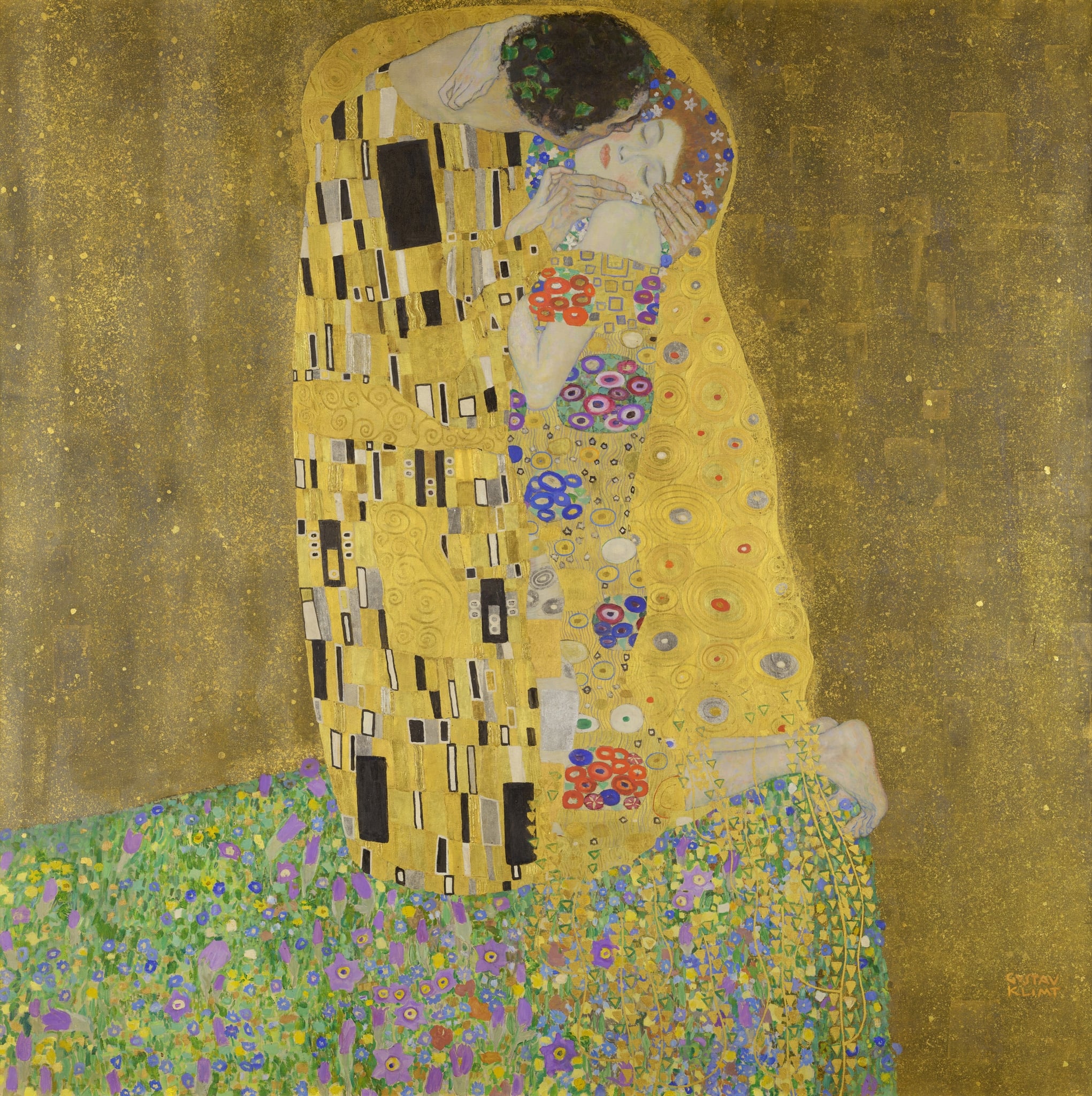
The Kiss stages human love as a <strong>sacred union</strong>, fusing two figures into a single, gold-clad form against a timeless field. Klimt opposes <strong>masculine geometry</strong> (black-and-white rectangles) to <strong>feminine organic rhythm</strong> (spirals, circles, flowers), then resolves them in radiant harmony <sup>[1]</sup><sup>[2]</sup>.
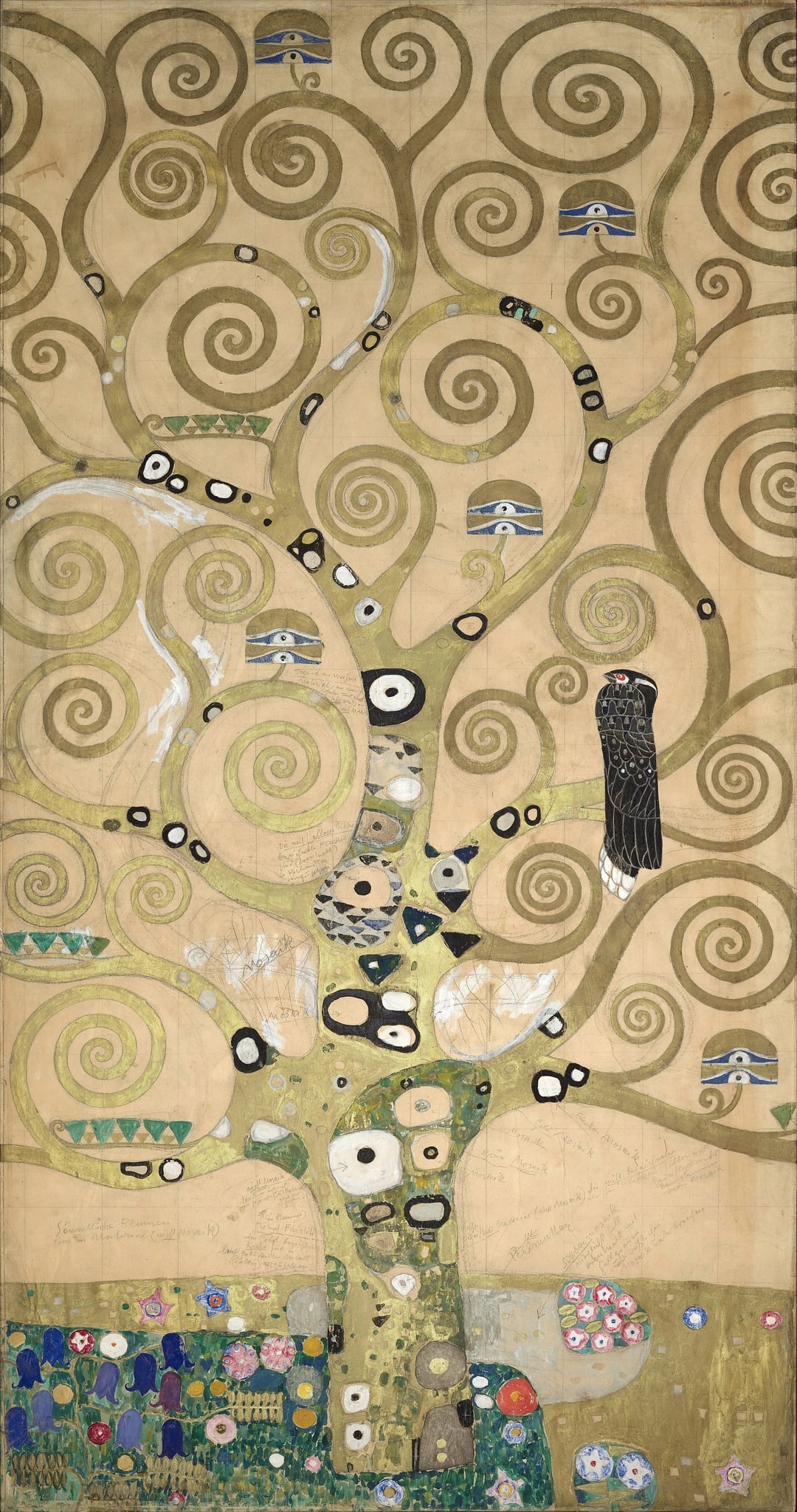
The Tree of Life by Gustav Klimt

The Tree of Life

Gustav Klimt (1910–1911 (design; mosaic installed 1911))

Gustav Klimt’s The Tree of Life crystallizes a <strong>cosmological axis</strong> in a gilded ornamental language: a rooted trunk erupts into <strong>endless spirals</strong>, embedded with <strong>eye-like rosettes</strong> and shadowed by a black, red‑eyed bird. Designed as part of the Stoclet dining‑room frieze, it fuses <strong>symbolism and luxury materials</strong> to link earthly abundance with timeless transcendence <sup>[1]</sup><sup>[2]</sup>.
The Kiss (Lovers) by Gustav Klimt

The Kiss (Lovers)

Gustav Klimt (1907–1908 (Belvedere lists 1908/09))

The Kiss (Lovers) crystallizes Klimt’s <strong>Golden Period</strong> ideal: erotic union staged as a sacred vision. Two bodies fuse beneath a single golden mantle, poised on a flowered ledge at the brink of the unknown, where <strong>pattern becomes symbol</strong> and intimacy becomes icon.