How Much Is Auditorium of the Old Burgtheater Worth?
Last updated: April 14, 2026
Quick Facts
- Methodology
- comparable analysis
Auditorium of the Old Burgtheater is a large, fully finished 1888–89 gouache on paper by Gustav Klimt in the Wien Museum. While never on the market, its exceptional scale, finish, and cultural significance justify a hypothetical auction value of $8–15 million, reflecting a premium over typical Klimt works on paper but a discount to his nine‑figure oils.
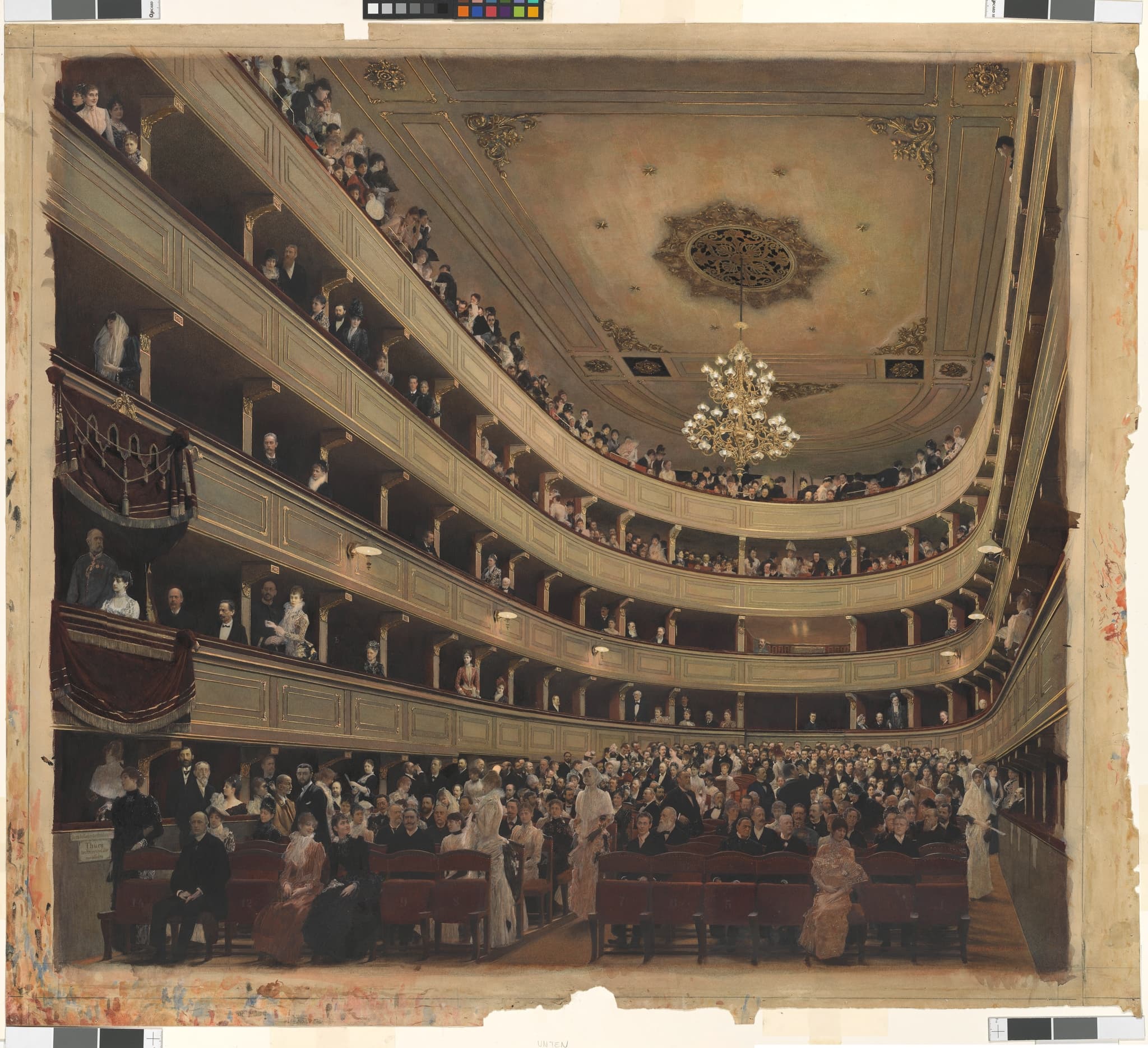
Auditorium of the Old Burgtheater
Gustav Klimt, 1888–1889 • Gouache on paper
Read full analysis of Auditorium of the Old Burgtheater →Valuation Analysis
What it is and why it matters: Gustav Klimt’s Auditorium of the Old Burgtheater (1888–89) is a large, fully realized gouache on paper (approx. 91.2 × 103 cm) documenting Vienna’s famed theater and the city’s social milieu on the eve of modernism. Commissioned by the City of Vienna and in the Wien Museum since 1907, it is an early, keystone image within Klimt’s development and a cornerstone record of fin‑de‑siècle Vienna [1].
Market anchors and medium effect: Klimt’s top prices are driven by museum‑caliber oils from his mature and golden periods. In November 2025, Portrait of Elisabeth Lederer achieved $236.4 million at Sotheby’s, setting a new artist record and resetting expectations for Klimt’s prime oils [2]. Other headline results include Lady with a Fan at about $108.4 million (Sotheby’s London, 2023) and Birch Forest at $104.6 million (Christie’s, 2022) [3][4]. These nine‑figure benchmarks underscore the dominance of large oils in Klimt’s price structure. Works on paper—even by Klimt—generally transact one to two orders of magnitude lower.
Positioning this work among works on paper: Recent, well‑publicized Klimt drawings (including studies related to Adele Bloch‑Bauer I) have typically realized around $0.5 million each, and a strong drawing sold for roughly €520,000 in Vienna in 2024 [6][7]. Those are modestly sized, largely linear studies. By contrast, Auditorium of the Old Burgtheater is exceptionally large and fully painted in gouache, with the visual presence of a cabinet painting and the added cachet of being a celebrated, oft‑reproduced image central to Viennese cultural history [1]. This rarity of scale, finish, and subject justifies a meaningful premium over standard drawing prices while remaining materially discounted versus top Klimt oils.
Conclusion and range: Under optimal conditions—clean title, a marquee New York or London evening sale, and no export impediments—the work should command approximately $8–15 million. This range reflects: (a) the ongoing depth of demand for blue‑chip Klimt driven by recent record‑setting results [2][3][4]; (b) the Modern category’s renewed momentum at the top end in 2025, with value and liquidity concentrated in best‑in‑class material [5]; and (c) an upward adjustment for this sheet’s scale, finish, and canonical status relative to typical Klimt works on paper [6][7]. If sold privately or with export constraints that restrict competitive international bidding, outcomes would likely compress toward the lower end of the band.
Key Valuation Factors
Art Historical Significance
High ImpactAuditorium of the Old Burgtheater is a landmark early Klimt that captures late‑19th‑century Viennese society at the theater—one of the city’s defining cultural stages. Created just before the Vienna Secession, it documents a pivotal moment in the artist’s trajectory from academic naturalism toward modernism. Beyond Klimt’s oeuvre, the sheet functions as a rare social panorama of fin‑de‑siècle Vienna, frequently reproduced in scholarship and exhibitions. This dual importance—as both an art‑historical milestone and a civic document—places the work in a rarefied tier among Klimt’s works on paper, supporting a valuation well above typical drawing prices and closer to the low‑eight‑figure realm normally reserved for exceptionally finished sheets of great scale and fame.
Medium, Scale, and Finish
High ImpactWhile works on paper by Klimt usually trail his oils substantially, this example is unusually large (c. 36 × 41 in.) and fully executed in gouache with a painterly, exhibition‑ready finish. Its scale and completion give it wall‑power comparable to a cabinet painting, a key differentiator from standard studies or sketches. Large, finished Klimt gouaches of celebrated subjects are rare in private hands; this scarcity warrants a significant premium to typical drawing benchmarks. The size also raises production and conservation complexity, but in market terms it enhances impact and salability. In short, the medium discount applies, but the sheet’s ambition and finish materially narrow that discount relative to ordinary Klimt works on paper.
Market Positioning vs. Klimt’s Prime Oils
Medium ImpactRecent auction results demonstrate intense global demand for Klimt’s mature oils, with records at $236.4m for a portrait and $100m+ for top landscapes. This sheet is outside the gilded “trophy” category and predates Klimt’s golden phase, so it does not access that nine‑figure collector base. However, the same collector cohort often seeks significant early works that illuminate the artist’s development. As a museum‑caliber, canonical image with strong name recognition, this gouache benefits from Klimt’s brand strength and scarcity, yet remains appropriately discounted relative to oils. The $8–15m range situates it above typical drawings but well below even the lower tier of recent Klimt oil prices.
Provenance and Institutional Status
Medium ImpactThe work has been in the Wien Museum since 1907 after an original civic commission, conferring unimpeachable provenance and scholarly visibility. Those attributes reduce transaction risk and enhance desirability. However, institutional ownership also means the work is not normally a market object; hypothetical sale would depend on deaccession policy and Austrian cultural‑property/export regimes. If offered with export limitations or constrained venue choices, competitive international bidding could be dampened and price elasticity reduced. Conversely, if the work were legally deaccessioned and placed in a New York or London evening sale, its institutional provenance and fame would maximize bidder confidence and help realize the full $8–15m potential.
Sale History
Auditorium of the Old Burgtheater has never been sold at public auction.
Gustav Klimt's Market
Gustav Klimt is a blue‑chip Modern master with exceptionally deep global demand and chronically limited supply, as many prime works are held in museums. The artist’s auction record was reset in November 2025 when Portrait of Elisabeth Lederer sold for $236.4 million at Sotheby’s, eclipsing earlier highs and confirming the strength of Klimt’s top‑tier portraits. Other mature oils, including Lady with a Fan ($108.4m, 2023) and Birch Forest ($104.6m, 2022), reinforce consistent nine‑figure appetite for best‑in‑class paintings. While works on paper transact at a steep discount to oils, Klimt’s brand, provenance sensitivity, and cross‑category appeal keep even exceptional drawings and gouaches highly sought after, especially when scale, finish, and subject elevate them above typical studies.
Comparable Sales
Lady with a Fan (Dame mit Fächer)
Gustav Klimt
Same artist; top-tier late oil portrait that anchors Klimt’s price structure. Useful ceiling to gauge the medium discount from oil to a large finished gouache.
$108.4M
2023, Sotheby's London
~$114.9M adjusted
Birch Forest (1903)
Gustav Klimt
Same artist; museum-caliber mature oil landscape. Serves as a high-end anchor to bracket a substantial discount for a (even exceptional) work on paper.
$104.6M
2022, Christie's New York
~$117.1M adjusted
Insel im Attersee (ca. 1901–02)
Gustav Klimt
Same artist; important mature oil landscape at the lower end of Klimt’s recent top-tier oils. Helps calibrate the oil-to-paper gap for valuation.
$53.2M
2023, Sotheby's New York
~$56.4M adjusted
Study for Portrait of Adele Bloch-Bauer I (drawing)
Gustav Klimt
Same artist; work on paper benchmark from a marquee provenance (Leonard A. Lauder). Smaller and a study (not finished), but establishes recent pricing for Klimt drawings.
$521K
2025, Sotheby's New York
Study for Judith II (drawing)
Gustav Klimt
Same artist; work on paper benchmark in Europe. Smaller, less finished study but shows the sub-$1m range for typical Klimt drawings.
$565K
2024, Dorotheum, Vienna
~$582K adjusted
Crouching Nude, Back View (1917, drawing)
Egon Schiele
Closely related Viennese Secession master; top-tier work on paper record at Dorotheum. Indicates the upper reach of the Austrian works-on-paper market for highly coveted sheets.
$3.5M
2025, Dorotheum, Vienna
Current Market Trends
Modern art rebounded in 2025, with sales growth and value concentration at the high end, particularly in New York. The Art Basel & UBS Global Art Market Report 2026 notes that Modern regained momentum after several softer years, and adjacent Impressionist/Post‑Impressionist sectors surged, benefiting blue‑chip late‑19th/early‑20th‑century masters. For Klimt, the result has been renewed price discovery at the very top, led by record‑setting oils tied to stellar provenance. Works on paper remain estimate‑sensitive but can command strong multiples when scale, finish, and canonical subject matter align. Marketability and exportability remain practical considerations for Austria‑held material, but trophy‑level Klimt objects continue to draw deep, international bidding.
Study print
Study this painting as a print
Pair the full artwork with a museum-style study sheet focused on one meaningful detail.
Sources
- Wien Museum collection entry: Zuschauerraum im Alten Burgtheater (Auditorium of the Old Burgtheater)
- Sotheby’s press: Leonard A. Lauder Collection results; Klimt record (Nov 18, 2025)
- CBS News: Gustav Klimt’s Lady with a Fan sets European auction record (June 27, 2023)
- The Art Newspaper: Paul G. Allen Collection—Klimt’s Birch Forest at $104.6m (Nov 10, 2022)
- Art Basel & UBS Global Art Market Report 2026
- The Art Newspaper: Gustav Klimt—A buyer’s guide (works on paper benchmarks)
- Dorotheum: Top price for Klimt drawing (May 22, 2024)