Girlfriends (Water Serpents I)

by Gustav Klimt

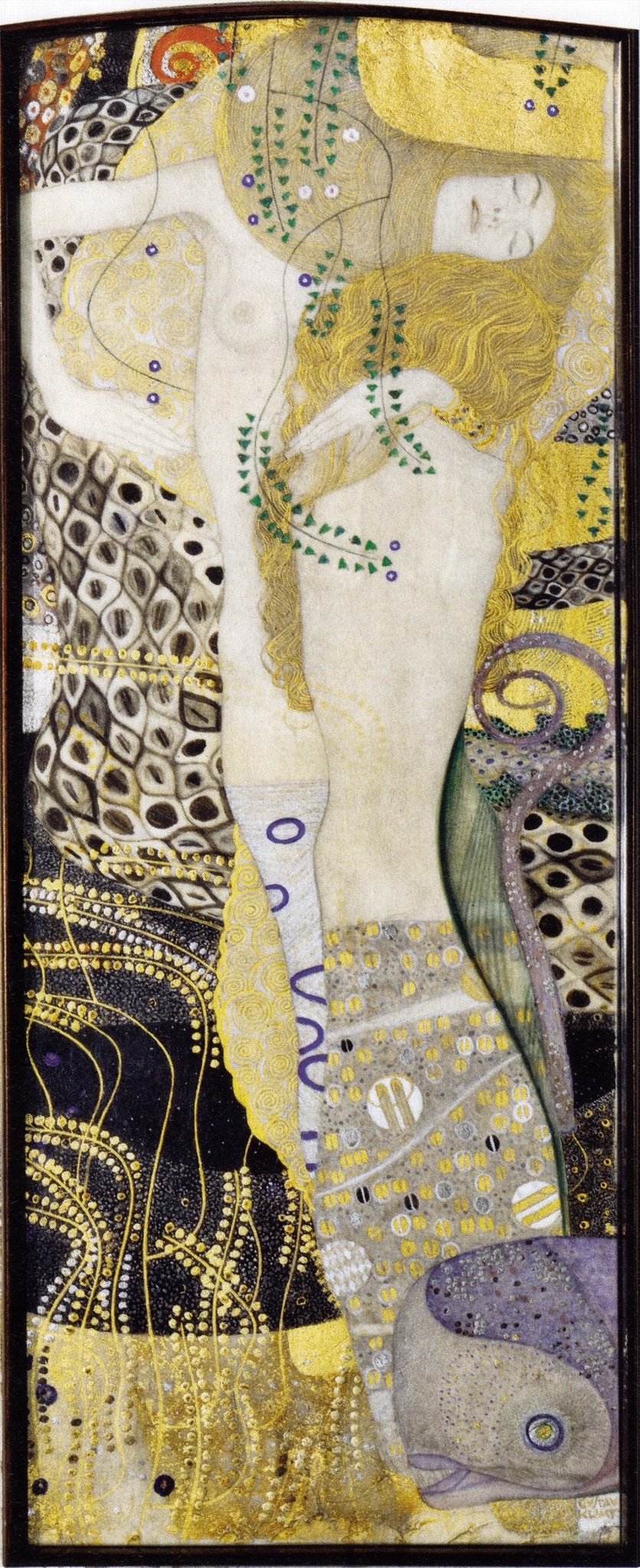
Gustav Klimt’s Girlfriends (Water Serpents I) stages two elongated nudes drifting in a jeweled, underwater field where bodies and ornament fuse into a single, luminous surface. Closed eyes, interlaced arms, and hair that streams like currents seal the scene in intimate secrecy, while metallic scales, eye-shaped ovals, and a watchful fish charge the water with erotic and mythic tension [1][2][3].

Study Print Studio

Create a personal study print

Build a companion study sheet around the part of this painting that speaks to you most. Choose a detail, shape an interpretation, and walk away with something personal and display-worthy.

Fast Facts

Year
1904; last revisions by 1907
Medium
Watercolor, gouache, pencil, gold, silver, platinum, and brass on parchment
Dimensions
50 × 20 cm
Location
Belvedere Museum, Vienna
See all Gustav Klimt paintings in Vienna
Girlfriends (Water Serpents I) by Gustav Klimt (1904; last revisions by 1907) featuring Closed eyes, Interlaced arms/embrace, Streaming golden hair as a veil, Eye-shaped ovals/scales

Click on any numbered symbol to learn more about its meaning

Meaning & Symbolism

Klimt composes the embrace as a vertical drift, letting the viewer’s gaze sink from the sleeping head at top right to the rounded fish at lower right, as if pulled by a current. The two pale bodies, pressed together and modestly veiled by streaming hair and vine-like strands of green triangles and purple beads, form a column of flesh held within a black-and-gold net of dots, ovals, and ribboning lines. This is not a natural sea but a field of serpentine ornament: eye-like scales swell and recede, gold beads run like phosphorescent plankton, and spiral coils gleam at the margins. Klimt’s choice of parchment heightened with gold, silver, platinum, and brass makes the water flicker between depth and surface, so the women seem both immersed and inlaid, an intentional oscillation between figure and ground that curators identify as central to the Water Serpents works 13. The fish with its fixed, circular eye at the lower edge registers like a sentinel or witness, intensifying the charged privacy of the scene while tying the title’s serpents to a larger ecology of scaled, watchful life 6. This erotic world is also a language of concealment. Klimt’s preparatory program from 1903 concentrated on female couples; here, the entwined nudes with closed eyes declare lesbian intimacy while mythic camouflage—mermaids, “snake skins,” stylized sea creatures—screens the embrace from literalism 2. The hair that veils breasts, the green-beaded tendrils that skim the abdomen, and the gold rosettes that hover over the torso do not merely decorate; they translate touch into patterned energy, a Secessionist solution to rendering sensation without anecdote. The result is a dream of desire as suspension: time slows, breath quiets, and bodies become currents. In place of sculptural volume, Klimt offers planar nakedness learned from Byzantine mosaic and Japanese print, converting anatomy into a field of rhythms where ornament is meaning, not accessory 4. The underwater setting extends a long Klimtian preoccupation with drifting female figures—Fish Blood and other studies plot this trajectory—culminating here in a perfectly balanced miniature whose shimmering metals literalize the sacred charge of erotic communion 45. Why Girlfriends (Water Serpents I) is important is that it crystallizes how Vienna Secession modernism made intimacy and decoration coextensive. The painting advances a modern, psychologically interior eroticism: faces sealed in sleep; limbs that caress without grasping; an environment that receives and reflects desire rather than staging it for public spectacle. It also compresses the era’s debates around the status of ornament—derided by some, sacralized by Klimt—into a persuasive image where ornament bears the weight of subject matter itself. Within the painter’s Golden Period, the precious metals are not opulence for its own sake but a technology for flattening, fusing, and spiritualizing the body; they make the embrace glow like an icon while keeping it underwater, private, and veiled 134. In this equilibrium—between sensual candor and symbolic cover, between human skin and serpentine pattern—Klimt proposes a radical thesis: intimacy is a medium, and its truest image is not narrative but patterned immersion 23.

Explore Deeper with AI

Ask questions about Girlfriends (Water Serpents I)

Popular questions:

Powered by AI • Get instant insights about this artwork

💬 Ask questions about this artwork!

Interpretations

Queer Studies / Coded Intimacy

Beginning in 1903, Klimt’s studies systematically pursued female couples, several published in Ver Sacrum, establishing a program of lesbian embrace veiled by myth and marine décor. In Water Serpents I, closed eyes, hair‑veiling, and aqueous drift operate as codes of privacy: erotic proximity is present, yet displaced into nymphs, “snake skins,” and floating beads. This strategy allowed Klimt to stage same‑sex desire at a moment when overt representation risked scandal, while still granting it centrality within the Golden Period’s sacred surface. The result is neither moral allegory nor anecdote but a queer syntax of touch translated into pattern, a historical bridge between Symbolist eroticism and later modernist explorations of desire’s interiority 345.

Source: Klimt Foundation; Leopold Museum; MoMA (Vienna 1900)

Figure–Ground Theory

Scholars emphasize the work’s programmed oscillation between figure and ground: pale bodies dissolve into a scaly field of dots, ovals, and coiling bands, then reassert themselves as a vertical column. This ebb and flow answers a central Secessionist problem—how to make ornament carry content—by letting pattern “touch” the bodies as if it were sensation itself. The underwater premise licenses this merger: currents become hair, plankton become gold beads, snakeskin becomes skin. The viewer’s eye can never stably hierarchize subject over surround; instead, intimacy is experienced as immersive patterned continuity, a modern alternative to narrative sequencing or sculptural modeling 52.

Source: MoMA (Vienna 1900); Getty

Iconography and Mythic Ecology

The titular “serpents” are less literal creatures than an ornamental ecology: snake‑skin motifs, stylized sea animals, and scaled arabesques that enfold the lovers. Within this ecology, the fixed, circular eye of the fish acts as a punctum—at once witness, sentinel, and otherworldly observer—complicating the scene’s privacy with a nonhuman gaze. Serpents in Klimt elsewhere mark medicine, danger, and vitality; here they register as ambient, reproductive pattern, converting erotic coupling into a naturalized, watchful habitat rather than a staged tableau. The mythic camouflage therefore doubles as a theory of environment: desire becomes habitat, and habitat answers back with eyes 36.

Source: Klimt Foundation; Kulturpool (Belvedere data)

Patronage, Exhibition, and Reception

First shown at Galerie Miethke in 1907, the work quickly entered elite Viennese patronage networks (Karl Wittgenstein by 1908), anchoring Klimt’s erotic miniatures within the city’s most powerful circles. Contemporary press noted the parchment’s delicacy and the underwater embrace, signaling that viewers read both the material rarity and the lesbian pairing as central features. Its later path to the Belvedere (Inv.-Nr. 5077) stabilized its public status, correcting myths of a private holding. The curatorial language around the Water Serpents pair has since fixed them as paradigms of Klimt’s Golden Period—intimacy made precious, and preciousness made concept—shaping a reception that sees ornament and eros as mutually constitutive 361.

Source: Klimt Foundation; Kulturpool; Belvedere Museum

Material-Technological Lens

Executed on parchment with watercolor, gouache, pencil, and an alloyed constellation of gold, silver, platinum, and brass, the work is a case study in how support and metallurgy drive meaning. Parchment’s fine tooth and warm translucence let metals sit on the surface as flakes and beads of light, so the “water” flickers between depth and inlay. That flicker is not embellishment but structure: it enforces a shallow, iconic space where bodies are inlaid rather than modeled, aligning sensuality with liturgical shimmer. In Secession Vienna, such costly surfaces read as both avant‑garde and archaic, a deliberate short‑circuiting of modernity with Byzantine splendor—Klimt’s way of making intimacy literally irradiate the image field 12.

Source: Belvedere Museum; Getty

Related Themes

About Gustav Klimt

Gustav Klimt (1862–1918), co-founder of the Vienna Secession, pivoted from controversial public commissions to a decorative-symbolist language in his Golden Period. Drawing on Byzantine mosaics and modern design, he fused opulent surfaces with psychological intensity. By 1908–09, he transformed scandal into canon, and The Kiss became Vienna’s emblem of modern love.
View all works by Gustav Klimt

More by Gustav Klimt

Portrait of Adele Bloch-Bauer I by Gustav Klimt

Portrait of Adele Bloch-Bauer I

Gustav Klimt (1907)

Gustav Klimt’s Portrait of Adele Bloch-Bauer I stages its sitter as a <strong>secular icon</strong>—a living presence suspended in a field of gold that converts space into <strong>pattern and power</strong>. The naturalistic face and hands emerge from a reliquary-like cascade of eyes, triangles, and tesserae, turning light, ornament, and status into the painting’s true subjects <sup>[1]</sup><sup>[2]</sup>.

Sunflower by Gustav Klimt

Sunflower

Gustav Klimt (1907/1908)

Gustav Klimt’s Sunflower turns a single bloom into a <strong>monumental, figure-like presence</strong>. A tapering stack of broad, drooping leaves rises from a <strong>mosaic-like carpet of round blossoms</strong>, crowned by a gold-flecked disc that glows against a cool, stippled field. The work fuses <strong>portrait, icon, and landscape</strong> into one emblem of vitality and quiet sanctity <sup>[1]</sup><sup>[2]</sup>.

Cottage Garden with Sunflowers by Gustav Klimt

Cottage Garden with Sunflowers

Gustav Klimt (1906–1907 (signed 1907))

Cottage Garden with Sunflowers is a square, horizonless field of blooms where a vertical column of <strong>sunflowers</strong> anchors an all-over weave of color and pattern. Klimt fuses <strong>ornament and nature</strong>, turning a humble Litzlberg cottage plot into a radiant matrix of cyclical life and renewal <sup>[1]</sup><sup>[4]</sup><sup>[5]</sup>.

The Kiss by Gustav Klimt

The Kiss

Gustav Klimt (1908 (completed 1909))

The Kiss stages human love as a <strong>sacred union</strong>, fusing two figures into a single, gold-clad form against a timeless field. Klimt opposes <strong>masculine geometry</strong> (black-and-white rectangles) to <strong>feminine organic rhythm</strong> (spirals, circles, flowers), then resolves them in radiant harmony <sup>[1]</sup><sup>[2]</sup>.
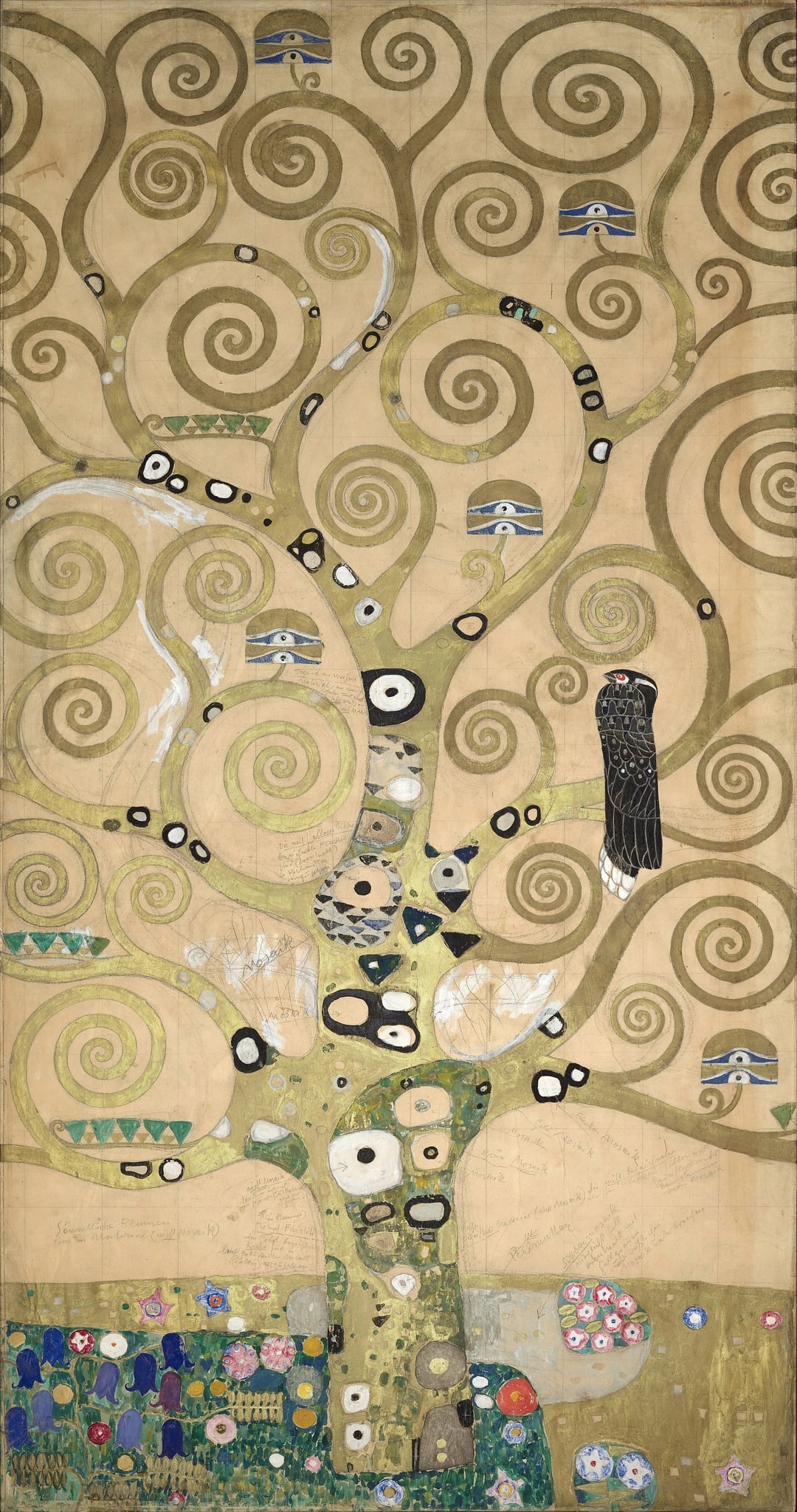
The Tree of Life by Gustav Klimt

The Tree of Life

Gustav Klimt (1910–1911 (design; mosaic installed 1911))

Gustav Klimt’s The Tree of Life crystallizes a <strong>cosmological axis</strong> in a gilded ornamental language: a rooted trunk erupts into <strong>endless spirals</strong>, embedded with <strong>eye-like rosettes</strong> and shadowed by a black, red‑eyed bird. Designed as part of the Stoclet dining‑room frieze, it fuses <strong>symbolism and luxury materials</strong> to link earthly abundance with timeless transcendence <sup>[1]</sup><sup>[2]</sup>.
The Kiss (Lovers) by Gustav Klimt

The Kiss (Lovers)

Gustav Klimt (1907–1908 (Belvedere lists 1908/09))

The Kiss (Lovers) crystallizes Klimt’s <strong>Golden Period</strong> ideal: erotic union staged as a sacred vision. Two bodies fuse beneath a single golden mantle, poised on a flowered ledge at the brink of the unknown, where <strong>pattern becomes symbol</strong> and intimacy becomes icon.