Emilie Flöge

by Gustav Klimt

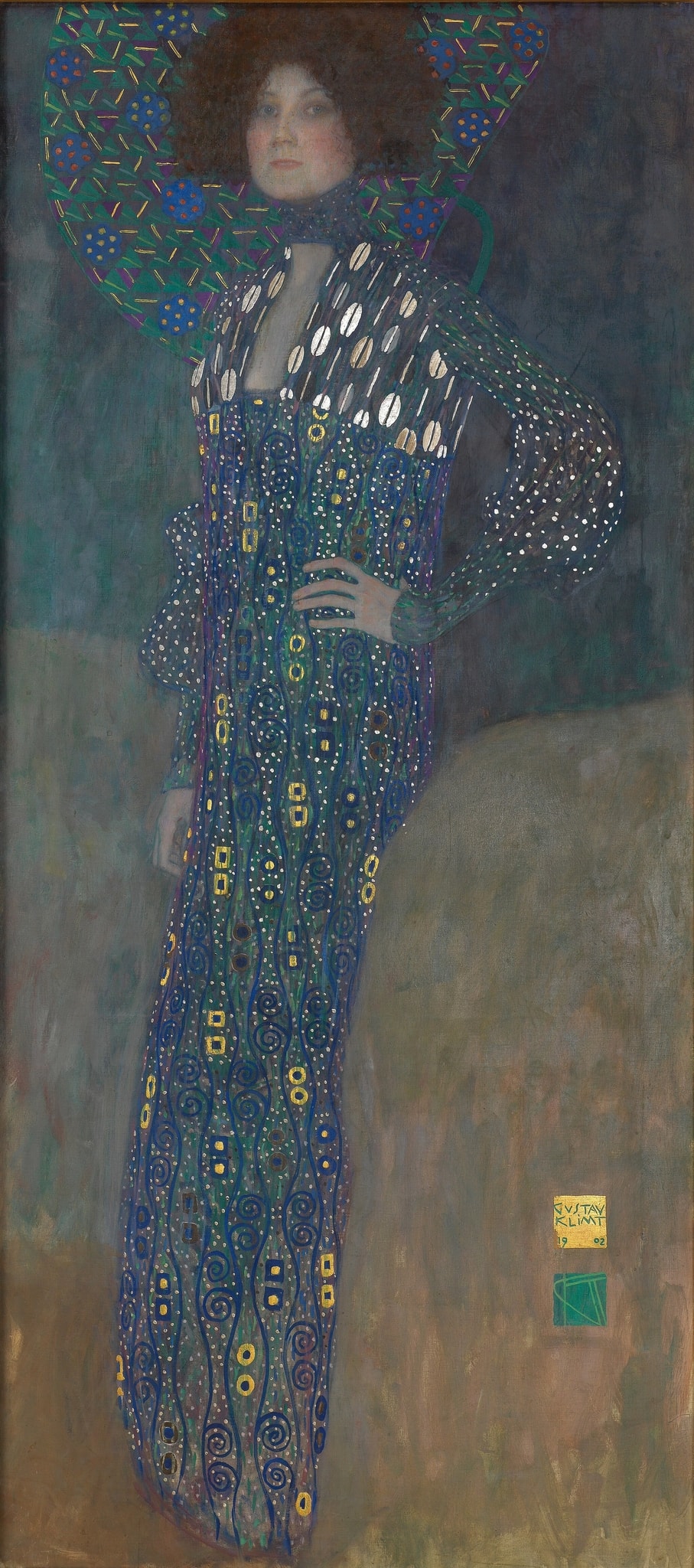
Gustav Klimt’s Emilie Flöge stages a modern identity as a work of design as much as portraiture: a columnar figure, hand on hip, radiates self-possession within a field of spirals, dots, and gold squares. The circular, flowered fan behind the head acts as a modern halo, collapsing depth and elevating presence in the Secessionist spirit of the Gesamtkunstwerk [1][2].
💰

Market Value

$160-220 million

How much is Emilie Flöge worth?

Study Print Studio

Create a personal study print

Build a companion study sheet around the part of this painting that speaks to you most. Choose a detail, shape an interpretation, and walk away with something personal and display-worthy.

Fast Facts

Year
1902
Medium
Oil on canvas
Dimensions
178 × 80 cm
Location
Wien Museum, Vienna
See all Gustav Klimt paintings in Vienna
Emilie Flöge by Gustav Klimt (1902) featuring Circular halo/fan, Spiral motifs, Gold squares/rectangles, Constellation-like white dots

Click on any numbered symbol to learn more about its meaning

Meaning & Symbolism

Klimt composes Emilie Flöge as a vertical monolith of will and style: the hand planted on the hip, the level, unflinching gaze, and the long sheath of blues and greens orchestrate a stance of calm command. The dress reads like a living mosaic—spirals coursing downward, dotted constellations pricking the sleeves, and regimented gold squares pulsing across the torso—so that textile becomes landscape and psychology at once. By refusing deep perspective and letting the patterned garment converse on equal terms with the surrounding field, Klimt declares that identity in Vienna circa 1900 is not merely represented; it is designed. Contemporary critics already grasped this mosaic and Byzantine inflection, reading the image as an icon of modernity rather than a conventional likeness 2. The circular, flowered disk behind the head intensifies that iconicity: a secular halo that stabilizes the composition and concentrates attention, while also acknowledging the cosmopolitan sources—Byzantine shimmer, Japoniste fan-forms, and seal-like monogram blocks at lower right—that nourished Secessionist surface culture 125. Fashion is the engine of meaning here. The loose, columnar reform dress—sequenced with ovals, dots, and small gilded rectangles—rejects constriction and advertises a new grammar of movement and self-presentation. In place of heraldic signs or domestic props, Klimt offers a symphony of motifs that perform selfhood: the sleeve’s staccato white dots read as breath or static; the bodice’s metallic flashes act like neural sparks; the vertical vines pull the eye upward and downward in a measured, meditative tempo. This choreography positions the sitter as a Gesamtkunstwerk, the integrated artwork of body, garment, and environment prized by the Vienna Secession 23. The result is not passive elegance but luxuriant self-possession: ornament as agency. Even the two square cartouches at the lower right—one inscribed with the signature and date, the other bearing the monogram—double as design modules, echoing Japanese hanko seals and reinforcing the painting’s thesis that authorship, identity, and decoration share a common visual language 125. Why Emilie Flöge is important is thus twofold. First, it marks an inflection point in Klimt’s mature style, where surface becomes sovereign and symbolism migrates into pattern; critics saw in it the tessellated world that would soon define his golden phase 2. Second, it visualizes the “New Woman” of fin-de-siècle Vienna—poised, entrepreneurial, and aesthetically self-directed—by making the dress not a costume but a declaration. In the soft shimmer of metallic accents and the refusal of corseted silhouette, Klimt paints freedom as ornament, modernity as design, and personhood as a deliberately fashioned field of signs. The painting stands as a manifesto for Secessionist modernism, proving that to redesign the surface of life is to redesign life itself 23.

Explore Deeper with AI

Ask questions about Emilie Flöge

Popular questions:

Powered by AI • Get instant insights about this artwork

💬 Ask questions about this artwork!

Interpretations

Formal Analysis: Surface Sovereignty and Icon-Flatness

Klimt’s composition rejects deep perspective in favor of a planar, tessellated field that lets garment and ground speak as equals. Critics in 1903 already sensed this shift, describing a "world of majolica and mosaic" and a "green-blue wreath of blossoms" that stabilize the head like a modern aureole—signals that space is being retooled as ornamental logic rather than recessionistic illusion 1. The figure reads as a vertical register of patterns—checkerboard, dots, spirals—whose measured repetition creates a visual tempo akin to frieze or icon. This formal recalibration anticipates Klimt’s golden phase: symbolism migrates into pattern; affect is carried by motif-density and rhythm instead of modeling and chiaroscuro. The portrait thereby advances a Secessionist proposition: that design can carry meaning as fully as representation 14.

Source: National Gallery of Victoria (Frances Lindsay); Encyclopaedia Britannica

Fashion History: Reformkleid as Agency and Economy

Flöge’s free-flowing Reformkleid—eschewing corsetry—embodies dress reform’s promise of mobility and health while projecting a new grammar of movement and selfhood. As a leading Viennese couturière, Flöge operationalized these ideals in her salon (opened 1904 with Hoffmann/Moser interiors), linking avant-garde fashion to the Wiener Werkstätte’s geometric idiom 1. The portrait’s chequered bodice and modular motifs presage workshop design vocabularies and translate the emancipatory politics of dress into visual structure. In this sense, Klimt stages fashion not as ornament to status but as the site of female professional agency, where aesthetics, commerce, and corporeal freedom converge—an interpretation aligned with dress-history scholarship on Reformkleider’s cultural work in fin-de-siècle Central Europe 15.

Source: National Gallery of Victoria; The Journal of Dress History

Reception History: Secession 1903 and the Icon of Modernity

First shown at the 18th Secession exhibition (1903–04), the portrait was read by contemporaries through a Byzantine/mosaic lens, affirming its anti-naturalistic, iconic charge. Ludwig Hevesi’s and Berta Zuckerkandl’s notices—cited in museum scholarship—register precisely what Klimt courts: a sanctified modern image built from ornamental means 1. This reception helps date its stylistic inflection within Klimt’s trajectory (signed 1902) and situates the work in the Secession’s Gesamtkunstwerk program, where the integration of arts and design reorients portraiture from likeness to designed presence. The painting thus served, from the outset, as an exhibition manifesto, signaling how the Secession’s public display culture legitimated pattern, surface, and cosmopolitan references as the new measure of modern portraiture 123.

Source: National Gallery of Victoria; Wien Museum (object record and press dossier)

Cross-Cultural Syntax: Japonisme, Byzantine Shimmer, and the Cartouche

The floral disk behind Flöge’s head reads doubly—as halo and as a Japanese leaf-fan—while the paired square cartouches echo hanko seals, relocating authorship into the ornamental field 16. Such syncretism mirrors Viennese Secession cosmopolitanism and Klimt’s well-documented engagement with East Asian art, where kimono-like patterning and modular signatures recalibrate pictorial emphasis from depth to surface citation 7. The Byzantine shimmer invoked by period critics dovetails with this Japoniste grammar, producing a hybrid iconography that is neither pastiche nor pure derivation but a designed, modern lingua franca. Authorship, in turn, becomes modular: signature-as-motif, motif-as-claim—an ethics of appropriation that acknowledges sources while asserting a distinct Secessionist idiom 167.

Source: NGV (period criticism); Wikipedia (summary of Wenzel/Whitford); Svitlana Shiells

Gender Studies: The New Woman as Gesamtkunstwerk

Hand on hip, unflinching gaze, and unstructured silhouette converge to perform the New Woman—poised, entrepreneurial, and aesthetically self-authored. The portrait integrates body, garment, and ground into a Gesamtkunstwerk, aligning with Secession ideals that fused fine and applied arts 14. Rather than domestic props or heraldry, Klimt composes identity via pattern logics—staccato sleeve-dots like breath, metallic flashes like neural sparks—rendering ornament an instrument of autonomy. The sitter’s profession matters: as a couturière, Flöge’s livelihood is design; the image dignifies creative labor as intellectual and modern. In this feminized authorship, freedom appears not as negation but as positive design choice, making agency legible in modules, seams, and surface 15.

Source: National Gallery of Victoria; Encyclopaedia Britannica; The Journal of Dress History

Medium Reflexivity: Signature as Design Module

Klimt’s two square cartouches—one inscribed with name/date, one with monogram—operate as designed units within the composition, flattening the boundary between authorial mark and decorative system 2. Their placement and blocky geometry echo East Asian seal conventions, turning authorship into an ornamental node that converses with the dress’s checkerboard and the field’s dotted matrix 67. This is medium reflexivity by design: the painting reflects on its own condition as a made surface, where attribution is not an external caption but an internal module. Such integration underscores the Secessionist thesis that painting, typography, and textile share a common visual syntax, with identity—of sitter and artist—articulated through repeatable, modular signs 127.

Source: Wien Museum (object record); NGV; Svitlana Shiells; Wikipedia (secondary synthesis)

Related Themes

About Gustav Klimt

Gustav Klimt (1862–1918), co-founder of the Vienna Secession, pivoted from controversial public commissions to a decorative-symbolist language in his Golden Period. Drawing on Byzantine mosaics and modern design, he fused opulent surfaces with psychological intensity. By 1908–09, he transformed scandal into canon, and The Kiss became Vienna’s emblem of modern love.
View all works by Gustav Klimt

More by Gustav Klimt

Portrait of Adele Bloch-Bauer I by Gustav Klimt

Portrait of Adele Bloch-Bauer I

Gustav Klimt (1907)

Gustav Klimt’s Portrait of Adele Bloch-Bauer I stages its sitter as a <strong>secular icon</strong>—a living presence suspended in a field of gold that converts space into <strong>pattern and power</strong>. The naturalistic face and hands emerge from a reliquary-like cascade of eyes, triangles, and tesserae, turning light, ornament, and status into the painting’s true subjects <sup>[1]</sup><sup>[2]</sup>.

Sunflower by Gustav Klimt

Sunflower

Gustav Klimt (1907/1908)

Gustav Klimt’s Sunflower turns a single bloom into a <strong>monumental, figure-like presence</strong>. A tapering stack of broad, drooping leaves rises from a <strong>mosaic-like carpet of round blossoms</strong>, crowned by a gold-flecked disc that glows against a cool, stippled field. The work fuses <strong>portrait, icon, and landscape</strong> into one emblem of vitality and quiet sanctity <sup>[1]</sup><sup>[2]</sup>.

Cottage Garden with Sunflowers by Gustav Klimt

Cottage Garden with Sunflowers

Gustav Klimt (1906–1907 (signed 1907))

Cottage Garden with Sunflowers is a square, horizonless field of blooms where a vertical column of <strong>sunflowers</strong> anchors an all-over weave of color and pattern. Klimt fuses <strong>ornament and nature</strong>, turning a humble Litzlberg cottage plot into a radiant matrix of cyclical life and renewal <sup>[1]</sup><sup>[4]</sup><sup>[5]</sup>.

The Kiss by Gustav Klimt

The Kiss

Gustav Klimt (1908 (completed 1909))

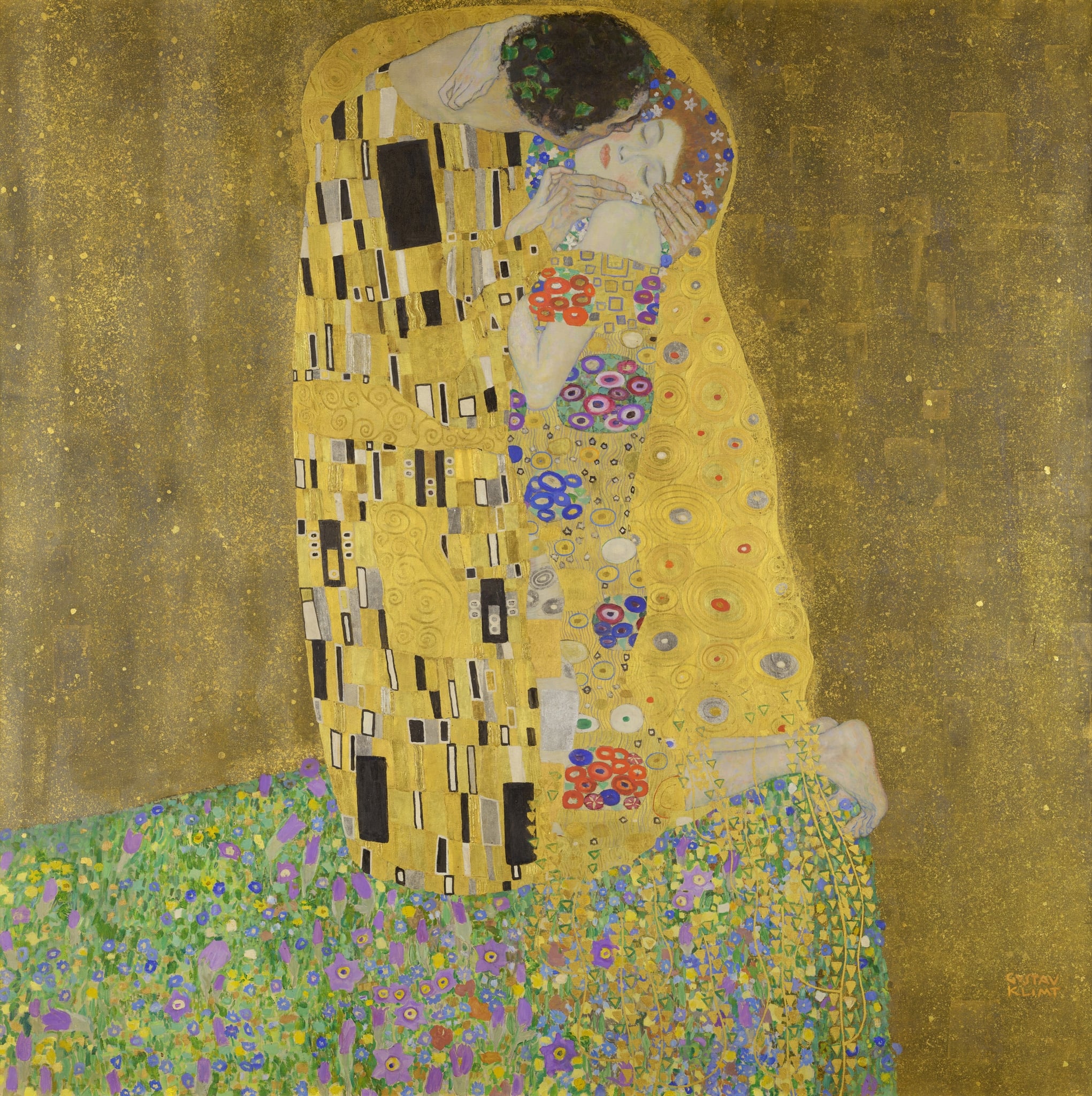
The Kiss stages human love as a <strong>sacred union</strong>, fusing two figures into a single, gold-clad form against a timeless field. Klimt opposes <strong>masculine geometry</strong> (black-and-white rectangles) to <strong>feminine organic rhythm</strong> (spirals, circles, flowers), then resolves them in radiant harmony <sup>[1]</sup><sup>[2]</sup>.
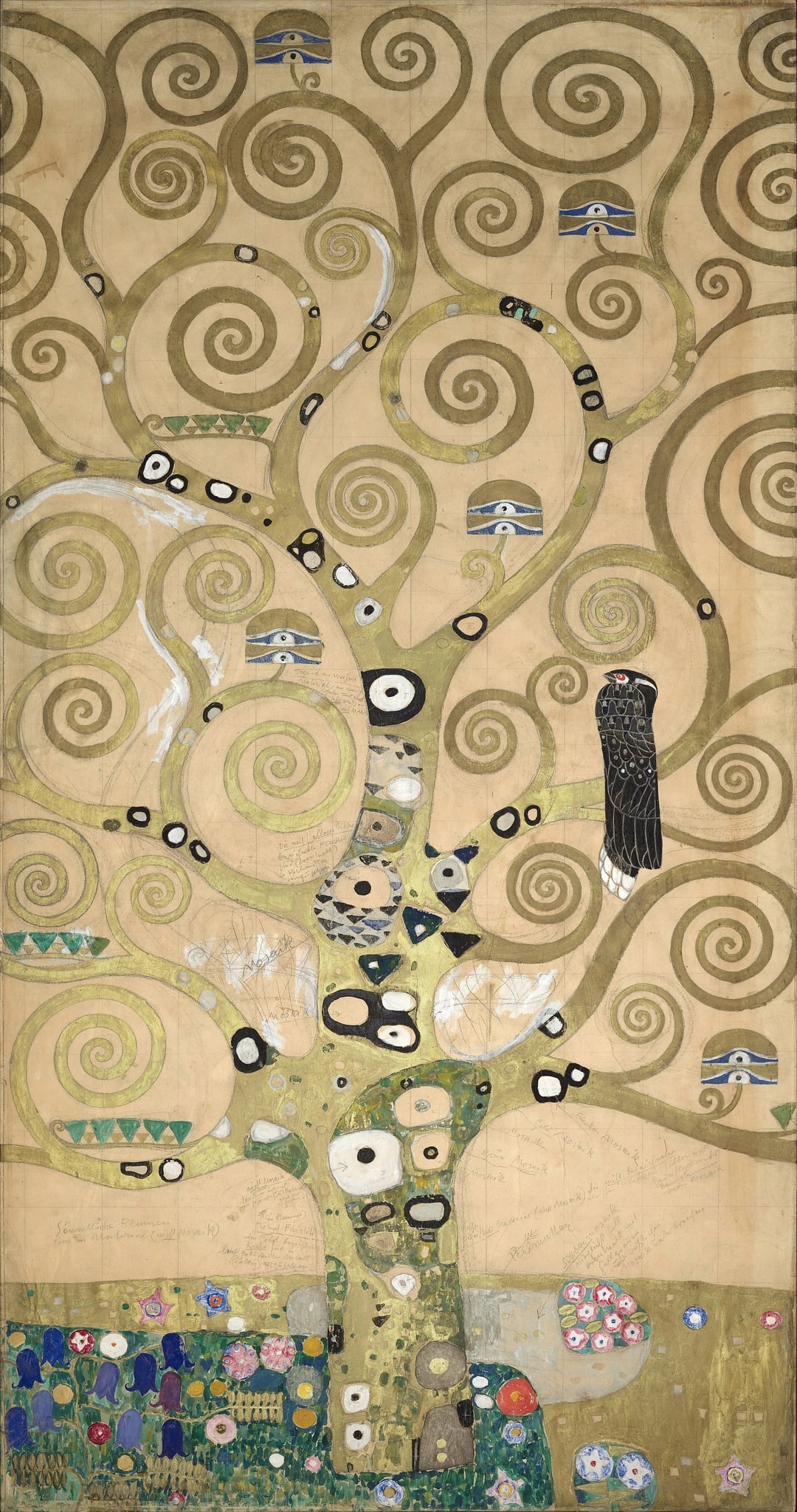
The Tree of Life by Gustav Klimt

The Tree of Life

Gustav Klimt (1910–1911 (design; mosaic installed 1911))

Gustav Klimt’s The Tree of Life crystallizes a <strong>cosmological axis</strong> in a gilded ornamental language: a rooted trunk erupts into <strong>endless spirals</strong>, embedded with <strong>eye-like rosettes</strong> and shadowed by a black, red‑eyed bird. Designed as part of the Stoclet dining‑room frieze, it fuses <strong>symbolism and luxury materials</strong> to link earthly abundance with timeless transcendence <sup>[1]</sup><sup>[2]</sup>.
The Kiss (Lovers) by Gustav Klimt

The Kiss (Lovers)

Gustav Klimt (1907–1908 (Belvedere lists 1908/09))

The Kiss (Lovers) crystallizes Klimt’s <strong>Golden Period</strong> ideal: erotic union staged as a sacred vision. Two bodies fuse beneath a single golden mantle, poised on a flowered ledge at the brink of the unknown, where <strong>pattern becomes symbol</strong> and intimacy becomes icon.