Part of the Tree of Life (Part 5)

by Gustav Klimt

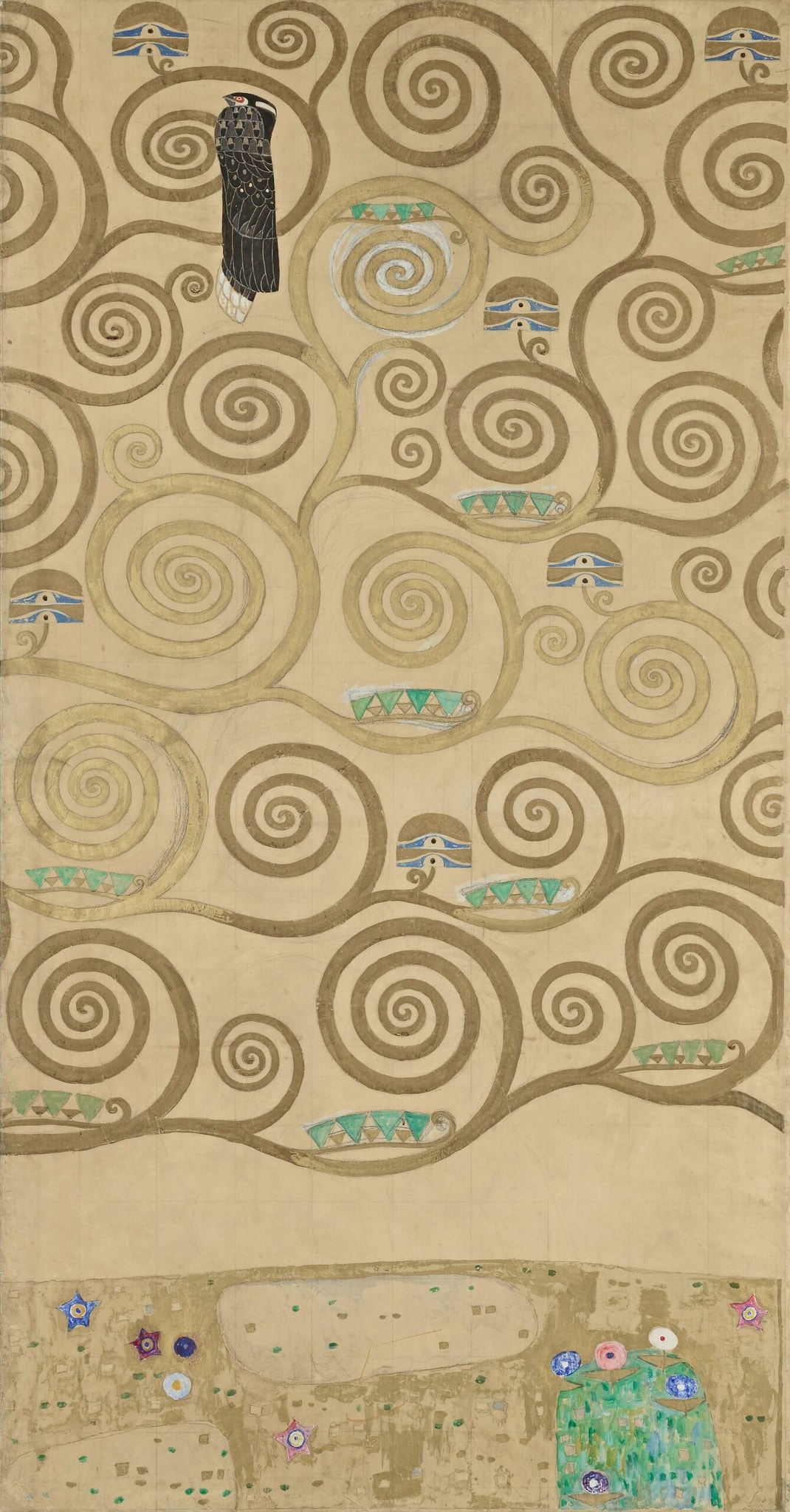
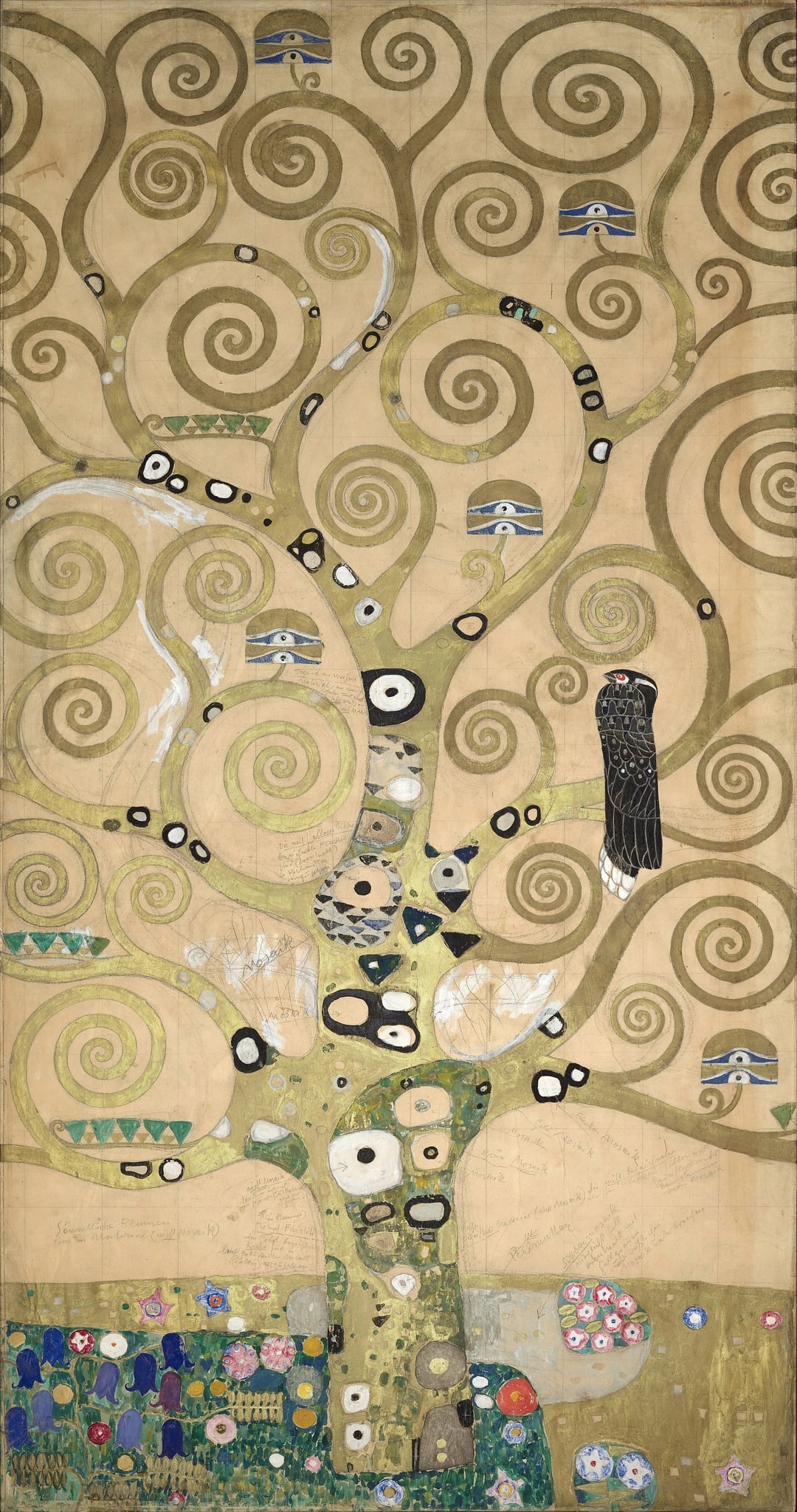
In Part of the Tree of Life (Part 5), Gustav Klimt renders a cosmos of spiraling branches studded with Eyes of Horus, turquoise tesserae, and a solitary dark bird. The panel condenses themes of vigilance, renewal, and mortality into a decorative grammar that served as a full-scale working cartoon for the Stoclet dining-room mosaics—a key Secessionist Gesamtkunstwerk [1][2].

Study Print Studio

Create a personal study print

Build a companion study sheet around the part of this painting that speaks to you most. Choose a detail, shape an interpretation, and walk away with something personal and display-worthy.

Fast Facts

Year
1910–1911
Medium
Chalk, pencil, gouache, with bronze, silver, gold, and platinum on transparent and drafting paper (cartoon)
Dimensions
200 × 102 cm
Location
MAK – Museum of Applied Arts, Vienna
See all Gustav Klimt paintings in Vienna
Part of the Tree of Life (Part 5) by Gustav Klimt (1910–1911) featuring Spiraling branches (volutes), Eyes of Horus, Dark bird (falcon-like), Green triangular tesserae/lozenges

Click on any numbered symbol to learn more about its meaning

Meaning & Symbolism

Klimt constructs a deliberate system of signs. The sweeping, centripetal spirals organize time as recurrence rather than linear progress; they model a world where energy curls back into itself and begins again. Within these coils, almond-shaped eyes with blue bands are not idle decoration but Eyes of Horus, the Egyptian amulets of protection and restoration that MAK identifies in the Tree of Life program 1. Their placement across multiple volutes implies a canopy of vigilance. The small green lozenges and triangular clusters act like seeds or tesserae, translating living growth into a mosaic logic that anticipates the frieze’s final material form in marble, glass, and enamel at the Palais Stoclet 2. The base band, where stylized blossoms and starbursts crystallize from the descending trunk, asserts that the spiraling order above precipitates tangible forms below—an emblem of life becoming matter. The solitary dark bird perched among the curls functions as a necessary interruption of gold abundance. Its vertical, patterned body echoes the mosaic textures and concentrates attention on the dialectic at the heart of the frieze: life’s plenitude set against a messenger of limit. Some commentators read the bird as a memento mori, a sign of death’s presence within the field of vitality 5; the MAK record also situates falcon motifs and Horus associations within the design, extending the reading toward protection and sky power rather than negation 1. Held between these poles—guardian falcon and death-bird—the figure stabilizes the composition as a passage between realms, refusing a naïve celebration of growth and insisting on cyclical rebirth instead of mere expansion. This aligns with Mary P. Warlick’s account of Klimt’s Egyptianizing program, in which Isis–Osiris myth, protective amulets, and waterlike spirals structure a drama of dismemberment and restoration across the Stoclet cycle 3. Why Part of the Tree of Life (Part 5) is important becomes clear when it is restored to its architectural function. This is not an easel painting but a precise cartoon that choreographs an environment—the dining room of the Stoclet House designed by Josef Hoffmann and executed by the Wiener Werkstätte. Klimt’s instructions translated his volutes and emblems into a high-luxury mosaic skin using glass, enamels, semiprecious stones, and metals, realized with Leopold Forstner’s workshop 2. In this role, the panel becomes the visual grammar that unifies a ritual space: its spirals arc toward the dancer of Expectation on one wall and the embracing pair of Fulfillment on the other, binding desire, union, and recurrence into one secular-sacred narrative map 13. The result exemplifies Secessionist ideals—fine and applied arts fused—while articulating a modern symbolism in which meaning is carried by pattern, material, and placement rather than by literal storytelling. The watchful eyes, the rhythmic curls, the grounded flowers, and the ambiguous bird together state a proposition: existence is continuous pattern under guardianship, always folding life and death into a single, shimmering order.

Explore Deeper with AI

Ask questions about Part of the Tree of Life (Part 5)

Popular questions:

Powered by AI • Get instant insights about this artwork

💬 Ask questions about this artwork!

Interpretations

Iconography: Egyptianizing Program

Klimt’s canopy is studded with almond eyes and falcon forms that are not generic ornaments but Eyes of Horus and Horus emblems, aligning the frieze with protection, healing, and royal-solar power. Read through Mary P. Warlick’s thesis, the Stoclet cycle stages an Isis–Osiris logic of dismemberment and reassembly: spirals suggest inundation and return, while the lovers (Expectation/Fulfillment) resolve the drama in rebirth. In this lens, Part 5 is a nodal field of apotropaic surveillance—a sky of guardians under which dining becomes a ritual of renewal. The Egyptianizing vocabulary does cultural work: it renders Klimt’s decorative modernism mythically charged, grounding sensual luxury in a cosmology of restoration rather than mere style 13.

Source: Mary P. Warlick (The Art Bulletin)

Material Translation: Cartoon to Mosaic

As a full-scale cartoon, Part 5 is a technical script for transformation into a high-luxury mosaic. Klimt’s annotations designate enamel, mother-of-pearl, glass, and metals, realized by the Wiener Werkstätte and Leopold Forstner’s workshop. The drawing’s modular spirals, lozenges, and “seeds” anticipate tessellated assembly, ensuring that symbolic emphasis—eyes, falcon, base blossoms—survives the shift from paper shimmer to stone and enamel. This medium migration amplifies meaning: protection (eyes) becomes literally inlaid into the architecture; recurrence (spirals) is fixed in durable, reflective matter that flickers with candlelight. The cartoon thus performs material thinking, encoding how symbolism must be seen, lit, and touched to cohere in the dining room’s ritual choreography 24.

Source: MoMA (Vienna 1900 catalog); MoMA (Art Nouveau materials)

Architecture as Ritual Grammar (Gesamtkunstwerk)

Part 5 is not an isolated image but a connector within Hoffmann’s total design. Its volutes reach toward the dancer of Expectation and the embracing Fulfillment, suturing the room into a narrative environment in which ornament guides movement and gaze. In Secessionist terms, this is a Gesamtkunstwerk: furniture, surfaces, and images co-orchestrated so that pattern carries meaning across thresholds and corners. Here, pattern functions liturgically—binding desire, union, and cyclical return into a dining rite. The effect is a secular-sacred chamber where the abstract tree also acts as an axial emblem linking floor to ceiling and west to east, collapsing decor and doctrine into one experiential continuum 12.

Source: MAK (collection/room context); MoMA (Vienna 1900)

Thanatos or Horus? The Bird’s Double Valence

The dark bird puncturing the golden field has fueled divergent readings. Museum-adjacent essays parse it as memento mori, a death-sign countering the tree’s fecundity—an inner brake on the room’s opulence. Yet MAK’s iconographic cues toward Horus falcons complicate this: a bird within an Egyptianizing program may signal sky-kingship and protection, not negation. The figure thus becomes a liminal mediator—both limit and guardian—stabilizing the composition between earthly growth and celestial oversight. This interpretive tension is productive: Klimt stages an ambiguous omen whose meaning flips with context, reinforcing the frieze’s broader theme of recurrence through interruption rather than unbroken ascent 15.

Source: MAK (motif identification); Emerging Infectious Diseases (cover essay)

Ornament as Semiotic System

Part 5 demonstrates how Klimt turns ornament into sign-bearing structure. Spirals act as temporal operators (recurrence), eyes as apotropaic indices (protection), and base blossoms as material precipitates (life→matter). Meaning is distributed—carried by pattern density, placement bands, and reflective media—rather than by figural narration. This aligns with Secessionist modernism in which abstraction supersedes mimesis, and architectural skin becomes syntax. Read this way, the frieze is a visual grammar: volutes = cycle; eyes = vigilance; bird = limit/guard; tesserae = embodiment. The cartoon trains fabricators—and future viewers—to read this code across the room, proving that in Klimt’s hands decor is discourse as much as delight 12.

Source: MAK (iconography and room schema); MoMA (Vienna 1900)

Conservation and the Work-Drawing Gaze

Seen at MAK as a work drawing, Part 5 reveals erasures, overlays, and metallic testing that the final mosaic conceals. Conservation and exhibitions like Klimt’s Magic Garden foreground this “behind-the-gold” layer, clarifying how choices about scale, reflectivity, and jointing shape iconographic legibility once translated to stone and enamel. These studio traces let us read the cartoon as a site of iterative problem-solving: which eyes catch light; how spirals span panel seams; where the bird arrests motion. The object thus doubles as process document and prototype, enriching interpretation by showing how Klimt engineered ornament to function optically and ritually in situ, not just pictorially on paper 26.

Source: MAK (Klimt’s Magic Garden exhibition); MoMA (materials/execution)

Related Themes

About Gustav Klimt

Gustav Klimt (1862–1918), co-founder of the Vienna Secession, pivoted from controversial public commissions to a decorative-symbolist language in his Golden Period. Drawing on Byzantine mosaics and modern design, he fused opulent surfaces with psychological intensity. By 1908–09, he transformed scandal into canon, and The Kiss became Vienna’s emblem of modern love.
View all works by Gustav Klimt

More by Gustav Klimt

Sunflower by Gustav Klimt

Sunflower

Gustav Klimt (1907/1908)

Gustav Klimt’s Sunflower turns a single bloom into a <strong>monumental, figure-like presence</strong>. A tapering stack of broad, drooping leaves rises from a <strong>mosaic-like carpet of round blossoms</strong>, crowned by a gold-flecked disc that glows against a cool, stippled field. The work fuses <strong>portrait, icon, and landscape</strong> into one emblem of vitality and quiet sanctity <sup>[1]</sup><sup>[2]</sup>.

Cottage Garden with Sunflowers by Gustav Klimt

Cottage Garden with Sunflowers

Gustav Klimt (1906–1907 (signed 1907))

Cottage Garden with Sunflowers is a square, horizonless field of blooms where a vertical column of <strong>sunflowers</strong> anchors an all-over weave of color and pattern. Klimt fuses <strong>ornament and nature</strong>, turning a humble Litzlberg cottage plot into a radiant matrix of cyclical life and renewal <sup>[1]</sup><sup>[4]</sup><sup>[5]</sup>.

The Kiss by Gustav Klimt

The Kiss

Gustav Klimt (1908 (completed 1909))

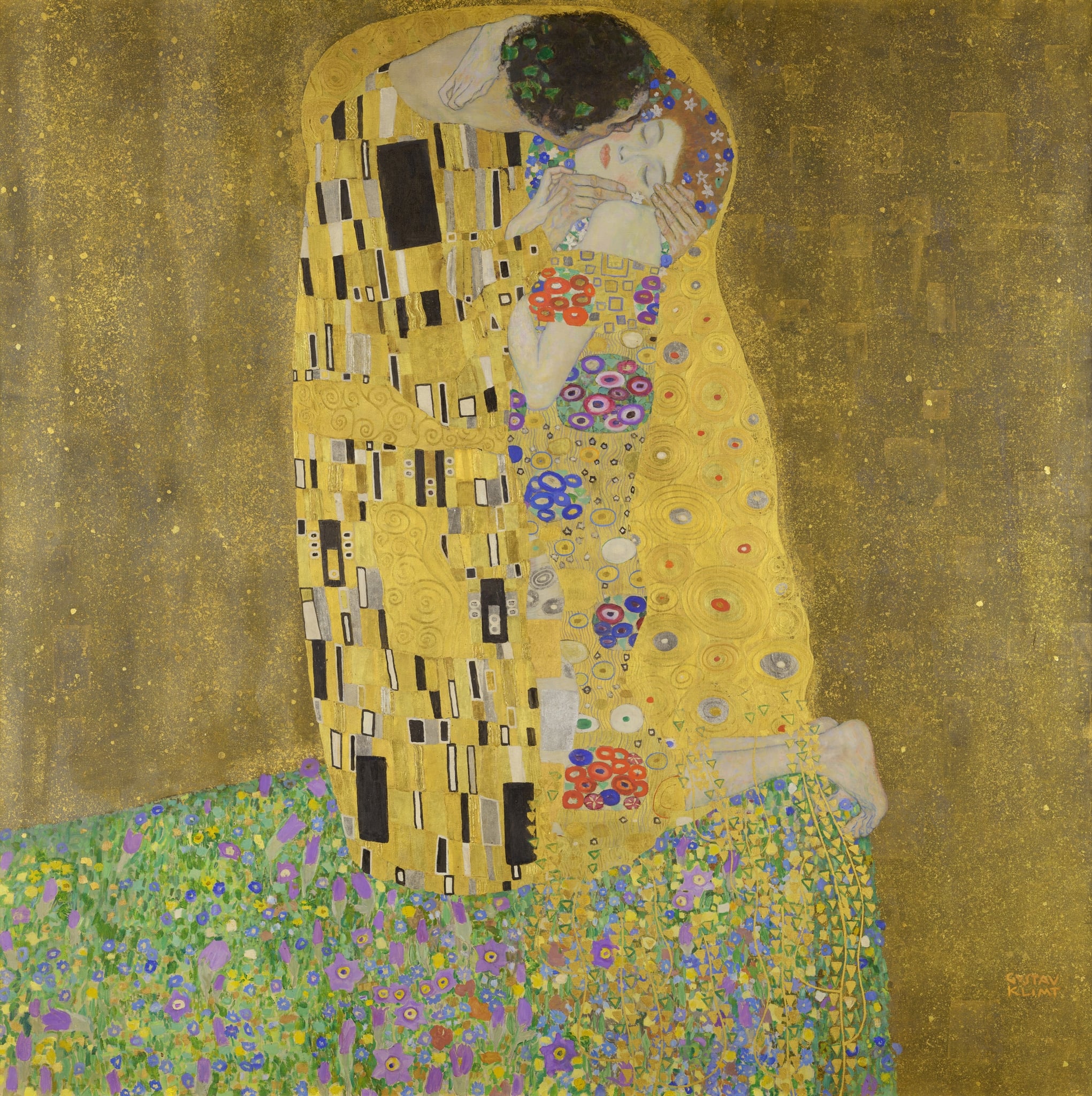
The Kiss stages human love as a <strong>sacred union</strong>, fusing two figures into a single, gold-clad form against a timeless field. Klimt opposes <strong>masculine geometry</strong> (black-and-white rectangles) to <strong>feminine organic rhythm</strong> (spirals, circles, flowers), then resolves them in radiant harmony <sup>[1]</sup><sup>[2]</sup>.
The Tree of Life by Gustav Klimt

The Tree of Life

Gustav Klimt (1910–1911 (design; mosaic installed 1911))

Gustav Klimt’s The Tree of Life crystallizes a <strong>cosmological axis</strong> in a gilded ornamental language: a rooted trunk erupts into <strong>endless spirals</strong>, embedded with <strong>eye-like rosettes</strong> and shadowed by a black, red‑eyed bird. Designed as part of the Stoclet dining‑room frieze, it fuses <strong>symbolism and luxury materials</strong> to link earthly abundance with timeless transcendence <sup>[1]</sup><sup>[2]</sup>.
The Kiss (Lovers) by Gustav Klimt

The Kiss (Lovers)

Gustav Klimt (1907–1908 (Belvedere lists 1908/09))

The Kiss (Lovers) crystallizes Klimt’s <strong>Golden Period</strong> ideal: erotic union staged as a sacred vision. Two bodies fuse beneath a single golden mantle, poised on a flowered ledge at the brink of the unknown, where <strong>pattern becomes symbol</strong> and intimacy becomes icon.

Flowering Poppies by Gustav Klimt

Flowering Poppies

Gustav Klimt (1907)

Gustav Klimt’s <strong>Flowering Poppies</strong> (1907) turns a meadow into a shimmering, all-over field where botany becomes <strong>ornament</strong>. A square canvas packed with red poppies, daisies, and fruiting trees compresses depth and invites a drifting gaze rather than linear recession <sup>[1]</sup><sup>[2]</sup>. The result is a sensuous, immersive vision that fuses observed nature with <strong>decorative abstraction</strong> <sup>[2]</sup>.