How Much Is Part of the Tree of Life (Part 5) Worth?
Last updated: April 21, 2026
Quick Facts
- Methodology
- comparable analysis
Assuming excellent condition and unconstrained marketability, Gustav Klimt’s Part of the Tree of Life (Part 5)—a non‑figural, full‑scale Stoclet Frieze cartoon at the MAK—would likely command $8–18 million. The range balances its museum‑grade significance and rarity against the works‑on‑paper discount and the fact that it is a branch‑only Tree segment rather than a figural panel.
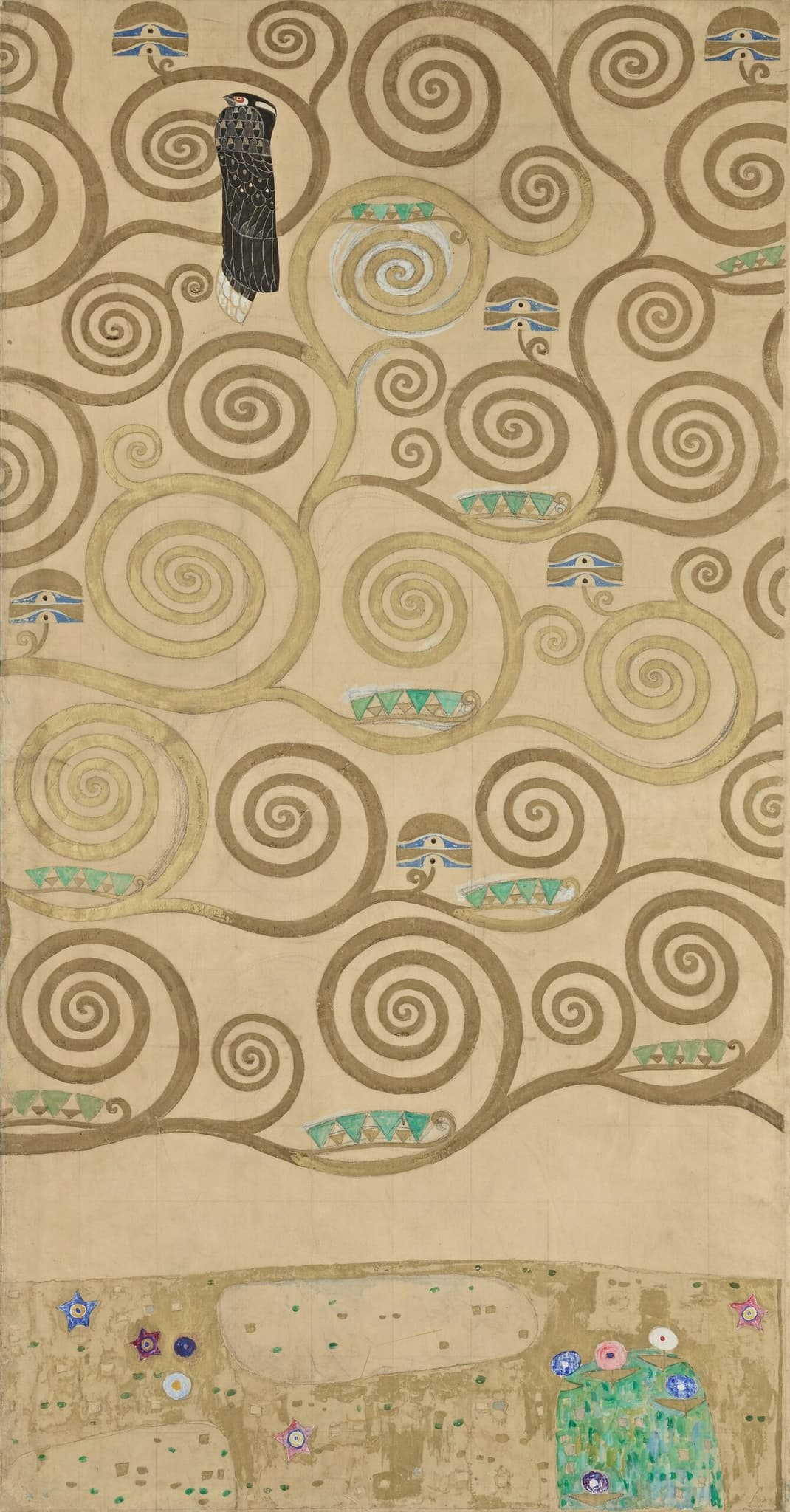
Part of the Tree of Life (Part 5)
Gustav Klimt, 1910–1911 • Chalk, pencil, gouache, with bronze, silver, gold, and platinum on transparent and drafting paper (cartoon)
Read full analysis of Part of the Tree of Life (Part 5) →Valuation Analysis
Conclusion: Indicative fair‑market value for Gustav Klimt’s Part of the Tree of Life (Part 5) is $8–18 million, assuming very good condition, clear title, and the ability to market and export the work internationally. This full‑scale, mixed‑media cartoon for the Stoclet Frieze is held by the MAK – Museum of Applied Arts, Vienna (inv. MAL 226‑5), measures approx. 200 × 102 cm, and is a non‑figural Tree segment within one of Klimt’s most celebrated decorative ensembles [1][2].
Methodology: With no known public sales of Klimt’s Stoclet cartoons, the estimate is derived by triangulating between: (i) record‑level results for Klimt’s masterpieces in oil, which set the demand ceiling; and (ii) high‑end works on paper, which set a category discount. Klimt’s market has seen unprecedented heights, including Portrait of Elisabeth Lederer at $236.4m (Sotheby’s, 2025) and Lady with a Fan at $108.4m (Sotheby’s, 2023) [3][4]. Major landscapes such as Birch Forest at $104.6m (Christie’s, 2022) reinforce the depth of demand for ornamental, non‑figural compositions in oil [5]. At the other end of the spectrum, prime drawings typically transact in the high six to low/mid seven figures (e.g., a 2024 study around €520k at Dorotheum), underscoring the generalized works‑on‑paper discount [6].
Rationale for range: The Stoclet cartoons are museum‑level, full‑scale, and highly finished works central to Klimt’s golden period visual language—the Tree of Life, Expectation, and Fulfillment—warranting a meaningful premium over typical drawings. However, they remain works on paper, with conservation sensitivities (transparent papers, metallic media) and a smaller buyer base than Klimt’s oils. Within the set, figural panels would likely command a further premium; by contrast, a branch‑only Tree segment like Part 5 reasonably sits in the $8–18m bracket, reflecting top‑tier importance within the works‑on‑paper category while staying materially below oil‑on‑canvas benchmarks [1][2][4][6].
Marketability factors: The cartoon’s current status in an Austrian museum implies practical constraints: institutional deaccession policies and export licensing (Bundesdenkmalamt) can limit buyer pools and affect realizable price [7]. Conversely, if hypothetically deaccessioned, in excellent condition, and globally marketed in a major evening sale, competitive bidding—buoyed by recent Klimt records—could test or exceed the upper end of this range, especially if accompanied by robust scholarship and exhibition pedigree [3][4][5].
Positioning: This estimate recognizes the object’s singular art‑historical weight and scarcity while applying a disciplined category discount. It is a premium valuation for a non‑figural Stoclet cartoon, calibrated to current blue‑chip demand and the demonstrated polarization toward masterpiece‑grade Klimt material [3][4][5][6].
Key Valuation Factors
Art Historical Significance
High ImpactPart of the Tree of Life (Part 5) belongs to the full-scale cartoons for the Stoclet Frieze—among Klimt’s most emblematic achievements of his golden, ornamental phase. The Tree of Life, Expectation, and Fulfillment motifs anchor core themes in Klimt’s synthesis of painting, design, and symbolism. As a large, resolved working cartoon that directly underpins the executed frieze, the work carries scholarly and cultural weight beyond typical drawings. Its significance is not only iconographic but also methodological, revealing Klimt’s process at 1:1 scale. This positions the piece as a museum-caliber cornerstone within Klimt’s oeuvre, supporting a valuation well above standard works on paper.
Rarity and Scale
High ImpactFull-scale, mixed-media Stoclet cartoons are vanishingly rare on the market and primarily held by institutions. At roughly 200 × 102 cm, the sheet’s monumentality and finish stand far apart from the small studies that constitute most of Klimt’s works-on-paper supply. Its decorative complexity (including metallic media) and direct relationship to a world-famous commission create a scarcity premium. The rarity effect compounds in trophy markets: collectors seeking blue-chip, museum-grade Klimt have few, if any, equivalents outside oils. This scarcity and scale justify a step-change in value over typical drawings and underwrite the upper half of the proposed range, provided condition is strong.
Medium and Condition Risk
Medium ImpactWhile far more important than standard sketches, the cartoon remains a work on paper on delicate transparent supports with metallic media—materials prone to deformation, oxidation/tarnish, and handling risk. Conservation stability, mounting history, and reversibility of any treatments are crucial and can materially shift price. Buyers also account for installation and long-term care costs. These risks and the broader market’s preference for oils create a structural discount versus Klimt’s canvases. In top, stable condition with a reputable conservation report, the work can compete for cross-category attention; if instability or losses are present, bidders will retreat to the lower end of the range.
Marketability and Legal/Export Context
Medium ImpactThe work is in the MAK, Vienna; any hypothetical sale would need to navigate museum policy and Austrian export regulations. Cultural property controls can narrow the buyer pool to domestic or approved purchasers, dampening competitive tension and price discovery. Conversely, a deaccessioned, fully exportable offering in a global evening sale, supported by top-tier scholarship and exhibition history, could unlock trophy-level competition. Recent record-setting Klimt results demonstrate deep demand at the apex, but those prices were achieved by oils. The net effect is a constraint-adjusted outlook: strong upside in an unconstrained context, tempered estimates if institutional or export limitations apply.
Sale History
Part of the Tree of Life (Part 5) has never been sold at public auction.
Gustav Klimt's Market
Gustav Klimt is a blue-chip, top-tier artist with a global collector base and multiple auction results above $100 million for oils. The market’s ceiling has been reset by landmark sales, including Portrait of Elisabeth Lederer at $236.4m (Sotheby’s, 2025) and Lady with a Fan at $108.4m (Sotheby’s, 2023), with major landscapes like Birch Forest at $104.6m (Christie’s, 2022) underscoring demand beyond portraits. Fresh, museum-grade works with strong provenance attract deep, international bidding, including significant Asian participation. Works on paper transact at a substantial discount to oils, but exceptional, large-scale and highly finished sheets—especially those tied to Klimt’s golden period—can command multi-million prices and cross-category interest.
Comparable Sales
Portrait of Elisabeth Lederer
Gustav Klimt
Same artist; top-tier benchmark for current Klimt demand and price ceiling; helps bracket the upper bound for museum-caliber Klimt material even though it is an oil, not a work on paper.
$236.4M
2025, Sotheby's New York
Lady with a Fan
Gustav Klimt
Same artist; late masterpiece in the Golden/ornamental idiom that underpins the Stoclet aesthetic; demonstrates depth of global trophy demand for Klimt, informing upside appetite.
$108.4M
2023, Sotheby's London
~$114.9M adjusted
Birch Forest
Gustav Klimt
Same artist; non‑figural, pattern‑dense composition from a closely related period. While an oil, its decorative surface logic is the closest market proxy for Klimt’s ornamental frieze language.
$104.6M
2022, Christie's New York
~$115.1M adjusted
Insel im Attersee
Gustav Klimt
Same artist; non‑portrait oil emphasizing ornamental color fields and surface—useful for bracketing value of decorative, non‑figural Klimt works versus drawings/cartoons.
$53.2M
2023, Sotheby's New York
~$56.4M adjusted
Portrait of Fräulein Lieser
Gustav Klimt
Same artist; recent high‑value oil sold in Austria, illustrating strong demand even with potential local/ex‑Austria constraints—relevant to any hypothetical sale of a Stoclet cartoon in Vienna.
$32.0M
2024, im Kinsky, Vienna
~$33.0M adjusted
Study for Judith II (drawing)
Gustav Klimt
Same artist; work on paper from the Golden period. Though far smaller and less finished than a full‑scale Stoclet cartoon, it anchors the drawings category and demonstrates the typical discount to oils.
$565K
2024, Dorotheum, Vienna
~$582K adjusted
Current Market Trends
The upper tier of the Modern market remains polarized: rare, masterpiece-grade works command intense competition, while mid-tier material is more selective. Klimt sits at the epicenter of this phenomenon, with recent record prices validating a strong appetite for best-in-class, ornamental and figurative masterworks. For Vienna Secession material, visibility through major exhibitions and scholarship supports demand. Within works on paper, buyers prize scale, finish, and direct ties to iconic commissions. However, conservation sensitivities and legal/export constraints (especially for Austrian heritage) can narrow buyer pools. In an unconstrained, globally marketed sale, trophy-level bidding for exceptional Klimt works remains likely.
Study print
Study this painting as a print
Pair the full artwork with a museum-style study sheet focused on one meaningful detail.
Sources
- Google Arts & Culture – MAK object page (MAL 226-5)
- MAK – Nine Cartoons for the Stoclet Frieze
- The Art Newspaper – Klimt record at Sotheby’s New York (2025)
- Sky News – Lady with a Fan sets European auction record (2023)
- The Art Newspaper – Paul G. Allen sale (Birch Forest $104.6m, 2022)
- Dorotheum – Top price for Klimt drawing (2024)
- Bundesdenkmalamt (Austria) – Export of cultural property