Florentine Cinquecento and Quattrocento

by Gustav Klimt

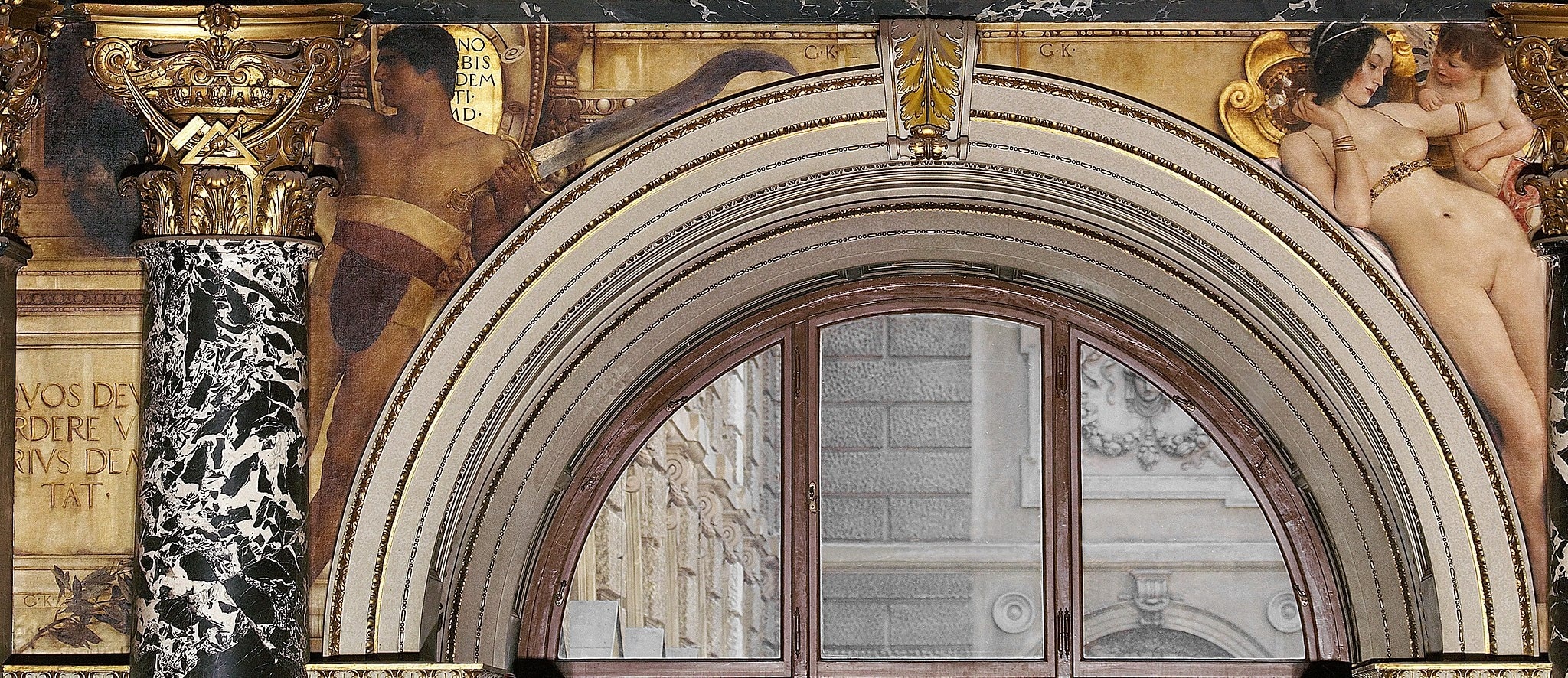
Gustav Klimt’s Florentine Cinquecento and Quattrocento stages a dialogue between heroic virtue and ideal beauty. A trophy-like Goliath head (standing for Michelangelo’s David) faces a reclining Venus with Cupid, all set within a gilded, marbleized architectural frame that fuses painting and ornament [1][2].

Study Print Studio

Create a personal study print

Build a companion study sheet around the part of this painting that speaks to you most. Choose a detail, shape an interpretation, and walk away with something personal and display-worthy.

Fast Facts

Year
1891
Medium
Oil on canvas (painted in studio; marouflaged to the staircase walls in 1891)
Dimensions
Not stated by KHM
Location
Kunsthistorisches Museum, Vienna (Grand Staircase)
See all Gustav Klimt paintings in Vienna
Florentine Cinquecento and Quattrocento by Gustav Klimt (1891) featuring Set square and compass, Latin moral inscription, Laurel sprig, Curved sword

Click on any numbered symbol to learn more about its meaning

Meaning & Symbolism

Placed high above the Grand Staircase, the pair works like a ceremonial proscenium where Florence’s two great Renaissance moments—Quattrocento and Cinquecento—confront and complement each other. At the left, Klimt condenses Michelangelesque virtue into a single, shocking sign: the severed head of Goliath held aloft—David evoked through his act rather than his body. Directly beneath, a crisply inscribed Latin maxim, translated by the museum as “He whom God would ruin, He first makes blind,” sharpens the moral of pride overthrown and reason restored to the city’s civic life 12. A laurel sprig near Klimt’s signature crowns the scene with the emblem of poetic and artistic triumph, tying David’s virtù to the triumphs of art itself 1. The male attendant gripping a curved blade compresses the Cinquecento’s energy into a single torsion: muscular, purposeful, and decisive—qualities Klimt aligns with high Renaissance monumentality. Across the arch, the Quattrocento answers with a Venus who reclines against gilded scrollwork while a putto cups her shoulder. Her softly modeled body, jeweled girdle, and turned gaze paraphrase Botticelli’s ideal—sensual yet ordered, humanist yet mythic—so that beauty itself becomes an ethical measure, not mere decoration 12. The two figures are separated—and rhythmically joined—by an illusionistic arch whose bands are pricked with gold beading; black-and-white “marble” columns rise into lush Corinthian capitals. On the left capital, Klimt even perches a set square and compass—draftsman’s tools that, in this context, quietly proclaim the Renaissance foundations of geometry, proportion, and crafted reason. The architectural veneer is not background; it is argument. It asserts that measured space and ornamental discipline are the very media through which heroism and beauty can be made legible. Klimt’s staging thus turns the staircase into a time-bridge: civic virtue (David) confronts, and ultimately harmonizes with, the ideal nude (Venus). Read together, the pair claims that Florence’s rebirth arose from a double reception of antiquity—stoic action and classical beauty—an interpretation explicitly underlined in the museum’s curatorial text 1. At the same time, the work announces the young Klimt’s own program. He synthesizes sculptural bodies with a luxurious, near-abstract décor, letting pattern, gold, and marbled surfaces frame and control the viewer’s attention. Scholars have identified this staircase cycle as pivotal for Klimt’s evolution: a laboratory where he learned to braid ornamental flatness with volumetric figuration, a strategy that becomes central to his later Symbolist and Secessionist idiom 3. Finally, the moral inscription cinches the narrative: if Goliath’s blindness signals hubris, David’s clear-sighted courage restores order; if Venus risks dissolving into sensuality, Klimt contains her within geometry and gilded architecture. The result is a didactic emblem for a museum temple: knowledge and beauty advance together when disciplined by measure, history, and craft. In that sense, the meaning of Florentine Cinquecento and Quattrocento exceeds Renaissance Florence; it is Klimt’s credo for art’s power to yoke erotic charge, heroic action, and ornamental reason into a single, radiant image—explaining why Florentine Cinquecento and Quattrocento is important both to the museum’s pedagogic program and to the artist’s own metamorphosis from Ringstraße decorator to modern master 123.

Explore Deeper with AI

Ask questions about Florentine Cinquecento and Quattrocento

Popular questions:

Powered by AI • Get instant insights about this artwork

💬 Ask questions about this artwork!

Interpretations

Formal/Technical Analysis: Marouflage, Mise-en-Scène, and Visual Governance

Executed in oil on canvas and then marouflaged to the Grand Staircase, the pair is engineered for elevated, oblique viewing; Klimt compensates with oversized emblems (the trophy head, the recumbent Venus) and an illusionistic architectural grid that acts like a visual governor for the ensemble 2. The gilded frieze, beadwork, and simulated marble are not passive décor but a scaffolding of attention, channeling sightlines along pilasters and arches to stage an art-historical thesis in situ 1. This site-specific orchestration anticipates the artist’s later command of ornamental fields to choreograph gaze and meaning, proving that Klimt’s “decorative” practice is also a sophisticated exercise in spatial rhetoric and museum pedagogy 3.

Source: Google Arts & Culture (KHM label); Kunsthistorisches Museum; Heidelberg University study [Haag ed., 2018]

Ideological Reading: Renaissance Virtù for an Imperial Museum

The dialectic of Davidic virtù and Venerean ideal—moral action and ethical beauty—does more than summarize Florence; installed in the Habsburgs’ encyclopedic museum, it functions as imperial pedagogy. By elevating Florentine civic exempla and humanist measure, the KHM claims lineage with a classical, rational order that legitimizes the museum’s own authority as a temple of knowledge 12. The Latin maxim about blindness before ruin operates like didactic propaganda, warning against hubris while sanctifying reason as a public virtue. Klimt’s selective Renaissance paraphrase thus becomes an ideology of culture-as-governance: art history is deployed to naturalize hierarchy, discipline the gaze, and frame beauty and courage as state-compatible virtues 12.

Source: Kunsthistorisches Museum; Google Arts & Culture (KHM-supplied text)

Gendered Classicism: Venus as Ethical Constraint, Not Sensual Excess

Klimt’s Venus paraphrases Botticelli yet is contained by geometry—arched bands, Corinthian capitals, and a jeweled cincture that toggles allure and restraint 12. Rather than indulging erotic plenitude, the composition posits quattrocento beauty as a normative technology: the body is idealized to model balance, temperance, and civic harmony. The putto’s guiding hand reads less as caprice than as a cue to regulated desire—Eros disciplined by proportion. In dialogue with the Cinquecento panel’s moralizing inscription, the female nude becomes an ethical instrument, translating humanist aesthetics into a measured protocol for looking, a move that prefigures Klimt’s later capacity to harness ornament to bind and structure sensuality 13.

Source: Kunsthistorisches Museum; Heidelberg University study [Haag ed., 2018]

Appropriation Strategy: Paraphrase over Quotation

Klimt avoids direct replicas of Michelangelo’s David or Botticelli’s Venus, opting instead for metonymy (Goliath’s head) and paraphrase (a Botticellian Venus) 12. This strategy asserts modern authorship: canonical forms are translated into a late‑19th‑century decorative syntax that privileges emblem, silhouette, and gilded surface. By compressing narrative into a single, iconic sign and staging the nude within an architectural argument, Klimt demonstrates how appropriation can produce new meaning without forfeiting reference. The result is a historiographic montage—Renaissance ideals reframed through Viennese historicism—anticipating Secessionist tactics where citation and invention cohabit, and where the prestige of the past is activated to underwrite a distinctly modern pictorial rhetoric 23.

Source: Google Arts & Culture (KHM label); Heidelberg University study [Haag ed., 2018]

Process and Trajectory: From Volumes to Fields

Scholars mark the staircase cycle as a laboratory where Klimt learned to braid volumetric figuration with ornamental flatness, a synthesis that becomes central to his Symbolist and Secessionist idiom 3. In the Florentine pair, bodies are robustly modeled yet arrested by patterned, near‑abstract décor and an insistent architectural skin. This tension—mass versus plane, flesh versus gold—generates a distinctly modern image logic: the decorative field does not merely embellish but structures meaning and tempo. The method presages the later “Golden Period,” where empirical volume yields to hieratic pattern, and where the truth of the figure is less mimetic than iconic, secured by the frame’s rational order rather than by illusionistic depth 31.

Source: Heidelberg University study [Haag ed., 2018]; Kunsthistorisches Museum

Related Themes

About Gustav Klimt

Gustav Klimt (1862–1918), co-founder of the Vienna Secession, pivoted from controversial public commissions to a decorative-symbolist language in his Golden Period. Drawing on Byzantine mosaics and modern design, he fused opulent surfaces with psychological intensity. By 1908–09, he transformed scandal into canon, and The Kiss became Vienna’s emblem of modern love.
View all works by Gustav Klimt

More by Gustav Klimt

Portrait of Adele Bloch-Bauer I by Gustav Klimt

Portrait of Adele Bloch-Bauer I

Gustav Klimt (1907)

Gustav Klimt’s Portrait of Adele Bloch-Bauer I stages its sitter as a <strong>secular icon</strong>—a living presence suspended in a field of gold that converts space into <strong>pattern and power</strong>. The naturalistic face and hands emerge from a reliquary-like cascade of eyes, triangles, and tesserae, turning light, ornament, and status into the painting’s true subjects <sup>[1]</sup><sup>[2]</sup>.

Sunflower by Gustav Klimt

Sunflower

Gustav Klimt (1907/1908)

Gustav Klimt’s Sunflower turns a single bloom into a <strong>monumental, figure-like presence</strong>. A tapering stack of broad, drooping leaves rises from a <strong>mosaic-like carpet of round blossoms</strong>, crowned by a gold-flecked disc that glows against a cool, stippled field. The work fuses <strong>portrait, icon, and landscape</strong> into one emblem of vitality and quiet sanctity <sup>[1]</sup><sup>[2]</sup>.

Cottage Garden with Sunflowers by Gustav Klimt

Cottage Garden with Sunflowers

Gustav Klimt (1906–1907 (signed 1907))

Cottage Garden with Sunflowers is a square, horizonless field of blooms where a vertical column of <strong>sunflowers</strong> anchors an all-over weave of color and pattern. Klimt fuses <strong>ornament and nature</strong>, turning a humble Litzlberg cottage plot into a radiant matrix of cyclical life and renewal <sup>[1]</sup><sup>[4]</sup><sup>[5]</sup>.

The Kiss by Gustav Klimt

The Kiss

Gustav Klimt (1908 (completed 1909))

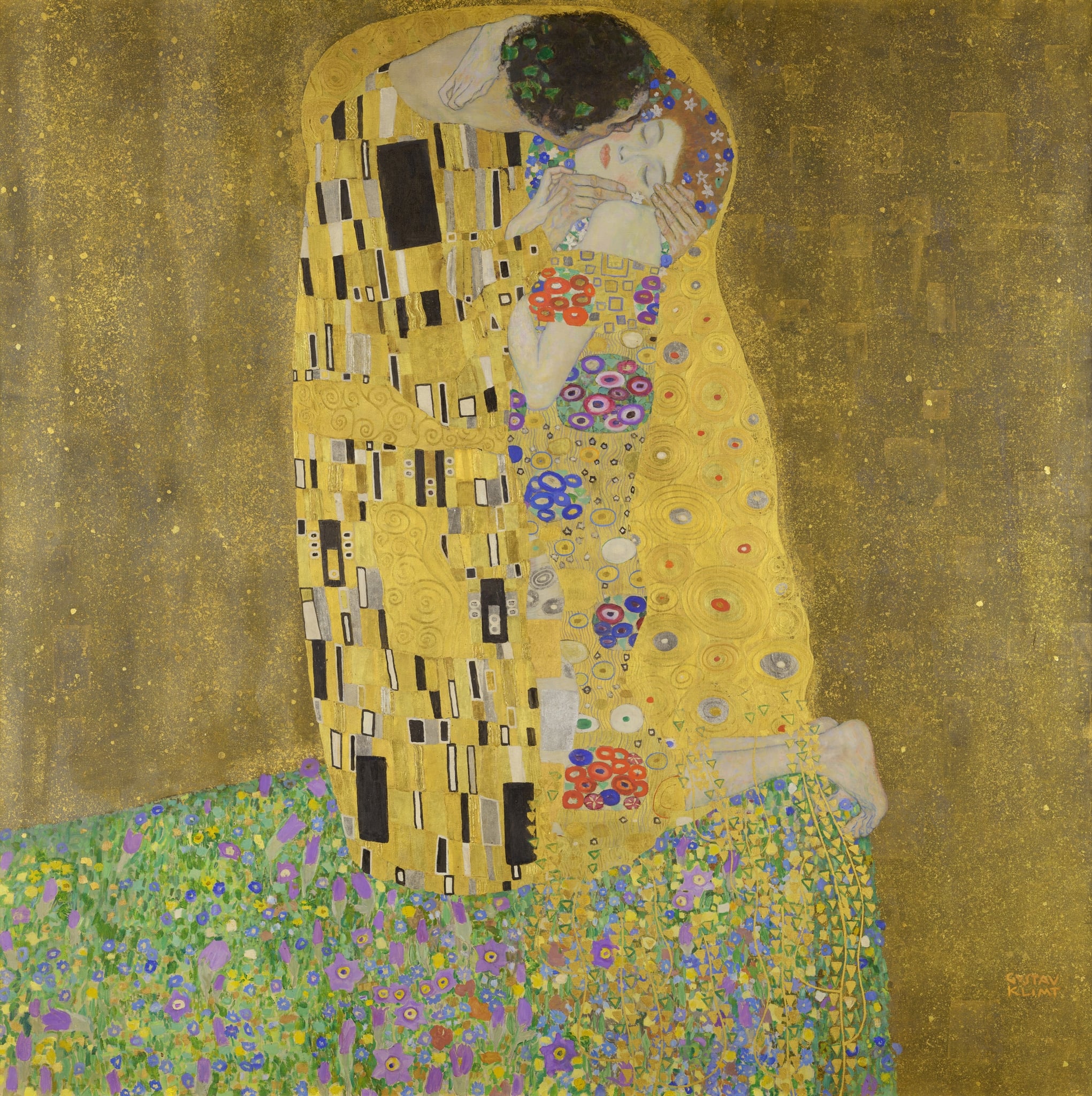
The Kiss stages human love as a <strong>sacred union</strong>, fusing two figures into a single, gold-clad form against a timeless field. Klimt opposes <strong>masculine geometry</strong> (black-and-white rectangles) to <strong>feminine organic rhythm</strong> (spirals, circles, flowers), then resolves them in radiant harmony <sup>[1]</sup><sup>[2]</sup>.
The Tree of Life by Gustav Klimt

The Tree of Life

Gustav Klimt (1910–1911 (design; mosaic installed 1911))

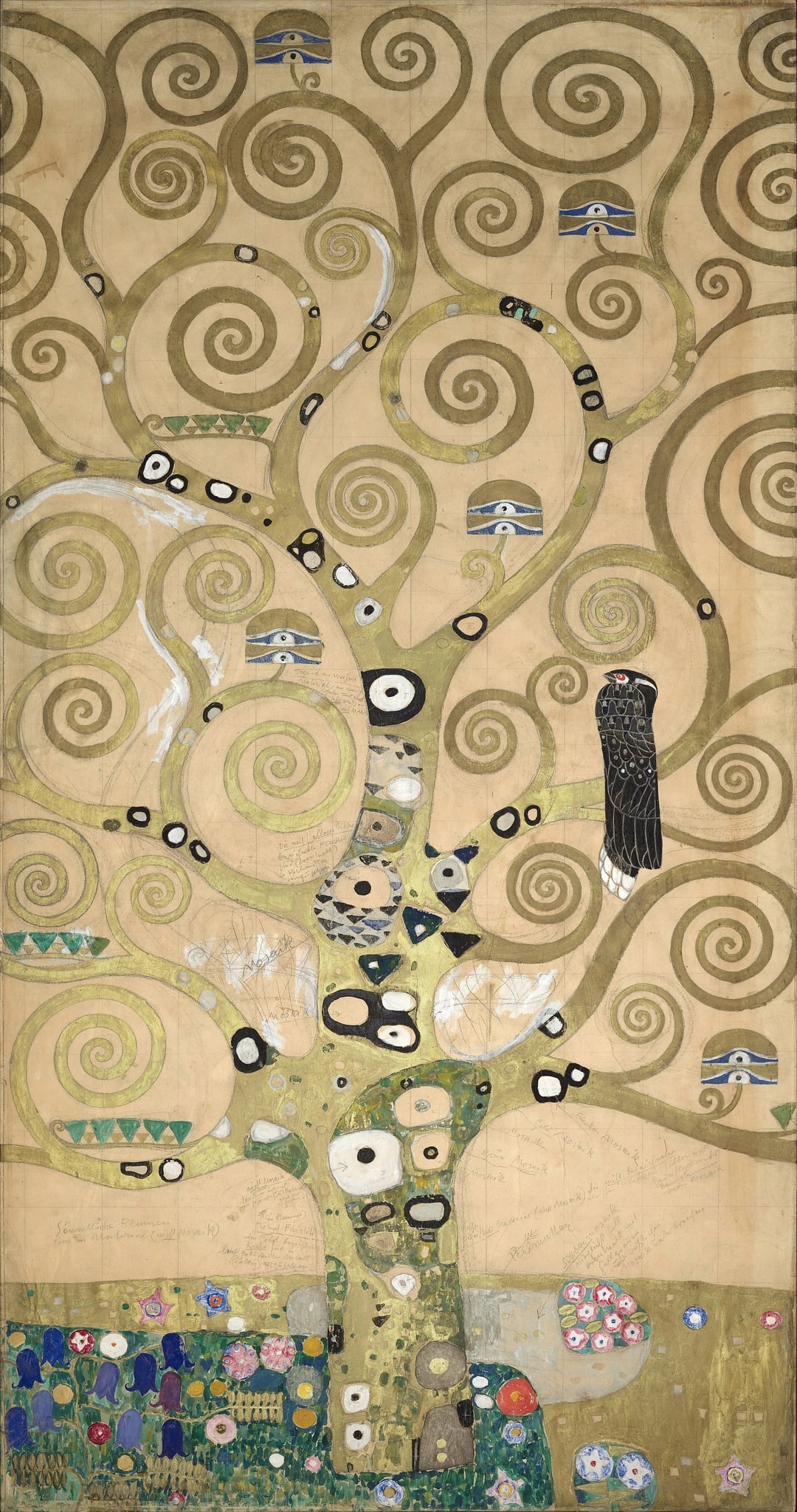
Gustav Klimt’s The Tree of Life crystallizes a <strong>cosmological axis</strong> in a gilded ornamental language: a rooted trunk erupts into <strong>endless spirals</strong>, embedded with <strong>eye-like rosettes</strong> and shadowed by a black, red‑eyed bird. Designed as part of the Stoclet dining‑room frieze, it fuses <strong>symbolism and luxury materials</strong> to link earthly abundance with timeless transcendence <sup>[1]</sup><sup>[2]</sup>.
The Kiss (Lovers) by Gustav Klimt

The Kiss (Lovers)

Gustav Klimt (1907–1908 (Belvedere lists 1908/09))

The Kiss (Lovers) crystallizes Klimt’s <strong>Golden Period</strong> ideal: erotic union staged as a sacred vision. Two bodies fuse beneath a single golden mantle, poised on a flowered ledge at the brink of the unknown, where <strong>pattern becomes symbol</strong> and intimacy becomes icon.