How Much Is Florentine Cinquecento and Quattrocento Worth?
Last updated: April 19, 2026
Quick Facts
- Methodology
- comparable analysis
Hypothetical fair‑market value for Gustav Klimt’s in‑situ “Florentine Cinquecento and Quattrocento” (1890–91) is $10–30 million. While art‑historically significant, the work’s early, decorative character and site‑specific installation warrant a steep discount versus Klimt’s late portraits and prime landscapes.
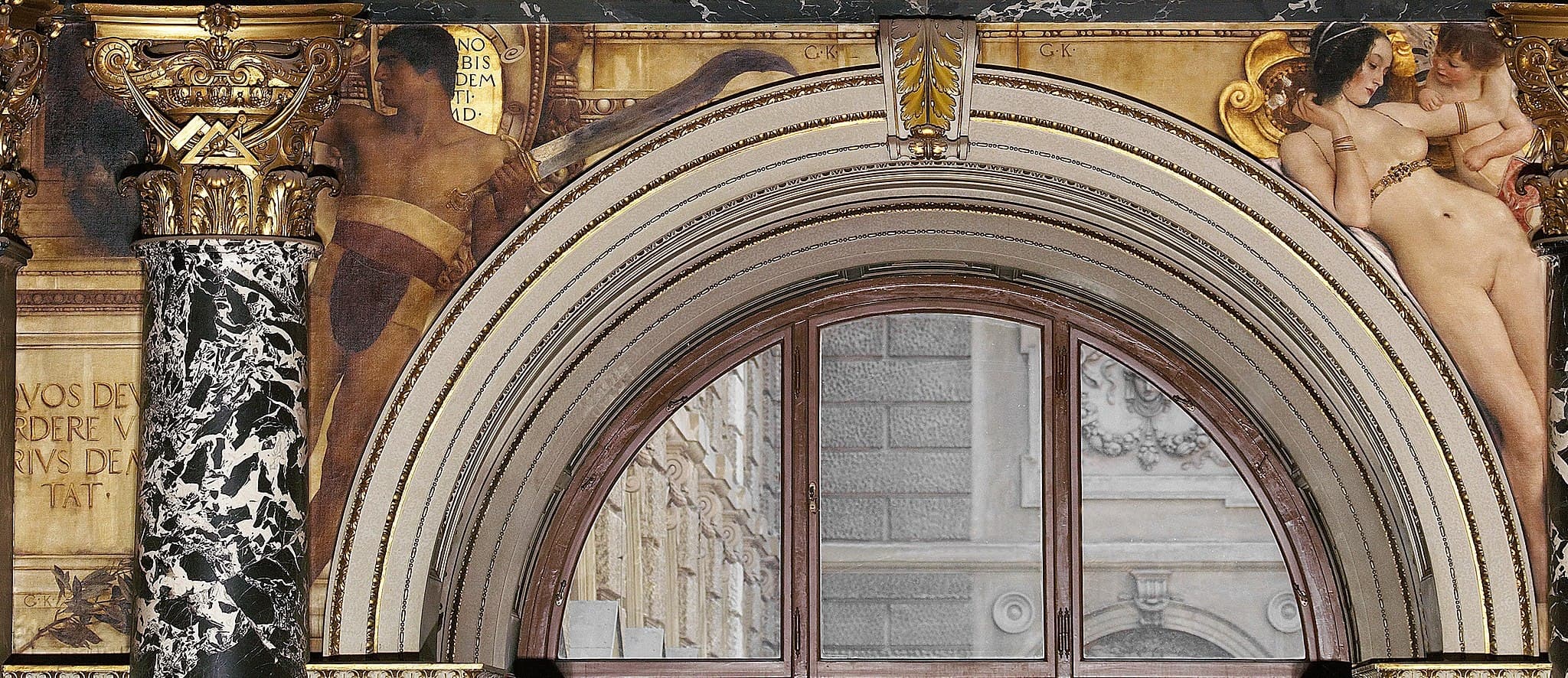
Florentine Cinquecento and Quattrocento
Gustav Klimt, 1891 • Oil on canvas (painted in studio; marouflaged to the staircase walls in 1891)
Read full analysis of Florentine Cinquecento and Quattrocento →Valuation Analysis
Conclusion: On a hypothetical, fair‑market basis—assuming lawful deaccession, safe detachment, and export permission—Gustav Klimt’s “Florentine Cinquecento and Quattrocento” is valued at $10–30 million. In real‑world terms, the work is effectively non‑transactable today: it was conceived for, and remains marouflaged within, the grand staircase of Vienna’s Kunsthistorisches Museum (KHM) and has never been offered for sale [1][2].
Methodology and benchmarks: The range is derived by indexing the piece against the current Klimt price architecture and then applying explicit discounts for period, type, authorship context, and site‑specific constraints. Klimt’s ceiling moved sharply higher in 2025 when Sotheby’s sold Portrait of Elisabeth Lederer for $236.4 million (with fees), establishing the record for a work of Modern art at auction and confirming deep, global demand for masterpiece‑grade late portraits [3]. Non‑portrait masterworks also command nine figures—e.g., Birch Forest at $104.6 million (Christie’s, 2022) [6]—and the 2025 sale of two landscapes at $86.0 million and $68.3 million, respectively, re‑rated the landscape sub‑segment upward [4]. Even in 2023, a late portrait (Lady with a Fan) realized $108.4 million in London, underscoring sustained appetite for Klimt’s mature idiom [5].
Rationale for discounting: The KHM staircase panel is a prestigious, formative commission (1890–91) but belongs to Klimt’s early, historicist/decorative phase preceding the Viennese Secession. Market demand is consistently strongest for the gold‑period and immediately post‑gold portraits and for the most luminous Attersee landscapes. Relative to those highly coveted categories, early decorative works trade at a substantial discount. Additional dampeners include the collaborative context of the staircase program (with Ernst Klimt and Franz Matsch), the less immediately iconic subject, and limited global name recognition of this specific panel compared with Klimt’s signature masterpieces [2].
Site‑specific and legal/practical constraints: The panels were painted on canvas and adhered to the architecture (marouflage); they remain in situ on the KHM’s grand staircase [1][2]. Any attempt to remove them would entail conservation risk, significant cost, and likely legal/heritage barriers in Austria, all of which narrow the buyer universe and depress fair‑market value. These same factors explain why the work has no public sale history and why its practical market value—in its current setting—is effectively zero despite the brand power of the Klimt name [1].
Countervailing positives: The Klimt name, museum‑grade provenance, monumental scale, and documentary importance within the artist’s biography all support an eight‑figure outcome in a hypothetical lawful sale process. That said, when set against nine‑figure late portraits and top landscapes, a $10–30 million range appropriately reflects category misalignment, authorship context, and site constraints while remaining consistent with a re‑rated Klimt market at the very top [3][4][5][6].
Key Valuation Factors
Art Historical Significance
High ImpactCommissioned for the Kunsthistorisches Museum’s grand staircase in 1890–91, this work belongs to Klimt’s foundational, pre‑Secession period. It documents his emergence within major public commissions and the collaborative context that preceded his breakthrough style. Institutional, in‑situ provenance amplifies historical weight. While this status bolsters cultural value, the market typically prices biography‑defining yet stylistically earlier works below the artist’s mature icons. Still, for connoisseurs and museums, the panel’s role in Klimt’s development—and its place within a landmark architectural program—confers a durable premium relative to generic early works.
Market Alignment with Desirable Period/Type
Medium ImpactKlimt’s price maxima concentrate in gold‑period and late portraits, followed by prime Attersee landscapes—categories that recently achieved $236.4m, $108.4m, and $86.0m/$68.3m, respectively, at auction. By contrast, the KHM panel is an early, decorative, non‑portrait work. Collectors paying at the top of the Klimt market generally target the sensuous, symbolist language of ca. 1900–1918. As a result, even with the powerful Klimt brand and museum provenance, this panel occupies a lower‑demand niche and requires a substantial stylistic/type discount versus headline comps.
Site-Specificity and Legal/Practical Constraints
High ImpactThe panel is marouflaged to the KHM staircase and remains in situ. Detachment would entail non‑trivial conservation risk, high costs, and likely engagement with Austrian heritage protections and export controls. These frictions sharply limit feasible transaction pathways and the buyer pool, suppressing open‑market pricing relative to portable, gallery‑ready paintings. Consequently, while an insurer might assign a high replacement or agreed value, the fair‑market valuation must incorporate a meaningful site‑specificity discount and acknowledge that real‑world transacting is currently implausible.
Provenance and Institutional Custody
Medium ImpactContinuous, museum‑level provenance from the Kunsthistorisches Museum ensures unimpeachable authenticity and due diligence, which are attractive to buyers and insurers. Yet the same institutional custody that elevates trust also reduces liquidity: deaccessions are rare, politically sensitive, and subject to legal/ethical review. If a lawful sale ever occurred, the KHM lineage would be a strong positive signal for quality and condition history; practically, however, institutional ownership today means market value is theoretical and any transaction would face exceptional scrutiny and procedural hurdles.
Sale History
Florentine Cinquecento and Quattrocento has never been sold at public auction.
Gustav Klimt's Market
Gustav Klimt is a blue‑chip, trophy‑grade name with global depth. Prices surged to new highs in 2025 when Sotheby’s sold Portrait of Elisabeth Lederer for $236.4 million (with fees), setting the auction record for Modern art and re‑calibrating expectations for late portraits. Demand extends beyond portraits: top landscapes achieved $86.0 million and $68.3 million in the same season, while Lady with a Fan brought $108.4 million in 2023. Supply is exceedingly thin, provenance scrutiny is rigorous, and competition is international (notably strong participation from Asia). In this environment, masterpiece‑quality, portable Klimts command nine‑figure prices; earlier or less emblematic works transact at a significant discount but still benefit from the brand’s strength.
Comparable Sales
Portrait of Elisabeth Lederer
Gustav Klimt
Same artist; record-setting late portrait establishes the absolute ceiling for Klimt and the brand premium. Not comparable in period or function (not site-specific), but anchors top-of-market demand.
$236.4M
2025, Sotheby's New York
Blumenwiese (Blooming Meadow)
Gustav Klimt
Same artist; prime, museum-level non-portrait painting showing eight-figure strength for non-icon portraits. Useful as an upper-bound for non-portrait Klimts vs. early decorative work.
$86.0M
2025, Sotheby's New York
Insel im Attersee (Island in the Attersee)
Gustav Klimt
Same artist; early 1900s landscape closer in date to the artist’s pre-gold period than late portraits. Demonstrates high pricing for non-portrait, non-gilded oils—still later and more market-friendly than the site-specific KHM panels.
$53.2M
2023, Sotheby's New York
~$56.9M adjusted
Dame mit Fächer (Lady with a Fan)
Gustav Klimt
Same artist; late, highly coveted portrait that set a then-record in 2023. Calibrates the top end for Klimt portraiture versus earlier decorative commissions.
$108.4M
2023, Sotheby's London
~$116.0M adjusted
Birch Forest
Gustav Klimt
Same artist; prime Period landscape from the Allen Collection, premium-inclusive. Illustrates sustained nine-figure appetite for museum-grade Klimts, against which early, site-specific decorative panels would be discounted.
$104.6M
2022, Christie's New York
~$115.0M adjusted
Portrait of Fräulein Lieser
Gustav Klimt
Same artist; late portrait sold in Vienna with strong but lower price than London/NY trophies. Useful as a lower anchor for accepted oil paintings, still far more marketable than in-situ architectural panels.
$37.5M
2024, im Kinsky, Vienna
~$38.6M adjusted
Current Market Trends
Modern art has led a post‑2024 rebound at marquee auctions, with a pronounced ‘flight to quality.’ Klimt exemplifies this: ultra‑scarce, museum‑level works achieved record levels, while buyer selectivity remained high for anything short of best‑in‑class. The category’s resilience is anchored by institutional scholarship, major single‑owner consignments, and a global collector base seeking canonical names. That said, liquidity is concentrated at the top, and period/style alignment strongly influences price. Site‑specific or early decorative works, even by blue‑chip artists, require discounts for practicality, legal constraints, and narrower demand relative to portable, signature‑period paintings.
Study print
Study this painting as a print
Pair the full artwork with a museum-style study sheet focused on one meaningful detail.
Sources
- Kunsthistorisches Museum, Klimt Staircase Program (press overview)
- Wikipedia (DE): Florentinisches Cinquecento und Quattrocento (Klimt)
- Sotheby’s: Historic night at Sotheby’s (Klimt record, Nov 2025)
- The Art Newspaper: Klimt record and landscape results (Nov 2025)
- Forbes: Klimt’s Lady with a Fan sells for $108.4m (Jun 2023)
- Christie’s: Birch Forest (Paul G. Allen Collection) result (Nov 2022)