Painting Meanings Essay
How a Portrait Beat a Country
Start with the face everyone in Vienna knew. Adele Bloch-Bauer—wealthy, sharp, and restless—sat for Klimt as he built a shrine of gold around her in 1907.
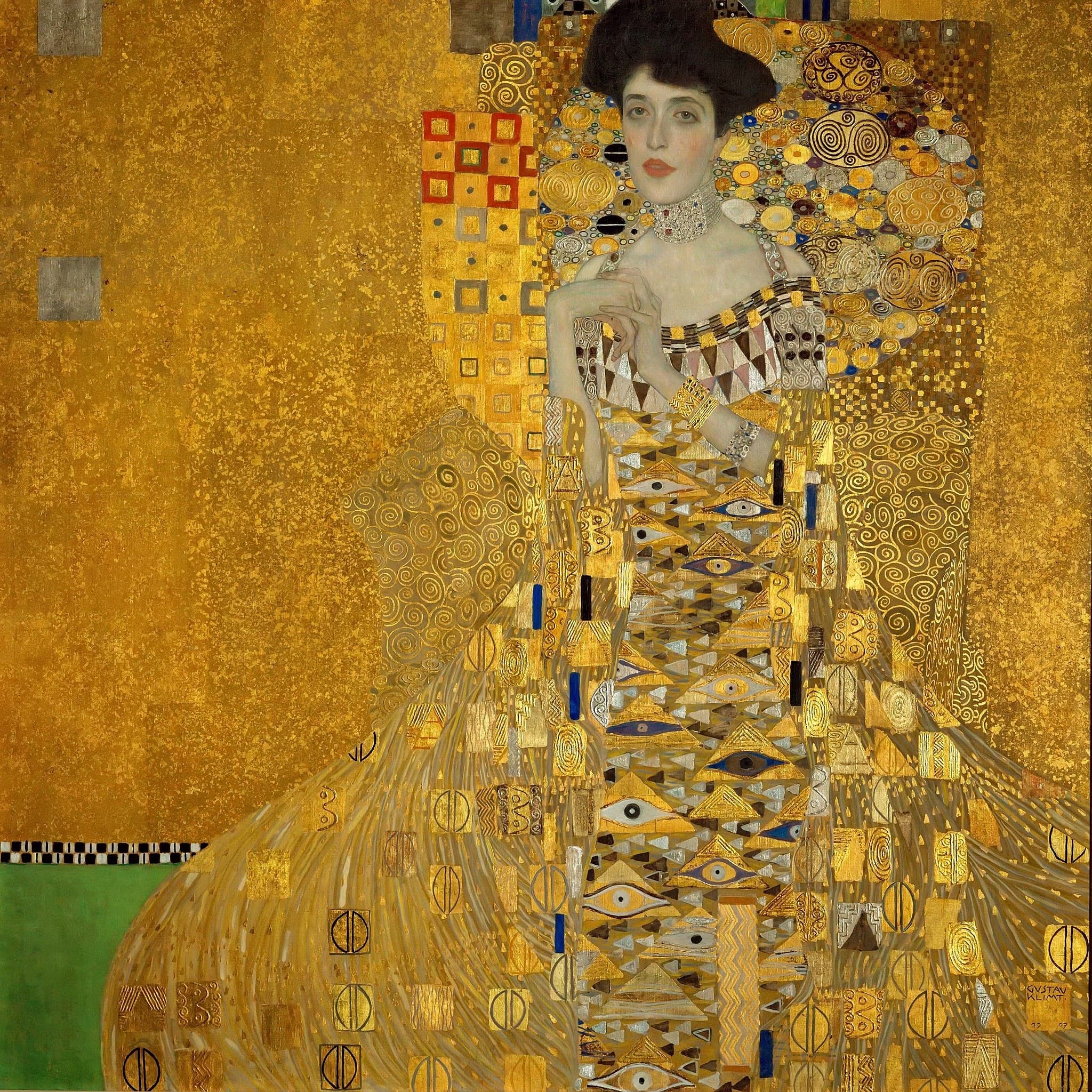
Start with the face everyone in Vienna knew. Adele Bloch-Bauer—wealthy, sharp, and restless—sat for Klimt as he built a shrine of gold around her in 1907. It’s the image that made his reputation glitter, the one now on every tote bag. But scroll past the sparkle and you hit a fault line: this portrait wasn’t just coveted; it was contested to the bone. See the work here for context and image details: /artworks/gustav-klimt/portrait-of-adele-bloch-bauer-i 1.
When the Nazis annexed Austria in 1938, the Bloch-Bauer collection was seized. Klimt’s portrait of Adele surfaced at the Austrian state museum, displayed as a national treasure while the family scattered in exile. The renaming did some of the dirtiest work. To scrub the sitter’s Jewish identity from wall labels and tour scripts, it became:
“Woman in Gold.” [12]
For decades, Austrian officials insisted the painting rightly belonged to the state, citing Adele’s 1923 will—read as an instruction that her husband should bequeath the Klimts to the museum when he died. The family read it differently: a request, not a binding legal transfer. At stake were memory, restitution, and a masterpiece that had become shorthand for a country’s self-image. A niece, Maria Altmann, living quietly in Los Angeles, decided to fight a government on principle—and on paper. The odds looked absurd.
Then the ground shifted. In 2004, the U.S. Supreme Court ruled that her lawsuit could proceed (Republic of Austria v. Altmann), blowing a hole in sovereign immunity for historical claims and greenlighting a case Austria never thought it would have to answer in court. The museum label suddenly felt less like fact and more like a dare. The evidence cut both ways, but the key was the will’s wording—"I ask" versus "I bequeath"—and the trail of Nazi-era coercion documented around the collection’s path to the Belvedere. The stalemate moved to arbitration in Vienna. The nation watched.
In January 2006, the panel ruled: the Klimts, including Adele I, must be returned to Altmann and her fellow heirs. The painting left Austria. A country’s Mona Lisa had a suitcase. As critic Peter Schjeldahl put it, Adele had long been treated as “the Mona Lisa of Austria” [12]. The phrase landed with a thud now. Who gets to keep a country’s Mona Lisa when the country took it in the first place?
Two months later came the market twist: Ronald S. Lauder bought the portrait for the Neue Galerie in New York for $135 million, then the highest price ever paid for a painting. The number was a headline, but the subtext was louder: a restitution victory instantly set the benchmark by which blue-chip trophies would be priced and judged [10]. The work didn’t vanish into a vault; it became the new face of a museum dedicated to the very world Vienna once shattered.
Look closely at the gold—Klimt’s lavish leaf and Byzantine shimmer aren’t just decadence. They were always a technology of awe, a way to canonize a living woman as a secular icon. In Adele’s case, that aura multiplied her symbolic value in every arena: legal, national, financial. Each triangle and watching eye in the dress reads like a ledger of who was looking and why. The painting didn’t change; our claims on it did, because names matter more than metals.
Here’s the reversal we don’t expect from art history: technique became testimony. Klimt’s gilding made Adele impossible to forget; her survival in memory helped her family prove what the paper trail could not finish on its own. The museum label that once erased her became the exhibit that restored her.
Today the portrait hangs at the Neue Galerie, framed not just by gold but by provenance—an origin story visitors read before they even meet her gaze [3][9][16]. The price tag gets repeated, but it’s really just a receipt. The real payment was returning Adele’s name to her face.
Notes
1 Painting Meanings: Portrait of Adele Bloch-Bauer I — /artworks/gustav-klimt/portrait-of-adele-bloch-bauer-i
[3] Neue Galerie on Google Arts & Culture — https://artsandculture.google.com/story/gustav-klimt%E2%80%99s-%E2%80%9Cportrait-of-adele-bloch-bauer-i-quot-neue-galerie-new-york/fQWRgy-UV1Ge2g
[9] Neue Galerie eMuseum (accession, object record) — https://neue.emuseum.com/objects/33/adele-blochbauer--i
[10] The Art Newspaper: “Lauder pays $135m for Bloch-Bauer Klimt” — https://www.theartnewspaper.com/2006/07/01/lauder-pays-dollar135m-for-bloch-bauer-klimt
[12] The New Yorker, Peter Schjeldahl, “Golden Girl” (2006) — https://www.newyorker.com/magazine/2006/07/24/golden-girl-2
[16] Neue Galerie — Exhibition: “Klimt and Adele Bloch-Bauer” — https://www.neuegalerie.org/exhibitions/klimt-and-adele-bloch-bauer
Sources & Further Reading
Portrait of Adele Bloch-Bauer I — Gustav Klimt