Schubert at the Piano. Design for the music room by Nikolaus Dumba

by Gustav Klimt

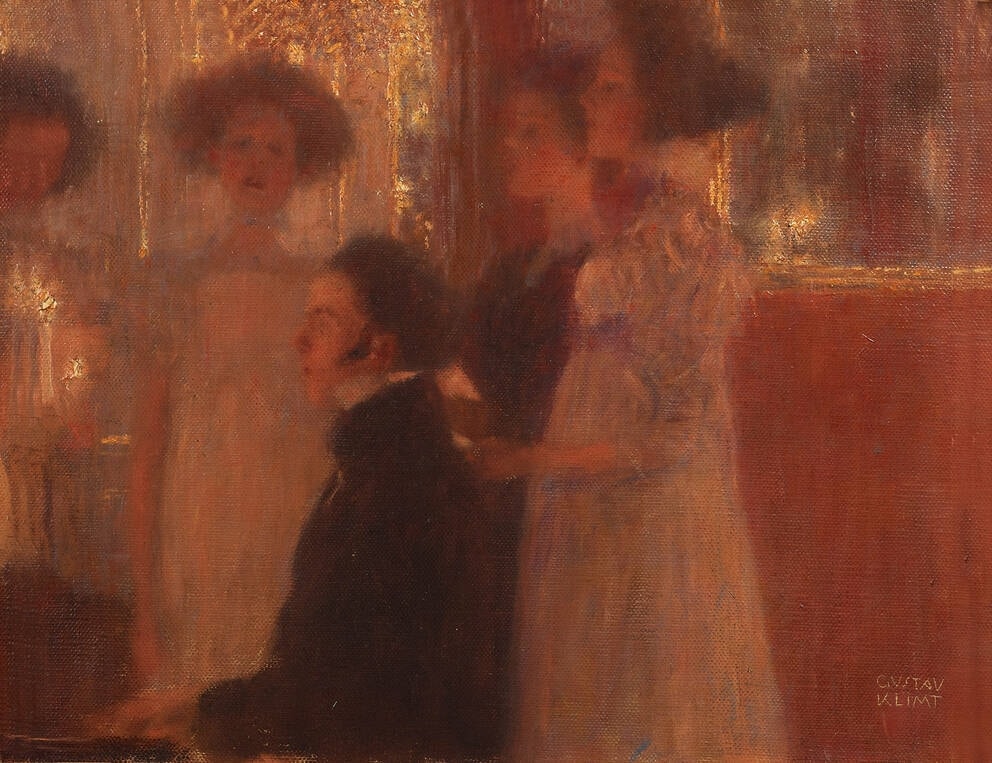
Klimt’s 1896 oil study Schubert at the Piano. Design for the music room by Nikolaus Dumba turns a domestic recital into a glowing myth of listening. In dim, rosy-gold light, a dark-clad pianist is encircled by a soft choir of women whose blurred faces dissolve into the shimmer of the room. Klimt fuses contour and light so that sound seems to become radiance, anticipating his decorative modernism [1][2].

Study Print Studio

Create a personal study print

Build a companion study sheet around the part of this painting that speaks to you most. Choose a detail, shape an interpretation, and walk away with something personal and display-worthy.

Fast Facts

Year
1896
Medium
Oil on canvas
Dimensions
30 × 39 cm
Location
Leopold Museum, Vienna (permanent loan, private collection)
See all Gustav Klimt paintings in Vienna
Schubert at the Piano. Design for the music room by Nikolaus Dumba by Gustav Klimt (1896) featuring Dark-clad pianist at the keyboard, Female listener-chorus, Golden scintillation of light, Mirror/reflection band

Click on any numbered symbol to learn more about its meaning

Meaning & Symbolism

Klimt stages intimacy as a rite. The pianist’s dark profile, set low at left with hands hovering over the keys, functions like a tonal anchor; around him, four young women in pale dresses drift forward, their faces softened into near-anonymity. Their indistinct features and gently haloed hair refuse portraiture and instead declare a collective listener—a small choir whose shared attention is the true subject. The painterly surface converts sound into atmosphere: flecks of gold and copper pulse across the rear wall and mirror, and the warm, reddish paneling at right stabilizes the field into flat bands, against which the figures seem to glow. Even the scratched signature at the lower right registers as an incised glint within this low-light environment, reinforcing the work’s stress on optical vibration over descriptive finish 1. The result is not a literal Schubertiade but a mythic vignette of Viennese listening, where music alters perception and dissolves edges. Klimt’s method declares his transition. Brushwork remains supple and observational—note the gently modeled cheek and sideburn of the pianist—yet contours melt where light concentrates, especially along the women’s sleeves and hair. This fusion of figure and surround adopts an Impressionist sensitivity to optical effects even as Klimt reduces deep space and moves toward a planar arrangement befitting an architectural setting (an overdoor) 12. The coppery scintillation evokes candle flame—an effect contemporaries linked to pointillist flicker—so that illumination becomes a metaphor for sound: the music’s resonance travels as specks, veils, and halos across the surface 24. The women hold the place of muses or amateur singers—Albertina studies confirm models with music leaves—thereby embedding communal music-making within the design while keeping identities generic and timeless 4. Their dresses are pointedly not Biedermeier; Klimt clothes them in forms familiar to the 1890s, asserting that this is Schubert remembered by modern Vienna rather than reenacted historically 4. Function clarifies symbolism. Commissioned for Nikolaus Dumba’s music room, the study prepares a domestic space to behave like a temple of song: the listeners form an apse around the quiet officiant at the keyboard. In the executed overdoor (1899), period photographs and research note that a black door framed the pianist, heightening the sense of a staged niche; critical reception celebrated the work’s dusky lyricism and subjective mood, contrasting it with the brighter allegorical pendant, Music 2. The later panel perished in the 1945 Immendorf fire, making this 30 × 39 cm canvas a vital hinge in Klimt’s development and in Vienna’s memory culture—evidence of the artist’s swift metamorphosis from historicist décor to Secession modernity 235. That is why Schubert at the Piano. Design for the music room by Nikolaus Dumba is important: it shows Klimt inventing a language where listening becomes light, community replaces celebrity, and a private room is transformed into a modern myth of sound 123.

Explore Deeper with AI

Ask questions about Schubert at the Piano. Design for the music room by Nikolaus Dumba

Popular questions:

Powered by AI • Get instant insights about this artwork

💬 Ask questions about this artwork!

Interpretations

Historical Context

Commissioned by the industrialist and music patron Nikolaus Dumba for a Ringstraße palace, Klimt’s design had to function as a supraporte while resonating with Vienna’s cult of Schubert in the 1890s. The commission’s long gestation (in hand by 1893; completed 1899) tracked Klimt’s shift from decorous historicism to Secession modernity; Karl Kraus joked that the patron “became a Modernist” in the process. Period showings at the Secession (1899, 1903/04) positioned the work as a touchstone of Viennese identity, while later provenance into the Lederer collection entwined it with the city’s elite taste before its loss in 1945 at Immendorf—making the 1896 study a rare conduit to that vanished interior world 235.

Source: Klimt Foundation; Lost Art Database; MAK Vienna

Formal/Architectural Analysis

As an overdoor, the image is engineered to read at a distance and to cap a threshold. Klimt flattens depth into tonal bands and orients the ensemble laterally, so figures hover like relief across warm paneling. In the finished panel, the composer is theatrically framed by a black door, converting architecture into pictorial proscenium; the surrounding listeners arc like an apse around a celebrant. The study shows Klimt testing edge‑dissolution—sleeves and hair fuse with ground—while preserving anchor nodes (the pianist’s silhouette, the right‑hand paneling) to stabilize the field. This balancing of planar design with optical flicker epitomizes his late‑1890s turn toward Jugendstil surface logic 12.

Source: Leopold Museum; Klimt Foundation

Iconography of Light and Sound

Klimt visualizes music as luminous particulate: coppery specks and veils behave like acoustic overtones. Contemporary accounts of the completed panel stress candlelight and a residual pointillist “flicker,” mapping Schubert’s resonance onto scintillation across wall, mirror, and hair. The scratched signature itself becomes a glint in the gloom, implicating authorship in the painting’s optical field. Rather than illustrate a specific Lied, Klimt offers an ambiance—Stimmung—where listening transforms perception. This synesthetic strategy, already legible in the 1896 study’s optical vibration, aligns with Albertina drawings that stage emergence from darkness via rhythmic contour and reserved highlights 124.

Source: Klimt Foundation; Leopold Museum; Albertina

Gendered Listening and Social Ritual

The four pale‑clad women are anonymized into a chorus of receptivity—models for collective attentiveness rather than portraits. Albertina studies show them holding music leaves, situating them within a culture of amateur, often female, salon musicianship. Their modern dress dislocates the scene from Biedermeier historicism, casting feminine presence as a contemporary conduit to Schubert. By foregrounding listeners over the star performer, Klimt revalues authorship: aura is produced socially, through gendered attention and synchronized breath. This echoes bourgeois leisure ideals while subtly critiquing celebrity by elevating communal absorption to the painting’s true subject 124.

Source: Albertina; Leopold Museum; Klimt Foundation

Reception and Memory Culture

On display at the 1899 Secession, Hermann Bahr hailed Klimt’s Schubert as “the most beautiful painting ever painted by an Austrian,” underscoring its role as a civic self‑image of refined, inward culture. The Arbeiter‑Zeitung contrasted the dusky, delicate subjectivity of Schubert with the radiant allegory Music, reading the pair as complementary modes of musical modernity—reverie versus emblem. Because the finished overdoor perished in 1945, the small 1896 study now anchors a memory discourse: it is both a document of Klimt’s stylistic pivot and a survivor standing in for a lost monument of Viennese identity, repeatedly invoked in scholarship and loss registers 23.

Source: Klimt Foundation; Lost Art Database

Related Themes

About Gustav Klimt

Gustav Klimt (1862–1918), co-founder of the Vienna Secession, pivoted from controversial public commissions to a decorative-symbolist language in his Golden Period. Drawing on Byzantine mosaics and modern design, he fused opulent surfaces with psychological intensity. By 1908–09, he transformed scandal into canon, and The Kiss became Vienna’s emblem of modern love.
View all works by Gustav Klimt

More by Gustav Klimt

Portrait of Adele Bloch-Bauer I by Gustav Klimt

Portrait of Adele Bloch-Bauer I

Gustav Klimt (1907)

Gustav Klimt’s Portrait of Adele Bloch-Bauer I stages its sitter as a <strong>secular icon</strong>—a living presence suspended in a field of gold that converts space into <strong>pattern and power</strong>. The naturalistic face and hands emerge from a reliquary-like cascade of eyes, triangles, and tesserae, turning light, ornament, and status into the painting’s true subjects <sup>[1]</sup><sup>[2]</sup>.

Sunflower by Gustav Klimt

Sunflower

Gustav Klimt (1907/1908)

Gustav Klimt’s Sunflower turns a single bloom into a <strong>monumental, figure-like presence</strong>. A tapering stack of broad, drooping leaves rises from a <strong>mosaic-like carpet of round blossoms</strong>, crowned by a gold-flecked disc that glows against a cool, stippled field. The work fuses <strong>portrait, icon, and landscape</strong> into one emblem of vitality and quiet sanctity <sup>[1]</sup><sup>[2]</sup>.

Cottage Garden with Sunflowers by Gustav Klimt

Cottage Garden with Sunflowers

Gustav Klimt (1906–1907 (signed 1907))

Cottage Garden with Sunflowers is a square, horizonless field of blooms where a vertical column of <strong>sunflowers</strong> anchors an all-over weave of color and pattern. Klimt fuses <strong>ornament and nature</strong>, turning a humble Litzlberg cottage plot into a radiant matrix of cyclical life and renewal <sup>[1]</sup><sup>[4]</sup><sup>[5]</sup>.

The Kiss by Gustav Klimt

The Kiss

Gustav Klimt (1908 (completed 1909))

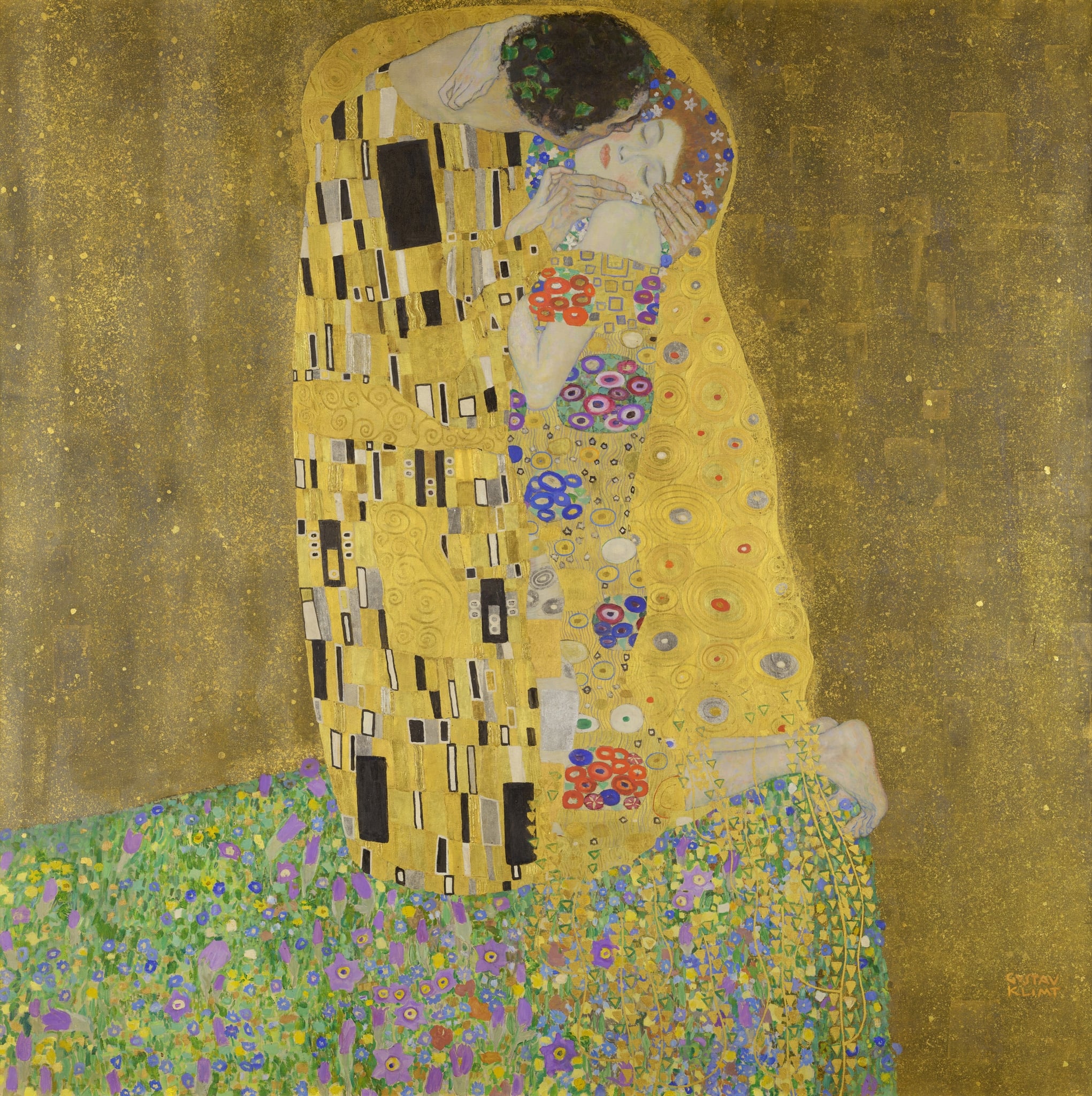
The Kiss stages human love as a <strong>sacred union</strong>, fusing two figures into a single, gold-clad form against a timeless field. Klimt opposes <strong>masculine geometry</strong> (black-and-white rectangles) to <strong>feminine organic rhythm</strong> (spirals, circles, flowers), then resolves them in radiant harmony <sup>[1]</sup><sup>[2]</sup>.
The Tree of Life by Gustav Klimt

The Tree of Life

Gustav Klimt (1910–1911 (design; mosaic installed 1911))

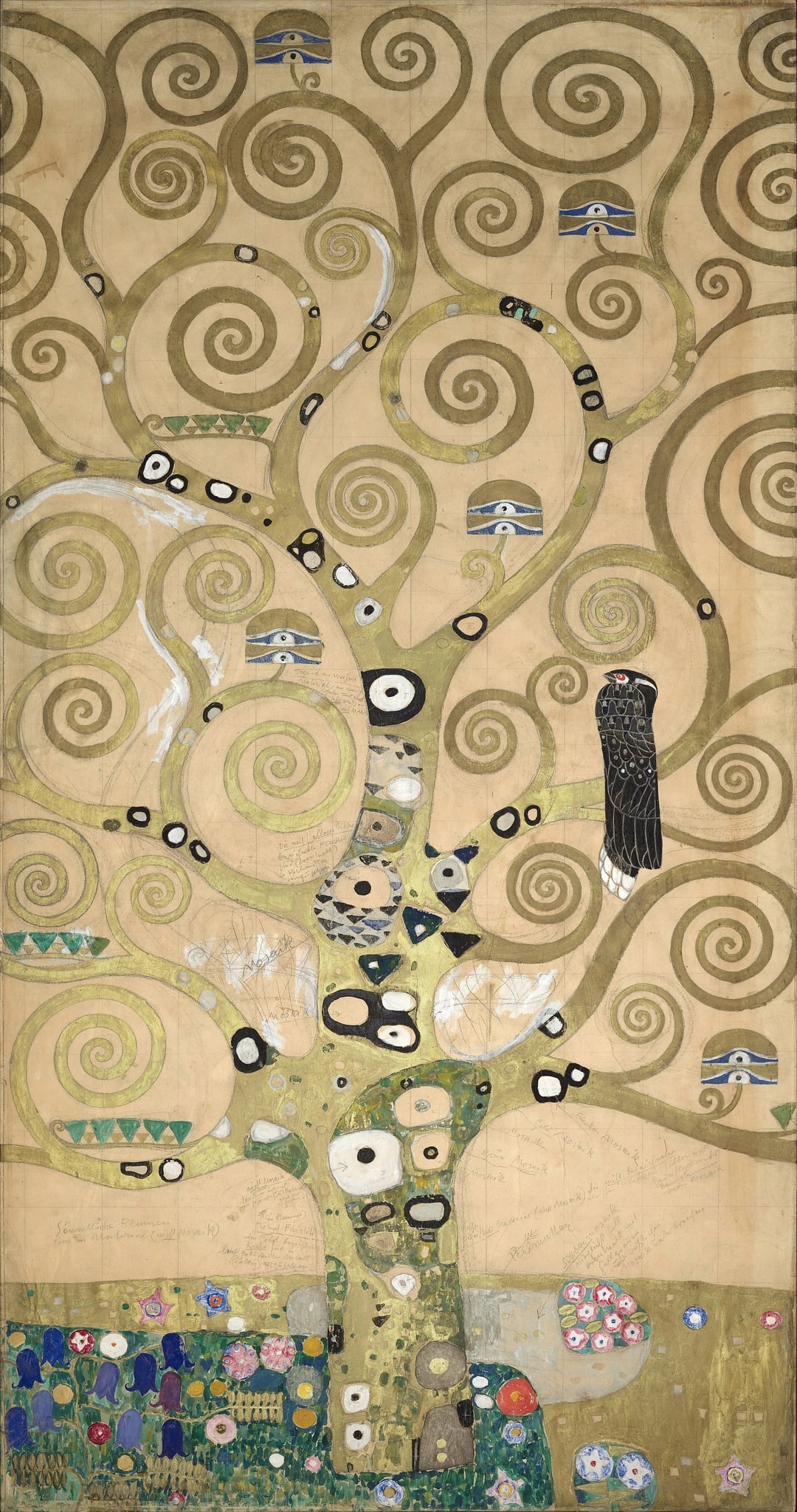
Gustav Klimt’s The Tree of Life crystallizes a <strong>cosmological axis</strong> in a gilded ornamental language: a rooted trunk erupts into <strong>endless spirals</strong>, embedded with <strong>eye-like rosettes</strong> and shadowed by a black, red‑eyed bird. Designed as part of the Stoclet dining‑room frieze, it fuses <strong>symbolism and luxury materials</strong> to link earthly abundance with timeless transcendence <sup>[1]</sup><sup>[2]</sup>.
The Kiss (Lovers) by Gustav Klimt

The Kiss (Lovers)

Gustav Klimt (1907–1908 (Belvedere lists 1908/09))

The Kiss (Lovers) crystallizes Klimt’s <strong>Golden Period</strong> ideal: erotic union staged as a sacred vision. Two bodies fuse beneath a single golden mantle, poised on a flowered ledge at the brink of the unknown, where <strong>pattern becomes symbol</strong> and intimacy becomes icon.