Forest Floor

by Gustav Klimt

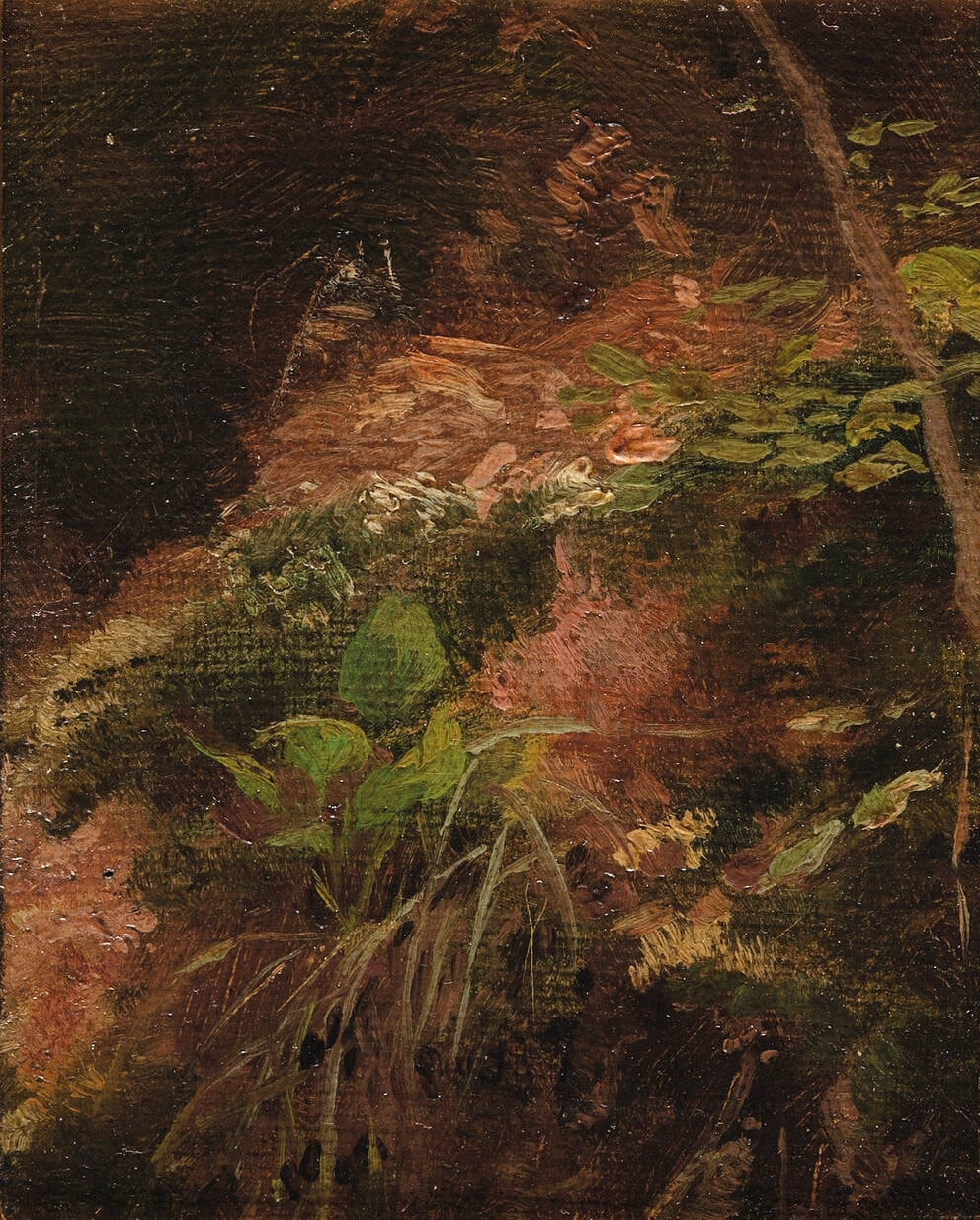
Forest Floor concentrates the eye on a miniature world of soil, moss, and leaf-litter rendered in tactile strokes and dark-to-amber light. Klimt frames a diagonal bank with a small sapling and sprouting leaves, turning the ground into a living tapestry of decay and renewal [1]. As an early oil sketch, it fuses academic chiaroscuro with a proto-decorative rhythm that hints at later developments [1].

Study Print Studio

Create a personal study print

Build a companion study sheet around the part of this painting that speaks to you most. Choose a detail, shape an interpretation, and walk away with something personal and display-worthy.

Fast Facts

Year
c. 1881/1882
Medium
Oil on canvas
Dimensions
10 × 8 cm
Location
Leopold Museum, Vienna
See all Gustav Klimt paintings in Vienna
Forest Floor by Gustav Klimt (c. 1881/1882) featuring Sapling (young tree), Sprouting leaves/tuft, Leaf litter (decaying leaves), Moss/lichen band

Click on any numbered symbol to learn more about its meaning

Meaning & Symbolism

Klimt constructs Forest Floor as a compact field of forces: a dark ground that absorbs light, a slanting bank that channels it, and a sparse armature of stems and leaves that catch it. The diagonal grade from lower left to upper right establishes movement and tension; against this slope, a thin sapling climbs at the right edge while lanceolate leaves and grasses splay outward near the bottom. Light from the upper left isolates patches of amber soil and glistening moss so that highlights are not incidental but structural—they articulate depth and bind disparate textures into a single pulse of illumination. This Baroque-inflected chiaroscuro, emphasized in the museum’s account, anchors the study in Klimt’s academic training and Historicist milieu 1. Yet within that discipline, the brushwork turns analytic observation into pattern: short strokes cluster into mottled networks; leaf-edges repeat in syncopated beats; and the ground’s granular browns and greens resolve into a soft grid of tonal patches. The image therefore operates as both record and design, an empirical note that already courts ornament. The painting’s subject—rotting leaves abutting pale sprouts—declares a program of cyclical time. Klimt does not allegorize this cycle with figures or emblems; he lets the forest floor itself perform it. The dark mass at upper left swallows forms; the amber ridge reveals them; the thin highlights on leaf ribs transmit them forward. Read as a statement about nature, the composition insists that growth is inseparable from decomposition, and that seeing requires an acceptance of partial visibility—things emerge only where light briefly touches them 1. Within Klimt’s broader practice, this early close-crop prefigures his later refusal of horizons and his investment in nature as a rejuvenating matrix, themes that scholarship has traced across his Secession-period landscapes—though those mature works systematize pattern and symbolism more overtly than this 1881/82 study 5. The connection should be drawn carefully: here the mood is observational rather than programmatic, consistent with Austrian Stimmungsrealismus and with Klimt’s student-era exercises in light and texture 2. Why Forest Floor is important follows from this doubleness. First, it verifies Klimt’s early “balance and harmony” through disciplined staging—diagonal slope, upper-left illumination, controlled darks—demonstrating technical command before his Secession breakthrough 1. Second, it seeds a method: intense close-range framing that turns natural minutiae into visual systems. The clustered leaves at mid-right, the tuft of grasses at lower center, and the stippled moss along the ridge behave less like isolated botanicals than like modules within a patterned field. That tendency anticipates the ornamental densities of his later forest interiors and lakescapes, where repetition and flatness become central to meaning 5. Finally, the work models an ethics of attention. By elevating a handful of leaves and grit to pictorial stature, Klimt posits the ground as a site of latent order and renewal—nature understood from the bottom up, not as panorama but as intimate process 12.

Explore Deeper with AI

Ask questions about Forest Floor

Popular questions:

Powered by AI • Get instant insights about this artwork

💬 Ask questions about this artwork!

Interpretations

Formal Analysis: Baroque Light, Academic Staging

This tiny oil sketch organizes space through a disciplined interplay of diagonal slope and upper-left illumination, a schema that recalls Baroque chiaroscuro and positions the work within Vienna’s Historicism. Rather than incidental sparkle, highlights on moss and soil are structural joints that articulate depth and knit textures into a unified rhythm of light. The compact format intensifies these decisions: with no horizon and minimal recession, value contrasts carry the burden of spatial coherence. Klimt’s early command of “balance and harmony” manifests as a carefully staged choreography—dark ground absorbing light, a slanting bank channeling it, leaf-ribs catching it—which reads like a lesson in how light models form before his Secession-era experiments with ornament and flatness 1.

Source: Leopold Museum

Medium/Scale Reflexivity: The Ethics of the Small

At only 10 × 8 cm, Forest Floor is a paradox of miniature monumentality. The tiny scale compels a near-view that collapses the picturesque into material encounter—brushstrokes as moss, flecks as loam. In this way the painting is reflexive about its medium: oil’s capacity for granular modulation becomes both subject and method. The work thus enacts an “ethics of attention” not by allegory but by scale, asking viewers to recalibrate looking from vista to particle. Such close-range framing prefigures Klimt’s later habit of eliminating the horizon, but here it remains an academic exercise grounded in Stimmungsrealismus: mood built from observed surface effects rather than overt symbolist coding 12.

Source: Leopold Museum; Klimt Foundation

Proto-Ornament: From Study to System

Although observational in premise, the painting organizes data into repeatable modules: tufted grasses, lanceolate leaves, stippled moss. These clusters behave less like isolated botanicals than like units in a visual system, anticipating the patterned densities of Klimt’s Secession landscapes. Yet chronology matters: in 1881/82 the tendency is nascent, embedded in academic method rather than the later square formats and decorative planes. The piece becomes a hinge where mimesis slides toward ornament—an “empirical note that already courts ornament”—suggesting how Klimt would ultimately translate nature’s particulars into rhythmic surface design without abandoning their descriptive charge 12.

Source: Leopold Museum; Klimt Foundation

Temporal Ecology: Life, Decay, and Partial Visibility

Forest Floor is a quiet treatise on cyclical time: “rotting leaves abutting pale sprouts” visualize a continuum where growth is inseparable from decomposition. Klimt refuses emblematic allegory; instead, time appears as partial visibility—forms emerge only where light grazes them. This phenomenological stance treats seeing as contingent and ecological: perception depends on angles, textures, and dampness that disclose or conceal. Later critics read Klimt’s landscapes as a “sacred spring” of renewal, but here that metaphysics is embryonic—an observational ethos aligning with mood-realism rather than a declarative symbolist program. The result is a micro-ecology rendered as light logic, not narrative 15.

Source: Leopold Museum; McColgan (Yale PhD)

Pedagogy and Process: Vienna School to Secession

Positioned during Klimt’s training at the Kunstgewerbeschule under Laufberger and Berger, the sketch functions like a didactic problem: model light across irregular textures; hold a diagonal; stabilize depth without horizon. The success of this exercise—its balance and harmony—helps explain how Klimt, years later, could compress space into patterned surfaces without losing legibility. Before the Secession’s decorative bravura, he learned to extract order from visual noise. Forest Floor documents that pedagogy: academic Historicism supplying the armature, while close-cropped observation and tonal grids hint at the methods that would mature on the Attersee and in forest interiors after 1897 13.

Source: Leopold Museum; Klimt Foundation Biography

Related Themes

About Gustav Klimt

Gustav Klimt (1862–1918), co-founder of the Vienna Secession, pivoted from controversial public commissions to a decorative-symbolist language in his Golden Period. Drawing on Byzantine mosaics and modern design, he fused opulent surfaces with psychological intensity. By 1908–09, he transformed scandal into canon, and The Kiss became Vienna’s emblem of modern love.
View all works by Gustav Klimt

More by Gustav Klimt

Portrait of Adele Bloch-Bauer I by Gustav Klimt

Portrait of Adele Bloch-Bauer I

Gustav Klimt (1907)

Gustav Klimt’s Portrait of Adele Bloch-Bauer I stages its sitter as a <strong>secular icon</strong>—a living presence suspended in a field of gold that converts space into <strong>pattern and power</strong>. The naturalistic face and hands emerge from a reliquary-like cascade of eyes, triangles, and tesserae, turning light, ornament, and status into the painting’s true subjects <sup>[1]</sup><sup>[2]</sup>.

Sunflower by Gustav Klimt

Sunflower

Gustav Klimt (1907/1908)

Gustav Klimt’s Sunflower turns a single bloom into a <strong>monumental, figure-like presence</strong>. A tapering stack of broad, drooping leaves rises from a <strong>mosaic-like carpet of round blossoms</strong>, crowned by a gold-flecked disc that glows against a cool, stippled field. The work fuses <strong>portrait, icon, and landscape</strong> into one emblem of vitality and quiet sanctity <sup>[1]</sup><sup>[2]</sup>.

Cottage Garden with Sunflowers by Gustav Klimt

Cottage Garden with Sunflowers

Gustav Klimt (1906–1907 (signed 1907))

Cottage Garden with Sunflowers is a square, horizonless field of blooms where a vertical column of <strong>sunflowers</strong> anchors an all-over weave of color and pattern. Klimt fuses <strong>ornament and nature</strong>, turning a humble Litzlberg cottage plot into a radiant matrix of cyclical life and renewal <sup>[1]</sup><sup>[4]</sup><sup>[5]</sup>.

The Kiss by Gustav Klimt

The Kiss

Gustav Klimt (1908 (completed 1909))

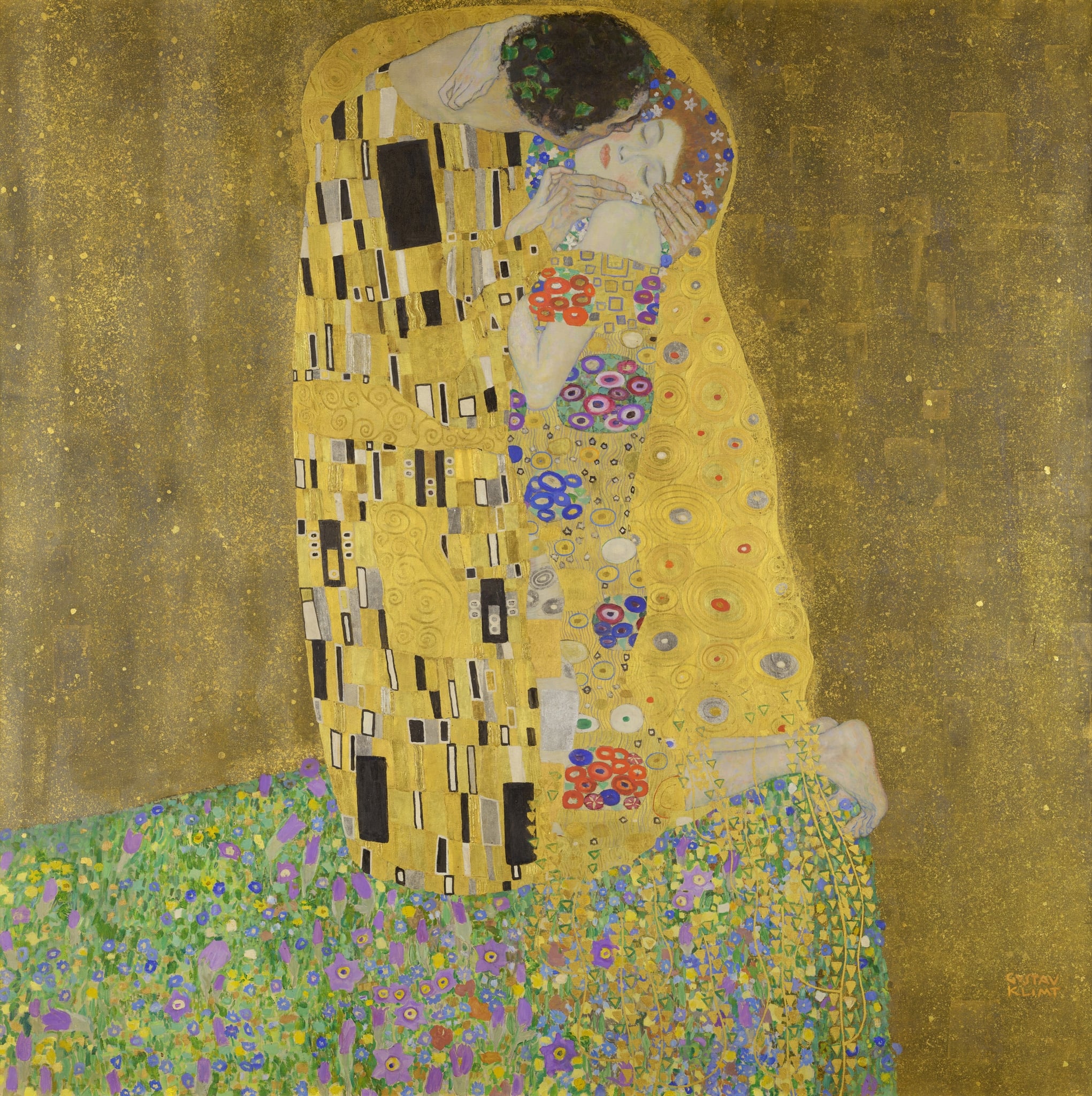
The Kiss stages human love as a <strong>sacred union</strong>, fusing two figures into a single, gold-clad form against a timeless field. Klimt opposes <strong>masculine geometry</strong> (black-and-white rectangles) to <strong>feminine organic rhythm</strong> (spirals, circles, flowers), then resolves them in radiant harmony <sup>[1]</sup><sup>[2]</sup>.
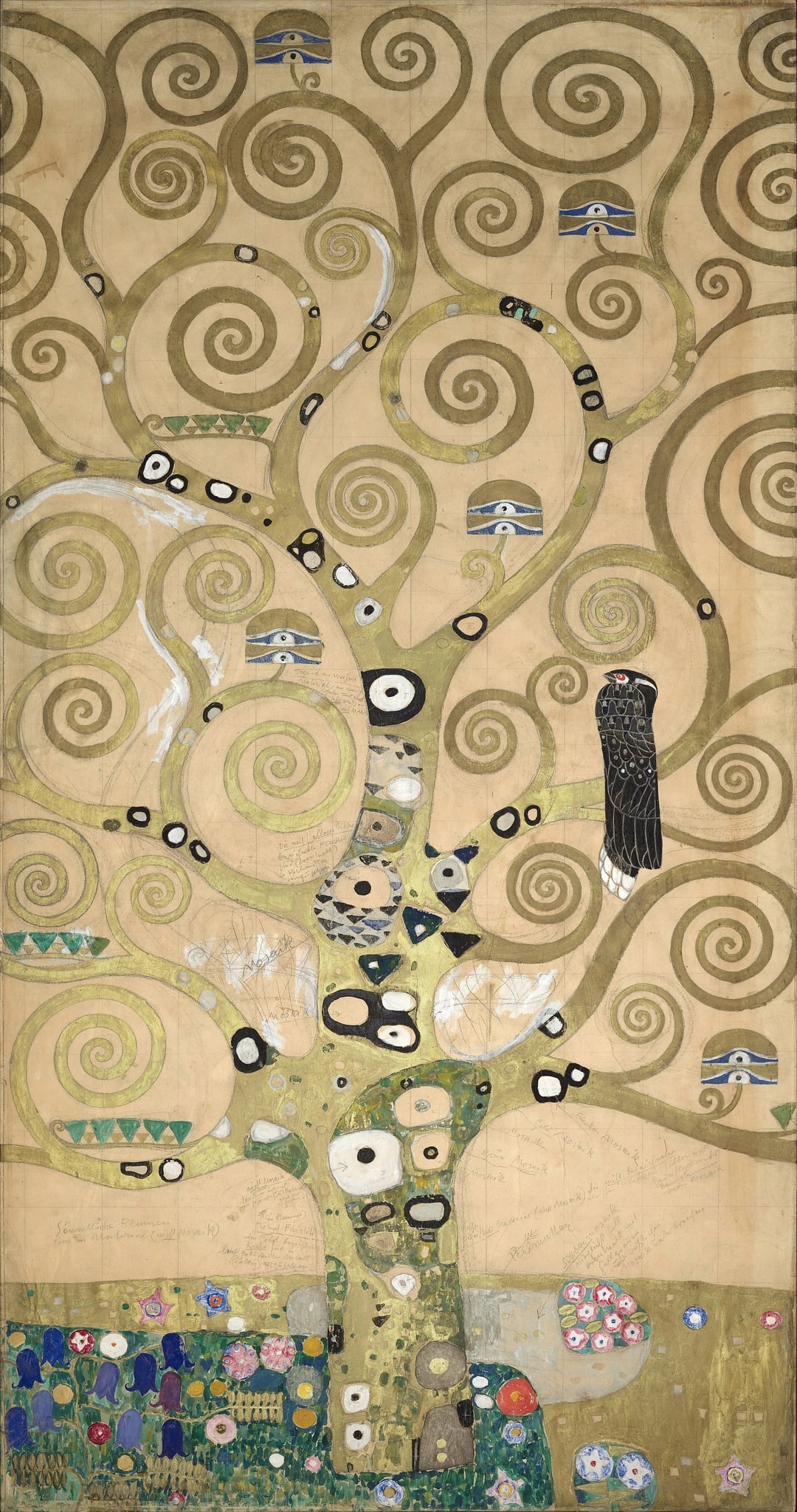
The Tree of Life by Gustav Klimt

The Tree of Life

Gustav Klimt (1910–1911 (design; mosaic installed 1911))

Gustav Klimt’s The Tree of Life crystallizes a <strong>cosmological axis</strong> in a gilded ornamental language: a rooted trunk erupts into <strong>endless spirals</strong>, embedded with <strong>eye-like rosettes</strong> and shadowed by a black, red‑eyed bird. Designed as part of the Stoclet dining‑room frieze, it fuses <strong>symbolism and luxury materials</strong> to link earthly abundance with timeless transcendence <sup>[1]</sup><sup>[2]</sup>.
The Kiss (Lovers) by Gustav Klimt

The Kiss (Lovers)

Gustav Klimt (1907–1908 (Belvedere lists 1908/09))

The Kiss (Lovers) crystallizes Klimt’s <strong>Golden Period</strong> ideal: erotic union staged as a sacred vision. Two bodies fuse beneath a single golden mantle, poised on a flowered ledge at the brink of the unknown, where <strong>pattern becomes symbol</strong> and intimacy becomes icon.