Expectation (Dancer)

by Gustav Klimt

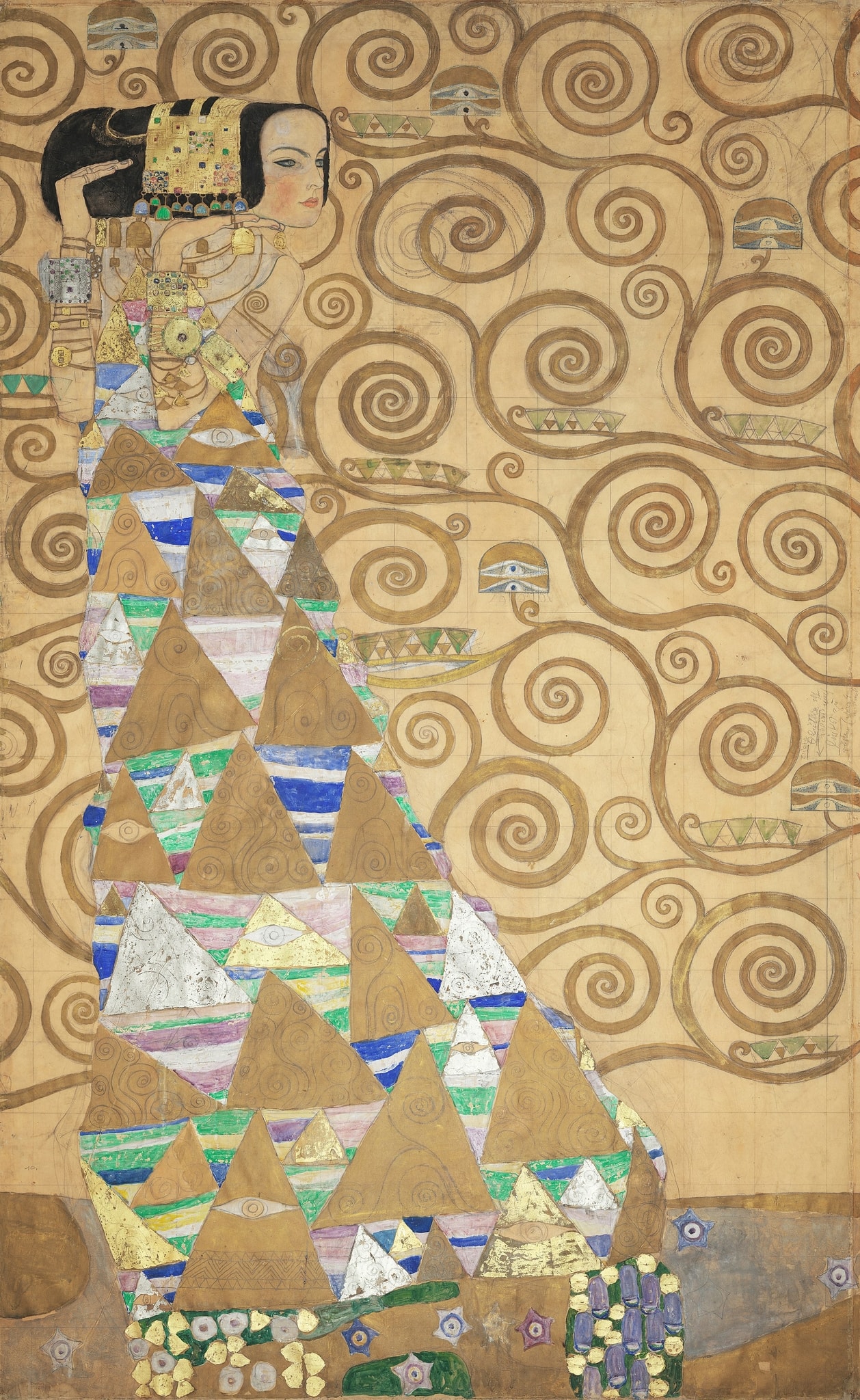
Expectation (Dancer) crystallizes a charged pause: a profile figure, rigid as an Egyptian relief, advances through a field of spiraling Tree of Life coils while a mosaic robe of triangles and watchful eyes armors her body. Klimt fuses ornament and symbol so that anticipation itself becomes pattern and gold-lit ritual [1][4].

Study Print Studio

Create a personal study print

Build a companion study sheet around the part of this painting that speaks to you most. Choose a detail, shape an interpretation, and walk away with something personal and display-worthy.

Fast Facts

Year
1911
Medium
Working drawing (cartoon) on tracing paper with graphite, gold, pastel, platinum, silver, bronze, appliqué, gouache (design for wall mosaic)
Dimensions
195.3 × 120 cm
Location
MAK – Museum of Applied Arts, Vienna (cartoon); realized mosaic in the Stoclet Palace, Brussels
See all Gustav Klimt paintings in Vienna
Expectation (Dancer) by Gustav Klimt (1911) featuring Tree of Life spirals, Eyes, Triangles (tessellated robe), Gold mosaic squares/rectangles

Click on any numbered symbol to learn more about its meaning

Meaning & Symbolism

Expectation (Dancer) stages anticipation as a ritual posture that fuses body, ornament, and fate. The woman’s head is shown in strict profile while the torso remains planar and frontal; her raised forearm, squared shoulder, and forward foot form an angular sequence of stops rather than a flowing step, declaring a hieratic grammar closer to papyrus reliefs than to ballet. Klimt’s choice is deliberate: by immobilizing the dancer, he converts movement into sign, letting the gesture perform an inner state of vigilance and desire 3. The robe’s tessellated triangles—golden, opaque, and iridescent—operate like a second skin of shields, simultaneously stabilizing and agitating the silhouette. Embedded eyes multiply across the garment and in the surrounding arabesques, asserting a field of watchfulness that makes expectation a mode of heightened perception as well as longing 16. The figure’s intent gaze—aimed into the spiral-thick space where the Tree uncoils—links her psychology to the frieze’s cosmology: time and destiny are not backdrops but the medium through which anticipation acquires force 4. Klimt grounds this psychic drama in a material theology of gold. In the MAK cartoon he specifies gold, silver, platinum, and mother-of-pearl for translation into mosaic, aligning the panel with Byzantine precedent and the jewel-like atmosphere of the Stoclet dining room 15. That gilded regime is not mere luxury; it sacralizes the pause before union and turns a private emotion into part of a Gesamtkunstwerk, where walls, furniture, and image sing the same chord 1. Within the frieze’s broader arc, Expectation faces its counterpart, Fulfillment, across the Tree of Life; the Dancer’s straining, forward-leaning pose becomes the necessary precondition for the lovers’ embrace. Warlick’s reading situates this polarity within an Egyptianizing program—Isis seeking Osiris—so that the spirals suggest cyclical rebirth and the dancer’s profile enacts the ritual phase that precedes restoration 2. Even if one brackets the myth, the panel’s Egyptian syntax remains decisive: profile head, frontal eye, compact torso, and emphatic, coded arms; modern dance experiments of the era, with their stylized “Oriental” poses, reinforce the work’s choreographic stillness rather than kinetic display 3. Formally, the picture engineers tension between linear captivity and ornamental release. The Tree’s tight spirals press against the figure’s contour like coiled springs of time; their repeated curls mirror the concentric swirls inscribed in many of the robe’s triangles, binding human will to vegetal patterning 4. At the hem, star-like rosettes and clustered rectangles punctuate the ground, as if seeds and tesserae together were germinating a pathway—expectation as a threshold condition. Across the surface, triangles oscillate between gleaming planes and scumbled, earthen facets, articulating a spectrum from perfected ideal to rough potential. Klimt thus writes a psychology into pattern: triangles as poised vectors; eyes as attentional charge; gold as an auratic guarantor; spirals as the script of fate. In converting these units into a dining-room mosaic—seen nightly under lamplight—Klimt ensured that anticipation would be performed by the room itself, each meal a minor rite of approach toward fulfillment 145. The result demonstrates how the Vienna Secession’s union of fine art and applied craft could carry symbolist content with architectural authority, making Expectation (Dancer) a keystone of early twentieth‑century decorative modernism 157.

Explore Deeper with AI

Ask questions about Expectation (Dancer)

Popular questions:

Powered by AI • Get instant insights about this artwork

💬 Ask questions about this artwork!

Interpretations

Material-Liturgical Reading

Klimt’s “material theology” is not metaphor alone: his MAK instructions demand gold, silver, platinum, enamel, and mother‑of‑pearl, aligning the Dancer with Byzantine mosaic practice and the cultic aura of Ravenna. Under lamplight, tesserae produce scintillation and halation, turning a domestic meal into a patterned rite where the pause before union becomes sacralized. The panel’s gilded register thus operates as a liturgical technology of seeing, disciplining the viewer into attentiveness—expectation as devotion. In this sense, the frieze is an exercise in applied theophany, where craft materials stage transcendence without abandoning function, a core Secessionist wager. The precious media do ideological work: they fuse ornament and authority, coding a bourgeois interior as a shrine to aesthetic experience and to the ethics of waiting made luminous 15.

Source: MAK; MoMA (Art Nouveau catalogue)

Egyptianizing Choreography and Modern Dance

The Dancer’s profile head, frontal torso, and codified arm—a stylized stop rather than a step—hybridize Pharaonic figural syntax with turn‑of‑the‑century “Orientalizing” modern dance. Studies for the panel show Klimt iterating angular arm positions to achieve a hieratic grammar of gesture. Rather than depict kinetic flow, he arrests motion into sign, converting dance into an ideogram of vigilance. This cross‑temporal choreography builds a conscious anachronism: the modern body submits to an antique canon to extract an inner state from outer pose. The result is a ritual stillness that feels performative yet immobile, a tableau that anticipates rather than arrives—precisely the affect the frieze requires to counterpoise the lovers’ embrace across the Tree 23.

Source: M. E. Warlick; Albertina (Google Arts & Culture)

Semiotics of Pattern: Eyes, Triangles, Spirals

Klimt scripts psychology through ornament. The garment’s proliferating eyes establish a surveillant field—attention turned outward and back upon the self—while the triangular tessellations operate as directional vectors and shield‑like plates, oscillating between allure and armor. The Tree’s spirals bind figure and ground in a recursive rhythm that reads as time’s coil and fate’s grammar. Together these motifs stage expectation as a semiotic ecology: vigilance (eyes), poised intention (triangles), and temporal pressure (spirals). Crucially, these signs are not merely painted; in mosaic they become granular, light-reactive units, so meaning flickers with the viewer’s movement and the room’s illumination—anticipation literally shimmers into legibility 146.

Source: MAK; WGA; Klimt Foundation – Klimt Database

Mythic Program: Isis Seeking Osiris

Warlick’s reading situates Expectation within an Egyptian rebirth cycle: the Dancer as Isis in the phase of quest and reconstitution. The Tree’s coils echo Nile cyclicality; the profile/frontal schema and emphatic arm underscore ritual action rather than narrative anecdote. Under this lens, “fulfillment” is not merely erotic closure but restoration after fragmentation, giving the bourgeois dining room an undertext of cosmic repair. The pairing across the wall—awaiting figure versus embracing couple—performs the passage from vigil to reunion. Even if one brackets specific deities, the Egyptianizing syntax encodes a myth of return and cyclical renewal, re-inscribing private desire into a cosmological order 24.

Source: M. E. Warlick (The Art Bulletin); Web Gallery of Art (context)

Gesamtkunstwerk as Social Ritual

Hoffmann’s room and Klimt’s frieze choreograph behavior: seating, sightlines, and the reflective mosaic field synchronize to make each meal a micro‑ceremony of approach. Expectation’s charged pause becomes a social tempo, modulating conversation and gaze across the table toward Fulfillment. This is Gesamtkunstwerk as etiquette: architecture, furniture, and image orchestrate a shared affective script—anticipation, offering, consummation. The decorative is thus not superficial; it is infrastructural, binding individuals into a ritual of attention through coordinated surfaces and materials. Klimt collapses the divide between high allegory and applied design, proving that symbolist content can govern an everyday rite without recourse to narrative panels or didactic text 15.

Source: MAK; MoMA (Art Nouveau catalogue)

Related Themes

About Gustav Klimt

Gustav Klimt (1862–1918), co-founder of the Vienna Secession, pivoted from controversial public commissions to a decorative-symbolist language in his Golden Period. Drawing on Byzantine mosaics and modern design, he fused opulent surfaces with psychological intensity. By 1908–09, he transformed scandal into canon, and The Kiss became Vienna’s emblem of modern love.
View all works by Gustav Klimt

More by Gustav Klimt

Portrait of Adele Bloch-Bauer I by Gustav Klimt

Portrait of Adele Bloch-Bauer I

Gustav Klimt (1907)

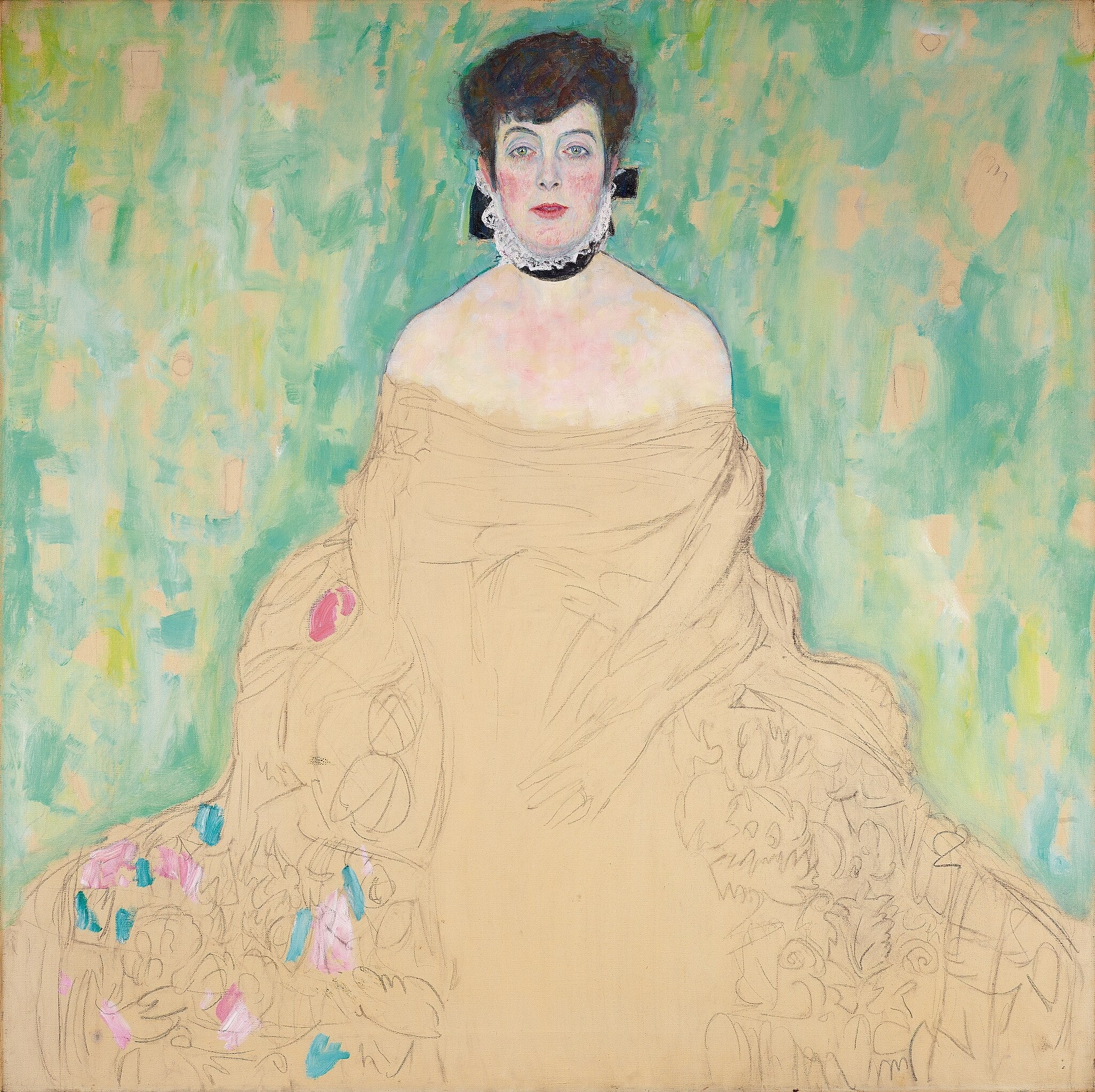
Gustav Klimt’s Portrait of Adele Bloch-Bauer I stages its sitter as a <strong>secular icon</strong>—a living presence suspended in a field of gold that converts space into <strong>pattern and power</strong>. The naturalistic face and hands emerge from a reliquary-like cascade of eyes, triangles, and tesserae, turning light, ornament, and status into the painting’s true subjects <sup>[1]</sup><sup>[2]</sup>.

Sunflower by Gustav Klimt

Sunflower

Gustav Klimt (1907/1908)

Gustav Klimt’s Sunflower turns a single bloom into a <strong>monumental, figure-like presence</strong>. A tapering stack of broad, drooping leaves rises from a <strong>mosaic-like carpet of round blossoms</strong>, crowned by a gold-flecked disc that glows against a cool, stippled field. The work fuses <strong>portrait, icon, and landscape</strong> into one emblem of vitality and quiet sanctity <sup>[1]</sup><sup>[2]</sup>.

Cottage Garden with Sunflowers by Gustav Klimt

Cottage Garden with Sunflowers

Gustav Klimt (1906–1907 (signed 1907))

Cottage Garden with Sunflowers is a square, horizonless field of blooms where a vertical column of <strong>sunflowers</strong> anchors an all-over weave of color and pattern. Klimt fuses <strong>ornament and nature</strong>, turning a humble Litzlberg cottage plot into a radiant matrix of cyclical life and renewal <sup>[1]</sup><sup>[4]</sup><sup>[5]</sup>.

The Kiss by Gustav Klimt

The Kiss

Gustav Klimt (1908 (completed 1909))

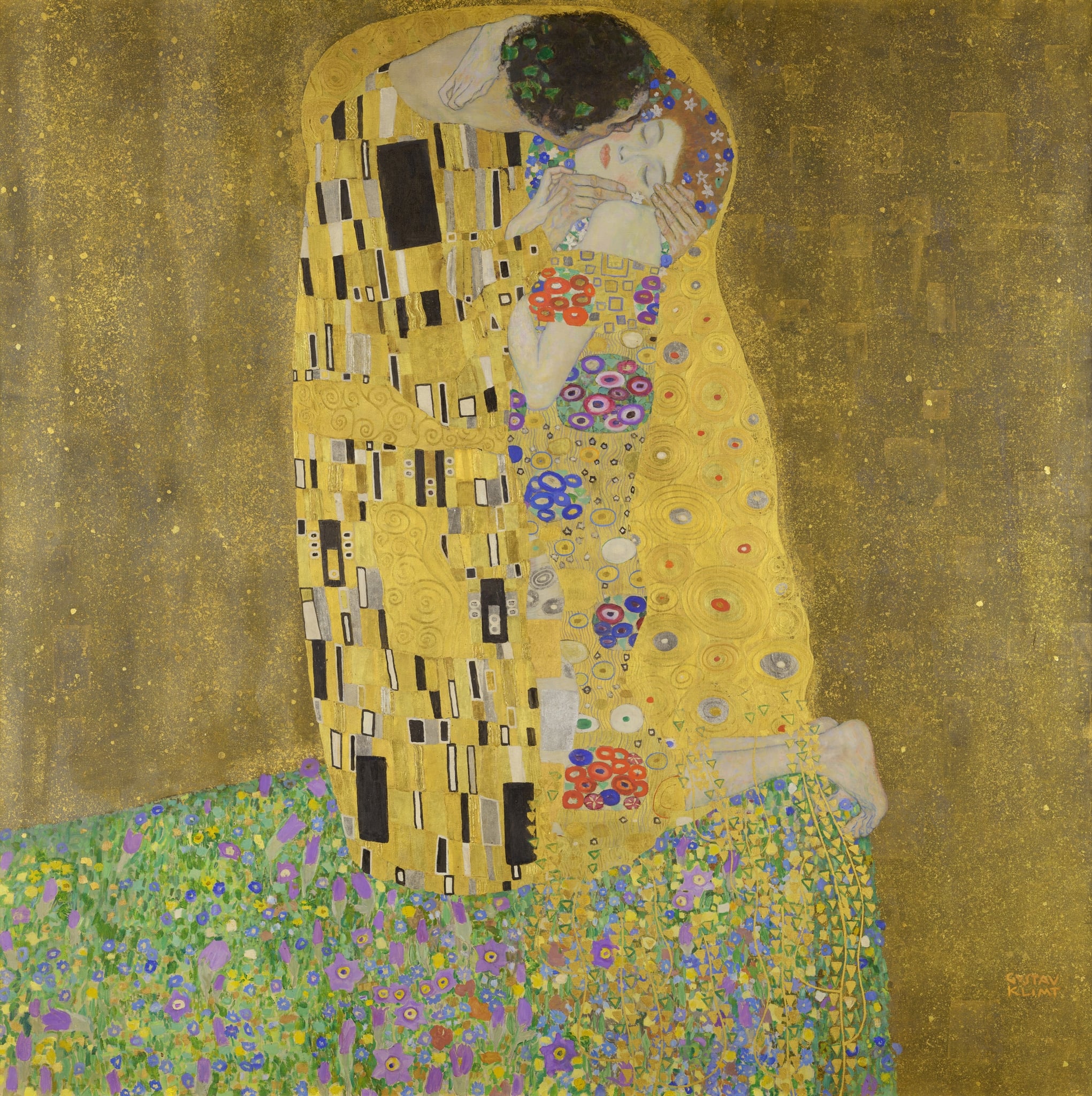
The Kiss stages human love as a <strong>sacred union</strong>, fusing two figures into a single, gold-clad form against a timeless field. Klimt opposes <strong>masculine geometry</strong> (black-and-white rectangles) to <strong>feminine organic rhythm</strong> (spirals, circles, flowers), then resolves them in radiant harmony <sup>[1]</sup><sup>[2]</sup>.
The Tree of Life by Gustav Klimt

The Tree of Life

Gustav Klimt (1910–1911 (design; mosaic installed 1911))

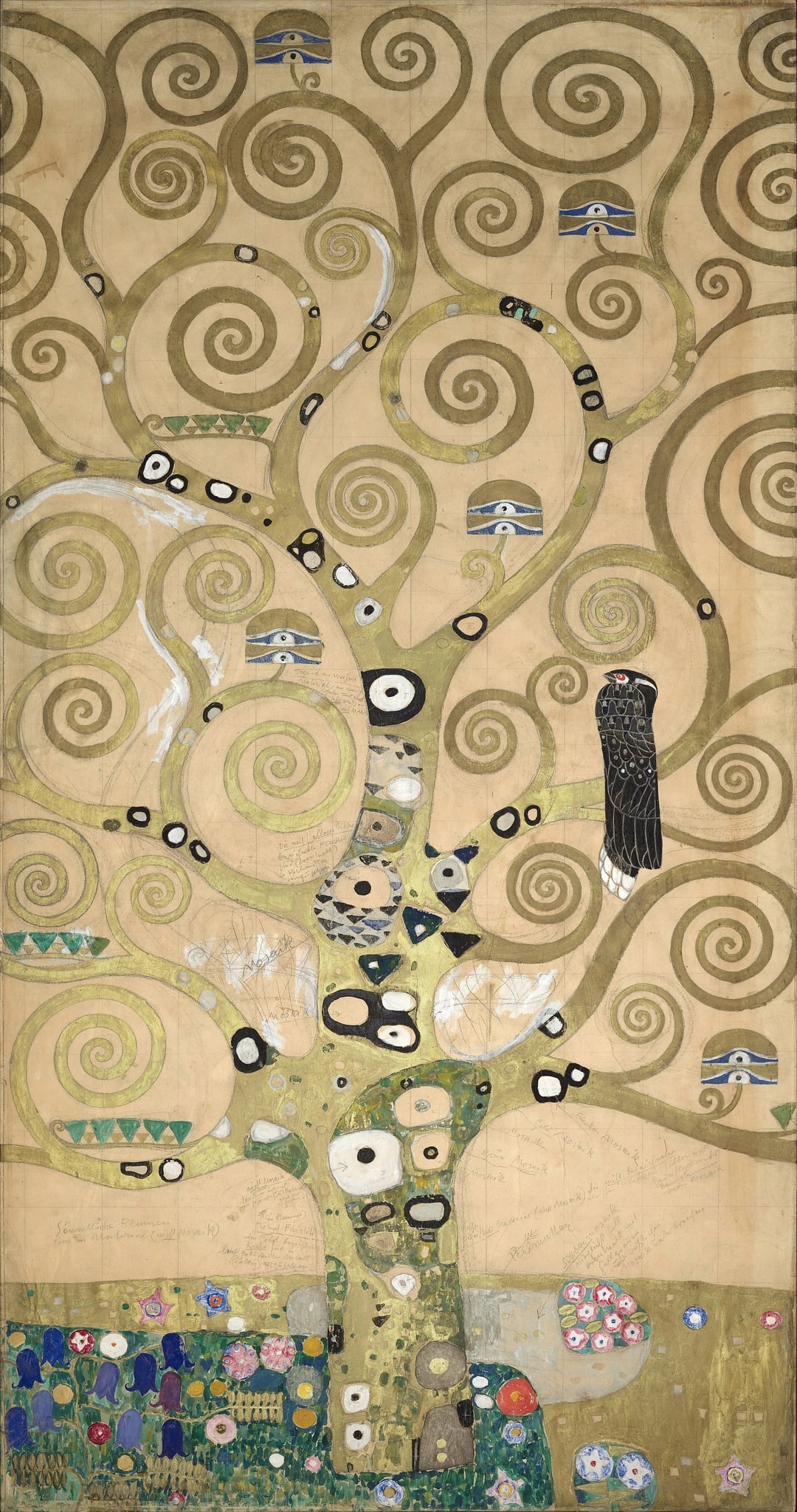
Gustav Klimt’s The Tree of Life crystallizes a <strong>cosmological axis</strong> in a gilded ornamental language: a rooted trunk erupts into <strong>endless spirals</strong>, embedded with <strong>eye-like rosettes</strong> and shadowed by a black, red‑eyed bird. Designed as part of the Stoclet dining‑room frieze, it fuses <strong>symbolism and luxury materials</strong> to link earthly abundance with timeless transcendence <sup>[1]</sup><sup>[2]</sup>.
The Kiss (Lovers) by Gustav Klimt

The Kiss (Lovers)

Gustav Klimt (1907–1908 (Belvedere lists 1908/09))

The Kiss (Lovers) crystallizes Klimt’s <strong>Golden Period</strong> ideal: erotic union staged as a sacred vision. Two bodies fuse beneath a single golden mantle, poised on a flowered ledge at the brink of the unknown, where <strong>pattern becomes symbol</strong> and intimacy becomes icon.