How Much Is Expectation (Dancer) Worth?
Last updated: April 19, 2026
Quick Facts
- Methodology
- comparable analysis
We estimate Gustav Klimt’s Expectation (Dancer) — the monumental, mixed‑media cartoon for the Stoclet Frieze — at $22–40 million in a fully marketable private‑sale context. This reflects its iconic Golden Period status and extreme rarity, offset by the medium (paper) and the absence of direct market comparables.
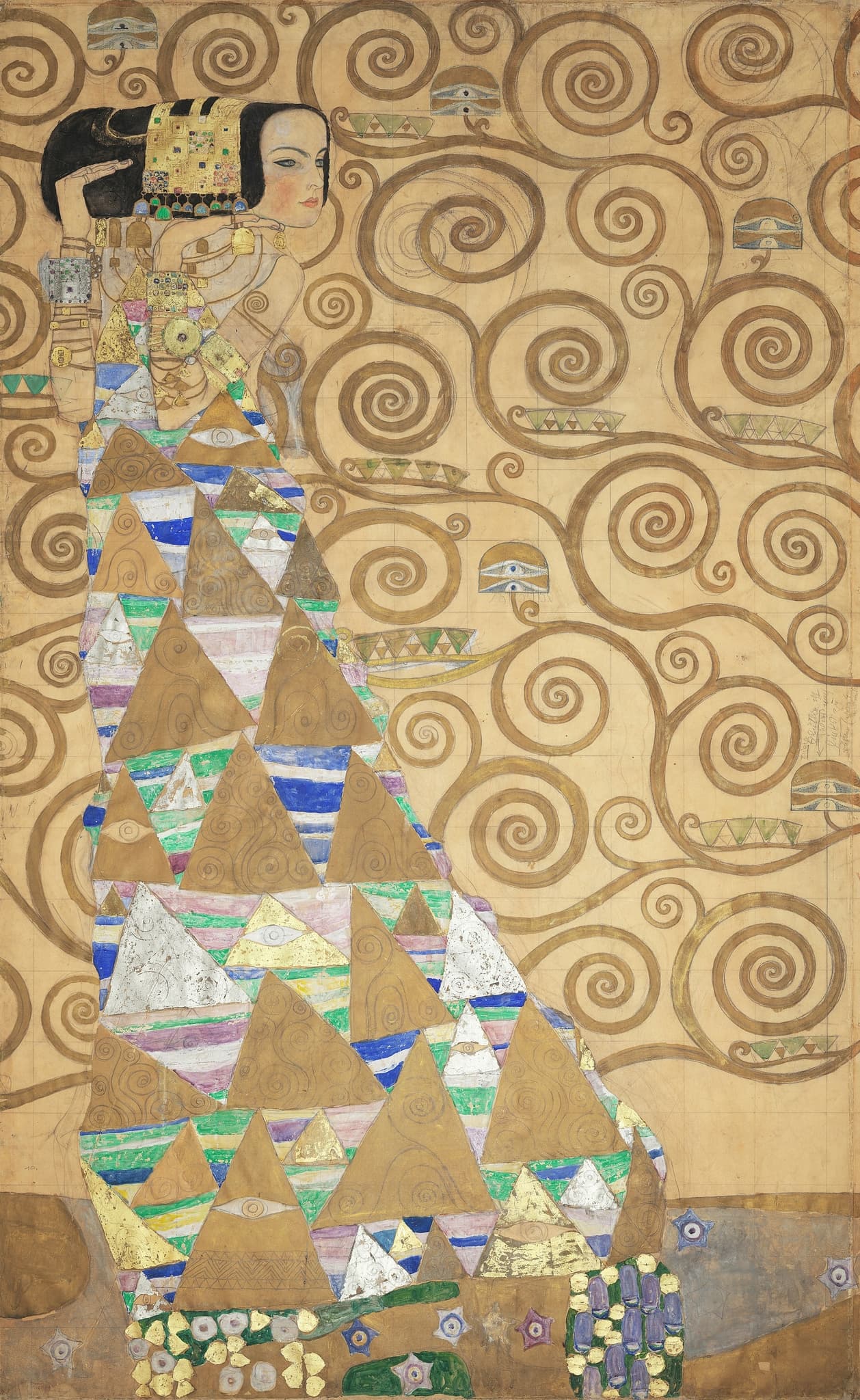
Expectation (Dancer)
Gustav Klimt, 1911 • Working drawing (cartoon) on tracing paper with graphite, gold, pastel, platinum, silver, bronze, appliqué, gouache (design for wall mosaic)
Read full analysis of Expectation (Dancer) →Valuation Analysis
Estimated value: $22–40 million (private‑sale, fully marketable). Expectation (Dancer) is a uniquely important, large‑scale, mixed‑media cartoon for the Stoclet Frieze, among the defining achievements of Gustav Klimt’s Golden Period. It is far more than a preparatory sketch: the elaborate application of gold and silver and the imposing scale place it at the apex of Klimt’s works on paper. This valuation positions the piece well above typical Klimt drawings while keeping a disciplined discount to the artist’s masterpiece oils.
Market anchors and method. We benchmark against recent marquee Klimt results to set the upper context and then apply a medium/marketability adjustment. Klimt’s auction ceiling has expanded dramatically, culminating in a 2025 record of approximately $236.4 million for a late portrait at Sotheby’s New York [1]. The market was already deep at nine figures: Lady with a Fan achieved about $108.4 million in 2023 [2], and Birch Forest made roughly $104.5 million in 2022 [3]. These establish robust global demand for Klimt’s Golden Period idiom. Standard Klimt drawings, by contrast, trade predominantly in the six‑figure range. The Stoclet cartoon sits between these poles: vastly more significant than ordinary works on paper, yet still a work on paper rather than an oil.
Why this work commands a premium within works on paper. Expectation (Dancer) is directly tied to the Stoclet Frieze — one of the most celebrated decorative cycles of the early 20th century — and represents the principal figural panel in that ensemble. Full‑scale, highly finished cartoons with gold and applied materials are vanishingly rare; no direct auction comparables exist. The work’s scale, finish and Golden Period subject compress the normal “paper discount” and justify a multi‑million‑dollar tier that is structurally distinct from routine charcoal or chalk studies [4].
Constraints and assumptions. The cartoon is held by the MAK – Museum of Applied Arts, Vienna, and subject to institutional stewardship and Austrian cultural‑property/export regimes [4]. Our value assumes a hypothetical scenario where the work is legally deaccessionable, title is clear, an export license permits global sale, and condition is very good with stable media and joins. In that fully marketable context, the most probable outcome lies in the $22–40 million range. If sale/export were restricted to a narrow buyer pool, value would compress; in a globally promoted, guarantee‑backed auction with broad competition, upside beyond the high estimate is possible but remains unproven by direct category comparables.
Key Valuation Factors
Art Historical Significance
High ImpactExpectation (Dancer) is the principal figural panel from the Stoclet Frieze, one of Klimt’s defining Golden Period achievements. As a full‑scale, highly finished cartoon that translates directly into the celebrated mosaic cycle, it is a cornerstone work within Klimt’s decorative oeuvre, second in public recognition only to icons such as The Kiss and the Adele portraits. Among works on paper, this cartoon ranks at the absolute summit for subject, scale, and refinement. That canonical status commands a substantial premium over ordinary preparatory studies and situates the work among the most important Klimt pieces outside oil on canvas.
Rarity and Lack of Substitutes
High ImpactThere are effectively no market comparables for Klimt’s full‑scale, gold‑enhanced Stoclet cartoons. Standard Klimt drawings—typically graphite, chalk, or charcoal figure studies—trade in a different, six‑figure band and cannot substitute for this object’s ambition, finish, or direct relationship to a world‑famous commission. This scarcity creates both a discovery premium and a bidder psychology akin to trophy chasing: top collectors and institutions seeking a Golden Period Klimt with gold and mosaic‑like ornament have almost no alternatives outside eight‑ or nine‑figure oils. That structural rarity justifies a valuation that is materially higher than normal works on paper.
Medium, Condition, and Scale
Medium ImpactThe work’s medium—mixed media with metallic leaf on joined sheets—introduces conservation and display considerations (light sensitivity, handling risk, and long‑term mounting). Those factors normally suppress valuations for works on paper relative to oils. However, the cartoon’s imposing scale, elaborate surface, and gold/silver application narrow the discount, functionally bridging drawing and autonomous artwork. Condition, stability of joins and applied materials, and the quality of historic treatments are pivotal: very good, well‑documented condition supports the upper tranche of the range; material fragility or significant restorations would pull the value to the lower end.
Provenance, Deaccession, and Export
Medium ImpactThe cartoon resides at the MAK – Museum of Applied Arts, Vienna, under Austrian cultural‑property protections. In real‑world terms, deaccession hurdles and export‑licensing constraints limit liquidity and can deter international buyers. Our valuation explicitly assumes a hypothetical scenario in which the work is freely deaccessionable, legally exportable, and offered internationally with clear title. If sale had to occur domestically or to a restricted buyer pool, value would compress materially. Conversely, transparent institutional provenance and a clean legal pathway enhance buyer confidence and help unlock the full global demand the estimate reflects.
Sale History
Expectation (Dancer) has never been sold at public auction.
Gustav Klimt's Market
Gustav Klimt is a blue‑chip, trophy‑level artist with a deep international buyer base. The upper bound of demand has expanded markedly: a late portrait achieved about $236.4 million at Sotheby’s New York in 2025, setting a new artist record and signaling exceptional appetite for museum‑caliber masterpieces [1]. Even before that, the market supported multiple nine‑figure results, including Lady with a Fan at roughly $108.4 million (Sotheby’s London, 2023) and Birch Forest at approximately $104.5 million (Christie’s New York, 2022) [2][3]. While typical Klimt drawings transact at six to low seven figures, the strongest Golden Period subjects with lavish ornament command intense competition, with Asian and U.S. collectors active at the very top end.
Comparable Sales
Portrait of Elisabeth Lederer
Gustav Klimt
Same artist; blue‑chip, late figural masterpiece with lavish ornament that sets the current ceiling for Klimt demand. Useful as an upper‑bound anchor even though it is an oil (not on paper).
$236.4M
2025, Sotheby's New York
Lady with a Fan (Dame mit Fächer)
Gustav Klimt
Same artist; late figural work with dense decorative patterning akin to the Stoclet idiom. Serves as a benchmark for top‑tier figural Klimt (though medium differs).
$108.4M
2023, Sotheby's London
~$114.9M adjusted
Birch Forest
Gustav Klimt
Same artist; Golden‑Period, highly ornamental surface (mosaic‑like), showing pricing for non‑portrait Klimt masterpieces. Provides an upper context even though it is an oil.
$104.5M
2022, Christie's New York
~$113.9M adjusted
Blumenwiese (Blooming Meadow)
Gustav Klimt
Same artist; decorative, gold‑period idiom with patterned, ornamental surface closely related to the frieze aesthetic. Upper‑tier non‑portrait pricing context (oil vs paper).
$86.0M
2025, Sotheby's New York
Insel im Attersee (Island in the Attersee)
Gustav Klimt
Same artist; non‑portrait Klimt with ornamental, tessellated surface language. Useful mid‑range benchmark for non‑portrait masterpieces (oil vs paper).
$53.2M
2023, Sotheby's New York
~$56.4M adjusted
Study on paper (Klimt drawing), Lauder Collection sale
Gustav Klimt
Same artist; medium‑similar (work on paper). Illustrates market norms for Klimt drawings, bracketing a lower bound versus the monumental, mixed‑media Stoclet cartoon.
$521K
2025, Sotheby's New York
Current Market Trends
The Modern/Impressionist segment has been led by marquee, guarantee‑backed consignments and concentrated trophy chasing. Klimt sits at the forefront of this dynamic: successive record prices have reinforced confidence in Golden Period material, particularly richly ornamented portraits and decorative works. Depth of bidding in 2023–2025 demonstrated robust global participation, including Asia‑based buyers, and a willingness to stretch for singular, museum‑quality lots. Works on paper remain discounted versus oils, but iconic, highly finished designs tied to famous cycles—especially with gold and mixed media—command a distinct premium lane above ordinary drawings, provided condition and marketability are strong.
Study print
Study this painting as a print
Pair the full artwork with a museum-style study sheet focused on one meaningful detail.