Roman and Venetian Quattrocento

by Gustav Klimt

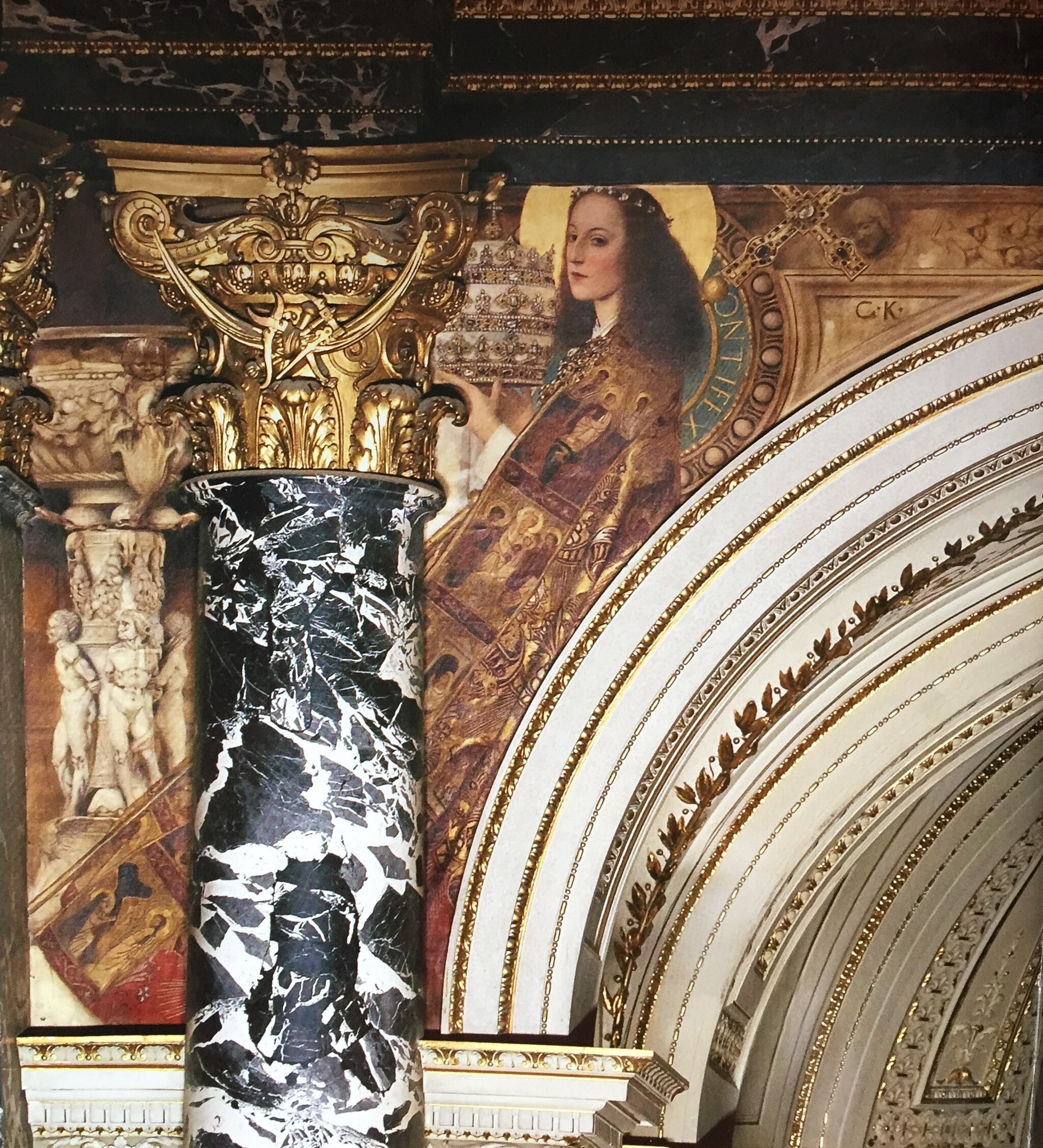
Gustav Klimt’s Roman and Venetian Quattrocento crowns the Kunsthistorisches Museum’s staircase with a didactic panorama of the Italian fifteenth century, balancing papal Rome and civic Venice. In the spandrel shown, a saintly female personification in pontifical vestments presents the papal tiara before a field of classicizing reliefs and Latin script, framed by real marble and gilded capitals. The ensemble fuses architecture and allegory, previewing Klimt’s later ornamental gold idiom while teaching viewers to read art through symbols [1][2].

Study Print Studio

Create a personal study print

Build a companion study sheet around the part of this painting that speaks to you most. Choose a detail, shape an interpretation, and walk away with something personal and display-worthy.

Fast Facts

Year
1891
Medium
Oil on canvas (marouflage to architecture)
Location
Kunsthistorisches Museum, Vienna, Main Staircase
See all Gustav Klimt paintings in Vienna
Roman and Venetian Quattrocento by Gustav Klimt (1891) featuring Papal tiara (triregnum), Halo-like gold disk, Latin inscription (“PONTIF…”), Pontifical vestments (embroidered cope)

Click on any numbered symbol to learn more about its meaning

Meaning & Symbolism

Klimt engineers a ceremonial threshold by welding real architecture to painted signification. In the image, a black‑and‑white marble column and gilded Corinthian‑fantasy capital physically interrupt the painted field, but the painter answers with gold‑laden surfaces that compete with the hardware’s luster. The Roman personification turns with a calm, knowing gaze, her mantle a dense brocade studded with miniature emblems and jewel‑tones; she lifts the triregnum (papal tiara), the compact emblem of pontifical sovereignty that anchors Rome’s quattrocento identity 1. Around her, crisp profiles and reliefs emulate antiquity, while the band with Latin letters—including the legible “PONTIF…”—projects institutional continuity from Rome’s past into Renaissance reform. A round, halo‑like disk behind her head and the CK monogram inscribed in the cartouche further stage sanctity and authorship as co‑agents of history. The scene declares that doctrine, ritual, and classicizing scholarship together authorize the rebirth of the arts. As viewers climb beneath the white, gold‑filleted arches, the painting reads as a rite of passage: you enter the galleries only after passing the exam of symbols. That pedagogy was programmatic—the staircase cycle was conceived as a walk through art history that mirrors the museum’s collections 12. The paired Venetian element completes the argument by shifting from papal to civic spectacle: a Doge modeled after Bellini’s Leonardo Loredan, wearing the Zogia and carrying a scepter, stands before the Lion of Saint Mark, Venice’s emblem 1. Rome’s sacramental power meets Venice’s republican pageantry, compressing the peninsula’s dual engines of authority into a single pedagogic node. This counterpoint also discloses Klimt’s pictorial strategy: fully modeled heads and hands are set against emphatically flat, patterned grounds, an approach that anticipates his later gold‑encrusted, planar idiom without abandoning descriptive clarity 4. The enamel‑like finish of the vestments, the near‑mosaic density of pattern, and the calculated friction between tactile bodies and decorative fields mark an early statement of the style that would make him synonymous with Viennese Modernism. Yet the decoration remains scrupulously research‑based—note the Siena‑derived holy‑water stoup in the intercolumniation that anchors the ensemble to a specific quattrocento prototype—underscoring that Klimt’s opulence serves accuracy as well as allure 1. Why Roman and Venetian Quattrocento is important, then, is twofold. Institutionally, it performs the museum’s mission in situ: a lucid, legible syllabus of symbols that transforms a staircase into a narrative of origins 12. Artistically, it crystallizes a method—juxtaposing authority (regalia) with ornament (pattern)—that becomes Klimt’s signature contribution to modern painting: a reconciliation of historical learning with sensuous surface. The result is not merely a homage to the fifteenth century; it is a demonstration that viewers can enter art history through light, gold, and memory—and that architecture, painting, and pedagogy can be one continuous surface 14.

Explore Deeper with AI

Ask questions about Roman and Venetian Quattrocento

Popular questions:

Powered by AI • Get instant insights about this artwork

💬 Ask questions about this artwork!

Interpretations

Historical Context

Installed in 1891 within the Kunsthistorisches Museum’s grand staircase, the ensemble operates as a state‑sponsored syllabus of the Italian quattrocento calibrated to Habsburg museum culture. Klimt’s contribution to the north wall fulfills a brief to map epochs of art history onto the visitor’s literal ascent, aligning iconography with the museum’s collecting fields. This is not generic allegory but a curated “in situ textbook,” where the Siena‑derived stoup, papal tiara, and Doge after Bellini substantiate the narrative of Rome and Venice as twin matrices of Renaissance renewal. The work’s pedagogical staging—12 meters above the floor and approached ceremonially—folds imperial display, scholarship, and public education into a single Gesamtkunstwerk, making the threshold itself an instrument of historical instruction 123.

Source: Kunsthistorisches Museum (object page; Gesamtkunstwerk exhibition; 2012 press text)

Iconographic Deep Dive

The Roman personification’s pontifical vestments and the raised triregnum concentrate doctrinal authority, while the legible band (“PONTIF…”) asserts continuity from antiquity through Renaissance reform. Counterpoised, the Venetian spandrel quotes Giovanni Bellini’s portrait of Doge Leonardo Loredan, recognizable via the coronation Zogia and scepter; behind him, the winged Lion of Saint Mark fuses saintly patronage with republican identity. Between them, the Siena‑derived holy‑water stoup and relief‑like profiles anchor the imagery in specific quattrocento prototypes rather than free invention. Klimt thus diagrams a dyad—papal sacrament and civic pageantry—whose emblems mediate power as ritual and spectacle, compressing a complex peninsula into a lucid heraldic grammar 1.

Source: Kunsthistorisches Museum (object page)

Formal Analysis

Klimt’s signature tension—fully modeled physiognomies set against emphatically flat, patterned grounds—is already operational here. Heads and hands receive tactile volume, while vestments and backdrops congeal into enamel‑like fields with near‑mosaic density. This dialectic anticipates the artist’s later gold‑oriented planar idiom: ornament is not accessory but structural, staging a friction between corporeal presence and decorative surface. As Lisa Florman argues for the staircase cycle, Klimt’s archaizing ornamental flatness becomes a modernist strategy rather than mere historicist garnish, a method of thinking pictorially about temporality and style. Roman and Venetian Quattrocento thus reads as an early laboratory where description and decoration lock into a productive stalemate—already modern in its self‑consciousness 14.

Source: Lisa Florman, The Art Bulletin (1990); Kunsthistorisches Museum

Materiality & Medium

Technically, these are oil on canvas works adhered to the architecture via marouflage, not fresco—a choice with conceptual bite. By bonding canvas to stone and staging real columns and capitals against painted gold, Klimt literalizes the contest between built space and pictorial artifice. The hardware’s physical luster meets painted luster, making the staircase a didactic theater of materials where medium performs meaning: Renaissance citation is not only represented but materially reenacted. KHM documentation of the staircase program underscores this integrated fabrication, aligning the commission with Vienna’s late Ringstraße ethos of total design. The result is a self‑aware hybrid that turns technique and installation into co‑authors of the iconographic message 25.

Source: Kunsthistorisches Museum (Gesamtkunstwerk materials; 2018 annual report)

Display, Distance, and Reception

Perched roughly 12 meters above the Entrance Hall, the panels were designed for oblique, processional viewing: pattern reads at a distance, while faces and regalia punctuate perception as mnemonic beacons. KHM’s temporary viewing bridge (2012; revived 2018) exposed the micro‑craft—minute emblems, enamel‑like paint handling—usually fused by distance into a ceremonial sheen. This oscillation between macro‑legibility and micro‑ornament is part of the work’s pedagogy: ascent compresses time (antique to Renaissance) while point‑of‑view toggles between symbolic clarity and textural density. The architecture tutors the eye, turning spectators into students whose movement activates the tableau’s didactic itinerary 23.

Source: Kunsthistorisches Museum (2012 press text; Gesamtkunstwerk exhibition materials)

Related Themes

About Gustav Klimt

Gustav Klimt (1862–1918), co-founder of the Vienna Secession, pivoted from controversial public commissions to a decorative-symbolist language in his Golden Period. Drawing on Byzantine mosaics and modern design, he fused opulent surfaces with psychological intensity. By 1908–09, he transformed scandal into canon, and The Kiss became Vienna’s emblem of modern love.
View all works by Gustav Klimt

More by Gustav Klimt

Portrait of Adele Bloch-Bauer I by Gustav Klimt

Portrait of Adele Bloch-Bauer I

Gustav Klimt (1907)

Gustav Klimt’s Portrait of Adele Bloch-Bauer I stages its sitter as a <strong>secular icon</strong>—a living presence suspended in a field of gold that converts space into <strong>pattern and power</strong>. The naturalistic face and hands emerge from a reliquary-like cascade of eyes, triangles, and tesserae, turning light, ornament, and status into the painting’s true subjects <sup>[1]</sup><sup>[2]</sup>.

Sunflower by Gustav Klimt

Sunflower

Gustav Klimt (1907/1908)

Gustav Klimt’s Sunflower turns a single bloom into a <strong>monumental, figure-like presence</strong>. A tapering stack of broad, drooping leaves rises from a <strong>mosaic-like carpet of round blossoms</strong>, crowned by a gold-flecked disc that glows against a cool, stippled field. The work fuses <strong>portrait, icon, and landscape</strong> into one emblem of vitality and quiet sanctity <sup>[1]</sup><sup>[2]</sup>.

Cottage Garden with Sunflowers by Gustav Klimt

Cottage Garden with Sunflowers

Gustav Klimt (1906–1907 (signed 1907))

Cottage Garden with Sunflowers is a square, horizonless field of blooms where a vertical column of <strong>sunflowers</strong> anchors an all-over weave of color and pattern. Klimt fuses <strong>ornament and nature</strong>, turning a humble Litzlberg cottage plot into a radiant matrix of cyclical life and renewal <sup>[1]</sup><sup>[4]</sup><sup>[5]</sup>.

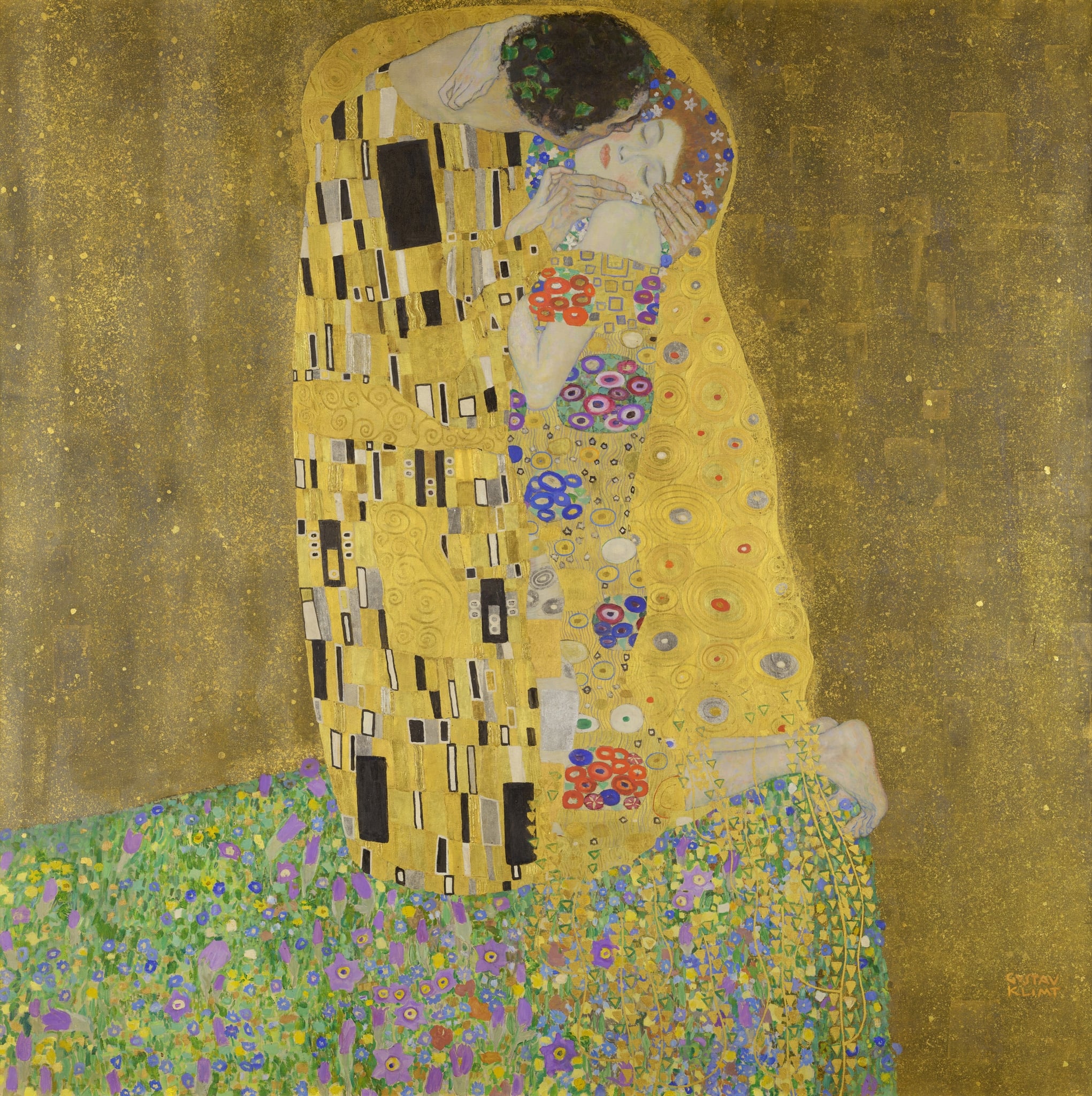
The Kiss by Gustav Klimt

The Kiss

Gustav Klimt (1908 (completed 1909))

The Kiss stages human love as a <strong>sacred union</strong>, fusing two figures into a single, gold-clad form against a timeless field. Klimt opposes <strong>masculine geometry</strong> (black-and-white rectangles) to <strong>feminine organic rhythm</strong> (spirals, circles, flowers), then resolves them in radiant harmony <sup>[1]</sup><sup>[2]</sup>.
The Tree of Life by Gustav Klimt

The Tree of Life

Gustav Klimt (1910–1911 (design; mosaic installed 1911))

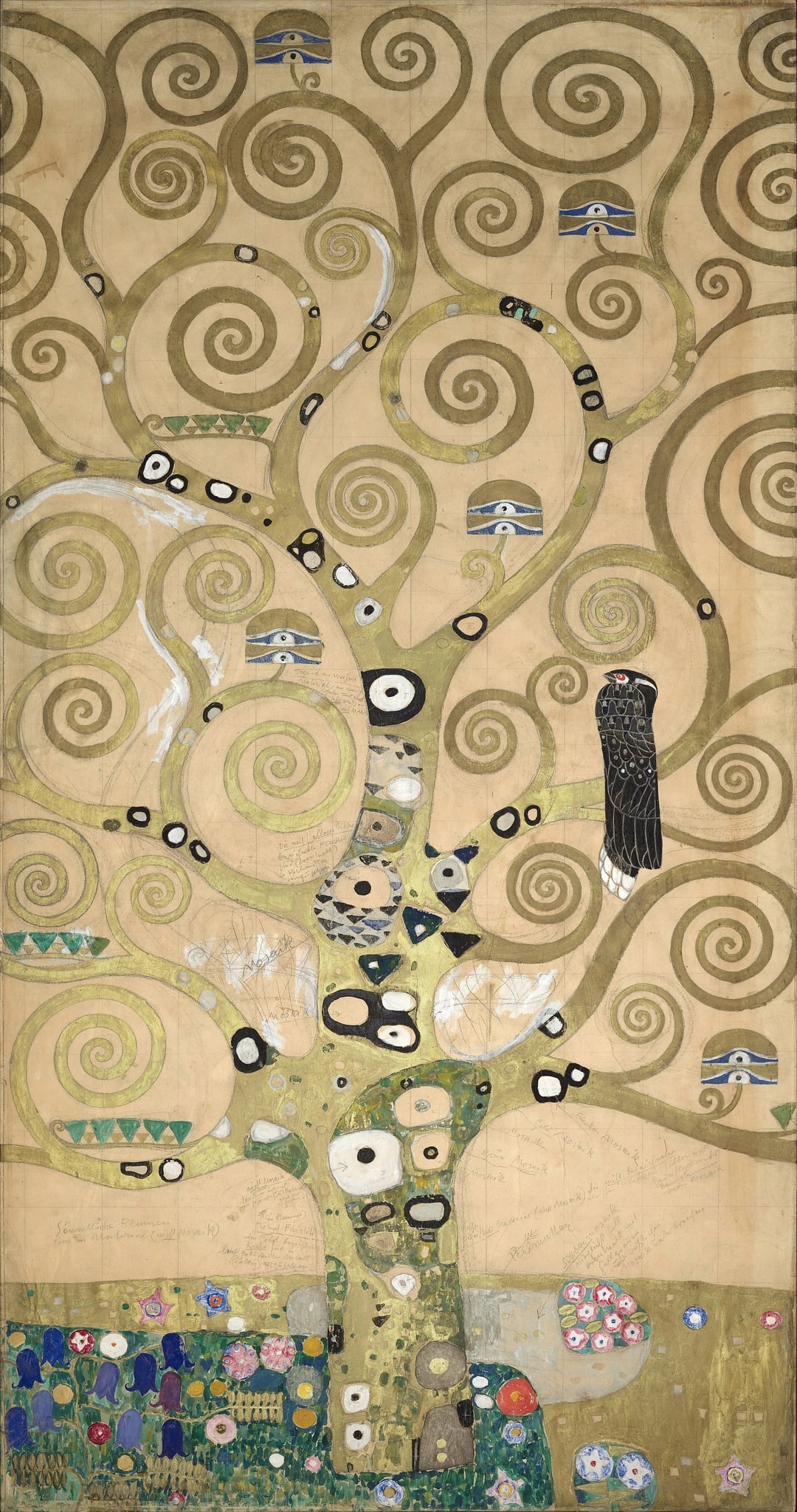
Gustav Klimt’s The Tree of Life crystallizes a <strong>cosmological axis</strong> in a gilded ornamental language: a rooted trunk erupts into <strong>endless spirals</strong>, embedded with <strong>eye-like rosettes</strong> and shadowed by a black, red‑eyed bird. Designed as part of the Stoclet dining‑room frieze, it fuses <strong>symbolism and luxury materials</strong> to link earthly abundance with timeless transcendence <sup>[1]</sup><sup>[2]</sup>.
The Kiss (Lovers) by Gustav Klimt

The Kiss (Lovers)

Gustav Klimt (1907–1908 (Belvedere lists 1908/09))

The Kiss (Lovers) crystallizes Klimt’s <strong>Golden Period</strong> ideal: erotic union staged as a sacred vision. Two bodies fuse beneath a single golden mantle, poised on a flowered ledge at the brink of the unknown, where <strong>pattern becomes symbol</strong> and intimacy becomes icon.