How Much Is Roman and Venetian Quattrocento Worth?
Last updated: April 19, 2026
Quick Facts
- Methodology
- comparable analysis
Counterfactually, if deaccession, safe detachment, and export were possible, Gustav Klimt’s in-situ Roman and Venetian Quattrocento would likely achieve $10–25 million. The estimate reflects Klimt’s blue‑chip demand but applies substantial discounts for the work’s early, decorative phase and site‑specific, marouflaged status within the Kunsthistorisches Museum’s staircase ensemble.
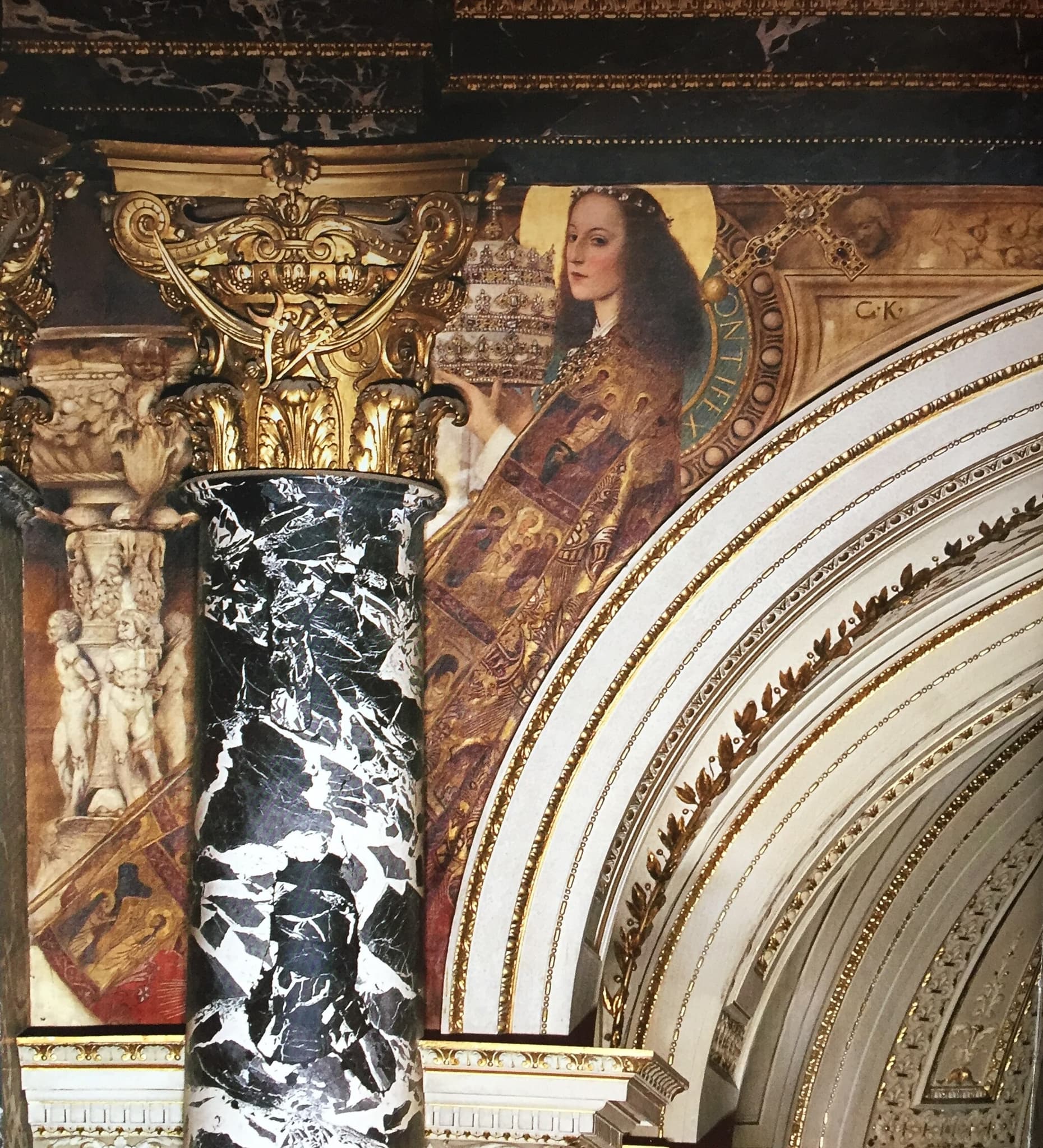
Roman and Venetian Quattrocento
Gustav Klimt, 1891 • Oil on canvas (marouflage to architecture)
Read full analysis of Roman and Venetian Quattrocento →Valuation Analysis
Object and marketability. Roman and Venetian Quattrocento (1891) is an oil-on-canvas decorative panel by Gustav Klimt, executed for the main staircase of Vienna’s Kunsthistorisches Museum and marouflaged to the architecture—i.e., physically integrated with the building. The KHM catalogs it as part of the building’s fixtures and shows it in situ, not as a deaccessionable easel work [1][7]. Given Austrian cultural property and export controls, any sale or export would face significant legal barriers [6]. Accordingly, this valuation is a hypothetical fair‑market proxy, not a price that could be realized today.
Market anchors for Klimt. Klimt’s market remains among the strongest in Modern art. Recent benchmarks include an artist auction record of $236.4m for Portrait of Elisabeth Lederer (Sotheby’s, 2025), alongside mature landscapes at $86.0m and $68.3m in the same season [2]. In Europe, Lady with a Fan (1917–18) made £85.3m ($108.4m) in 2023 [3], while Birch Forest (1903) achieved $104.6m in 2022 as part of the Paul G. Allen Collection [4]. These results establish a robust ceiling for late portraits and prime “golden‑period” landscapes, underscoring the brand strength and depth of demand for top‑tier Klimt canvases.
Positioning of the KHM panel. The subject is an early historicist allegory from Klimt’s pre‑Secession period, conceived as an architectural decoration rather than an independent easel masterpiece. Collectors demonstrably prioritize late portraits and high‑period landscapes; early decorative allegories sit materially lower in the market hierarchy. In addition, the work’s site‑specific marouflage, ensemble dependency, and probable detachment/condition risks materially constrain salability and display options—factors that the market prices in heavily.
Deriving the $10–25m range. Using the mature non‑portrait Klimt landscape band (~$60–100m+) as an upper reference, we apply substantial downward adjustments for (i) period/style (early academic/decorative vs. golden‑period idiom), (ii) site‑integration and conservation risk, and (iii) legal/export friction that would shrink the buyer pool. These combined discounts plausibly exceed 60–80% relative to prime non‑portrait canvases, yielding a counterfactual fair‑market range of $10–25 million if, and only if, the panel could be safely detached, lawfully deaccessioned, and exported with clear title. If export were restricted to Austria/EU only, the achievable price would likely compress further.
Other considerations. Museum provenance is a positive signal, but in this case also underscores non‑marketability. The 2024 Vienna auction of Portrait of Fräulein Lieser—reported sold at ~€35m with fees before the transaction reportedly unraveled amid unresolved restitution matters—illustrates how legal and reputational issues can derail Klimt deals even for portable easel works [5]. An insurance/indemnity value for the KHM staircase ensemble could exceed fair‑market value because it reflects uniqueness and risk; however, no public figures are available [1]. The indicated range would tighten with a current conservation report (feasibility/cost of detachment), precise dimensions/authorship notes, and clarity on deaccession/export pathways.
Key Valuation Factors
Site-specific, legal, and export constraints
High ImpactThe work is marouflaged within the main staircase of the Kunsthistorisches Museum and catalogued as part of the building’s fixtures. As a publicly held, in-situ element, it is effectively non‑alienable; Austria’s export‑control framework would further impede any hypothetical sale. Even in a counterfactual scenario where deaccession were permitted, the need for export permissions and associated legal diligence would shrink the global buyer pool and depress pricing relative to portable easel paintings. These constraints represent a primary discount driver and justify treating any figure as a hypothetical fair‑market proxy rather than an immediately realizable price.
Period and stylistic position (pre‑Secession decorative phase)
High ImpactExecuted in 1891, the panel belongs to Klimt’s early historicist/decorative period, preceding his mature Secessionist and ‘golden’ idioms. While historically important, collectors and institutions competing at the top of the Klimt market overwhelmingly target late portraits and prime landscapes. This stylistic and chronological gap from Klimt’s most coveted period materially lowers demand intensity and price potential. Accordingly, we apply a substantial period/style discount when benchmarking against late portraits and high‑period landscapes that have achieved $80m–$200m+ in recent seasons.
Provenance and ensemble context
Medium ImpactMuseum provenance is generally value‑positive, signaling unimpeachable ownership history and care. Here, however, the panel is one element within a celebrated architectural ensemble (the KHM staircase cycle). Its identity is bound to the interior; extracting it compromises the integrity of both the work and the space. That ensemble dependency diminishes standalone desirability for private collectors and many institutions. While provenance confers trust and scholarship, the ensemble context ultimately tempers price formation in a hypothetical sale of a single panel.
Condition, conservation, and detachment risk
High ImpactMarouflaged canvases pose non‑trivial risks: detachment can endanger paint layers, ground, and support; post‑removal stabilization, lining, and mounting add cost and uncertainty. Buyers discount for potential losses, future conservation obligations, and the absence of a conventional frame/display context. Without a current technical report and feasibility plan, risk premiums remain elevated. Even assuming a successful detachment, the work’s prior integration into architecture may affect surface readings and presentation options, all of which must be priced in.
Artist brand strength and scarcity of oils
Medium ImpactKlimt is a blue‑chip name with multiple eight‑ and nine‑figure results. Recent seasons reset the artist’s ceiling, with a 2025 portrait at $236.4m and mature landscapes at $68.3m–$86.0m, demonstrating deep global demand for top material. The mere fact of an autograph Klimt oil creates a strong baseline. However, brand strength alone does not overcome period, subject, and site‑integration discounts; instead, it provides a floor that supports low‑ to mid‑eight‑figure pricing in a counterfactual, fully marketable scenario.
Sale History
Roman and Venetian Quattrocento has never been sold at public auction.
Gustav Klimt's Market
Gustav Klimt sits at the apex of the Modern market. His auction ceiling was reset in November 2025 when Portrait of Elisabeth Lederer realized $236.4m at Sotheby’s, while mature landscapes cleared at $86.0m and $68.3m the same evening, confirming depth beyond portraits. In 2023, Lady with a Fan set a European auction record at £85.3m ($108.4m), and in 2022 Birch Forest made $104.6m in the Paul G. Allen sale. Demand concentrates on late portraits and golden‑period landscapes with stellar provenance; such works exhibit trophy‑lot liquidity. Restitutions and single‑owner consignments continue to catalyze supply, while Asian and U.S. buyers remain decisive at the top end.
Comparable Sales
Birch Forest
Gustav Klimt
Same artist; oil on canvas; museum‑grade non‑portrait painting providing a clear top‑of‑market benchmark for Klimt oils. Different period (1903 Golden Phase) and not site‑integrated, but useful as an upper‑bound anchor for brand strength.
$104.6M
2022, Christie's New York
~$115.0M adjusted
Insel im Attersee (Island in the Attersee)
Gustav Klimt
Same artist; oil on canvas; prime landscape (c.1901–02) showing pricing for non‑portrait Klimt oils below the absolute trophy tier. Later period and not decorative/site‑specific, but a relevant benchmark for non‑portrait demand.
$53.2M
2023, Sotheby's New York
~$56.4M adjusted
Dame mit Fächer (Lady with a Fan)
Gustav Klimt
Same artist; late portrait (1917–18) that set a European auction record, evidencing peak demand for top Klimt canvases. Subject/period differ from the early decorative KHM panel, so this serves as a high‑end, non‑decorative anchor.
$108.4M
2023, Sotheby's London
~$114.9M adjusted
Blumenwiese (Blooming Meadow)
Gustav Klimt
Same artist; oil on canvas; mature landscape that cleared at a very strong level in 2025, indicating depth for non‑portrait Klimt works. Not site‑integrated/decorative, but a pertinent non‑portrait comparator.
$86.0M
2025, Sotheby's New York
Waldabhang bei Unterach am Attersee (Forest Slope in Unterach on the Attersee)
Gustav Klimt
Same artist; oil on canvas; mature non‑portrait landscape sold robustly alongside other Klimts in 2025, reinforcing current pricing bands for high‑quality Klimt oils outside portraiture.
$68.3M
2025, Sotheby's New York
Portrait of Elisabeth Lederer
Gustav Klimt
Same artist; oil on canvas; late portrait that set the artist’s auction record and Modern‑category record. Stylistically and historically distinct from the early decorative KHM panel, but it sets the absolute ceiling for Klimt’s market.
$236.4M
2025, Sotheby's New York
Current Market Trends
The Modern/Impressionist segment remains top‑heavy, with a pronounced flight to quality: blue‑chip, museum‑grade works command fierce competition while secondary‑tier material is price sensitive. Klimt exemplifies this bifurcation—late portraits and prime landscapes consistently achieving $60m–$200m+, while earlier, academic or decorative works sit materially lower. After a softer 2024, late‑2025 marquee sales rebounded on the back of trophy consignments. However, legal, provenance, and conservation complexities can derail deals, particularly in Austria and Germany, underscoring the premium the market places on turnkey, portable masterpieces versus site‑specific or technically complex works.
Study print
Study this painting as a print
Pair the full artwork with a museum-style study sheet focused on one meaningful detail.
Sources
- KHM online collection: Römisches und venezianisches Quattrocento
- The Art Newspaper: Klimt record at Sotheby’s New York (Nov 2025)
- Sky News: Lady with a Fan sets European auction record (2023)
- The Art Newspaper: Paul G. Allen sale—Birch Forest at $104.6m (2022)
- AP News: Portrait of Fräulein Lieser Vienna sale and aftermath (2024)
- Austrian Federal Monuments Authority: Cultural property export rules
- Wikipedia (DE): Bilder im Stiegenhaus des Kunsthistorischen Museums (marouflage/context)