Flowering Poppies

by Gustav Klimt

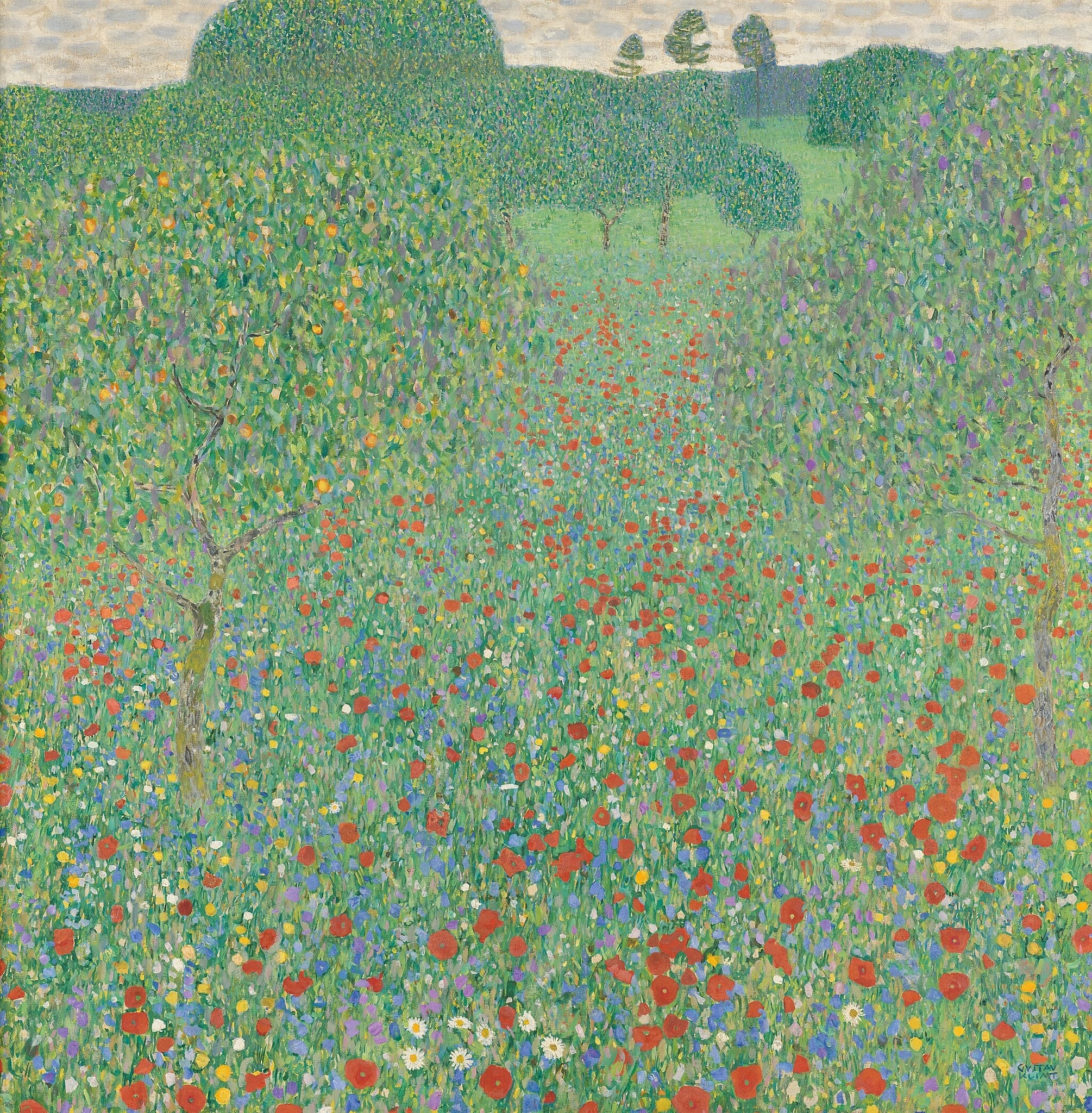
Gustav Klimt’s Flowering Poppies (1907) turns a meadow into a shimmering, all-over field where botany becomes ornament. A square canvas packed with red poppies, daisies, and fruiting trees compresses depth and invites a drifting gaze rather than linear recession [1][2]. The result is a sensuous, immersive vision that fuses observed nature with decorative abstraction [2].
💰

Market Value

$8-35 million

How much is Flowering Poppies worth?

Fast Facts

Year
1907
Medium
Oil on canvas
Dimensions
110 x 110 cm
Location
Österreichische Galerie Belvedere, Vienna
See all Gustav Klimt paintings in Vienna
Flowering Poppies by Gustav Klimt (1907) featuring Red poppies, White daisies, Fruiting apple trees, Pebble-like cloud band

Click on any numbered symbol to learn more about its meaning

Meaning & Symbolism

Klimt constructs Flowering Poppies as a controlled equilibrium between depth and pattern. The square format and elevated horizon compress the view; a narrow band of mottled, pebble-like clouds tops the composition while orchard trees, loaded with orange-yellow fruit, flank the meadow like soft walls 12. Within this frame, he stages depth through subtle scale shifts—poppies and daisies diminish as they recede, trees enlarge and overlap—yet he immediately dissolves that depth by fusing leaves, blossoms, and fruit into a continuous matrix of small, mosaic-like strokes 24. The eye cannot travel along a single path; it drifts, grazing across tessellated flecks of green punctuated by rhythmic reds. This drifting is not casual but programmatic: it asserts the Secessionist ideal that painting can function as a total environment, its surface orchestrated like a textile while still anchored in lived observation around Lake Attersee 235. Meaning accrues from this formal orchestration. The poppies’ saturated reds act as visual syncopations against the cool field, a pulse that reads as vitality and, by longstanding European iconography, as sleep and dream — a double valence that lets the meadow figure both plenitude and passing time 6. The fruiting apple trees add another register: their golden orbs suggest fecundity and sensual knowledge, associations familiar in European tradition and resonant with Klimt’s Symbolist milieu, even if not codified by the artist in writing 73. Form and symbol reinforce each other: the all-over pattern bathes the scene in timeless presentness, while the specific motifs—poppies that bloom and fade quickly, apples ripening toward harvest—quietly insist on seasonality and mortality. The thin sky, rendered as decorative pebbles, seals the field like a canopy, heightening the sense of enclosure and sanctuary without freezing the scene; tufts of distant treetops tilt just enough to suggest breeze and life 2. The painting’s importance lies in how decisively it integrates these layers at a peak moment in Klimt’s practice. In 1907—the year of Adele Bloch-Bauer I’s golden splendor—he channels a comparable ornamental intelligence into landscape, achieving what scholars call the climax of his pointillist preoccupation: pure, juxtaposed touches of color generate both light and a suggestive, hovering depth 24. Contemporary viewers sensed this synthesis. Shown as Poppies in Bloom at the 1908 Kunstschau, the work was praised for a paradisiacal, voluptuous calm, testimony to its capacity to overwhelm perception while remaining meticulously constructed 2. Situated within the Vienna Secession’s aspiration to unite art and life, Flowering Poppies demonstrates how a commonplace field becomes a total artwork: sensual, immersive, and conceptually taut. Its square architecture, ornamental surface, and symbolically charged flora advance a modern vision in which nature is neither mere subject nor backdrop but a vehicle for reflecting on pleasure, time, and the dream of permanence within inevitable change 123.

Explore Deeper with AI

Ask questions about Flowering Poppies

Popular questions:

Powered by AI • Get instant insights about this artwork

💬 Ask questions about this artwork!

Interpretations

Formal Analysis: Orchestration of Surface and Space

Klimt engineers a paradox: subtle recession via diminishing blossoms and overlapping trees, immediately countered by a near tapestry of flecked strokes that welds ground and motif 2. The square format plus elevated horizon deny a central vanishing path, compelling the eye to drift laterally among tesserae-like touches. This calibrated drift is not casual; it governs attention through rhythmic red syncopations (poppies) against a cool, speckled field. Belvedere commentary stresses the use of pure, juxtaposed color to create both luminosity and a hovering depth, akin to pointillism yet folded into Jugendstil ornament 14. The result is an optical weave: micro-contrasts build light while macro-patterns flatten form, situating the picture between plein-air notation and decorative construction 24.

Source: Belvedere Museum; Klimt Foundation (Klimt Database)

Symbolic Reading: Sleep, Fecundity, and Time

Iconographically, poppies carry a durable European link to sleep/dream and death (via opium), lending nocturnal and memento mori undertones to their blazing reds 5. The orchard’s orange‑yellow fruit invokes fecundity and erotic or cognitional “knowledge,” associations richly documented for apples across European traditions 6. Klimt left no written program, but within his Symbolist milieu such flora function as culturally legible signs: quick-blooming poppies, ripening apples, and a decorative sky-canopy coordinate a register of seasonality, pleasure, and mortality 2. Form reinforces symbol: an all-over presentness suspends narrative time, while botanical specifics insist on cycles of growth and decline—pleasure edged by perishability 256.

Source: ScienceDirect (Strandberg et al.); Cambridge University Press (Campbell); Klimt Foundation (Klimt Database)

Medium Reflexivity: Ornament, Gold-Age Logic, and Landscape

Painted the same year as Adele Bloch‑Bauer I’s golden splendor, Flowering Poppies redeploys Klimt’s ornamental intelligence from portraiture into landscape. Instead of metal leaf, he achieves a quasi‑mosaic surface through pure, juxtaposed touches of color, letting hue-contrast do the work of shimmer and depth 24. The narrow, pebble-like sky reads like a frieze; the orchard “walls” behave architectonically, turning the canvas into a patterned field aligned with Secession design ideals. This is landscape as medium critique: it asks how far painting can move toward textile and wall while retaining observational charge. The answer is a hybrid optics—hovering depth nested in decorative flatness—that makes the meadow a laboratory for modern pictorial syntax 24.

Source: Belvedere Museum; Klimt Foundation (Klimt Database)

Phenomenology of Looking: Enclosure and Drift

The picture’s elevated horizon and enclosing trees stage a sanctuary that regulates the viewer’s body and gaze. With no privileged path into depth, attention drifts across particulate marks—an absorption akin to meditation rather than traversal 2. This experiential design aligns with the Secessionist drive to unite art and life, proposing painting as an ambient, room-shaping presence rather than a window onto elsewhere 23. The rhythmic reds operate like pulses in a field of cool greens, a visual tempo that organizes duration as much as space. What emerges is a phenomenological contract: the work offers shelter for looking, and looking, slowed and patterned, becomes the subject itself 23.

Source: Klimt Foundation (Klimt Database); Encyclopaedia Britannica

Historical Context

Exhibited as “Poppies in Bloom” at the 1908 Kunstschau, the canvas met a public primed by the Vienna Secession for art as environmental experience. Franz Servaes praised its “paradisiacal tranquility” and astral color, signaling how Klimt’s landscapes could rival his portraits in sensual impact 2. The square format and high horizon—hallmarks of his Attersee summers—align with Secession display strategies that framed pictures as wall-like fields, contiguous with design and architecture 23. Early purchase by Viktor Zuckerkandl, a patron linked to Purkersdorf Sanatorium, situates the work within a progressive network where art, design, and healthful modern living intertwined. In this milieu, Flowering Poppies operates not merely as view but as a crafted atmosphere, consistent with the movement’s Gesamtkunstwerk ambitions 23.

Source: Klimt Foundation (Klimt Database); Encyclopaedia Britannica

Socio-Cultural Lens: Leisure & Recreation

Klimt’s Attersee routine—summer retreats devoted to painting—maps bourgeois leisure onto artistic method. Flowering Poppies transforms a day’s walk into chromatic plenitude, echoing early-20th-century wellness cultures that prized nature as restorative setting 23. The work’s enclosure—orchard “walls,” a pebbled sky-band—curates an intimate refuge rather than grand vista, aligning with garden culture and sanatorium ideals that framed nature as designed, health-giving space. Patronage by Viktor Zuckerkandl, tied to Purkersdorf’s reform aesthetics, reinforces how cultivated leisure, design modernism, and Secession painting converged in Vienna 1900. The meadow thus reads as a stylized precinct of rest and renewal, where cultivated looking becomes a counterpart to cultivated living 23.

Source: Klimt Foundation (Klimt Database); Encyclopaedia Britannica

Related Themes

About Gustav Klimt

Gustav Klimt (1862–1918), co-founder of the Vienna Secession, pivoted from controversial public commissions to a decorative-symbolist language in his Golden Period. Drawing on Byzantine mosaics and modern design, he fused opulent surfaces with psychological intensity. By 1908–09, he transformed scandal into canon, and The Kiss became Vienna’s emblem of modern love.
View all works by Gustav Klimt

More by Gustav Klimt

Portrait of Adele Bloch-Bauer I by Gustav Klimt

Portrait of Adele Bloch-Bauer I

Gustav Klimt (1907)

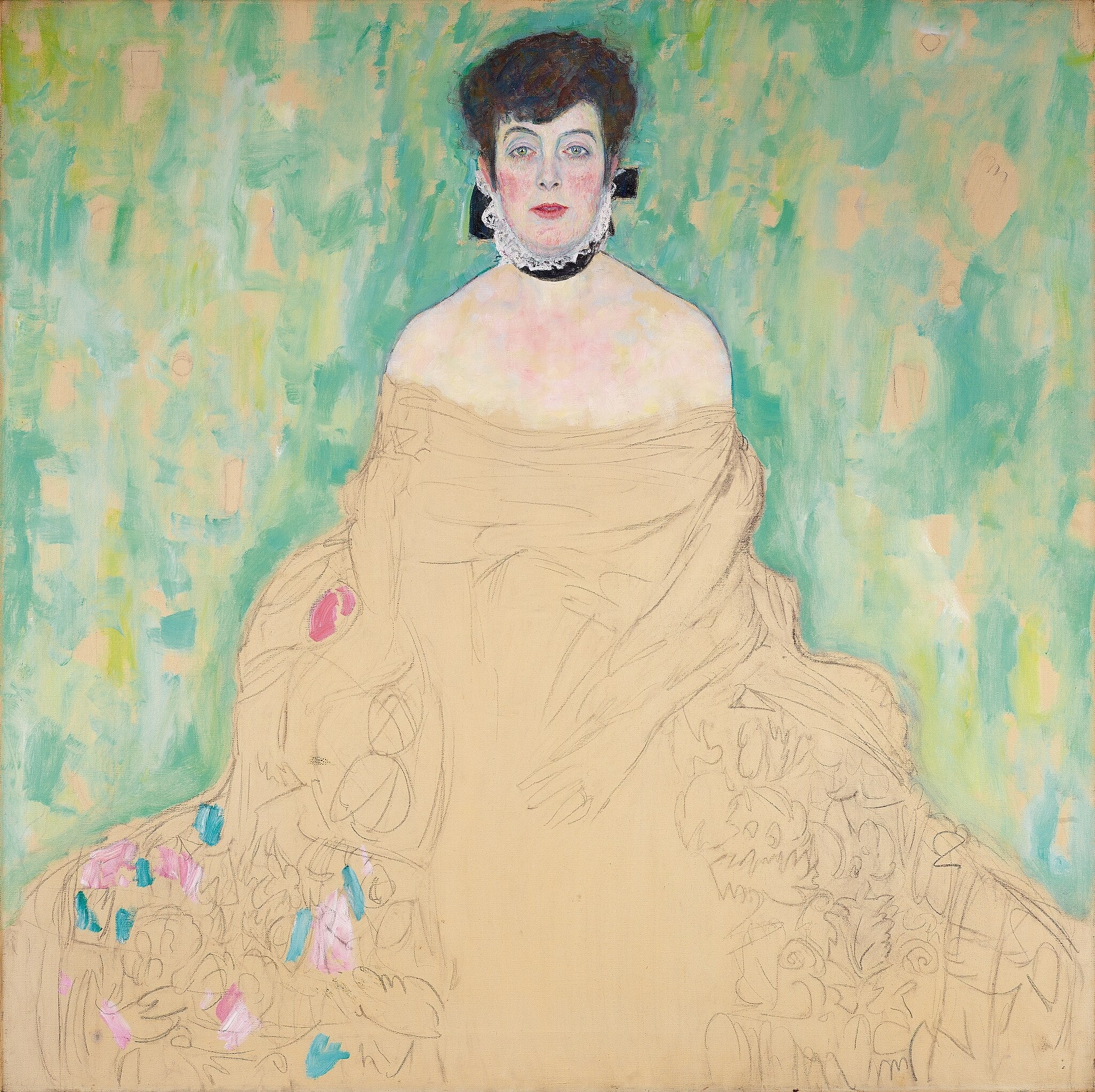
Gustav Klimt’s Portrait of Adele Bloch-Bauer I stages its sitter as a <strong>secular icon</strong>—a living presence suspended in a field of gold that converts space into <strong>pattern and power</strong>. The naturalistic face and hands emerge from a reliquary-like cascade of eyes, triangles, and tesserae, turning light, ornament, and status into the painting’s true subjects <sup>[1]</sup><sup>[2]</sup>.

Sunflower by Gustav Klimt

Sunflower

Gustav Klimt (1907/1908)

Gustav Klimt’s Sunflower turns a single bloom into a <strong>monumental, figure-like presence</strong>. A tapering stack of broad, drooping leaves rises from a <strong>mosaic-like carpet of round blossoms</strong>, crowned by a gold-flecked disc that glows against a cool, stippled field. The work fuses <strong>portrait, icon, and landscape</strong> into one emblem of vitality and quiet sanctity <sup>[1]</sup><sup>[2]</sup>.

Cottage Garden with Sunflowers by Gustav Klimt

Cottage Garden with Sunflowers

Gustav Klimt (1906–1907 (signed 1907))

Cottage Garden with Sunflowers is a square, horizonless field of blooms where a vertical column of <strong>sunflowers</strong> anchors an all-over weave of color and pattern. Klimt fuses <strong>ornament and nature</strong>, turning a humble Litzlberg cottage plot into a radiant matrix of cyclical life and renewal <sup>[1]</sup><sup>[4]</sup><sup>[5]</sup>.

The Kiss by Gustav Klimt

The Kiss

Gustav Klimt (1908 (completed 1909))

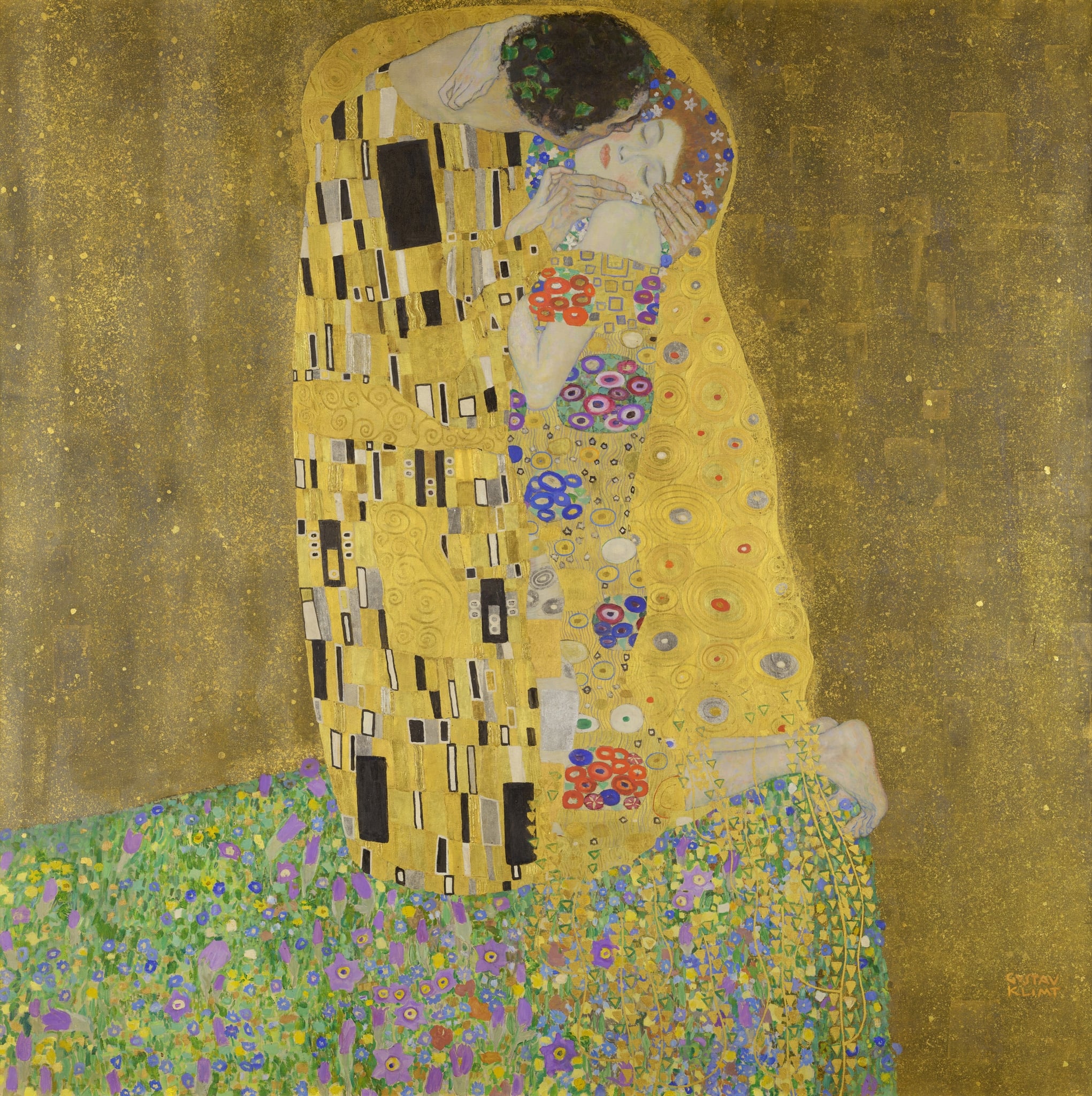
The Kiss stages human love as a <strong>sacred union</strong>, fusing two figures into a single, gold-clad form against a timeless field. Klimt opposes <strong>masculine geometry</strong> (black-and-white rectangles) to <strong>feminine organic rhythm</strong> (spirals, circles, flowers), then resolves them in radiant harmony <sup>[1]</sup><sup>[2]</sup>.
The Tree of Life by Gustav Klimt

The Tree of Life

Gustav Klimt (1910–1911 (design; mosaic installed 1911))

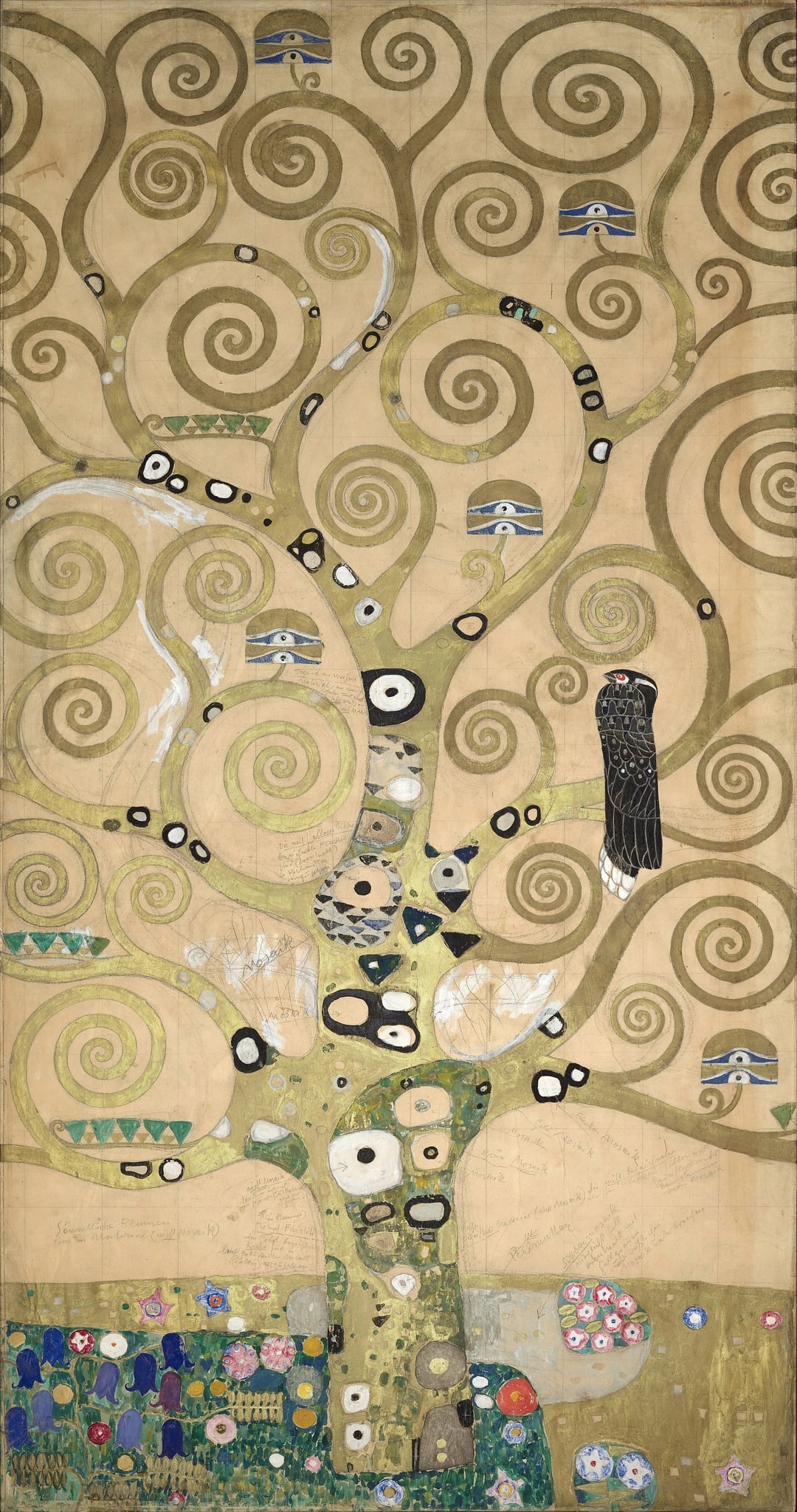
Gustav Klimt’s The Tree of Life crystallizes a <strong>cosmological axis</strong> in a gilded ornamental language: a rooted trunk erupts into <strong>endless spirals</strong>, embedded with <strong>eye-like rosettes</strong> and shadowed by a black, red‑eyed bird. Designed as part of the Stoclet dining‑room frieze, it fuses <strong>symbolism and luxury materials</strong> to link earthly abundance with timeless transcendence <sup>[1]</sup><sup>[2]</sup>.
The Kiss (Lovers) by Gustav Klimt

The Kiss (Lovers)

Gustav Klimt (1907–1908 (Belvedere lists 1908/09))

The Kiss (Lovers) crystallizes Klimt’s <strong>Golden Period</strong> ideal: erotic union staged as a sacred vision. Two bodies fuse beneath a single golden mantle, poised on a flowered ledge at the brink of the unknown, where <strong>pattern becomes symbol</strong> and intimacy becomes icon.