Fulfillment

by Gustav Klimt

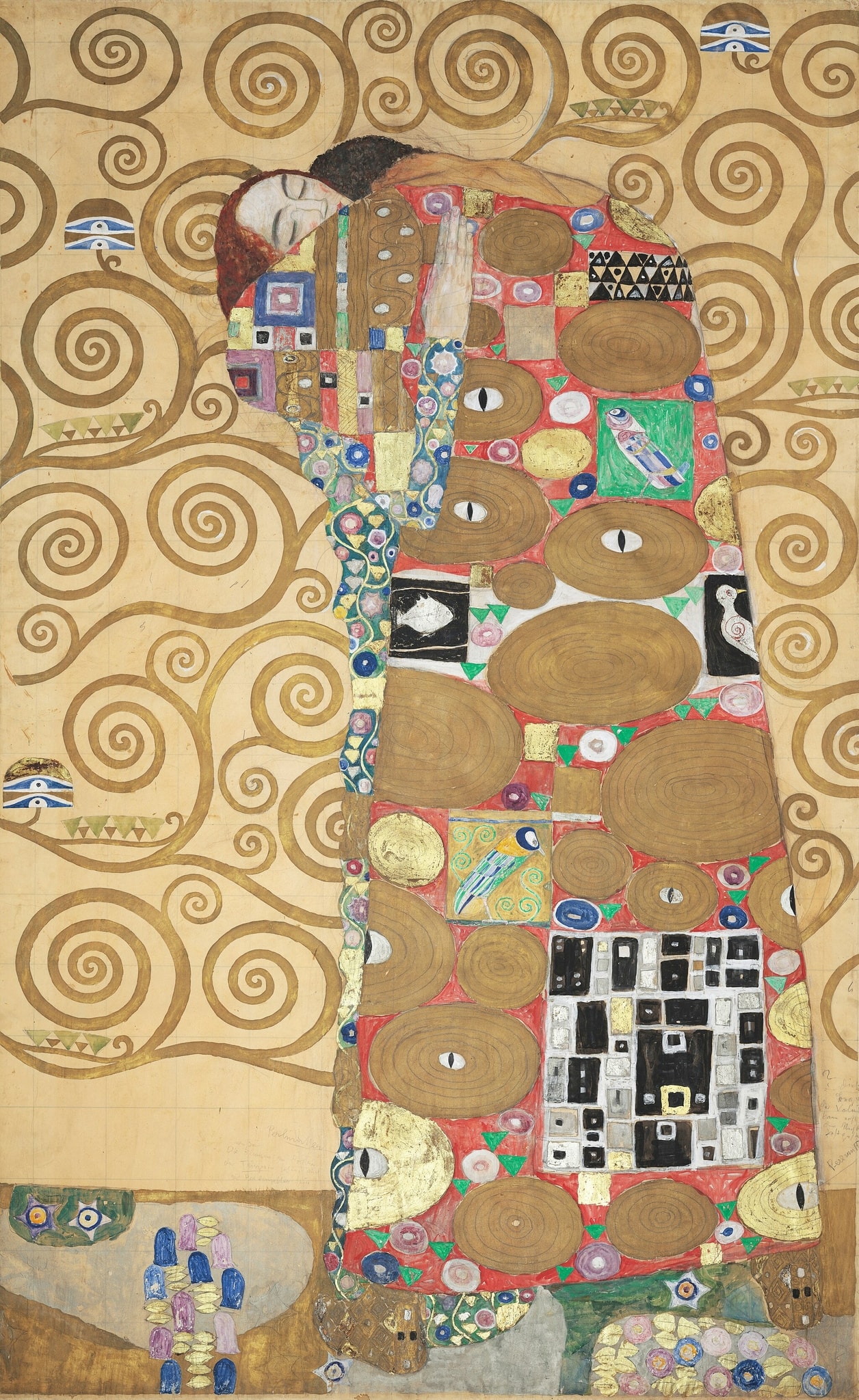
Klimt’s Fulfillment fuses two lovers into a single, radiant figure set before the spiraling Tree of Life, turning private embrace into a sacral consummation. Patterned robes—ovals, eyes, and flowers against black‑and‑white rectangles—stage a union of feminine/masculine energies within a golden, eternal field [1][3].
💰

Market Value

$50-90 million

How much is Fulfillment worth?

Study Print Studio

Create a personal study print

Build a companion study sheet around the part of this painting that speaks to you most. Choose a detail, shape an interpretation, and walk away with something personal and display-worthy.

Fast Facts

Year
1910–1911 (cartoon); mosaic installed by 1911
Medium
Chalk, graphite, gouache, and bronze/silver/gold/platinum leaf on tracing and drafting papers (cartoon)
Dimensions
200 x 102 cm
Location
MAK – Museum für angewandte Kunst, Vienna (cartoon); realized mosaic at Palais Stoclet, Brussels (private)
See all Gustav Klimt paintings in Vienna
Fulfillment by Gustav Klimt (1910–1911 (cartoon); mosaic installed by 1911) featuring Tree of Life spirals, Apotropaic eyes, Golden ovals/disks, Black-and-white squares/rectangles

Click on any numbered symbol to learn more about its meaning

Meaning & Symbolism

Klimt declares consummation as a state of completion within cosmos, not merely a private emotion. The bowed male head curves over the woman’s serene, closed-eyed face; their profiles lock into one vertical silhouette whose edge is articulated by tessellated squares, disks, and spirals. This compositional welding states, without anecdote, that identity persists yet becomes more itself in union. The surrounding Tree of Life—an orchestration of golden spirals—anchors the lovers in a field of cyclical time and growth: its whorls are not background but the life-principle that pulls the pair into a stable orbit 13. The embrace is thus more than affection; it is fulfillment within a cosmic mechanism. Klimt codes this fulfillment through an ethics of ornament. The woman’s robe blooms with rounded forms—ovals, floral medallions, and repeated eye-motifs—while the man’s mantle condenses into rectilinear blacks and whites. This binary is deliberate: organic versus geometric, curvilinear fertility versus rational order. Their junction along the seam of the embrace shows the two systems interlocking rather than canceling each other, an argument for complementarity as the engine of wholeness 13. The insistent eyes, set into both the garment and adjacent ground, operate as apotropaia—watchful emblems that secure the sacred space of union even as the lovers withdraw. Early twentieth‑century viewers steeped in Egyptomania would have recognized the talismanic logic of such motifs; Klimt adapts it, not to narrate a myth, but to guarantee the embrace against fragmentation or harm 3. Nearby, a small bird embedded among the forms adds a counter-tone: it hovers between messenger and memento, threading eros with vigilance, life with the thought of its limit—a quiet check that intensifies rather than negates the couple’s completion 13. Material and setting clinch the work’s claim. Conceived for Josef Hoffmann’s Stoclet dining room as part of a total work of art, the design instructs fabricators in precious metals—including platinum leaf to preserve a cool, untarnishing brilliance—so the realized mosaics could glow with icon-like permanence 125. Gold in Klimt is never mere luxury; it reclassifies figures as presences, placing them in a timeless register indebted to Byzantine mosaics yet synthetically modern. In Fulfillment that auric field performs consecration: the lovers become a rite enacted before and within the Tree. Installed opposite Expectation and flanked by the Tree’s spiraling expanse, the panel completes a room‑length cycle of approach, union, and ongoing vitality. Within the Vienna Secession’s program to dissolve boundaries between art and life, Fulfillment makes the dining room—a site of daily ritual—into a chamber of renewal, where ornament is argument and pattern is metaphysics 245. The image’s lasting force lies in this clarity: Klimt articulates love as alignment—of bodies, symbols, and environment—so that fulfillment is not climax but equilibrium, a sustained, watchful harmony held together by eyes, squares, spirals, and gold.

Explore Deeper with AI

Ask questions about Fulfillment

Popular questions:

Powered by AI • Get instant insights about this artwork

💬 Ask questions about this artwork!

Interpretations

Symbolic Reading (Egyptianizing Program)

Seen through an Egyptianizing lens, the frieze mobilizes apotropaic devices—the insistent eyes akin to the Udjat and the dark bird hovering between messenger and memento—to secure and temper eros within a cycle of death and rebirth. Rather than narrating Isis–Osiris, Klimt abstracts their logic: the Tree of Life spirals act as regenerative emblems; the gaze‑laden ground wards off harm; the embrace becomes a hieros gamos without a story, a rite of renewal encoded in ornament. This is not quotation but syncretic modernism: Klimt distills protective and cyclical meanings into a new decorative syntax, so that protection, fertility, and vigilance are carried by pattern itself, not by figures of gods. The result is a symbolic machine in which eyes, spirals, and bird stabilize fulfillment against fragmentation 3.

Source: M. E. Warlick, The Art Bulletin

Material Theology (Gold, Platinum, Mosaic)

Klimt’s material program functions like a theology of surfaces. Specifying gold and notably platinum (to avoid silver’s tarnish) ensured a cool, untarnishing brilliance once translated into Stoclet’s mosaics, giving the couple an icon‑like permanence. In this register, gold is not luxury but consecration: it reclassifies bodies as presences and binds them to a timeless field. The mosaic translation by Forstner’s workshop amplifies this by turning brush decisions into tessellated light, so that “fulfillment” is literally built from reflective modules. The surface thus becomes doctrine: precious metal + mosaic = sanctified durability. In a domestic dining room, this material rhetoric elevates daily ritual into a luminous rite of renewal 245.

Source: MAK (conservation/research); MoMA (Vienna 1900 catalog)

Gesamtkunstwerk & Domestic Ritual

Within Hoffmann’s Stoclet, Klimt’s panel is not a picture but a programmed environment. Installed opposite Expectation and flanked by the Tree’s unfolding, Fulfillment completes a room‑length cycle of approach, union, and ongoing vitality. In a space devoted to dining—a quotidian rite—the frieze operationalizes Secessionist ideals: the synthesis of arts dissolves boundaries between ornament and meaning, object and architecture. UNESCO’s account underscores how the palace orchestrates multiple crafts into a single, high‑order design; Klimt’s contribution is the iconographic engine that turns the dining room into a chamber of renewal. Here, ornament acts as liturgy: viewers “perform” the cycle by moving through the room, experiencing union as spatial sequence rather than narrative scene 12.

Source: UNESCO World Heritage Centre; MAK

Gendered Ornament as Ethical Complementarity

The interlock of ovals/eyes/flowers (her robe) with squares/rectangles (his mantle) stages gender as a negotiated complementarity. Klimt’s Jugendstil vocabulary makes the seam of the embrace a hinge where organic fecundity meets rational order—neither cancels the other; both are intensified in contact. This is less biography than ornamental ethics: pattern carries the argument that difference fulfills itself in relation. Read beside Klimt’s Golden‑Phase idiom (flat gold grounds, Byzantine/Japoniste planarities), the bodies become supports for sign‑systems that propose a modern, non‑narrative account of sexual union as balanced reciprocity, not domination. Such coding aligns with broader Secession ambitions to resolve dichotomies—craft/fine art, feminine/masculine—through designed harmony 56.

Source: MAK (object record); Belvedere (Klimt overview)

Authorship, Translation, and the Workshop

Fulfillment troubles single‑author myths. Klimt’s full‑scale cartoons—replete with technical notations—were realized as mosaics by Leopold Forstner’s Wiener Mosaikwerkstätte. This translation from drawing to tesserae is not passive reproduction but co‑authorship: choices of glass, stone, and metal calibrate reflection, edge, and chroma, altering how spirals orbit and how the gold field reads in ambient light. Within the Secession’s Werkbund ethos, such distributed making is a principle, not a compromise; the work’s meaning depends on the craft ecology that materializes its metaphysics. Acknowledging the workshop reframes Fulfillment as a designed system—concept, notation, and fabrication—where the harmony it depicts is mirrored by the coordinated labor that produces it 472.

Source: MoMA (Vienna 1900 catalog); The Met (Forstner entry); MAK (conservation)

Related Themes

About Gustav Klimt

Gustav Klimt (1862–1918), co-founder of the Vienna Secession, pivoted from controversial public commissions to a decorative-symbolist language in his Golden Period. Drawing on Byzantine mosaics and modern design, he fused opulent surfaces with psychological intensity. By 1908–09, he transformed scandal into canon, and The Kiss became Vienna’s emblem of modern love.
View all works by Gustav Klimt

More by Gustav Klimt

Part of the Tree of Life (Part 1) by Gustav Klimt

Part of the Tree of Life (Part 1)

Gustav Klimt (1910–1911)

Gustav Klimt’s Part of the Tree of Life (Part 1) is a full‑scale design cartoon for the Stoclet dining‑room frieze, where a gold ground hosts branching spirals, <strong>Eye‑of‑Horus</strong> rosettes, falcon emblems, and crisp triangular leaves. The panel fuses <strong>symbolism</strong> and <strong>ornament</strong> to stage life’s cyclical renewal within a luxurious, sacred‑like register <sup>[1]</sup><sup>[3]</sup>.

The Kiss by Gustav Klimt

The Kiss

Gustav Klimt (1908 (completed 1909))

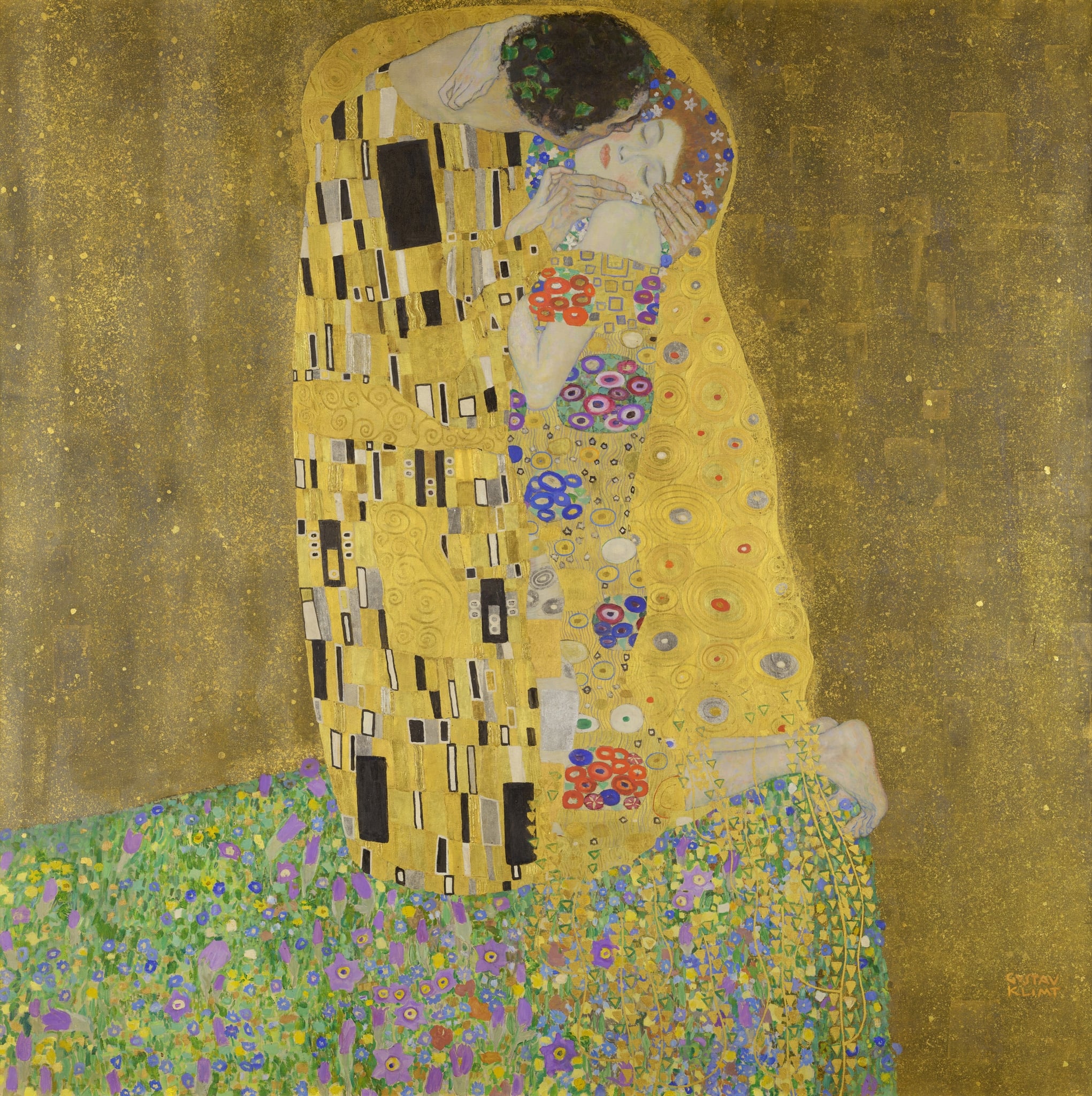
The Kiss stages human love as a <strong>sacred union</strong>, fusing two figures into a single, gold-clad form against a timeless field. Klimt opposes <strong>masculine geometry</strong> (black-and-white rectangles) to <strong>feminine organic rhythm</strong> (spirals, circles, flowers), then resolves them in radiant harmony <sup>[1]</sup><sup>[2]</sup>.
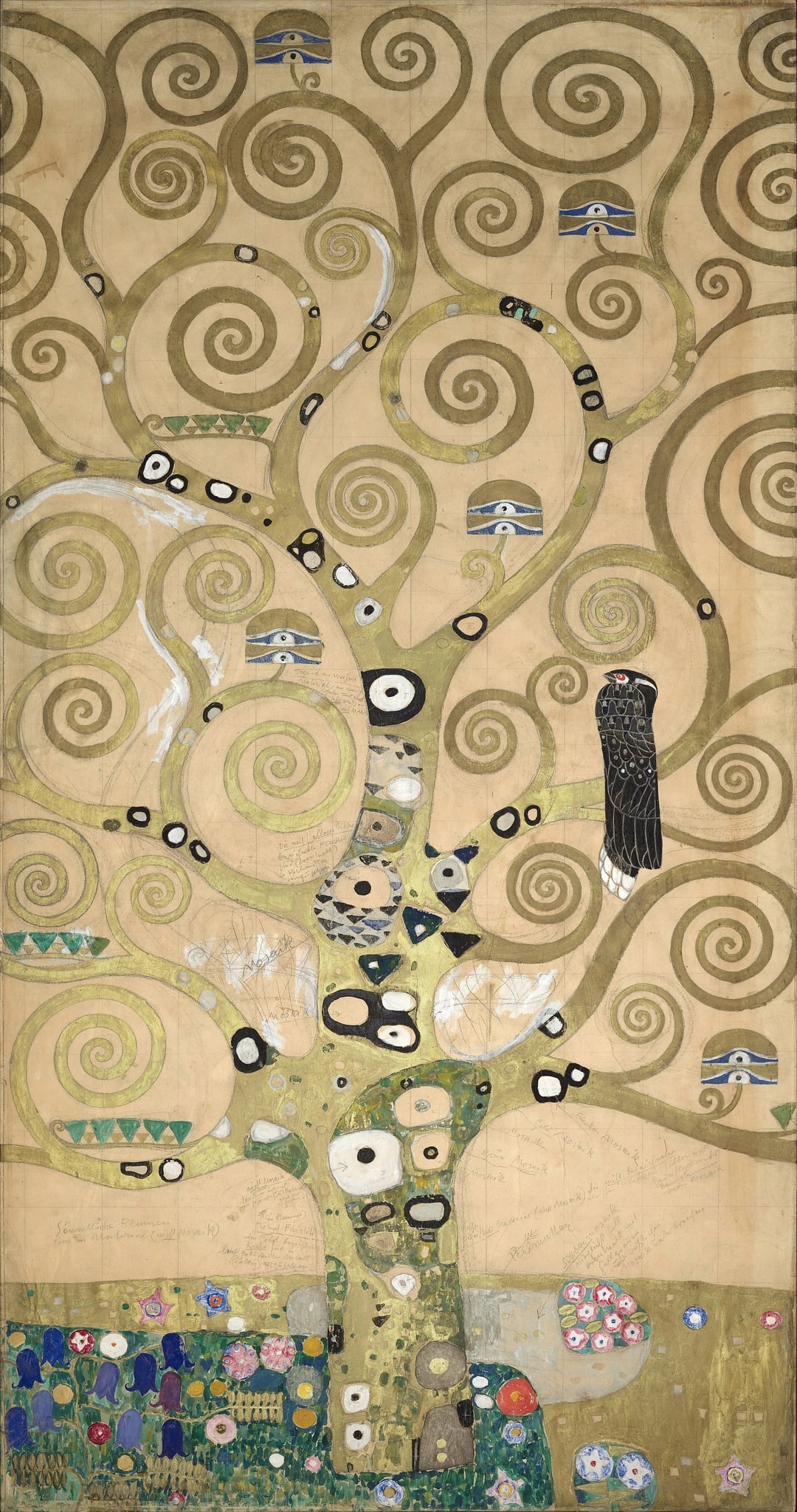
Tree of Life (Part 4) by Gustav Klimt

Tree of Life (Part 4)

Gustav Klimt (1910–1911)

Tree of Life (Part 4) stages a gilded axis where <strong>spiraling branches</strong>, <strong>amuletic eyes</strong>, and a <strong>black raptor</strong> compress growth, vigilance, and mortality into a single ornamental system. The mosaic-like bark and jewel-bright flower carpet root the image in fecund earth while the volutes coil upward toward the abstract and the eternal <sup>[1]</sup><sup>[6]</sup>.

Rosebush (Part 6) by Gustav Klimt

Rosebush (Part 6)

Gustav Klimt (1910/11)

In Rosebush (Part 6), a single, wavering stem climbs through a field of gold spirals while regimented green-and-blue triangular leaves and pale, jewel-like blossoms punctuate its path. Around it, vivid butterflies and star-flowers animate the surface. Klimt fuses nature and ornament into a <strong>precious</strong>, <strong>cyclical</strong> emblem of growth, metamorphosis, and renewal.

Knight (Part 9) by Gustav Klimt

Knight (Part 9)

Gustav Klimt (1910–1911)

Klimt’s Knight (Part 9) turns chivalry into a <strong>geometric icon</strong>: a vertical standard of stacked bars and checks flanked by <strong>ranks of circles and triangles</strong> that read as shields and studs. Set on a <strong>golden ground</strong> and crowned and undergirded by ornamental zones, it proclaims vigilance and ethical guardianship between the frieze’s figural scenes. <sup>[1]</sup>

The Tree of Life by Gustav Klimt

The Tree of Life

Gustav Klimt (1910–1911 (design; mosaic installed 1911))

Gustav Klimt’s The Tree of Life crystallizes a <strong>cosmological axis</strong> in a gilded ornamental language: a rooted trunk erupts into <strong>endless spirals</strong>, embedded with <strong>eye-like rosettes</strong> and shadowed by a black, red‑eyed bird. Designed as part of the Stoclet dining‑room frieze, it fuses <strong>symbolism and luxury materials</strong> to link earthly abundance with timeless transcendence <sup>[1]</sup><sup>[2]</sup>.