How Much Is Tree of Life (Part 4) Worth?
Last updated: April 28, 2026
Quick Facts
- Methodology
- comparable analysis
Tree of Life (Part 4) is a monumental, metal‑heightened, full‑scale cartoon for Klimt’s Stoclet Frieze—one of the most iconic achievements of his Golden Period. With Klimt’s top-end market at historic highs and virtually no supply of Stoclet cartoons, a fair market estimate of $15–25 million is justified, assuming excellent condition and an unrestricted, globally marketed sale.
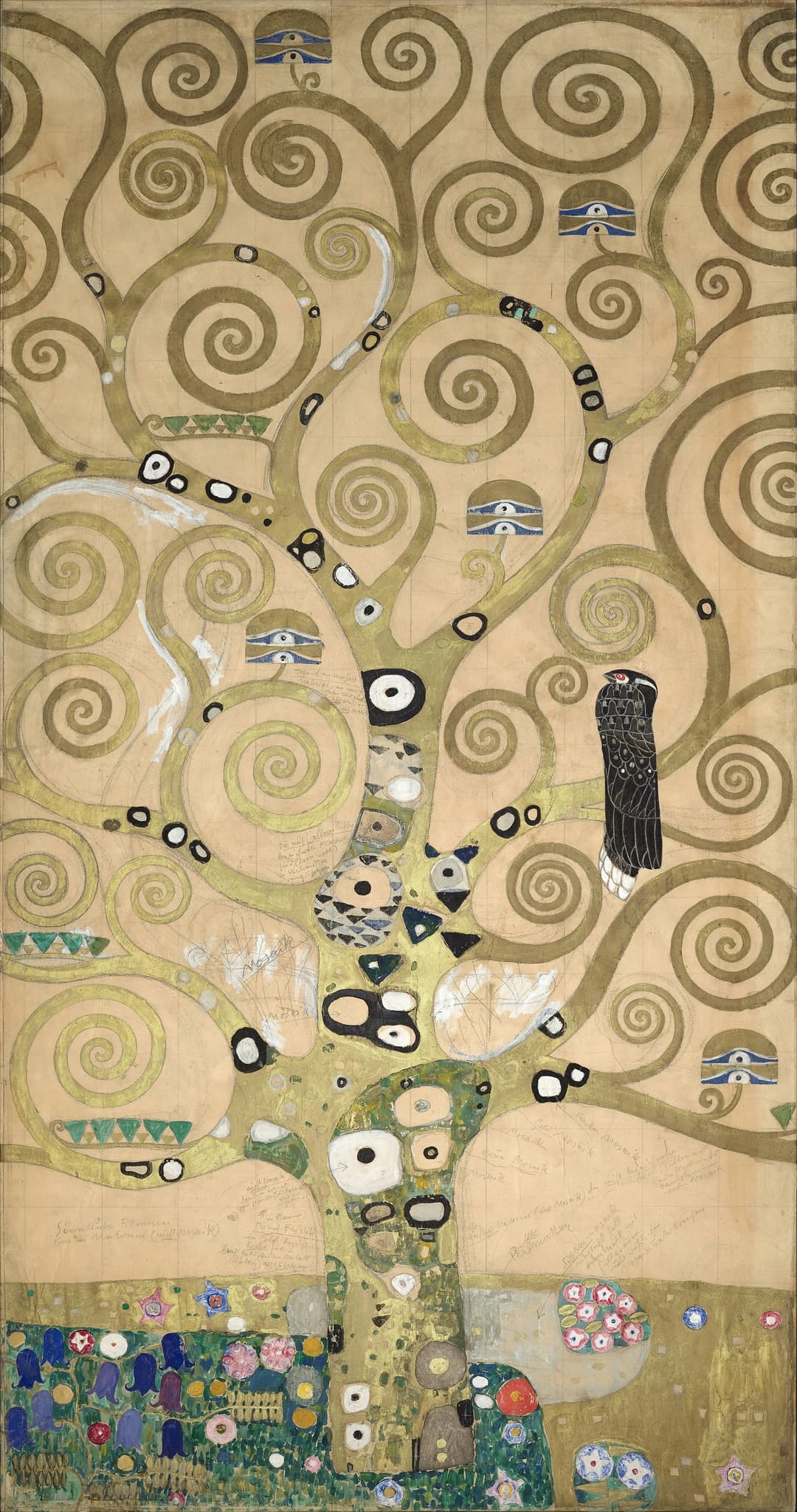
Tree of Life (Part 4)
Gustav Klimt, 1910–1911 • Chalk, pencil, gouache, bronze, silver, gold and platinum on transparent paper (cartoon for mosaic)
Read full analysis of Tree of Life (Part 4) →Valuation Analysis
Work and context. Tree of Life (Part 4) is one of nine full‑scale cartoons for the Stoclet Frieze, executed on transparent paper with chalk, pencil, gouache, and metallics (bronze, silver, gold, platinum) at an imposing 200 × 102 cm. It is held by the MAK – Museum of Applied Arts, Vienna, and forms part of Klimt’s celebrated Golden Period decorative cycle for the Palais Stoclet, Brussels—a cornerstone in the artist’s oeuvre and in Viennese Secessionist design history [1].
Artist market calibration. Klimt sits at the apex of the Modern market. Recent headline results include Lady with a Fan (2023) at about $108m in London [2], the record-setting Portrait of Elisabeth Lederer (2025) at $236.4m in New York [3], and Birch Forest (2022) at $104.6m [6]. These figures establish extraordinary brand strength and deep global demand—especially for Golden Period and highly decorative imagery closely aligned with the Stoclet aesthetic.
Where works on paper trade—and why this is different. Standard Klimt drawings routinely realize strong six-figure prices (e.g., Dorotheum’s Study for Judith II at roughly $565k in 2024) [4], with similar levels observed in late‑2025 New York evening sales for high‑quality sheets [7]. Part 4, however, is not a typical study: it is a museum‑scale, metal‑heightened, near‑finished cartoon directly tied to a canonical commission. As such, it should command a multiple of ordinary drawing prices while remaining well below Klimt’s great oils.
Rarity and trophy appeal. Full‑scale Stoclet Frieze cartoons are essentially off‑market; most reside in institutions, and the subject—the Tree of Life—is among Klimt’s most widely recognized motifs. A legally marketable example would be a once‑in‑a‑generation opportunity, likely attracting cross‑category trophy buyers who respond to scale, finish, and iconic imagery. This supply scarcity, coupled with Klimt’s re‑priced top end, supports a valuation in the mid‑teens to low‑twenties (USD millions) [1],[3].
Constraints and sensitivities. The work is museum property in Austria, where export of culturally significant objects requires approval from the Federal Monuments Authority. Any deaccession or cross‑border sale could be delayed or constrained, potentially narrowing the buyer pool and affecting price formation [5]. Condition is pivotal: transparent paper with metallic media can be fragile; excellent stability and presentation quality would support the top of the range.
Conclusion and estimate. Balancing Klimt’s exceptional market momentum, the cartoon’s art‑historical significance, scale, degree of finish, and extreme rarity against medium-specific and regulatory constraints, we estimate fair market value today at $15–25 million, assuming outstanding condition, clear title, and a fully promoted global sale via a top-tier venue. Should export be restricted or condition prove compromised, the achievable outcome would likely gravitate toward the lower band [2],[3],[5].
Key Valuation Factors
Art Historical Significance
High ImpactPart of the full-scale preparatory cycle for the Palais Stoclet Frieze, this cartoon directly underpins one of Klimt’s defining Golden Period achievements. The Tree of Life motif is among the artist’s most reproduced and studied images, bridging painting, design, and Gesamtkunstwerk ideals. As a large, metal‑heightened working drawing that captures Klimt’s ornamental language at full scale, it occupies a privileged position within the oeuvre—more consequential than typical studies and on par, in scholarly interest, with exhibition‑caliber works on paper. This centrality ensures broad institutional and private collector appeal and supports pricing well above ordinary drawings while remaining below iconic oils.
Rarity and Trophy Appeal
High ImpactFull‑scale Stoclet Frieze cartoons are vanishingly scarce on the market; most are in institutions and have seldom, if ever, been available for private ownership. The combination of monumental format, metallic execution, and a universally recognizable subject positions this sheet as a trophy‑level opportunity with cross‑category resonance. In a market where top Klimt paintings regularly achieve nine figures, the chance to acquire a museum‑grade, Golden Period cartoon tied to a landmark commission would likely catalyze aggressive bidding from global collectors, reinforcing a valuation far above standard Klimt works on paper.
Medium, Scale, and Degree of Finish
High ImpactAt roughly 200 × 102 cm and executed with gouache and metallics on transparent paper, the sheet is effectively a finished, full‑size design instrument for a major decorative program. This is qualitatively different from small pencil studies: it reads as an autonomous, visually complete work while revealing Klimt’s process. The presence of bronze, silver, gold, and platinum heightens visual impact and collecting appeal but also increases conservation sensitivity. The monumental scale and fully articulated design justify a substantial premium over ordinary drawings, underpinning a mid‑teen to low‑twenty million valuation in a competitive, unconstrained sale.
Legal/Ownership and Export Constraints
Medium ImpactThe work is held by a public museum in Austria, where the export of protected cultural property requires permitting by the Federal Monuments Authority. In practice, such oversight can delay or restrict international transfers, narrowing the buyer pool and complicating logistics. While a fully approved, globally marketed sale could unlock international demand and maximize price, a constrained or domestic‑only route could compress competitive tension and lower the outcome. These regulatory factors do not diminish intrinsic value but can materially influence realized price and timing in any hypothetical transaction.
Condition and Conservation Risk
Medium ImpactTransparent paper supports and metallic media are inherently delicate. Risks include oxidation or tarnish of metals, embrittlement or tears in the support, past restorations, and light sensitivity that restricts display. A recent, detailed condition report demonstrating media stability, minimal losses, and reversible, museum‑standard conservation would support the upper end of the range. Conversely, significant structural issues, disfiguring restorations, or compromised legibility of metallic passages would depress demand and push the valuation toward the lower band, given the premium collectors place on presentation quality for trophy‑level works on paper.
Sale History
Tree of Life (Part 4) has never been sold at public auction.
Gustav Klimt's Market
Gustav Klimt is a blue‑chip pillar of the Modern market. Prices for prime paintings climbed sharply in recent seasons: Lady with a Fan achieved about $108m in 2023 (a European auction record at the time), and in 2025 a portrait set a new Klimt and modern‑art auction record at $236.4m in New York. Decorative, Golden Period landscapes also reached new heights, with Birch Forest at $104.6m. Demand is deep and global, with strong participation from U.S. and Asian buyers. Works on paper remain far below the prices of oils, typically in the high six figures, but the very best, exhibition‑scale sheets tied to landmark projects can command multi‑million‑dollar results in the right venues.
Comparable Sales
Study for Judith II (drawing)
Gustav Klimt
Same artist and Golden Period subject; high‑quality work on paper benchmark for Klimt drawings though far smaller and without metallic media; calibrates the ‘ordinary’ drawing market for Klimt.
$565K
2024, Dorotheum, Vienna
~$582K adjusted
Drawing (study), Sotheby’s New York Evening Sale
Gustav Klimt
Same artist; recent public pricing for Klimt works on paper (standard-scale study); useful floor for medium while highlighting rarity/premium of a full‑scale Stoclet cartoon.
$521K
2025, Sotheby's New York
A nude man (Michelangelo drawing, rediscovered)
Michelangelo
Category analogue: a museum‑caliber, historically important preparatory drawing; demonstrates that singular, finished works on paper tied to major projects can achieve mid‑tens of millions.
$24.3M
2022, Christie's Paris
~$27.0M adjusted
Head of a Muse (drawing)
Raphael
Record‑level Old Master drawing; highly finished study for a major work. Serves as an upper‑bound analogue for the top of the works‑on‑paper market when rarity, quality, and art‑historical importance converge.
$47.9M
2009, Christie's London
~$72.0M adjusted
Birch Forest (1903)
Gustav Klimt
Same artist, closely related decorative/landscape idiom and period; anchors current demand ceiling for Klimt masterpieces (though oil on canvas, not paper).
$104.6M
2022, Christie's New York
~$116.0M adjusted
Blumenwiese (Blooming Meadow) (1908)
Gustav Klimt
Same artist and Golden Period; ornamental, nature‑driven composition akin to the Stoclet aesthetic; demonstrates current appetite for Klimt’s most decorative imagery.
$86.0M
2025, Sotheby's New York
Current Market Trends
The top end of the Modern category has been polarized but resilient: supply is thin, yet masterpiece‑level works continue to attract intense global bidding. After a softer 2024, marquee 2025 sales in New York reset price ceilings for several blue‑chip names, including Klimt, reinforcing confidence among trophy buyers. Collectors have prioritized provenance, condition, and iconic imagery—precisely the attributes embodied by the Stoclet Frieze material. Venue and regulatory context matter: New York evening sales with broad international access outperform constrained venues. Against this backdrop, a museum‑grade Klimt cartoon with export clearance would be well‑positioned to achieve a mid‑eight‑figure result.
Study print
Study this painting as a print
Pair the full artwork with a museum-style study sheet focused on one meaningful detail.
Sources
- MAK / Google Arts & Culture: Stoclet Frieze Cartoon, Part 4
- The Art Newspaper: Klimt’s Lady with a Fan sets European auction record (2023)
- Sotheby’s: Historic night—Klimt record at the Breuer building (Nov 2025)
- Dorotheum: Top price for Klimt drawing (May 2024)
- Bundesdenkmalamt (Austria): Export of cultural goods
- Christie’s: Paul G. Allen Collection—Part I results (Birch Forest)
- The Art Newspaper: Klimt record and related drawing results (Nov 2025)