Still Life

by Claude Monet

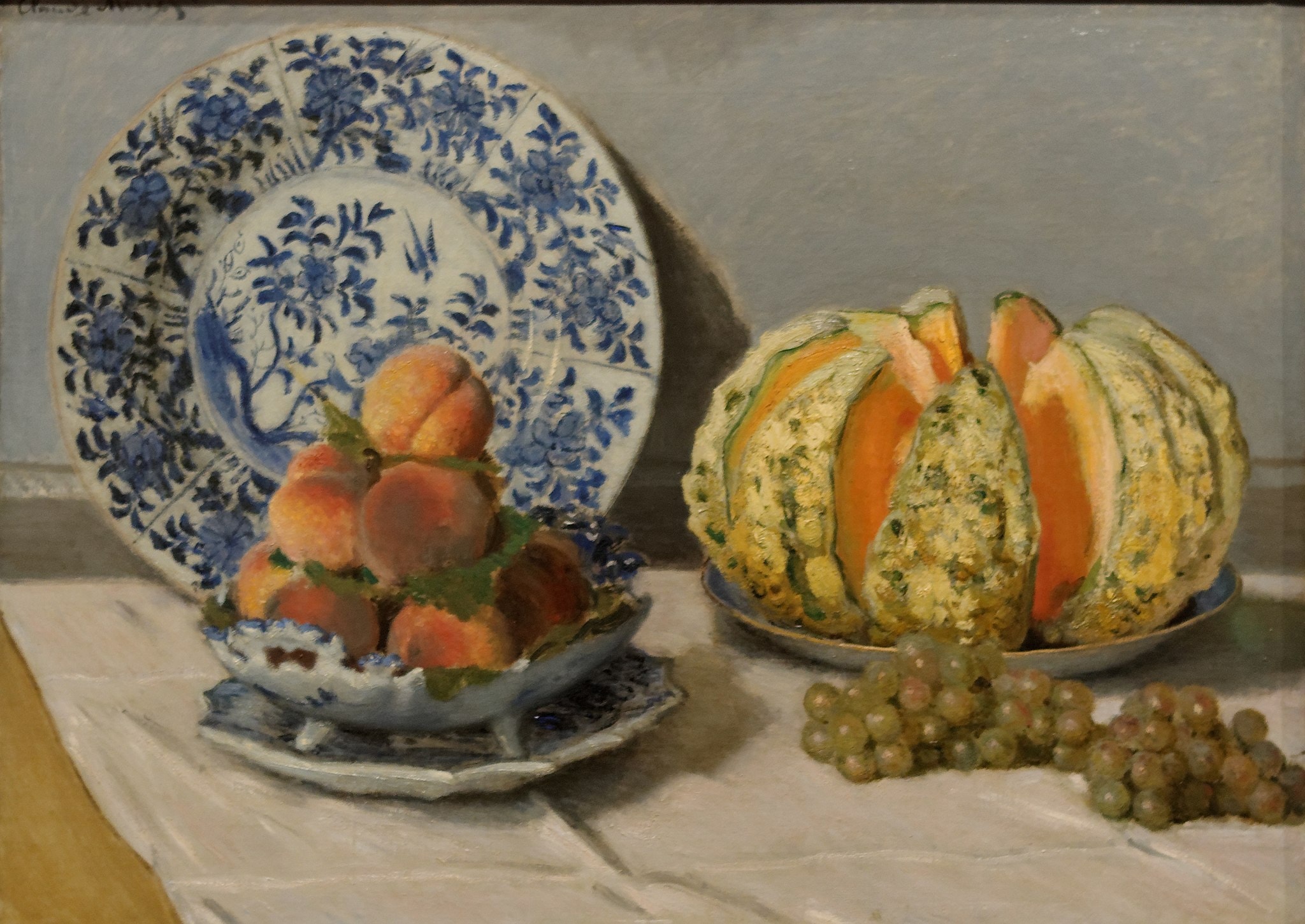
Claude Monet’s Still Life (1872) stages ripe peaches, a cut melon, and scattered grapes before luminous blue-and-white porcelain, turning a domestic spread into a drama of light and texture. Cool ceramics and a pale wall frame the warm, tactile fruit, while firm contours yield to buttery impasto on the melon’s rind. The painting renews a venerable genre through an Impressionist focus on perception and chromatic contrast [1][2].
💰

Market Value

$8-14 million

How much is Still Life worth?

Study Print Studio

Create a personal study print

Build a companion study sheet around the part of this painting that speaks to you most. Choose a detail, shape an interpretation, and walk away with something personal and display-worthy.

Fast Facts

Year
1872
Medium
Oil on canvas
Dimensions
53 x 73 cm
Location
Calouste Gulbenkian Museum, Lisbon
See all Claude Monet paintings in London
Still Life by Claude Monet (1872) featuring Blue-and-white porcelain charger, Footed compote dish, Peaches, Cut melon

Click on any numbered symbol to learn more about its meaning

Meaning & Symbolism

Monet builds the picture around two blue-and-white porcelains: a large plate standing upright and a footed compote heaped with peaches. Their cool cobalt patterning throws the fruit’s oranges and pinks into relief, while a deep cast shadow arcs across the plate, anchoring the tabletop in observed daylight. To the right, a segmented melon opens like a crown, its bright orange flesh cupped by a pitted, yellow-green rind rendered with palpable impasto. Grapes spill across the white cloth in soft, silvery greens, their translucence pricked by mauve notes. These specific choices—upright charger, footed dish, cut fruit, white linen—belong to an 18th–19th‑century still-life vocabulary that Monet both inherits and updates. Where a Chardin might invite moral reflection through restraint, Monet emphasizes the act of seeing itself: the compote rim is crisply stated, but the melon’s rind dissolves into loaded, broken strokes, letting paint mimic touch. That shift from line to facture turns the table into a theater of perception—cool glaze versus velvety peach skin, porcelain gleam versus absorbent cloth—so that matter becomes a record of light 12. The painting’s cultural signals compound this perceptual drama. Blue-and-white wares, whether Chinese export or European chinoiserie, were emblems of modern bourgeois refinement in 19th‑century France, collected and displayed as indices of cosmopolitan taste amid a vogue for East Asian design. By pairing such porcelain with seasonal produce, Monet situates domestic pleasure within a global material circuit, yet keeps the scene intimate and unpretentious 4. The fruit carries historically plausible, lightly worn associations: peaches whisper of youth and tenderness; grapes of sociability and wine; and the cut melon—its flesh exposed and perishable—suggests sweetness measured against time. Monet does not press these into allegory. Instead, he lets the motif’s tradition hum in the background while the surface insists on the present tense of looking, echoing the modern still-life turn in Manet and resonating with Monet’s own intermittent returns to melon subjects later in the decade 256. Painted in 1872 at Argenteuil, as Impressionism cohered, Still Life brings plein‑air lessons indoors: natural light shapes the shadowed plate; chromatic complements stage a controlled vibration; and the brush records fact as sensation. That fusion—classical arrangement tuned to modern optics—explains why Still Life is important: it demonstrates, on a modest table, Monet’s broader program to make vision itself the subject of painting 123.

Explore Deeper with AI

Ask questions about Still Life

Popular questions:

Powered by AI • Get instant insights about this artwork

💬 Ask questions about this artwork!

Interpretations

Global Taste and the Imperial Table

The painting’s blue‑and‑white porcelains do more than decorate; they place the Argenteuil table within 19th‑century Europe’s craze for Chinese‑style wares and Japoniste design. In Victorian and French interiors, “old blue” functioned as a portable emblem of cultivated taste, a collectible sustained by long‑running trade and imitation across empires. Monet’s pairing of these wares with local fruit turns the still life into a node of exchange—a quiet register of global circulation set against domestic calm. Rather than a didactic critique, the work naturalizes cosmopolitan desire within everyday life, showing how imported motifs became visual shorthand for refinement in middle‑class homes 13.

Source: Victoria and Albert Museum; Calouste Gulbenkian Museum (Google Arts & Culture)

Plein‑Air Indoors: Optics on a Tabletop

Painted in Argenteuil as Impressionism cohered, the work translates outdoor lessons to an indoor set‑up: the plate’s cast shadow behaves like observed daylight, while chromatic complements (orange fruit against cobalt patterns) create a measured vibration. This is not merely a studio confection but a controlled experiment in the physics of perception—light, reflection, and hue interaction—reinforced by Monet’s dialectic of crisp edges and dissolving passages. Seen against the Argenteuil project, where artists pursued transient effects on the Seine, the still life becomes a compact laboratory for Impressionist seeing, proving that modern optics could animate even a simple tea service 23.

Source: National Gallery of Art (The Impressionists at Argenteuil); Calouste Gulbenkian Museum (Google Arts & Culture)

Lineage and Revision: From Chardin to Manet to Monet

Monet’s ensemble nods to the 18th–19th‑century still‑life vocabulary—upright charger, compote, cut melon—yet his facture revises the tradition. Where Chardin’s cut melons imply restrained sensuality, Monet literalizes sensation in paint: the melon’s rind becomes a field of impastoed touch, a modern answer to Chardin’s moral quiet. In parallel, Manet’s melon‑and‑peaches still life refreshes the genre with immediacy and tonal audacity. Monet positions himself within this lineage but pivots the payoff toward perception itself: seeing, rather than symbol, does the rhetorical work. The result feels at once canonical and experimental—a classic motif re-authored through modern optics 736.

Source: National Gallery of Art (Manet, Still Life with Melon and Peaches); Calouste Gulbenkian Museum (Google Arts & Culture); Christie’s (scholarly lot notes)

Cycles of Making: 1872 as Prelude to 1879–80

This 1872 tabletop is a precocious trial for the cluster of melon still lifes Monet paints in 1879–80, when personal loss and market pressures steered him toward saleable, controllable motifs. By contrast, W.245 shows an early, less market‑driven curiosity about the genre’s optical potential. Comparing the two moments clarifies strategy: later melons become a sustained motif—scaled, repeated, and varied—while the 1872 canvas reads as an exploratory hinge between landscape practice and indoor experiment. The recurrence underscores how still life served Monet as both economic buffer and formal laboratory, enabling rapid iterations on light, texture, and chromatic structure 45.

Source: Art Institute of Chicago (Online Scholarly Catalogues); Museum Barberini

Soft Symbolism without Allegory

Monet keeps allegory at bay yet lets fruit associations hum: peaches allude to youth and tenderness; grapes to conviviality and wine; the cut melon—“its flesh exposed and perishable”—to time-bound pleasure. Rather than emblem‑book clarity, these meanings remain atmospheric, activated by proximity to porcelain’s cool decorum. The domestic setting tempers sensual charge into civilized delight, a balance Chardin modeled and moderns recalibrated. Monet’s refusal to press the symbols hard is itself modern: sensation over sermon, presentness over parable. The painting thus sustains a double register—tactile immediacy for the eye, and faint iconographic echoes for the learned viewer 673.

Source: Christie’s (scholarly lot notes on Monet’s melon still lifes); National Gallery of Art (Manet comparator); Calouste Gulbenkian Museum (Google Arts & Culture)

Related Themes

About Claude Monet

Claude Monet (1840–1926) led Impressionism’s pursuit of open-air painting and optical immediacy, especially during his Argenteuil years focused on modern leisure and light. He later developed serial studies of changing conditions, culminating in the Water Lilies cycle [2].
View all works by Claude Monet

More by Claude Monet

Haystacks Series by Claude Monet | Light, Time & Atmosphere by Claude Monet

Haystacks Series by Claude Monet | Light, Time & Atmosphere

Claude Monet

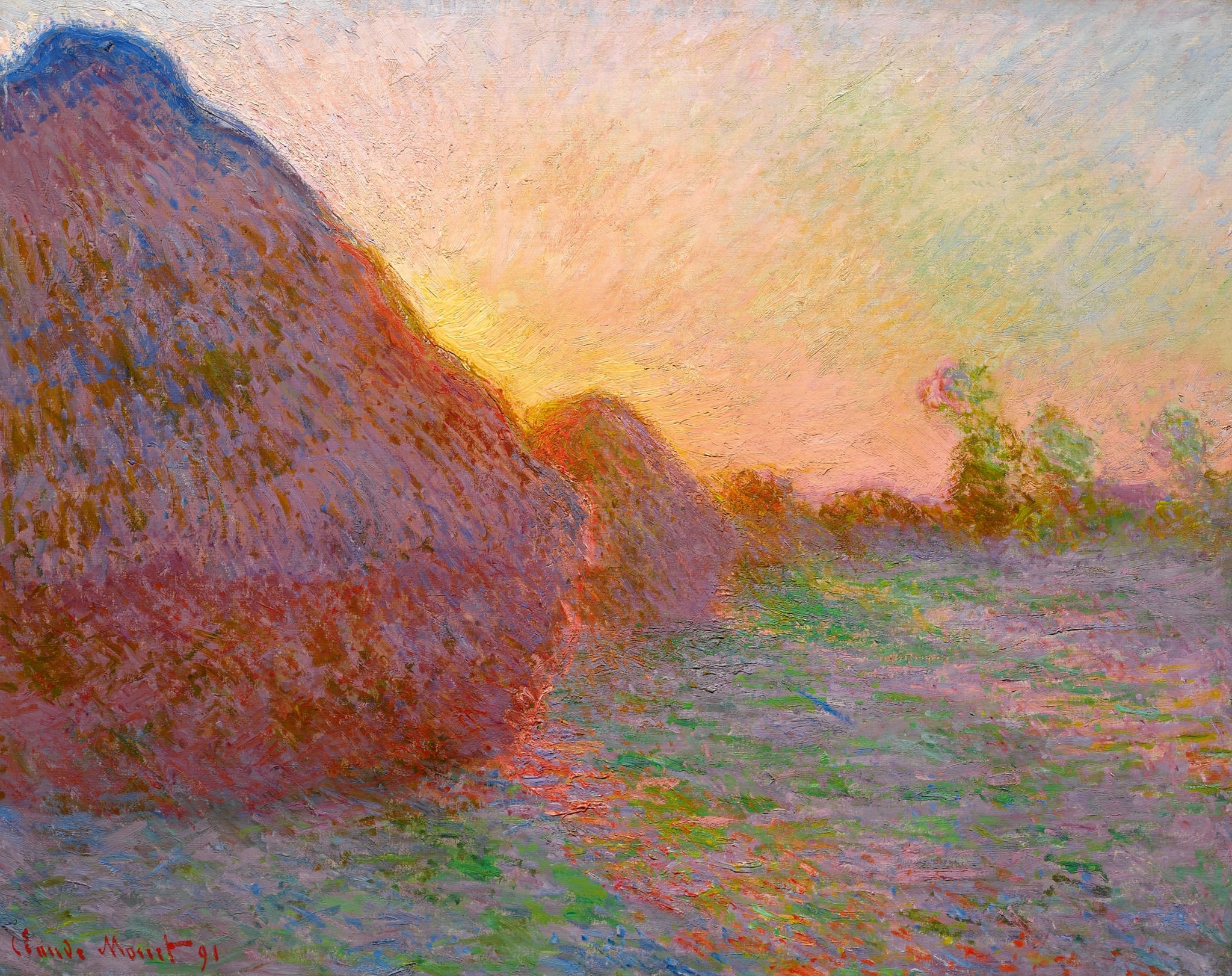
Claude Monet’s <strong>Haystacks Series</strong> transforms a routine rural subject into an inquiry into <strong>light, time, and perception</strong>. In this sunset view, the stacks swell at the left while the sun burns through the gap, making the field shimmer with <strong>apricot, lilac, and blue</strong> vibrations.
Women in the Garden by Claude Monet

Women in the Garden

Claude Monet (1866–1867)

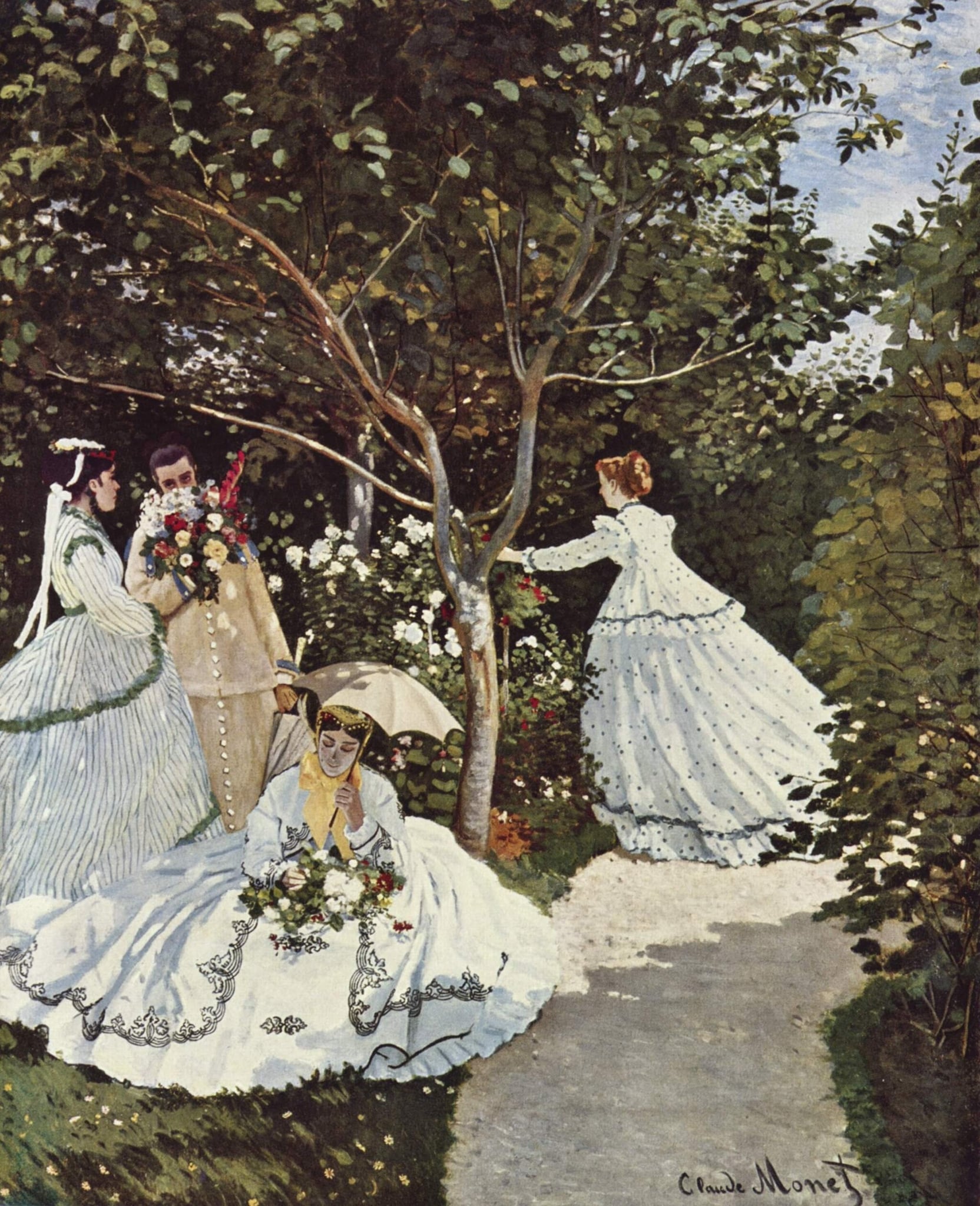
Claude Monet’s Women in the Garden choreographs four figures in a sunlit bower to test how <strong>white dresses</strong> register <strong>dappled light</strong> and shadow. The path, parasol, and clipped flowers frame a modern ritual of leisure while turning fashion into an instrument of <strong>perception</strong>. The scene reads less as portraiture than as a manifesto for painting the <strong>momentary</strong> outdoors <sup>[1]</sup><sup>[3]</sup>.
The Train in the Snow (The Locomotive) by Claude Monet

The Train in the Snow (The Locomotive)

Claude Monet (1875)

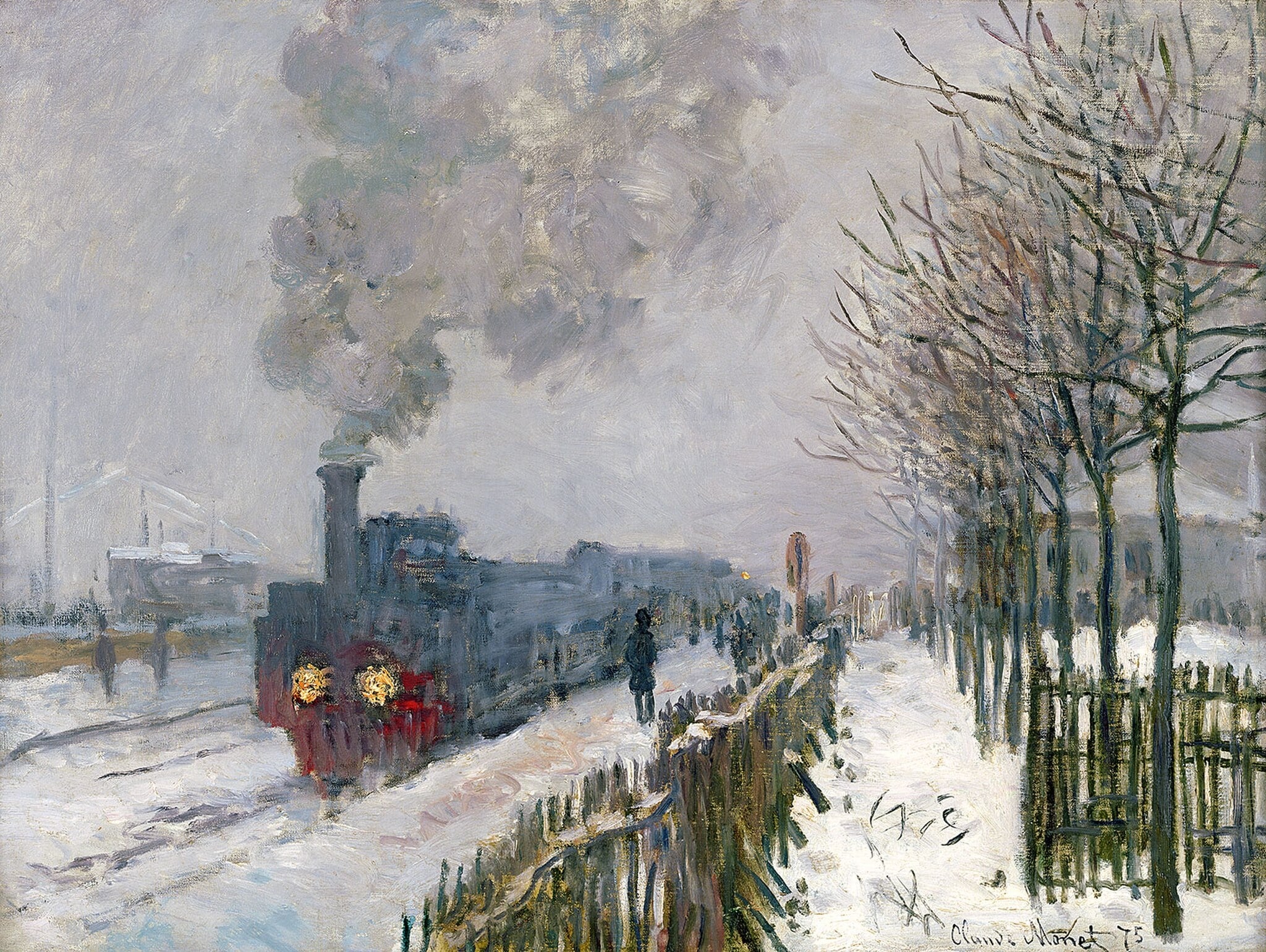
Claude Monet’s The Train in the Snow (The Locomotive) (1875) turns a suburban winter platform into a study of <strong>modernity absorbed by atmosphere</strong>. The engine’s twin yellow headlights and a smear of red push through a world of greys and violets as steam fuses with the low sky, while the right-hand fence and bare trees drill depth and cadence into the scene <sup>[1]</sup><sup>[4]</sup>. Monet fixes not an object but a <strong>moment of perception</strong>, where industry seems to dematerialize into weather <sup>[1]</sup><sup>[2]</sup>.
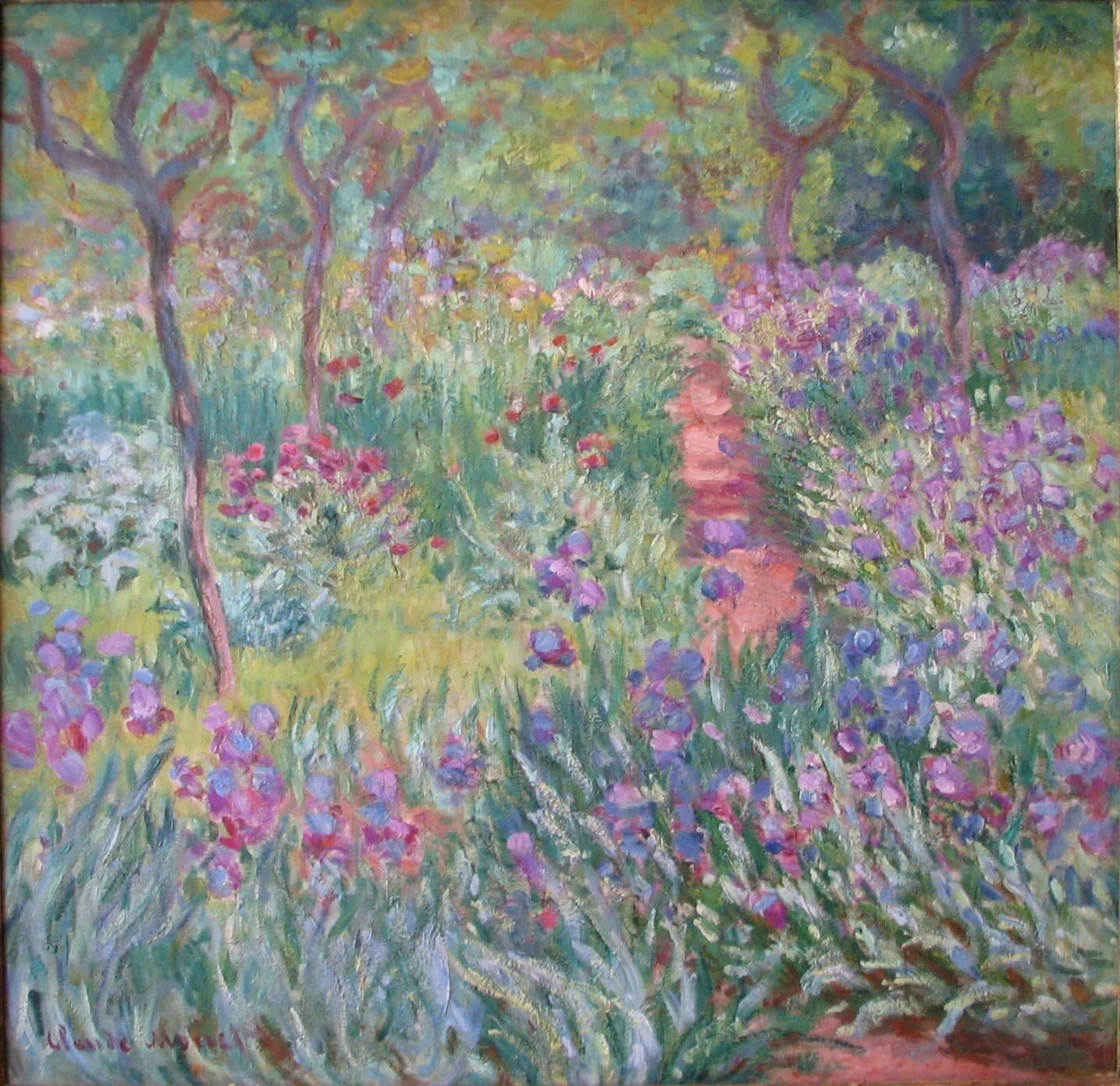
The Artist's Garden at Giverny by Claude Monet

The Artist's Garden at Giverny

Claude Monet (1900)

In The Artist's Garden at Giverny, Claude Monet turns his cultivated Clos Normand into a field of living color, where bands of violet <strong>irises</strong> surge toward a narrow, rose‑colored path. Broken, flickering strokes let greens, purples, and pinks mix optically so that light seems to tremble across the scene, while lilac‑toned tree trunks rhythmically guide the gaze inward <sup>[1]</sup><sup>[3]</sup>.
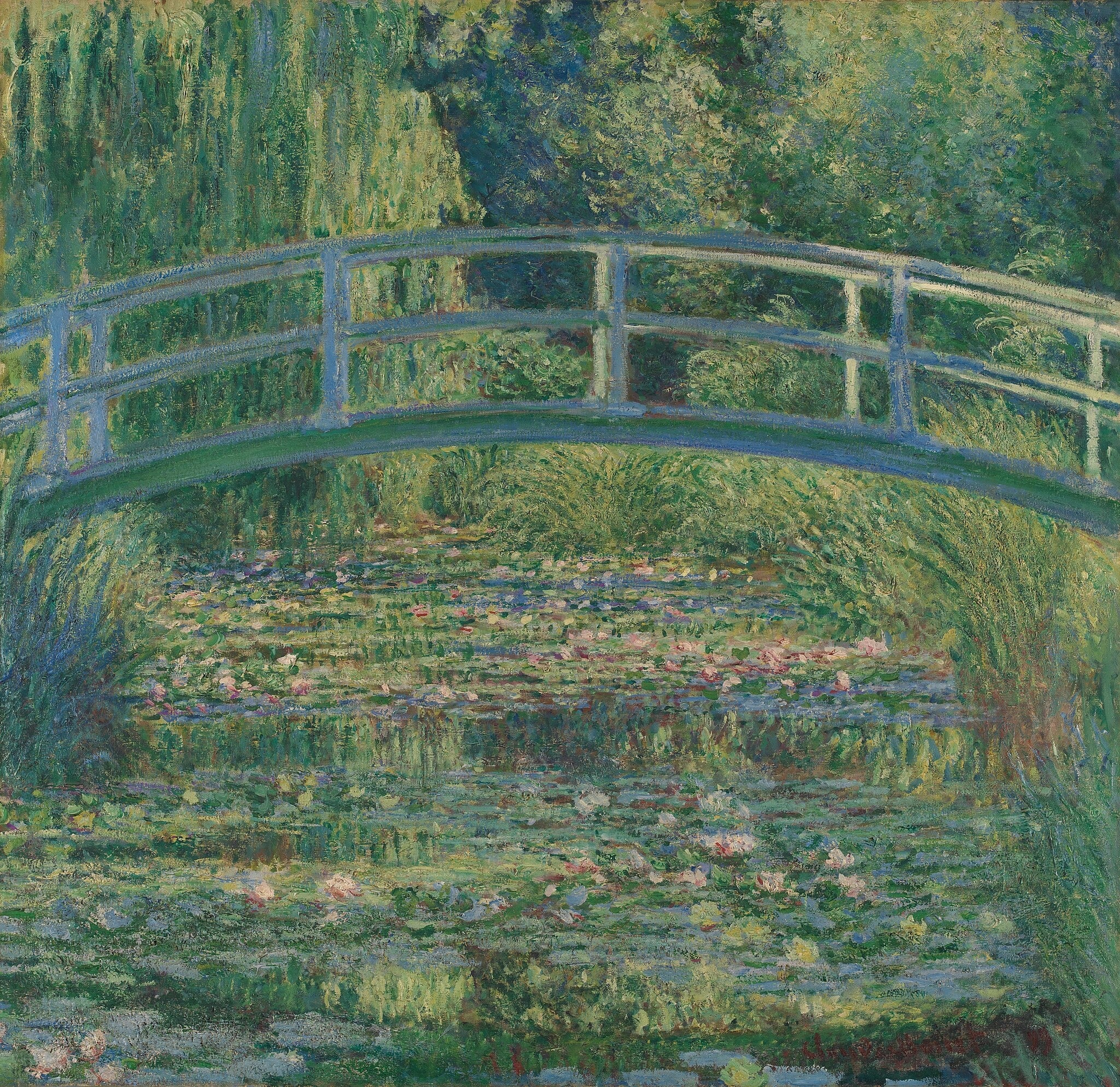
Water Lilies by Claude Monet

Water Lilies

Claude Monet (1899)

<strong>Water Lilies</strong> centers on an arched <strong>Japanese bridge</strong> suspended over a pond where lilies and rippling reflections fuse into a single, vibrating surface. Monet turns the scene into a study of <strong>perception-in-flux</strong>, letting water, foliage, and light dissolve hard edges into atmospheric continuity <sup>[1]</sup><sup>[3]</sup>.
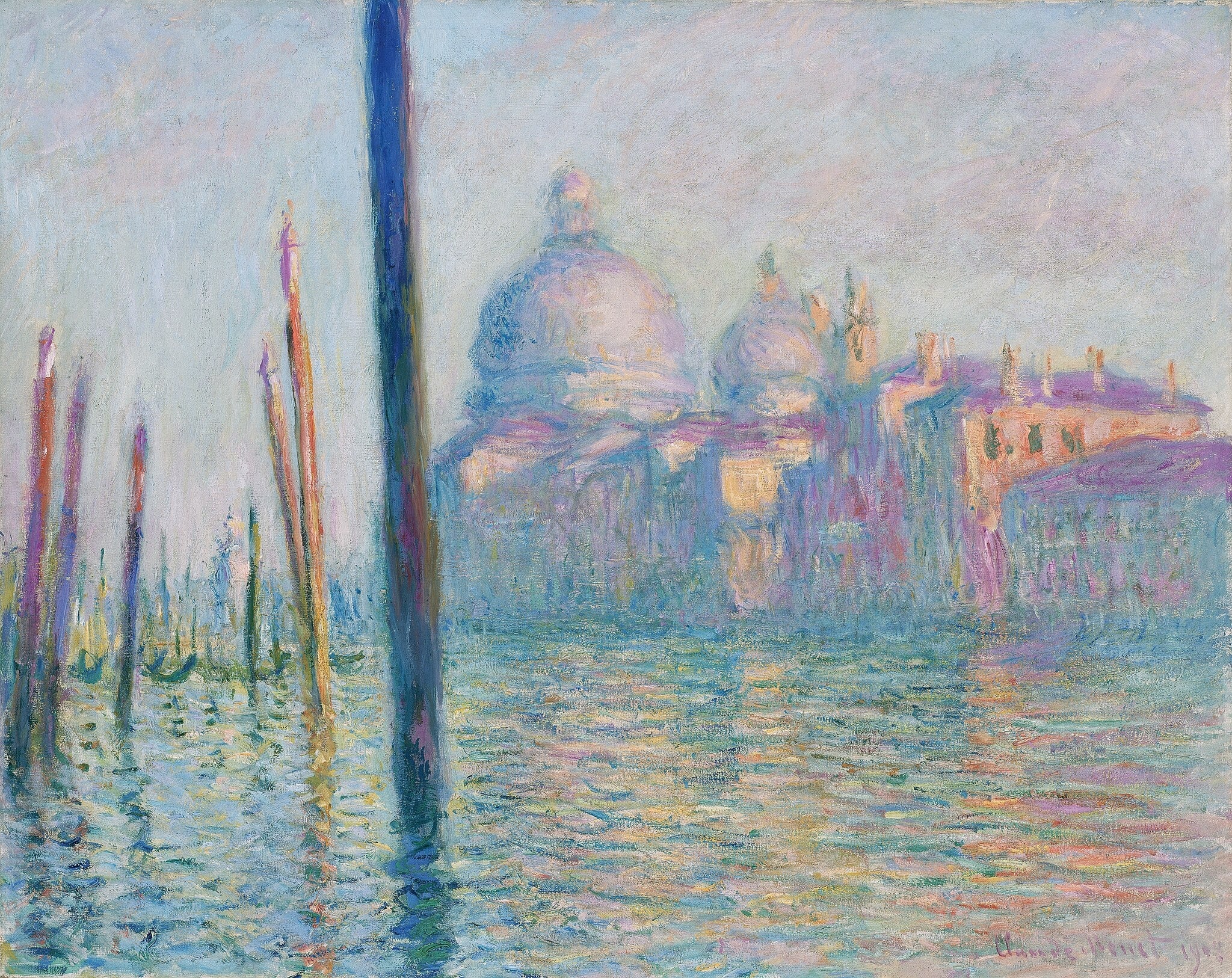
The Grand Canal by Claude Monet

The Grand Canal

Claude Monet (1908)

Claude Monet’s The Grand Canal turns Venice into <strong>pure atmosphere</strong>: the domes of Santa Maria della Salute waver at right while a regiment of <strong>pali</strong> stands at left, their verticals reverberating in the water. The scene asserts <strong>light over architecture</strong>, transforming stone into memory and time into color <sup>[2]</sup><sup>[3]</sup>.