Palm Trees at Bordighera

by Claude Monet

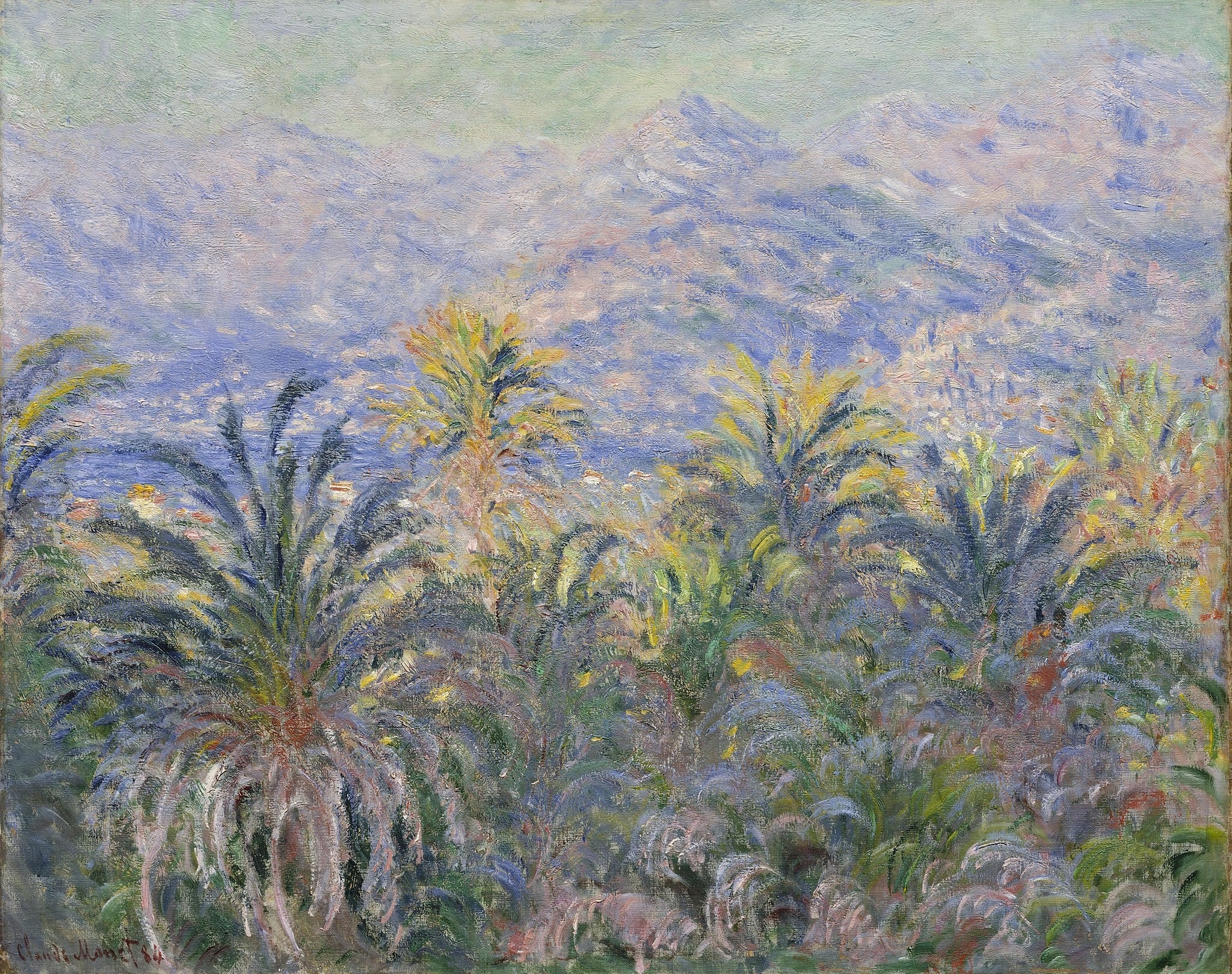
Claude Monet’s Palm Trees at Bordighera (1884) turns a Riviera grove into vibrating atmosphere: palm fronds surge across the foreground while a cobalt sea and violet-blue Alps dissolve into a misted sky. Monet pushes cool mauves, blues, and lemon tints into broken strokes so the scene reads as light-in-motion rather than botany [1][2].
💰

Market Value

$10-14 million

How much is Palm Trees at Bordighera worth?

Fast Facts

Year
1884
Medium
Oil on canvas
Dimensions
64.8 × 81.3 cm
Location
The Metropolitan Museum of Art, New York
See all Claude Monet paintings in New York
Palm Trees at Bordighera by Claude Monet (1884) featuring Palm fronds (foreground screen), Cobalt sea band, Violet-blue Alps, Curved, rhythmic brushstrokes

Click on any numbered symbol to learn more about its meaning

Meaning & Symbolism

Monet composes Palm Trees at Bordighera as a three-tier field of sensation: a massed screen of palms pressed to the picture plane; a slim, cobalt band of sea with flecks of ochre and coral; and a wide mantle of violet-blue mountains melting into pale, greenish sky. The palms are not catalogued specimens but rhythmic marks—curved, overlapping strokes of emerald, slate, lilac, and lemon that flutter like script. Their arcs echo the low wavelets of the sea and the scalloped ridges of the Alps, turning foliage, water, and rock into a continuous syntax of movement. In place of crisp edges, Monet lays wet-over-wet passages and scumbled veils, so forms cohere only as the eye adjusts, enacting the very act of looking in fierce Mediterranean light. This decision aligns with his letters from the trip, where he admits the radiance demanded “all the tones of pink and blue,” as if only chromatic daring could meet the glare he faced 12. Foreground density is the painting’s thesis. The nearest palms surge upward, their cool, mauve-touched fronds catching flashes of lemon and rose—accents that tilt the whole register toward shimmering contrast rather than sunburnt brightness. In doing so, Monet flips a traveler’s cliché of southern ‘heat’: the sensation of heat is made to feel cool, vibrating, and airy. Mid-distance details—tiny warm dabs that may suggest tiled roofs along the Bay of Ventimiglia—are intentionally suppressed beneath the vegetal screen, a choice scholars identify across the Bordighera series, where architecture and even the spectacular coastline become mere supports for the study of tangled growth 23. The mountains at the horizon dissolve into lilac haze, achieving the atmospheric gradation the Met notes: a soft evanescence in which distance becomes time—an index of looking, not mapping 1. The result is an optical hierarchy in which immediacy (the fronds’ flicker) overrules description (topography), declaring that what matters is how the place feels in a glance. As context, the palm motif carried connotations of the Riviera’s cultivated ‘exotic’ modernity—Bordighera’s famed gardens and nursery culture made palms civic emblems—yet Impressionist method resists fixed allegory 34. Monet therefore uses palms not as symbols of victory or oasis but as a modern, challenging form whose spiky arcs and tufted crowns let him test high-key complements under blinding sun. The curved, calligraphic fronds act like vectors for wind and light, embodying vitality and resilience without narrative program. This emphasis on designed or cultivated nature anticipates Monet’s lifelong project at Giverny, where he would orchestrate vegetation to serve perception itself 24. In short, why Palm Trees at Bordighera is important: it captures a turning point where travel, horticulture, and Impressionist optics converge, pushing Monet toward a new language of dense, animated surfaces that transform landscape from site into sensation 124.

Explore Deeper with AI

Ask questions about Palm Trees at Bordighera

Popular questions:

Powered by AI • Get instant insights about this artwork

💬 Ask questions about this artwork!

Interpretations

Historical Context

Monet’s 1884 sojourn on the Ligurian coast was a targeted search for new motifs and Mediterranean light. Letters from the trip describe glare that demanded “all the tones of pink and blue,” even a “palette of diamonds,” signaling a recalibration of chroma and value for southern conditions 16. Crucially, Bordighera’s famed gardens (notably the Moreno estate) offered access to cultivated palms and citrus, aligning the project with the Riviera’s horticultural modernity and tourism boom 3. The Met identifies the view toward the Bay of Ventimiglia and the Alps, yet those landmarks recede behind foliage, consonant with accounts that Monet reduced architecture and coastline to subordinate roles across the campaign 12. The canvas thus materializes a moment when travel infrastructure, garden culture, and plein-air experiment converged to extend Impressionism’s range.

Source: The Metropolitan Museum of Art; Art Institute of Chicago; Wildenstein Plattner Institute

Formal Analysis

The picture’s logic is an optical hierarchy: tactile, calligraphic fronds dominate, while sea and mountains resolve into soft, receding bands. Monet’s wet-over-wet passages and scumbled veils trade contour for vibration, requiring the eye to knit strokes into form—what the Met frames as an answer to Mediterranean radiance 1. Cool lilacs and violets, pricked by lemon and rose, produce “shimmering” contrast rather than heat-scorched glare, a chromatic inversion that keeps the surface aerated even at maximum density. Repetition of arcs—fronds, wavelets, Alpine ridges—creates a unifying rhythm that substitutes syntax (brushstroke sequences) for linear perspective. The result is less a mapped vista than a field of forces, where hue, value, and mark-making orchestrate depth and motion.

Source: The Metropolitan Museum of Art

Exoticism and Garden Modernity

While Impressionism resists programmatic symbolism, Bordighera’s palms carried contemporary meanings: they were civic emblems and tourist lures, products of curated gardens that staged the Riviera as an exotic modernity 34. Exhibition scholarship stresses how such dense, non-classical vegetation furnished modern garden subjects, prefiguring Monet’s horticultural authorship at Giverny—designing nature to serve perception 4. Richard Thomson argues that discovering mimosa, palms, and intense southern light catalyzed Monet’s shift toward garden-centered modernism 5. In Palm Trees at Bordighera, the palm is not an allegory but a formal provocation—spiky silhouettes and tufted crowns that test complementary contrasts under fierce sun—embedding global plant circulations within an avant-garde pictorial experiment.

Source: Royal Academy of Arts; Wildenstein Plattner Institute; Richard Thomson

Phenomenology of Light

Monet stages looking itself: forms “cohere only as the eye adjusts,” a phenomenological script in which vision is a time-based assembly of chromatic incidents 1. The cool mauve–blue register contradicts the touristic equation of the South with burning warmth, letting flickers of lemon and coral articulate glare without bleaching local color. This aligns with Monet’s confession that Mediterranean brilliance forced unprecedented color daring—the famous “palette of diamonds” remark 6. Instead of mirage or haze as metaphor, the painting offers a procedural account of perception: atmospheric gradation and stroke-accumulation become the mechanics by which distance and immediacy are felt, turning landscape into a study of appearance-in-formation.

Source: The Metropolitan Museum of Art; Fondation Beyeler

Serial Practice and Suppressed Topography

Across the Bordighera canvases, scholars note Monet’s tendency to let vegetal masses eclipse built forms, a move the AIC links to a sustained experiment with Mediterranean motifs over description 2. In this canvas, roofs and coastline flicker as warm dabs behind a palm screen; topography becomes a support for near-field agitation. WPI ties this to the campaign’s breadth—dozens of views from Ventimiglia to Menton—where repetition and variation allowed Monet to shift attention from site identity to painterly problems (color intervals, stroke rhythms) 3. The sea–mountain band secures orientation, but priority goes to immediacy—the fronds’ flicker—advancing a serial logic in which each canvas isolates and recombines variables of sensation rather than cataloguing places.

Source: Art Institute of Chicago; Wildenstein Plattner Institute

Tourism, Leisure, and the Riviera Image

Bordighera’s palms were assets of a leisure economy that sold the Riviera as a curated paradise; yet Monet overturns the “traveler’s cliché of southern ‘heat’” by cooling the palette and multiplying tonal transitions 1. This counter-cliché modernizes the tourist view: instead of a picturesque, legible prospect, viewers confront density and partial occlusion, akin to arriving within gardens rather than surveying them. Thomson situates this within fin‑de‑siècle taste for horticultural spectacle, where cultivated exotics framed modern leisure and visual novelty 5. Monet’s refusal to spotlight villas or promenades, while letting palms command the field, recasts leisure not as social display but as heightened seeing under extraordinary light.

Source: The Metropolitan Museum of Art; Richard Thomson

Related Themes

About Claude Monet

Claude Monet (1840–1926) led Impressionism’s pursuit of open-air painting and optical immediacy, especially during his Argenteuil years focused on modern leisure and light. He later developed serial studies of changing conditions, culminating in the Water Lilies cycle [2].
View all works by Claude Monet

More by Claude Monet

Boating by Claude Monet

Boating

Claude Monet (1887)

Monet’s Boating crystallizes modern leisure as a drama of perception, setting a slim skiff and two pale dresses against a field of dark, mobile water. Bold cropping, a thrusting oar, and the complementary flash of hull and foliage convert a quiet outing into an experiment in <strong>modern vision</strong> and the <strong>materiality of water</strong> <sup>[1]</sup><sup>[2]</sup>.

The Thames below Westminster by Claude Monet

The Thames below Westminster

Claude Monet (about 1871)

Claude Monet’s The Thames below Westminster turns London into <strong>light-made architecture</strong>, where Parliament’s mass dissolves into mist and the river shivers with <strong>industrial motion</strong>. Tugboats, a timber jetty with workers, and the rebuilt Westminster Bridge assert a modern city whose power is felt through atmosphere more than outline <sup>[1]</sup>.

Haystacks Series by Claude Monet | Light, Time & Atmosphere by Claude Monet

Haystacks Series by Claude Monet | Light, Time & Atmosphere

Claude Monet

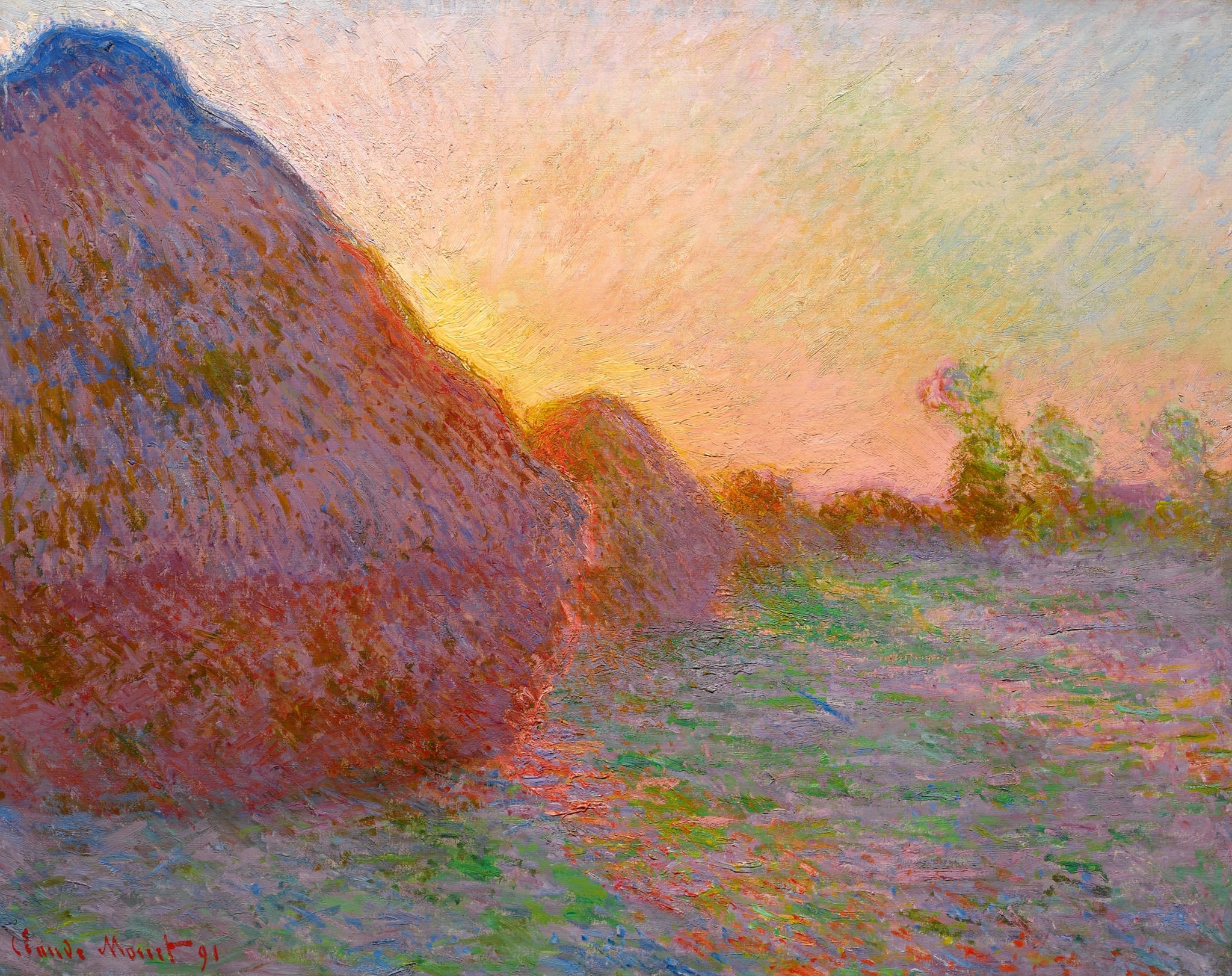
Claude Monet’s <strong>Haystacks Series</strong> transforms a routine rural subject into an inquiry into <strong>light, time, and perception</strong>. In this sunset view, the stacks swell at the left while the sun burns through the gap, making the field shimmer with <strong>apricot, lilac, and blue</strong> vibrations.
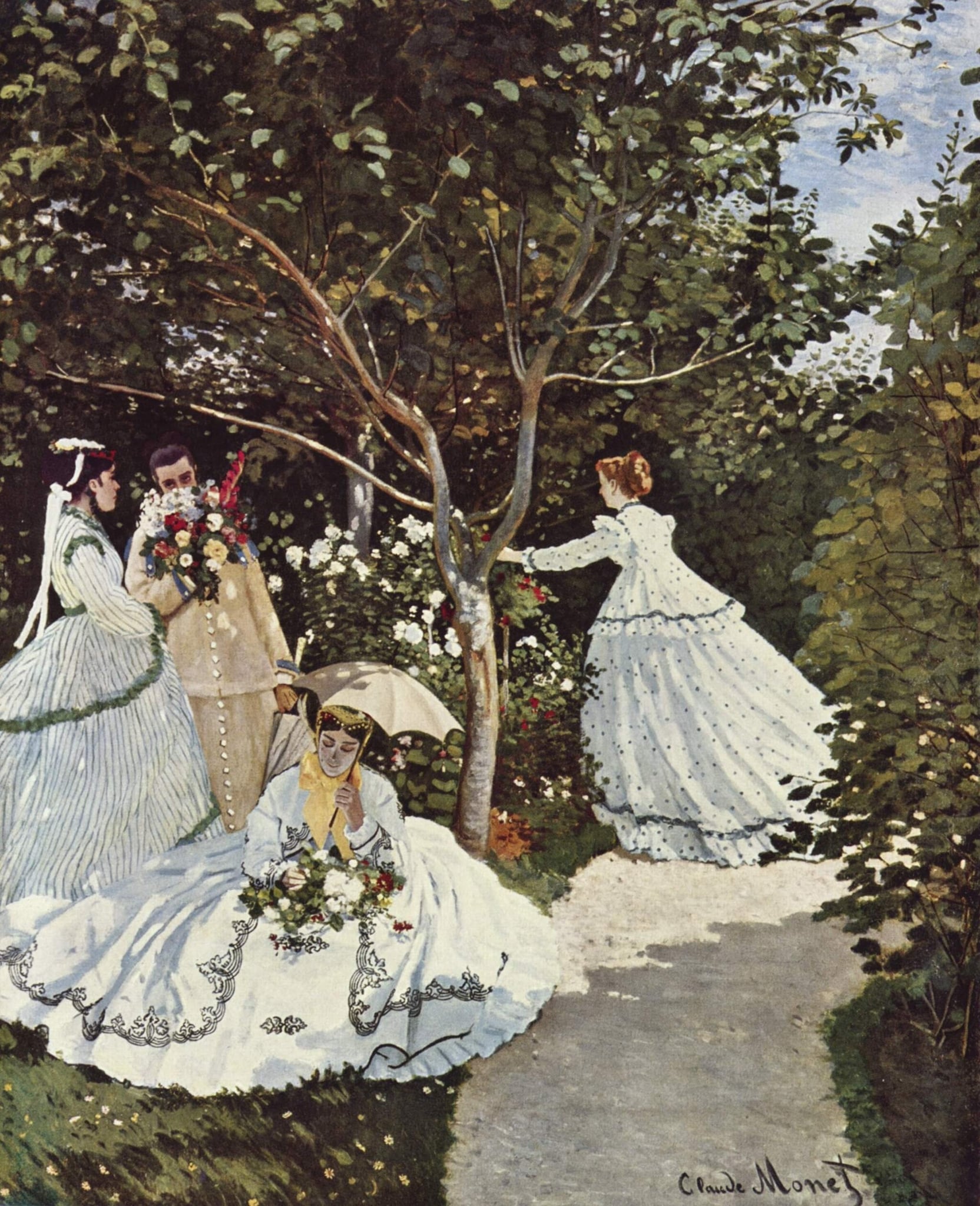
Women in the Garden by Claude Monet

Women in the Garden

Claude Monet (1866–1867)

Claude Monet’s Women in the Garden choreographs four figures in a sunlit bower to test how <strong>white dresses</strong> register <strong>dappled light</strong> and shadow. The path, parasol, and clipped flowers frame a modern ritual of leisure while turning fashion into an instrument of <strong>perception</strong>. The scene reads less as portraiture than as a manifesto for painting the <strong>momentary</strong> outdoors <sup>[1]</sup><sup>[3]</sup>.
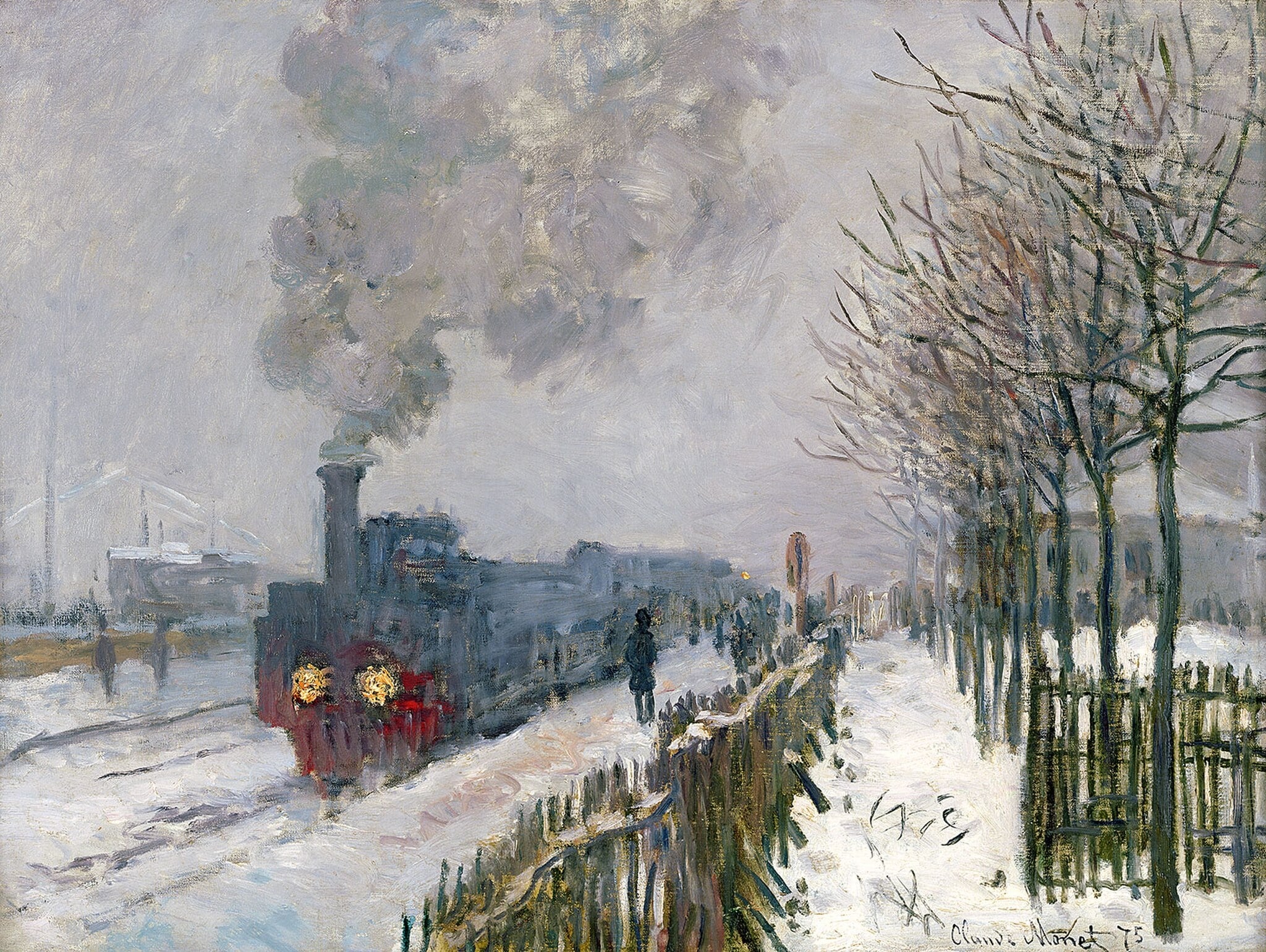
The Train in the Snow (The Locomotive) by Claude Monet

The Train in the Snow (The Locomotive)

Claude Monet (1875)

Claude Monet’s The Train in the Snow (The Locomotive) (1875) turns a suburban winter platform into a study of <strong>modernity absorbed by atmosphere</strong>. The engine’s twin yellow headlights and a smear of red push through a world of greys and violets as steam fuses with the low sky, while the right-hand fence and bare trees drill depth and cadence into the scene <sup>[1]</sup><sup>[4]</sup>. Monet fixes not an object but a <strong>moment of perception</strong>, where industry seems to dematerialize into weather <sup>[1]</sup><sup>[2]</sup>.
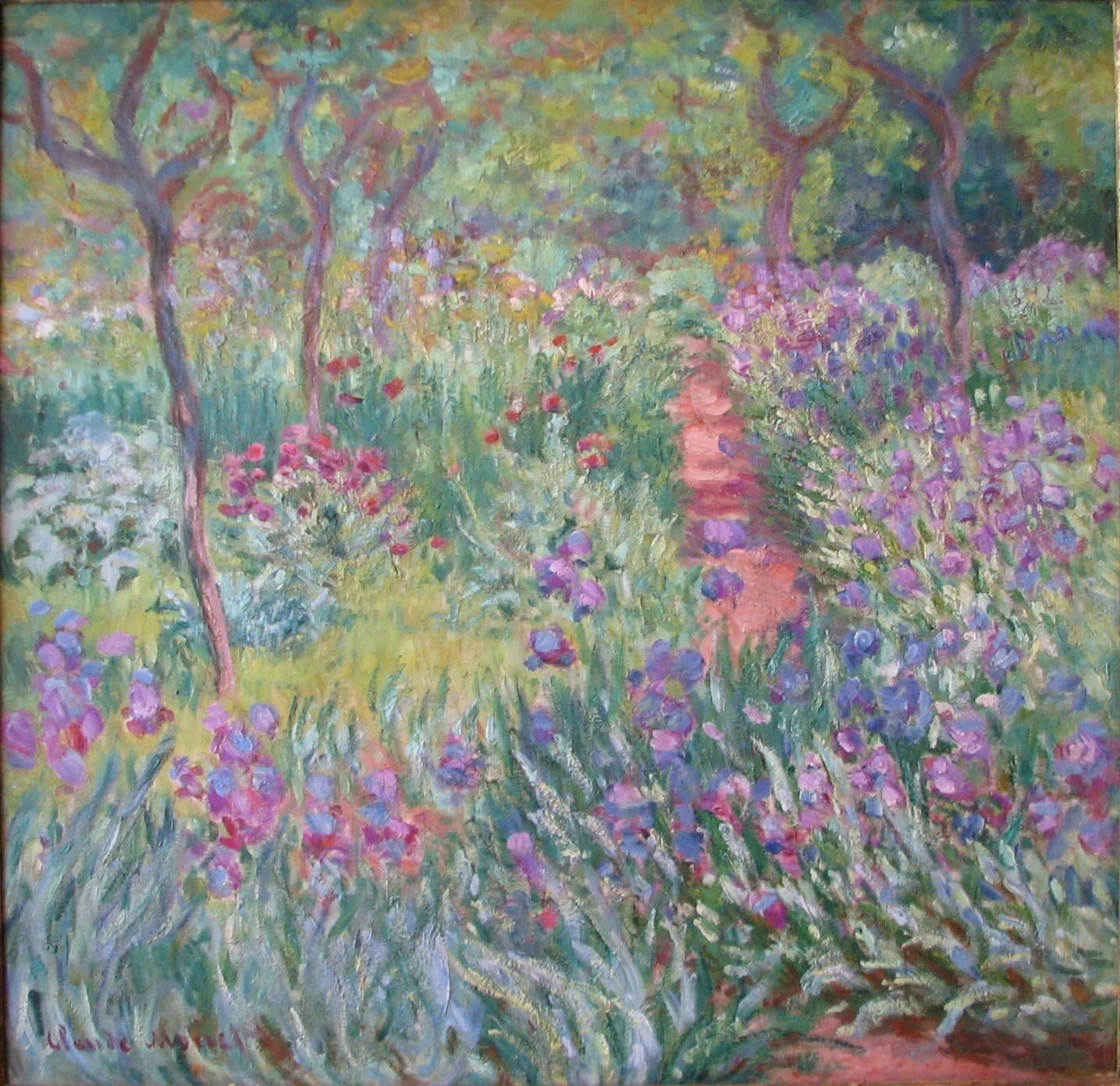
The Artist's Garden at Giverny by Claude Monet

The Artist's Garden at Giverny

Claude Monet (1900)

In The Artist's Garden at Giverny, Claude Monet turns his cultivated Clos Normand into a field of living color, where bands of violet <strong>irises</strong> surge toward a narrow, rose‑colored path. Broken, flickering strokes let greens, purples, and pinks mix optically so that light seems to tremble across the scene, while lilac‑toned tree trunks rhythmically guide the gaze inward <sup>[1]</sup><sup>[3]</sup>.