Tahitian Women on the Beach
by Paul Gauguin
Study Print Studio
Create a personal study print
Build a companion study sheet around the part of this painting that speaks to you most. Choose a detail, shape an interpretation, and walk away with something personal and display-worthy.
Fast Facts
- Year
- 1891
- Medium
- Oil on canvas
- Dimensions
- 69 x 91.5 cm
- Location
- Musée d’Orsay, Paris
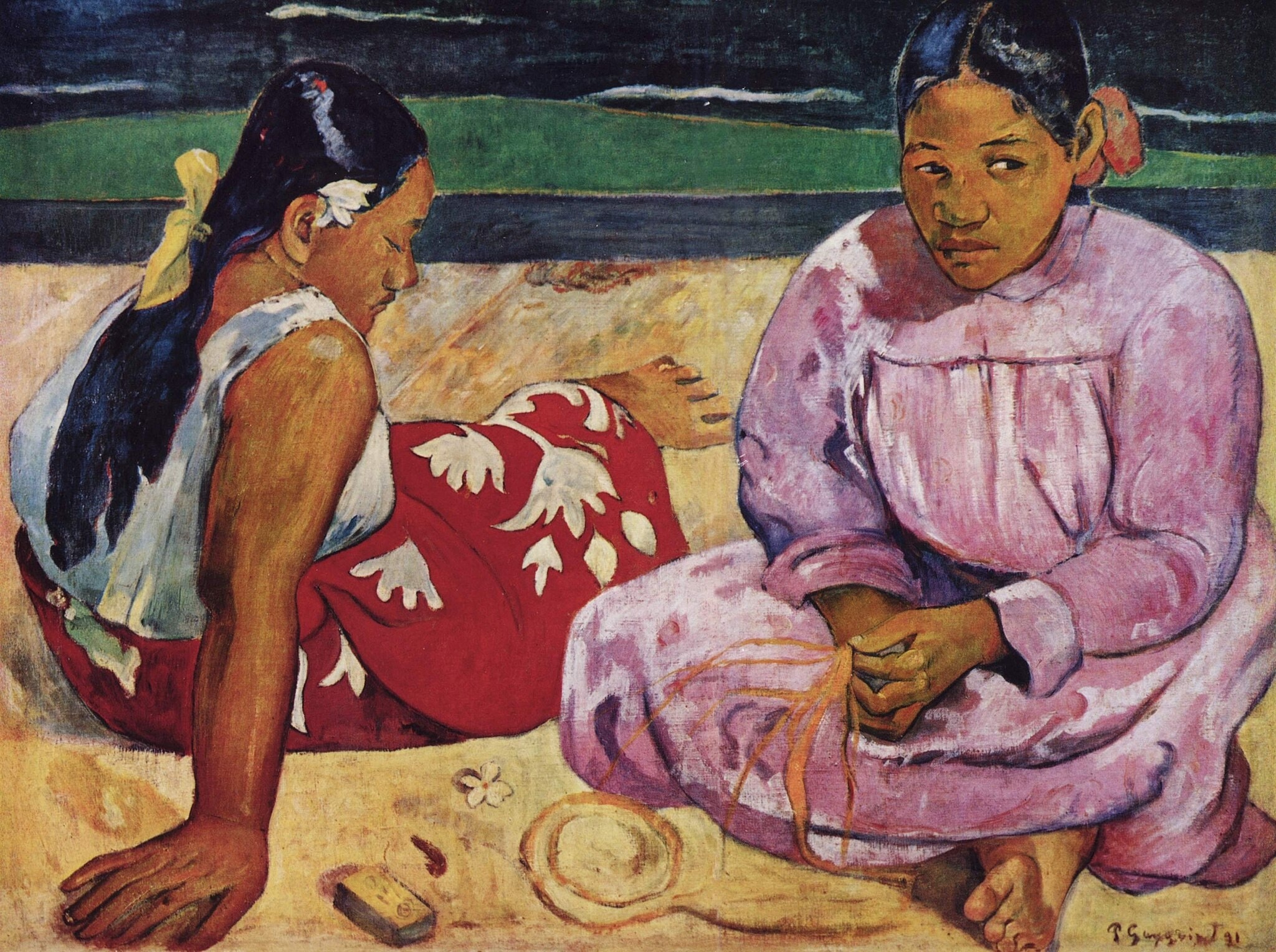
Click on any numbered symbol to learn more about its meaning
Meaning & Symbolism
Explore Deeper with AI
Ask questions about Tahitian Women on the Beach
Popular questions:
Powered by AI • Get instant insights about this artwork
Interpretations
Comparative Variant: Garment Toggling as Concept
Source: Musée d’Orsay; Staatliche Kunstsammlungen Dresden
Dress History & Respectability Politics
Source: Art Institute of Chicago
From Synthetism to Fauvism: A Formal Genealogy
Source: Musée d’Orsay; Encyclopaedia Britannica (Synthetism/Symbolism)
Postcolonial/Feminist Lens: Withheld Access
Source: Groundings (University of Glasgow); Musée d’Orsay
Semiotics of the Beach: A Tablet of Signs
Source: Musée d’Orsay; Encyclopaedia Britannica (Synthetism)
Liminal Psychology: Threshold Calm
Source: Réunion des Musées Nationaux–Grand Palais; Musée d’Orsay
Related Themes
About Paul Gauguin
More by Paul Gauguin
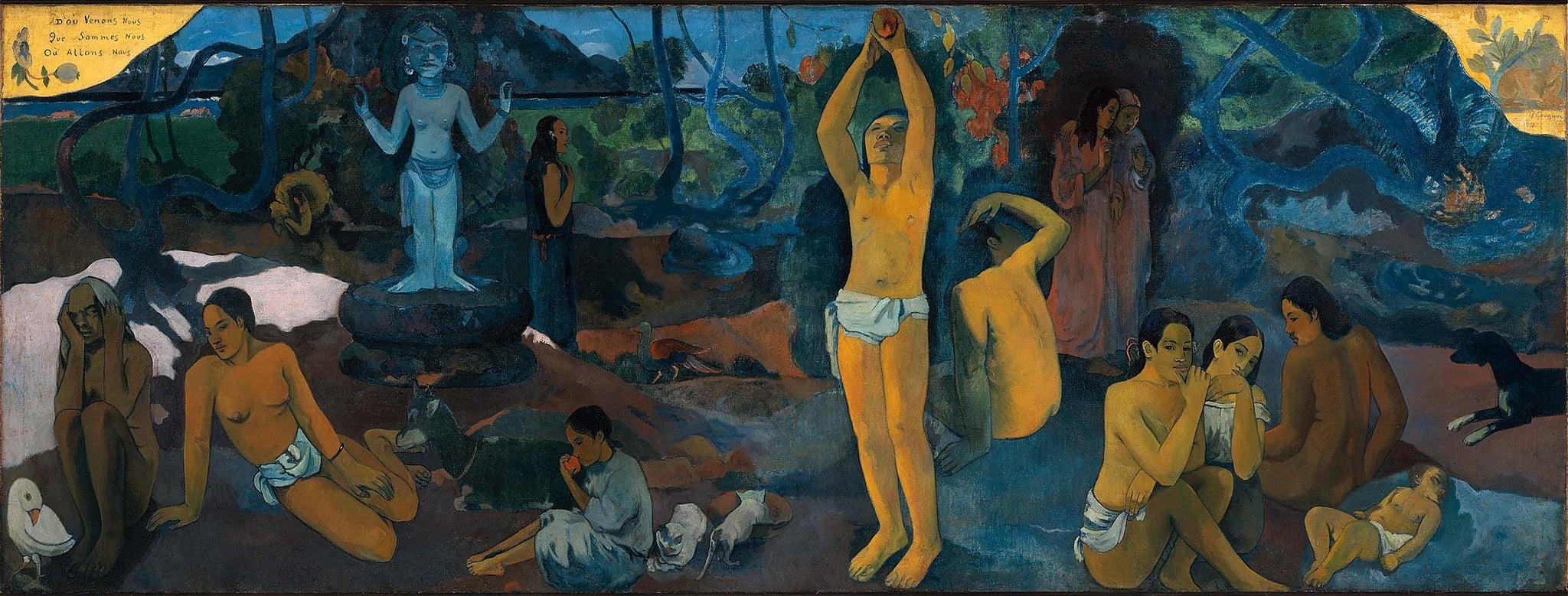
Where Do We Come From? What Are We? Where Are We Going?
Paul Gauguin (1897–1898)
A panoramic frieze staged in a Tahitian grove, Paul Gauguin’s Where Do We Come From? What Are We? Where Are We Going? unfolds right-to-left as a cycle of life, from an infant at the far right to an aged woman at the far left. Amid saturated blues and ochres, a central figure reaches for fruit and a pale-blue idol stands motionless, creating a theatre of <strong>origin, desire, and destiny</strong> that never resolves into a single answer.
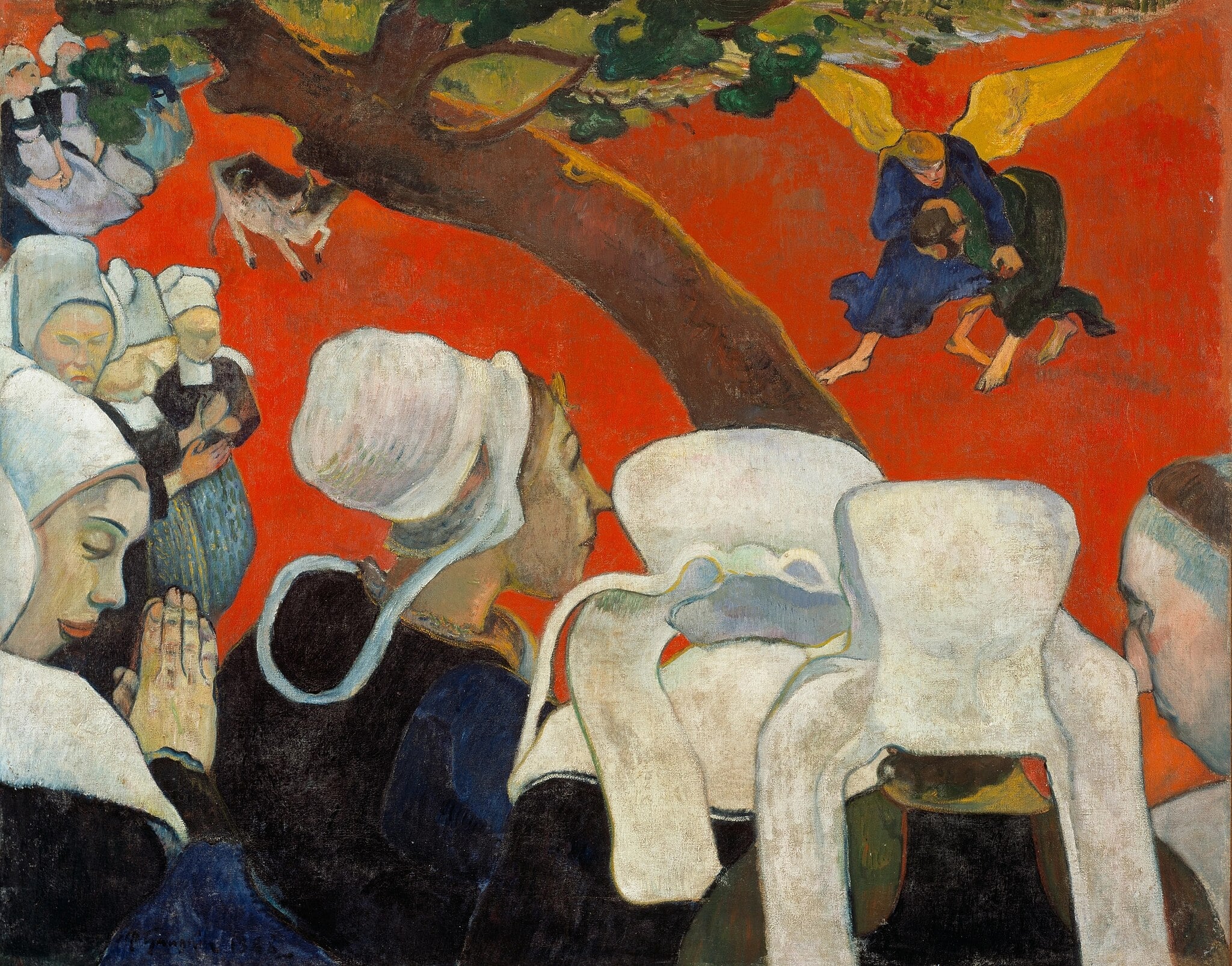
Vision After the Sermon
Paul Gauguin (1888)
Paul Gauguin’s Vision After the Sermon (1888) stages a divide between lived ritual and <strong>collective vision</strong>: Breton women pray in the foreground while, across a diagonal tree, Jacob wrestles an angel on a <strong>flat red field</strong>. With <strong>bold contours</strong> and <strong>non‑naturalistic color</strong>, Gauguin turns faith into pictorial form, making inner experience the painting’s true subject <sup>[1]</sup><sup>[2]</sup>.
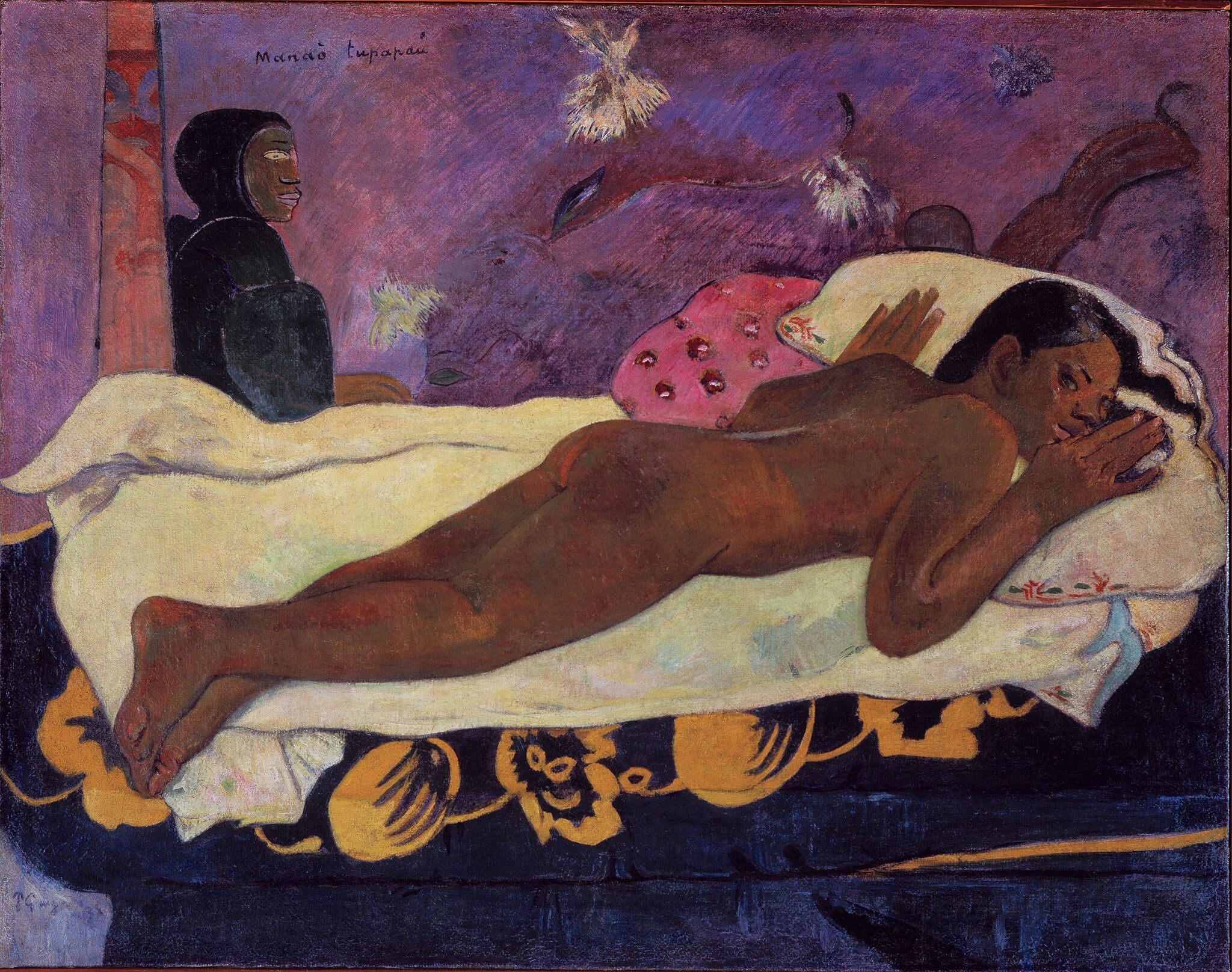
Spirit of the Dead Watching
Paul Gauguin (1892)
Spirit of the Dead Watching stages a nocturnal confrontation between a rigid, prone nude and a dark, hooded presence at the bed’s edge, fusing <strong>desire</strong> with <strong>dread</strong>. Flat patterns, cloisonné outlines, and violet-black fields convert the room into a symbolic plane where a Tahitian <strong>tupapaú</strong> may be either guardian or threat. The work crystallizes Gauguin’s Synthetist aim to make color and contour carry <strong>mythic psychology</strong> rather than mere description <sup>[1]</sup><sup>[2]</sup>.
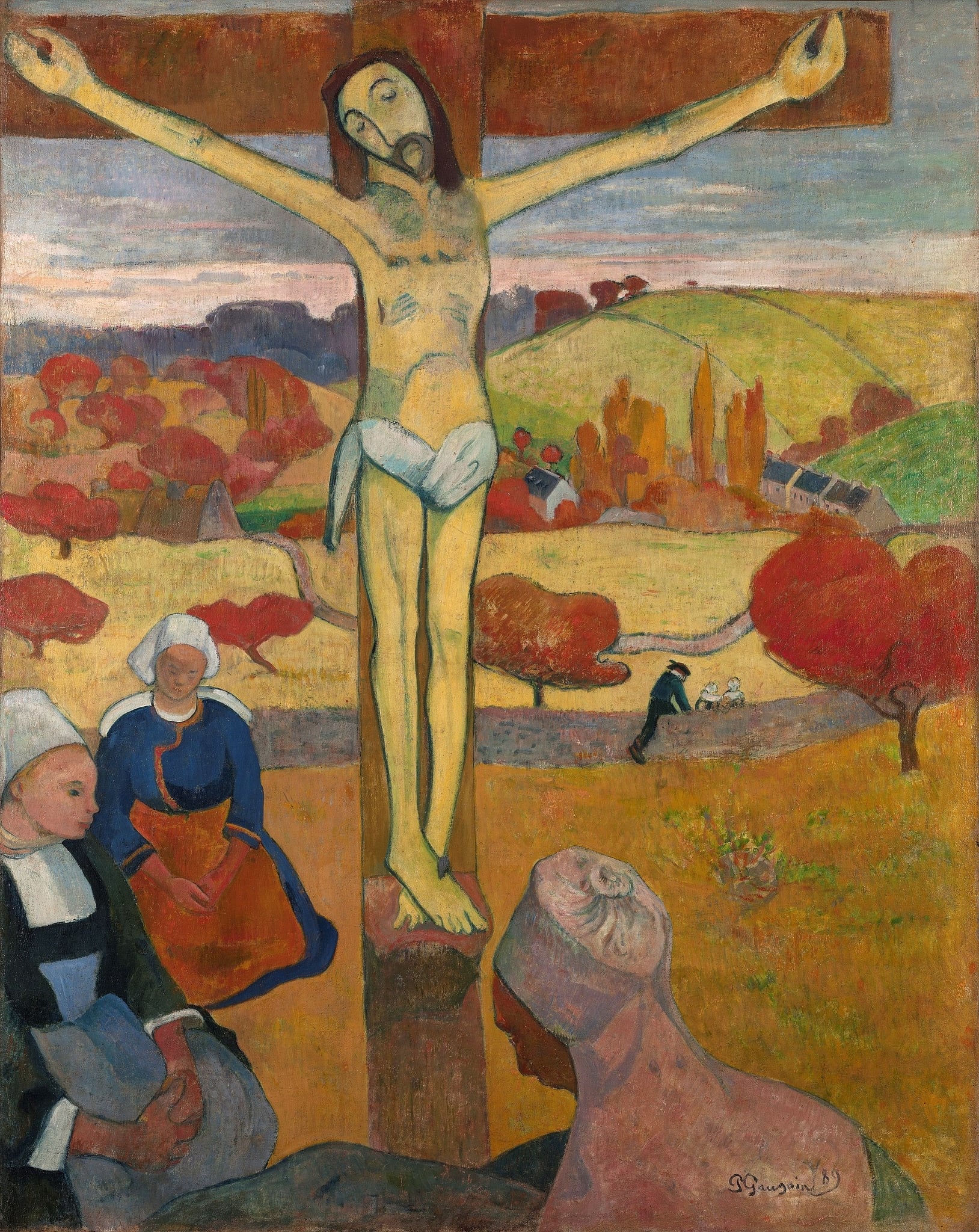
The Yellow Christ
Paul Gauguin (1889)
Paul Gauguin’s The Yellow Christ (1889) fuses sacred narrative with everyday Brittany, rendering a lemon‑<strong>yellow</strong> Christ in a rural autumn landscape. Through <strong>Synthetist</strong> color and <strong>Cloisonnist</strong> contours, the work declares spiritual meaning over naturalism, placing devotion among kneeling Breton women beneath a banded, hope‑tinged sky <sup>[1]</sup><sup>[3]</sup>.