How Much Is Tahitian Women on the Beach Worth?
Last updated: May 4, 2026
Quick Facts
- Methodology
- comparable analysis
A theoretical insured/replacement value for Paul Gauguin’s Tahitian Women on the Beach (1891, Musée d’Orsay) is estimated at $30–90 million. This range is derived from recent top‑tier Tahitian Gauguin auction benchmarks, reported private‑sale ceilings, and the dampening effect of long‑standing museum ownership on saleability.
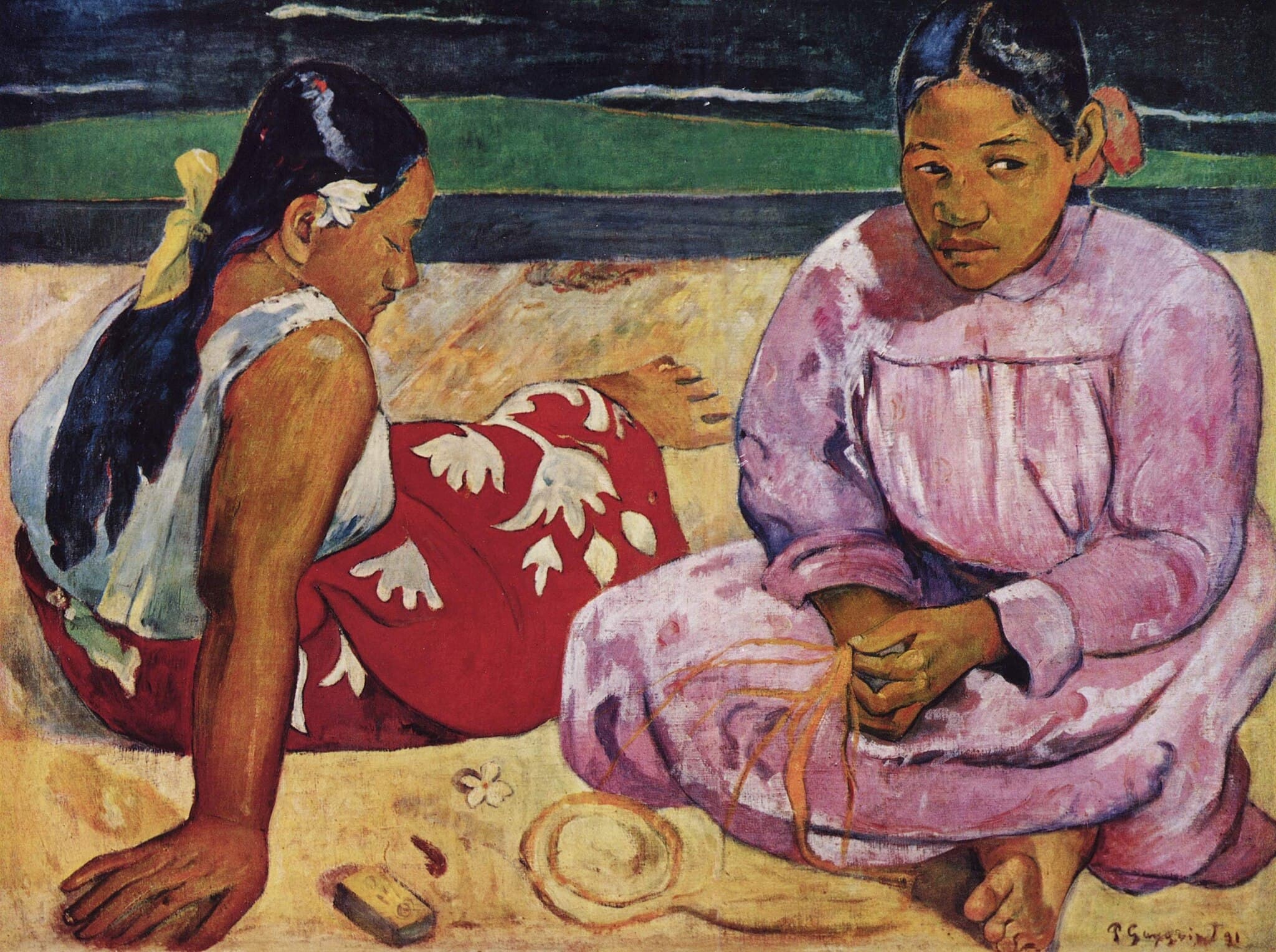
Tahitian Women on the Beach
Paul Gauguin, 1891 • Oil on canvas
Read full analysis of Tahitian Women on the Beach →Valuation Analysis
Valuation overview: I place a hypothetical market/insurance value for Paul Gauguin’s Tahitian Women on the Beach (1891) at approximately $30,000,000–$90,000,000. The range reflects calibrated comparables from Gauguin’s Tahitian period, most notably the public‑auction benchmark set by Maternité II in 2022 and widely reported private‑sale outliers, while explicitly accounting for the painting’s museum provenance and consequent lack of market liquidity [1][2].
Comparables and calibration: Recent public and private transactions for Gauguin’s Tahitian works set a broad market envelope. The Christie’s November 2022 sale of Maternité II established a new public auction high for Gauguin (reported ~US$105.7M), which indicates what top‑tier Tahitian compositions can achieve under optimal sale conditions [2]. Reported private transactions such as Nafea Faa Ipoipo have been cited at materially higher sums, though those figures remain opaque and should be used cautiously as upper‑bound evidence [3]. Using those anchors, I scaled down for relative factors — size, compositional importance, and the painting’s institutional ownership — to derive the $30–90M range.
Museum ownership and provenance: The work is accessioned RF 2765 at Musée d’Orsay and was donated to the French state in 1923; that provenance confirms authenticity and excellent custodial history but also means the work is not realistically available to the open market absent extraordinary circumstances or deaccession policy changes [1]. Museum status typically increases an insured/replacement valuation relative to a comparable private sale (because institutions prize public access and scholarship) while simultaneously reducing the liquidity premium a speculative private buyer might pay.
Condition, size and exhibition impact: The canvas (69 × 91.5 cm per Musée d’Orsay records) should be assessed by a current technical/condition report to refine the estimate; small but important condition issues can materially affect realized prices. Exhibition and publication history—if strong—would push value toward the upper bound; absent such credentials the painting is more likely to reside in the mid‑range of the estimate.
Conclusion and next steps: This is a hypothetical, market‑comparable valuation intended for insurance/replacement and strategic planning. To convert this into a formal insured value or a sale estimate, obtain: (a) the museum’s condition/conservation reports and any internal valuation they are willing to disclose, (b) a catalogue‑raisonné entry and exhibition/bibliography dossier, and (c) a tailored comparable‑sales run from auction‑house archives (Christie’s/Sotheby’s) and private‑sale records to apply size/condition/exhibition adjustments precisely [1][2][3][4].
Key Valuation Factors
Art Historical Significance
High ImpactTahitian Women on the Beach (1891) is a mature example from Gauguin’s central Tahitian period, a phase that defines his market and critical reputation. The subject—Tahitian figures in a beach setting—recurs in Gauguin’s most collectible works and therefore commands interest from major institutions and specialist collectors. While not as universally identified by the public as Where Do We Come From…?, the painting carries strong scholarly relevance and contributes to artistic narratives around Gauguin’s color, form and Synthetist approach. That scholarly weight supports a high valuation impact because museums and informed collectors prize canonical Tahitian compositions and are willing to pay demonstrably high sums for top examples.
Provenance & Museum Ownership
High ImpactThe painting’s provenance—artist to private owners and donated to the French state in 1923—provides unambiguous institutional provenance and an extended public custodial chain (Musée d’Orsay accession RF 2765). This provenance increases authenticity confidence and academic desirability, which elevates insured/replacement valuation. Conversely, public‑museum ownership imposes practical limits on saleability: the work is not freely tradable and would only reach the market under exceptional deaccession or state permissions. That dual effect (strong provenance raising theoretical value; immobility reducing speculative sale premiums) is a dominant driver in the estimate.
Condition & Physical Attributes
Medium ImpactPhysical size (69 × 91.5 cm) places the painting in a medium‑format class—it is neither a small study nor a monumental canvas—so size adjusts comparables modestly. The absence of publicly available conservation/condition reports creates valuation uncertainty. Restorations, lining, varnish issues or structural problems can depress realized prices materially; conversely, pristine condition and early conservation work can support the higher end of the range. A formal conservation report is necessary to narrow the band and apply appropriate condition discounts or premiums.
Market Comparables & Benchmark Sales
High ImpactRecent benchmark sales for Tahitian Gauguins (notably Maternité II, Christie’s Nov 2022, widely reported at ~US$105.7M) establish a strong public auction ceiling under ideal sale conditions [2]. Pre‑2022 public‑auction highs and reported opaque private sales (e.g., Nafea Faa Ipoipo) create a wide valuation envelope. Applying direct comparables requires adjusting for composition, size, condition and exhibition history; those adjustments are the primary mechanism for moving an estimate within the $30–90M band. Hence comparables have a major influence on the valuation.
Market Liquidity & Saleability
Medium ImpactEven for culturally important Gauguins, the buyer pool for top Tahitian works is constrained to deep‑pocket collectors, institutions and sovereign buyers; liquidity is therefore limited. Museum ownership further constrains sale options, which reduces the speculative premium a buyer might pay. Private‑sale opacity (wide reported figures) can create headline risk but does not reliably translate into realized public prices. Liquidity considerations therefore moderate the estimate and justify a conservative lower bound while leaving room for higher values under exceptional demand.
Sale History
Tahitian Women on the Beach has never been sold at public auction.
Paul Gauguin's Market
Paul Gauguin occupies the upper tier of the late‑19th‑century market: his Tahitian works are among the most sought‑after in Post‑Impressionism and command strong institutional and private demand. Public‑auction records were materially reset in 2022 by a high‑profile sale, and private transactions have produced higher reported figures, though those are often opaque. Market interest centers on canonical Tahitian compositions; price formation is highly sensitive to provenance, condition, and exhibition history. Collectors view Gauguin as a blue‑chip modern master, though realized values vary widely by specific work and sale context.
Comparable Sales
Maternité II
Paul Gauguin
Large Tahitian-period Gauguin sold at public auction; reset the artist's auction benchmark in Nov 2022 and shows what the market will pay for top-tier Tahitian works.
$105.7M
2022, Christie's, New York
~$116.3M adjusted
Nafea Faa Ipoipo (When Will You Marry?)
Paul Gauguin
Widely reported private-sale outlier for a major Tahitian Gauguin; establishes an upper bound on private-market demand (note: price transparency and reporting remain disputed).
$210.0M
2014, Private sale (reported; Staechelin collection → Qatari buyer)
~$273.0M adjusted
Pre-2022 top-tier Gauguin public-auction benchmark (aggregate)
Paul Gauguin (aggregate)
Representative aggregate of top public-auction results for Gauguin before the 2022 Maternité II sale (commonly cited range c.$30–$40M); useful as a baseline for pre-benchmark market levels.
$37.0M
2019, Various (Christie's / Sotheby's — aggregated examples)
~$42.5M adjusted
Current Market Trends
The market for top‑tier Gauguin remains robust, anchored by exceptional results at marquee evening sales and selective private acquisitions. Since the 2022 public auction benchmark, demand for museum‑quality Tahitian works has stayed concentrated among global ultra‑high‑net‑worth collectors and institutions. However, market liquidity remains narrow and pricing is volatile, meaning only the most distinguished canvases will approach the upper ranges of the valuation envelope.
Study print
Study this painting as a print
Pair the full artwork with a museum-style study sheet focused on one meaningful detail.