How Much Is The Yellow Christ Worth?
Last updated: May 2, 2026
Quick Facts
- Methodology
- extrapolation
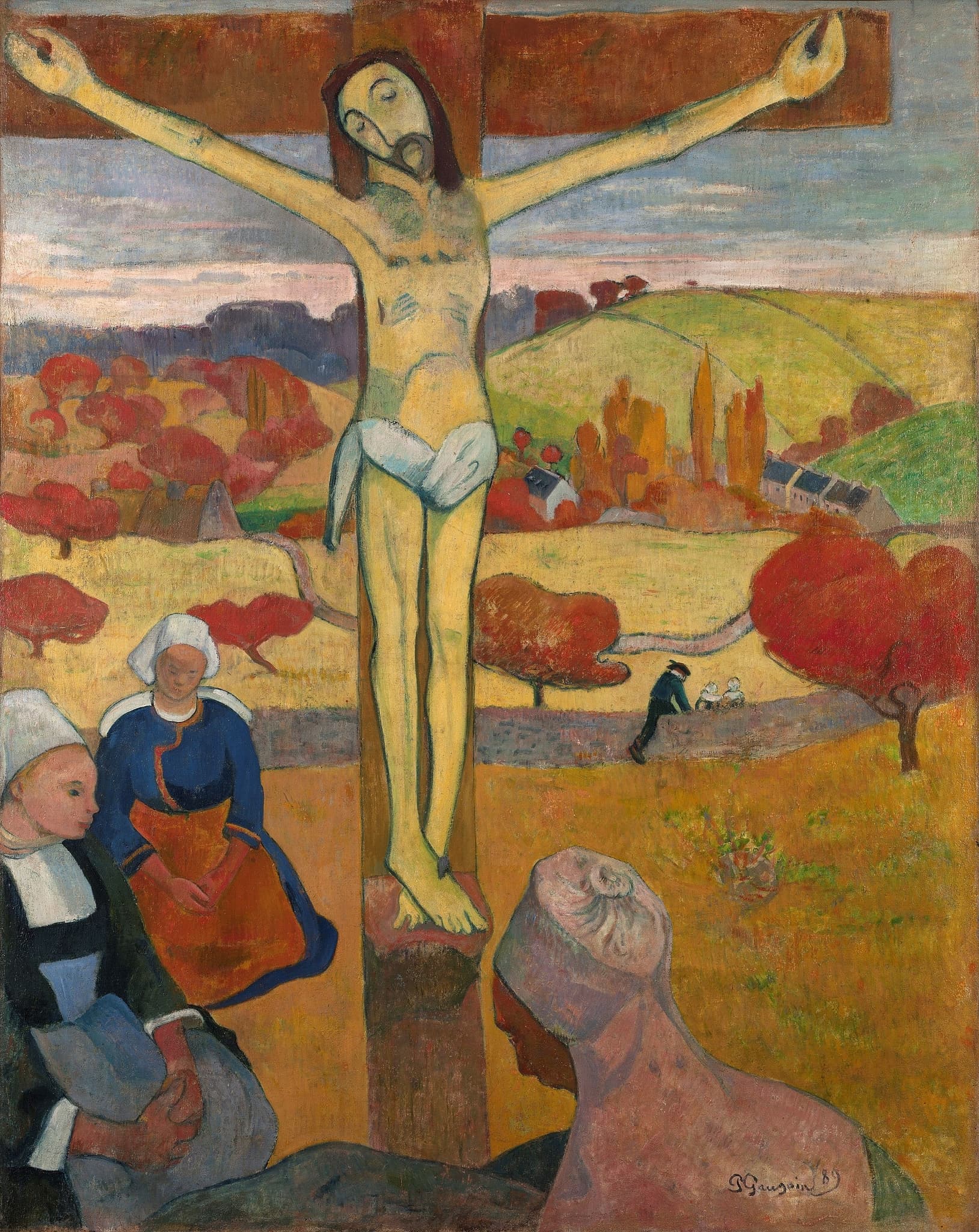
Estimated fair-market value for Paul Gauguin’s The Yellow Christ (1889) is $190–240 million. The range extrapolates above Gauguin’s $105.7 million auction record and triangulates against the ~$210 million private-sale benchmark, reflecting the work’s canonical status, institutional provenance, and extreme scarcity.
Valuation Analysis
Conclusion: We estimate Paul Gauguin’s The Yellow Christ (1889) at $190–240 million fair-market value. This synthesis positions the picture among the artist’s most valuable works, reflecting its art-historical centrality within Gauguin’s Pont‑Aven/Synthetist period, its textbook status, and its long, unimpeachable museum provenance at the Buffalo AKG Art Museum [1].
Valuation approach: The estimate is derived by extrapolating from two anchor points. First, Gauguin’s public‑auction apex of $105.73 million for Maternité II (1899) at Christie’s in 2022 demonstrates demonstrated trophy‑level liquidity under competitive, marquee conditions [2]. Second, the widely reported private sale of Nafea faa ipoipo? (When Will You Marry?) (1892) at approximately $210 million establishes a proven private benchmark for Gauguin’s absolute top tier [3]. The Yellow Christ is one of the most cited images in late‑19th‑century art history—arguably the defining Western‑period canvas by the artist—justifying an upward extrapolation from the public record and a positioning proximate to the private benchmark.
Why this work commands a premium: The Yellow Christ is a keystone of Symbolism and Synthetism, taught globally and reproduced in virtually every major Gauguin survey [1]. Its scarcity is absolute: works of this stature are seldom available, and this painting has been institutionally held since 1946. Its provenance—artist; Schuffenecker; Fayet; Paul Rosenberg; wartime seizure and restitution; 1946 acquisition by the Albright Art Gallery (now Buffalo AKG)—is deeply researched and of the highest caliber [1]. The work’s scale (c. 92 × 73 cm) and condition stewardship in a leading museum further support prime‑tier valuation [1].
Market context and timing: While the overall art market cooled in 2024, the top end rebounded in 2025 with renewed competition for best‑in‑class, blue‑chip masterpieces, reinforcing the resilience of the ultra‑trophy segment [4]. Recent, period‑adjacent Breton works by Gauguin continue to transact at materially lower levels (e.g., a c.1889–90 panel at ~$4.93 million in 2025), underscoring how iconography, scale, and brand recognition drive step‑function pricing at the apex [5]. Within this backdrop, a canonical museum‑class Gauguin such as The Yellow Christ would likely attract global guarantors and cross‑category buyers if ever openly offered.
Positioning of the range: The $190–240 million band sits above the public‑auction record and below the inflation‑adjusted reading of the 2015 private benchmark, acknowledging that Tahitian‑period subjects have historically captured the very top prices, yet recognizing that The Yellow Christ’s art‑historical primacy, universal recognition, and institutional‑quality provenance warrant near‑peak pricing. Absent condition impediments and under full competitive exposure, this range represents a confident, defensible fair‑market indication today [1][2][3][4][5].
Key Valuation Factors
Art Historical Significance
High ImpactThe Yellow Christ is a cornerstone of Gauguin’s Pont‑Aven/Synthetist period and a foundational image in Symbolism, reproduced across survey texts and exhibitions for more than a century. It encapsulates Gauguin’s radical flattening of form, cloisonné contours, and non‑naturalistic color to convey spiritual intensity, making it a canonical case study in late‑19th‑century modernism. This status translates directly into market value: works that define an artist’s contribution to the development of modern art command persistent, global demand. Among Gauguin’s Western‑period paintings, none carries greater curricular and scholarly ubiquity. That centrality warrants a premium that narrows the gap to his highest Tahitian‑period financial benchmarks.
Provenance and Institutional Ownership
High ImpactThe painting’s ownership chain—artist; Emile Schuffenecker; Gustave Fayet; Paul Rosenberg; wartime seizure and restitution; and the 1946 purchase by the Albright Art Gallery (now Buffalo AKG)—is exemplary. Rosenberg’s name, the work’s documented restitution journey, and nearly eight decades of stewardship in a leading U.S. museum collectively enhance confidence and desirability. Such blue‑chip provenance reduces transactional risk and supports aggressive bidding should the work ever be deaccessioned or offered privately. Institutional ownership also signals peer‑validated importance, helping position the painting at or near the top of Gauguin’s marketable oeuvre.
Rarity and Supply Constraint
High ImpactCanonical, museum‑caliber Gauguins are acutely scarce, and Synthetist masterworks of this renown are effectively absent from the marketplace. The Yellow Christ has not appeared at public auction and has been institutionally held since 1946, reinforcing a perception of near‑non‑substitutability. In ultra‑trophy markets, scarcity acts as a multiplicative force on price, especially when works satisfy multiple premium criteria (iconic subject, scholarly consensus, and first‑rate provenance). With virtually no close substitutes and deep recognition among both institutions and private collectors, scarcity strongly supports a valuation close to the artist’s absolute top tier.
Market Benchmarks and Trophy Demand
Medium ImpactGauguin’s public‑auction record is $105.73 million (Christie’s, 2022), while the best‑documented private benchmark is approximately $210 million (2015). The spread illustrates the premium private buyers have paid for the most coveted Tahitian works. However, the top segment of the market has remained resilient and selective, with renewed strength in late‑2025. Extrapolating from these markers, and adjusting for The Yellow Christ’s icon status despite its pre‑Tahiti date, a $190–240 million indication is consistent with trophy‑level demand dynamics, sitting above the auction apex yet within reach of the private benchmark under competitive conditions.
Sale History
Paul Rosenberg (private sale)
Purchased by the Albright Art Gallery (now Buffalo AKG Art Museum) from Paul Rosenberg following wartime restitution; price not publicly disclosed.
Paul Gauguin's Market
Paul Gauguin is a blue‑chip, top‑tier Post‑Impressionist whose greatest works reside primarily in museums. Public auction prices span a wide range by medium, date, and subject, from mid‑six figures for ceramics to more than $100 million for prime oils. The artist’s current public‑auction record is $105.73 million (Christie’s, 2022, Maternité II), and his best‑documented private transaction is approximately $210 million for Nafea faa ipoipo? (2015). Historically, Tahitian‑period subjects achieve the highest prices, but Gauguin’s most iconic Western‑period images also command exceptional demand. Supply of museum‑caliber paintings in private hands is extremely limited, making any true masterpiece a potential market‑moving event.
Comparable Sales
Maternité II
Paul Gauguin
Same artist; museum‑caliber, large oil from Gauguin’s Tahitian period. Establishes the modern public‑auction ceiling for the artist and shows trophy‑level liquidity under marquee conditions.
$105.7M
2022, Christie's New York
~$115.2M adjusted
Nafea faa ipoipo? (When Will You Marry?)
Paul Gauguin
Same artist; iconic 1892 Tahitian oil. Widely reported private sale around $210m; the key private benchmark for Gauguin’s top tier and a practical upper bound for blue‑chip demand.
$210.0M
2015, Private sale
~$273.0M adjusted
L’Homme à la hache (Man with an Axe)
Paul Gauguin
Same artist; 1891 Tahitian‑period figural oil long considered a landmark. A prior auction milestone that helps anchor top‑tier pricing for major Gauguin oils.
$40.3M
2006, Christie's New York
~$63.7M adjusted
Maternité (I)
Paul Gauguin
Same artist; seminal Tahitian‑period oil from the celebrated Maternité theme. A major early 2000s benchmark that, inflation‑adjusted, sits mid‑eight figures for comparable quality.
$39.2M
2004, Sotheby's New York
~$65.9M adjusted
La Maison du Pen du, gardeuse de vache
Paul Gauguin
Same artist; c.1889–90 Breton (Pont‑Aven) period oil on panel—closest in period/location to The Yellow Christ. Smaller, non‑iconic subject but useful as a like‑period market datapoint.
$4.9M
2025, Sotheby's New York
Nature morte avec pivoines de chine et mandoline
Paul Gauguin
Same artist; 1885 French‑period oil with strong provenance (restituted). Demonstrates public pricing for non‑iconic, pre‑Pont‑Aven works and helps bracket the lower bound for non‑trophy oils.
$10.4M
2023, Sotheby's New York
~$11.0M adjusted
Current Market Trends
Following a cooler 2024, the high end of the market rebounded in 2025, with selective but intense competition for best‑in‑class, blue‑chip works. Data indicate a continued bifurcation: broad mid‑market softness alongside strength for trophies with pristine provenance and institutional visibility. Within this context, Gauguin’s apex works remain scarce at auction; the 2022 $105.73 million result reset expectations for public pricing, while private benchmarks remain higher. Overall liquidity for late‑19th‑century masterpieces is healthy, and quality continues to trump quantity, favoring canonical, museum‑grade examples.
Study print
Study this painting as a print
Pair the full artwork with a museum-style study sheet focused on one meaningful detail.
Sources
- Buffalo AKG Art Museum – Object record: Le Christ jaune (The Yellow Christ)
- Christie’s – Paul G. Allen Collection totals $1.62B; Gauguin’s Maternité II at $105.73M
- Artnet News – Legal filings indicate Gauguin’s ‘When Will You Marry?’ sold for about $210M
- Art Basel & UBS – The Art Market Report 2025 (market overview and trends)
- Sotheby’s – November 2025 Modern sales overview (includes Gauguin Breton-period result)