How Much Is Vision After the Sermon Worth?
Last updated: May 2, 2026
Quick Facts
- Last Sale
- $6K (1925, National Galleries of Scotland (purchase))
- Methodology
- comparable analysis
Hypothetical fair-market value: $150–250 million (midpoint ≈$200 million). This range is anchored to Gauguin’s $105.7m public auction record and the widely reported ~$210m private sale of a top-tier Gauguin, combined with the painting’s textbook status as the defining Pont‑Aven/Synthetist masterpiece.
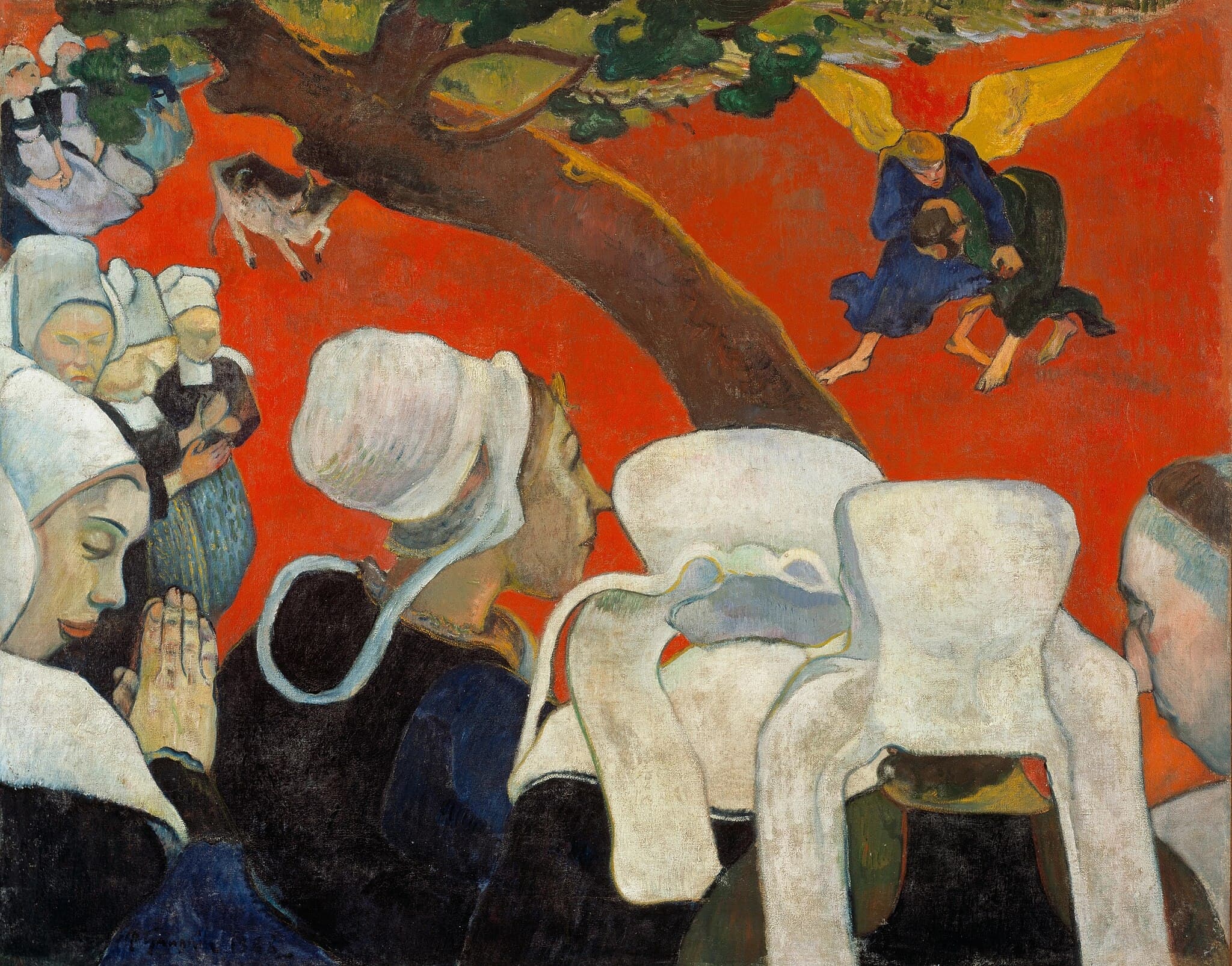
Vision After the Sermon
Paul Gauguin, 1888 • Oil on canvas
Read full analysis of Vision After the Sermon →Valuation Analysis
Vision After the Sermon (Jacob Wrestling with the Angel) (1888) is a cornerstone of modern art and the signature statement of Gauguin’s Pont‑Aven Synthetism. It is one of the artist’s most frequently reproduced and discussed images, held by the National Galleries of Scotland since 1925. Its art‑historical centrality, scale, and exceptional provenance place it in the absolute top tier of Gauguin’s oeuvre [1].
The estimate of $150–250 million is derived by positioning the work against the strongest available price anchors for Gauguin. Publicly, the benchmark is Maternité (II) at $105.73 million (Christie’s, Paul G. Allen Collection, 2022) [2]. Privately, the widely reported sale of Nafea faa ipoipo? (When Will You Marry?) at roughly $210 million provides a ceiling reference for peak Gauguin demand in recent years [3]. While many top-dollar results gravitate to Tahitian-period subjects, Vision After the Sermon is so art‑historically definitive—marking the crystallization of Synthetism—that connoisseur and institutional appetite would plausibly support pricing around or above the public auction record and within striking distance of the private benchmark.
Recent transactions illuminate the spread between decorative/strong works and true trophies. In 2024, the National Gallery of Australia acquired the Breton-period Le toit bleu (Ferme au Pouldu) for $6.5 million—an important purchase, but an order of magnitude below canonical masterpieces [5]. This gap underscores how rarity, subject, and art‑historical weight drive nine‑figure outcomes for the very top Gauguins. Vision After the Sermon sits squarely in that ultra-scarce, textbook category.
Category conditions remain supportive at the pinnacle. While the Impressionist & Post‑Impressionist auction sector contracted in 2024 (turnover down ~17%), the weakness reflected fewer trophy consignments rather than diminished demand; the top end has shown resilience, with buyers concentrating capital in best‑in‑class works [4]. The record 2022 Gauguin result further confirms robust nine‑figure liquidity for blue‑chip masterpieces [2].
Pragmatically, this picture is a keystone of a UK national collection and is highly unlikely to be sold; any hypothetical transaction would face stringent deaccession and export controls. The range presented therefore reflects hypothetical fair‑market/insurance‑replacement logic for a once‑in‑a‑generation masterpiece. On balance of comparables, significance, and current trophy-market dynamics, a central tendency around $200 million is justified, with a reasonable trading band of $150–250 million [1][2][3][4][5].
Key Valuation Factors
Art Historical Significance
High ImpactThis is one of Gauguin’s most important works, widely considered the defining statement of Synthetism and a key Pont‑Aven image. It is central to narratives of Post‑Impressionism and Symbolism, profoundly influencing the Nabis and subsequent modernist developments. Its frequent publication and display cement its canonical status. Works with this degree of art‑historical weight—comparable to an artist’s “signature” painting—command a substantial premium because they embody a turning point in the artist’s development and in the history of art more broadly, making them targets for the most sophisticated collectors and institutions.
Rarity and Supply
High ImpactMasterpieces of this caliber by Gauguin are almost entirely absorbed into public institutions or long‑term private collections. The public market for top-tier Gauguin canvases is starved of supply, with the artist’s strongest works appearing only once per generation. Near‑zero availability pushes qualified buyers to compete when a masterpiece is hypothetically in play, inflating achievable price levels. This scarcity premium is especially acute for breakthrough Pont‑Aven pictures, which are rarer on the market than later Tahitian works and carry disproportionate scholarly value relative to supply.
Period and Subject Appeal
High ImpactAlthough Tahitian-period subjects often set the artist’s top market prices, Vision After the Sermon’s Pont‑Aven date (1888) and radical pictorial language—the flat crimson ground, bold contour, and symbolic narrative—make it one of Gauguin’s most recognizable compositions. For academically driven collectors and institutions, the painting’s role in formal innovation outweighs conventional subject preferences, supporting nine‑figure valuation. The work’s distinctive iconography and color field also provide strong visual branding, a factor that consistently correlates with premium pricing for masterpieces.
Provenance and Institutional Prestige
Medium ImpactThe painting has been in the National Galleries of Scotland since 1925, a prestigious and stabilizing provenance. Institutional ownership reduces the likelihood of an actual sale and would trigger export/deaccession scrutiny in the UK, but it also underscores the work’s unimpeachable status and desirability. For hypothetical fair‑market or insurance‑replacement valuation, such museum-grade provenance bolsters confidence and supports a premium multiple, even as it introduces practical barriers to any real‑world transaction.
Sale History
National Galleries of Scotland (purchase)
Purchased by the National Galleries of Scotland in 1925 for £1,150; ≈US$5,600 at the 1925 $4.86/£ gold-parity. Date approximate.
Paul Gauguin's Market
Paul Gauguin is a blue‑chip Post‑Impressionist with deep global demand and extremely limited supply of major works. His public auction record stands at $105.73 million for Maternité (II) (Christie’s, 2022), confirming nine‑figure liquidity at the top end. A widely reported private sale of Nafea faa ipoipo? around $210 million further indicates the price ceiling for peak Gauguin masterpieces. While mid‑tier paintings and works on paper transact across a wide band, the very best paintings—especially those with landmark art‑historical significance or compelling provenance—attract concentrated connoisseur and institutional bidding, enabling step‑change pricing that materially exceeds routine auction comparables.
Comparable Sales
Nafea faa ipoipo? (When Will You Marry?)
Paul Gauguin
Same artist; museum‑grade, iconic masterpiece demonstrating nine‑figure private demand for peak Gauguin. Large, major figural composition (though Tahitian period, not Pont‑Aven).
$210.0M
2015, Private sale (Staechelin Collection to Qatari buyer; widely reported)
~$286.0M adjusted
Maternité (II)
Paul Gauguin
Same artist; late Tahitian‑period masterwork and current public auction record for Gauguin—key public price anchor for top‑tier works (comparable scale and market stature, different subject/period).
$105.7M
2022, Christie's New York (Paul G. Allen Collection, Part I)
~$116.7M adjusted
Te Fare (La Maison)
Paul Gauguin
Same artist; early Tahitian figural painting of comparable size category, publicly auctioned—useful for gauging strong but non‑trophy pricing below the absolute masterpiece tier.
$25.0M
2017, Sotheby's London (Impressionist & Modern Evening Sale)
~$33.0M adjusted
Te Bourao II
Paul Gauguin
Same artist; Tahitian‑period canvas (late 1890s). Illustrates pricing for significant but less iconic Gauguin paintings at auction—context for the spread between decorative/solid works and trophies.
$10.5M
2019, Artcurial Paris
~$13.3M adjusted
Le toit bleu (Ferme au Pouldu)
Paul Gauguin
Same artist; Breton/Pouldu phase (1890), close in time/place to Vision After the Sermon. Museum acquisition gives a recent benchmark for non‑trophy Breton‑period paintings.
$6.5M
2024, Private sale to National Gallery of Australia (publicly reported price)
~$6.7M adjusted
Danse bretonne
Paul Gauguin
Same artist; 1889 Breton subject (very close in theme/period). Small oil on panel—useful to understand demand for Breton‑iconography works, though scale/importance are far below Vision.
$1.2M
2025, Artcurial Paris
Current Market Trends
In 2024 the Impressionist & Post‑Impressionist auction sector contracted (turnover down ~17%), driven by a shortage of trophies and a shift toward lower price points. Yet demand for masterpiece‑grade works remained robust, as evidenced by standout nine‑figure results in adjacent Modern pillars and Gauguin’s 2022 record. By 2025, the top end showed renewed strength, with buyers concentrating capital in the best names and safest, museum‑grade material. Against this backdrop, a canonical Gauguin of Pont‑Aven importance would likely command intense competition and clear the nine‑figure threshold comfortably, despite broader market selectivity.
Study print
Study this painting as a print
Pair the full artwork with a museum-style study sheet focused on one meaningful detail.
Sources
- National Galleries of Scotland — Vision of the Sermon (Jacob Wrestling with the Angel) collection entry
- Christie’s — Paul Gauguin, Maternité (II) (Paul G. Allen Collection), price realized $105,730,000
- The Boston Globe — Lawsuit reveals Gauguin painting was not world’s most expensive (cites ~$210m private price)
- Art Basel & UBS — The Art Market: Auctions dashboard (2025)
- The Art Newspaper — Australia’s National Gallery acquires country’s first Gauguin painting for $6.5m