How Much Is Where Do We Come From? What Are We? Where Are We Going? Worth?
Last updated: May 1, 2026
Quick Facts
- Last Sale
- $80K (1936, Marie Harriman Gallery (sold to Museum of Fine Arts, Boston))
- Methodology
- extrapolation
Hypothetical open-market value for Paul Gauguin’s Where Do We Come From? What Are We? Where Are We Going? is estimated at $250–450 million. This range extrapolates from Gauguin’s $105.7m public auction record and the ~$210m private sale of Nafea Faa Ipoipo?, with a rarity and masterpiece premium recognizing this canvas as the artist’s culminating work, held by the Museum of Fine Arts, Boston.
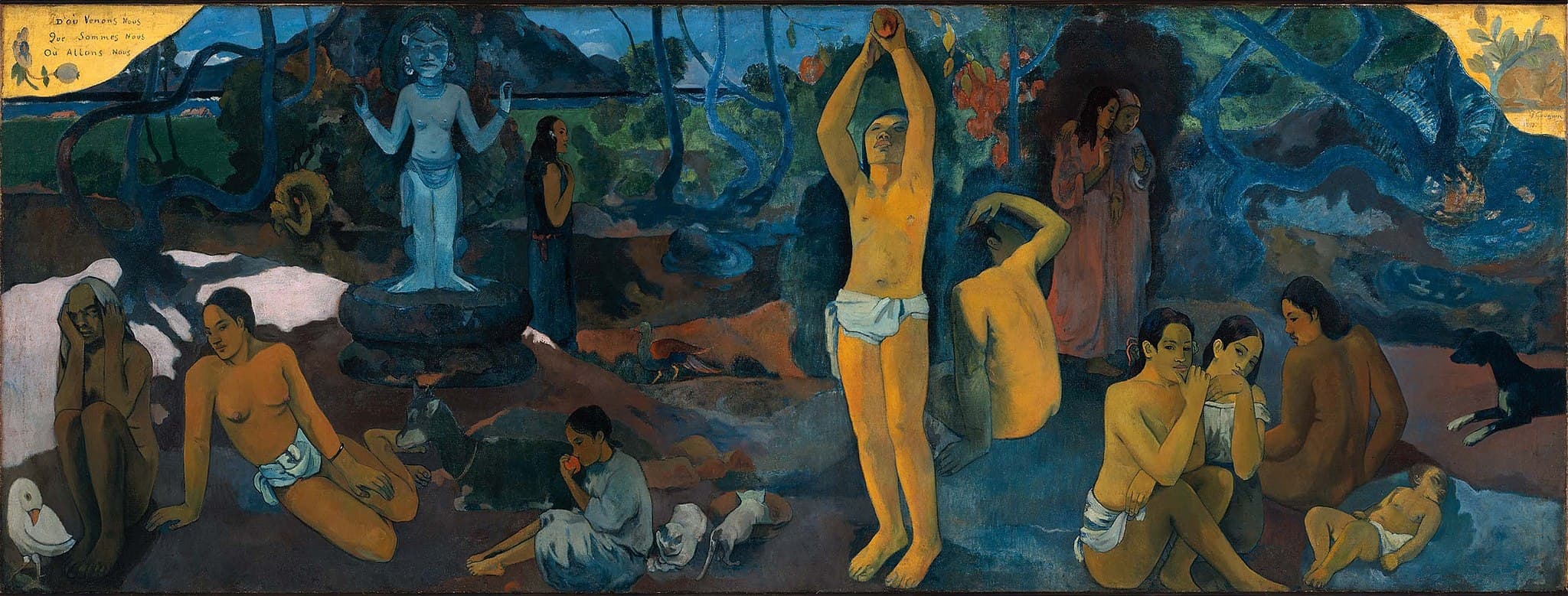
Where Do We Come From? What Are We? Where Are We Going?
Paul Gauguin, 1897–1898 • Oil on canvas
Read full analysis of Where Do We Come From? What Are We? Where Are We Going? →Valuation Analysis
Valuation conclusion: We estimate a hypothetical fair-market/insurance-replacement value of $250–450 million for Paul Gauguin’s Where Do We Come From? What Are We? Where Are We Going? (1897–98). This is widely regarded as Gauguin’s masterpiece—monumental in scale and ambition—and is a defining work of his Tahitian period. It resides in the Museum of Fine Arts, Boston, and has no public auction history, making this an extrapolated indication rather than a prediction of sale [1].
Comparative benchmarks: The artist’s public auction record stands at $105.73 million for Maternité II (1899), realized at Christie’s in 2022 from the Paul G. Allen Collection, resetting Gauguin’s market at the nine-figure level [2]. In private trade, Nafea Faa Ipoipo? (When Will You Marry?) (1892) was reported around $210 million in 2015—later corroborated in legal filings—establishing a credible benchmark for an iconic Tahitian-period painting of museum caliber [3]. In the broader trophy market, record-setting results such as Gustav Klimt’s $236.4 million portrait at Sotheby’s (Nov 2025) demonstrate current capacity for late-19th/early-20th-century masterpieces at or above the mid–$200 millions [4].
Why this picture sits above those benchmarks: The Boston canvas is commonly characterized as Gauguin’s summative statement—an expansive, frieze-like synthesis of his Tahitian imagery and Symbolist philosophy. On art-historical grounds, it outranks nearly all peers, including Nafea Faa Ipoipo?, and it is significantly larger and more conceptually ambitious than the works anchoring the $100m–$210m benchmarks. Scarcity is extreme: Tahitian icons of this magnitude are effectively unavailable, and true substitutes do not exist. In an open-market scenario—whether auction with a guarantee or a brokered private sale—competition from a handful of sovereign, institutional, and ultra-high-net-worth buyers could readily push above Gauguin’s known highs.
Offsetting and practical considerations: Its monumental scale narrows display logistics and the practical collector pool; macro volatility can influence risk appetite. However, at the apex of the market, quality, canonical status, and institutional validation generally trump constraints. The MFA reportedly acquired the painting for about $80,000 in 1936—an instructive historical footnote that underscores its longstanding recognition and institutional anchoring, even if not directly useful as a modern price comparable [5].
Bottom line: Anchoring to the artist’s $105.7m public record and ~$210m private benchmark, and applying an exceptional-masterpiece and rarity premium consistent with current trophy dynamics, a $250–450 million range is justified. This places the work comfortably above prior Gauguin transactions and in line with the most consequential, museum-grade pictures of the period [2][3][4].
Key Valuation Factors
Art Historical Significance
High ImpactThis canvas is widely regarded as Gauguin’s culminating statement—a monumental synthesis of his Tahitian imagery and Symbolist philosophy. It is omnipresent in scholarship and survey texts and frequently singled out as the artist’s masterpiece. Its narrative ambition, scale, and formal innovation position it at the apex of Gauguin’s oeuvre. Works that define an artist’s legacy command premiums well beyond price records for excellent but less pivotal examples. Compared with other celebrated Gauguins, this painting’s conceptual breadth and canonical status justify a materially higher valuation. In trophy pricing, art-historical primacy is a decisive driver: collectors and institutions will stretch for the single work that encapsulates an artist’s significance better than any other.
Rarity and Scarcity
High ImpactTahitian-period masterpieces of this ambition almost never trade, and most are held in museums or long-term private collections. No true substitute exists for this painting’s combination of size, subject, and art-historical weight. Scarcity at the trophy tier forces buyers to pay a steep premium to secure a once-in-a-generation opportunity, especially for artists with global institutional resonance. Even within Gauguin’s Polynesian corpus, large-scale, multi-figure, philosophically framed compositions are exceptionally rare. The near-zero availability of direct comparables, coupled with the intense competition expected from a small number of capable buyers, supports a valuation meaningfully above the artist’s known public and private price points.
Market Benchmarks and Trophy Dynamics
High ImpactGauguin’s public auction record is $105.73m (Maternité II, 2022), and his best-known private benchmark is ~ $210m for Nafea Faa Ipoipo? (2015). The broader late‑19th/early‑20th‑century trophy market has recently supported prices in the mid‑$200m range (e.g., Klimt at $236.4m in 2025). In this context, an even more important Gauguin—commonly described as his masterpiece—merits an extrapolated premium above these anchors. The upper bound reflects intense, scarcity-driven bidding and the capacity of sovereign/ultra‑high‑net‑worth collectors to set new benchmarks for singular works. The lower bound is supported by the established nine‑figure floor for iconic Tahitian-period Gauguins and current trophy liquidity.
Condition, Scale, and Practicalities
Medium ImpactThe painting’s monumental width makes shipping, installation, and conservation planning non-trivial, potentially narrowing the collector pool. At the very top of the market, however, logistical hurdles rarely suppress pricing for canonical works, especially where institutional or sovereign buyers are involved. Condition would be a material variable in any formal appraisal; assuming stable, museum-managed condition consistent with MFA stewardship, it should support pricing at the high end. The sheer presence and display impact of a work over twelve feet wide can, in the right context, operate as a positive value driver—enhancing institutional appeal—even as it reduces the number of feasible private display environments.
Sale History
Marie Harriman Gallery (sold to Museum of Fine Arts, Boston)
Acquired by the MFA, Boston; contemporaneous reporting placed the price at $80,000.
Paul Gauguin's Market
Paul Gauguin is a blue-chip, museum-caliber artist with global institutional representation. His market is led by Tahitian-period oils, which command the strongest demand and top prices. The public auction record is $105.73 million (Maternité II, 2022), while the highest reported private sale is Nafea Faa Ipoipo? (When Will You Marry?) at around $210 million (2015). Mid-scale oils from strong periods trade in the low-to-mid single-digit millions, but top-tier Polynesian icons are either museum-held or tightly controlled, creating extreme scarcity. Collectors value Gauguin’s synthesis of Post‑Impressionism and Symbolism, despite ongoing debates around his biography and colonial context; for masterpiece-level pictures, demand remains deep and international.
Comparable Sales
Nafea Faa Ipoipo? (When Will You Marry?)
Paul Gauguin
Same artist and iconic Tahitian-period subject; widely reported top private price for Gauguin, establishing the best direct private benchmark for a museum-caliber Polynesian masterpiece.
$210.0M
2015, Private sale (reportedly to the State of Qatar)
~$285.6M adjusted
Maternité II
Paul Gauguin
Same artist; late Tahiti-period, large-format oil with Polynesian figures; current public auction record for Gauguin. Strong public benchmark for top-tier works by the artist.
$105.7M
2022, Christie's New York (Paul G. Allen Collection)
~$116.3M adjusted
L’Homme à la hache (Man with an Axe)
Paul Gauguin
Same artist; early Tahitian-period oil and long-standing prior auction record (pre-2022). Useful historical anchor for top-period Gauguin oils, despite smaller scale and different (more severe) subject.
$40.3M
2006, Christie's New York
~$64.0M adjusted
Portrait of Elisabeth Lederer
Gustav Klimt
Not same artist, but a closely adjacent, late-19th/early-20th-century museum-caliber trophy that set a modern-art auction record. Demonstrates current market capacity for nine-figure masterpieces.
$236.4M
2025, Sotheby's New York
Piles de romans parisiens (Romans parisiens)
Vincent van Gogh
Adjacent Post-Impressionist masterpiece by Gauguin’s key contemporary; recent blue-chip benchmark showing deep demand for best-period works in this canon.
$62.7M
2025, Sotheby's New York
Current Market Trends
From 2024 to early 2026, the art market has been bifurcated: routine material softened amid macro volatility, while true trophies set or approached records. A quieter 2024 gave way to renewed top-end confidence in late 2025, with nine-figure results for blue-chip late‑19th/early‑20th‑century works underscoring deep liquidity at the pinnacle. For Gauguin and close peers, best‑period, canonical oils with unimpeachable provenance continue to outperform, while secondary media and lesser periods are estimate‑sensitive. In this environment, singular, museum-grade masterworks can command scarcity and legacy premiums, justifying estimates that exceed prior artist records when the work is broadly regarded as the most important of its kind.
Study print
Study this painting as a print
Pair the full artwork with a museum-style study sheet focused on one meaningful detail.
Sources
- Museum of Fine Arts, Boston — Object record
- Christie’s — Visionary: The Paul G. Allen Collection Part I totals $1.5B (includes Gauguin Maternité II at $105.73m)
- The Art Newspaper — Gauguin sold for $210m, not $300m, say legal documents
- Sotheby’s — The New York Sales, November 2025 (Breuer results; Klimt modern-art record)
- The Christian Science Monitor — On a Gauguin and a museum (reporting on MFA Boston’s $80,000 purchase in 1936)