How Much Is Spirit of the Dead Watching Worth?
Last updated: May 2, 2026
Quick Facts
- Methodology
- comparable analysis
Spirit of the Dead Watching (Manao tupapau), 1892, is a cornerstone of Gauguin’s Tahiti I period and among his most reproduced, studied, and institutionally celebrated works. Anchored by the ~$210m private sale of Nafea faa ipoipo? (1892) and the $105.73m auction record for Maternité II (1899), a hypothetical fair‑market value for this painting falls credibly in the high nine figures. We estimate $170–230 million, subject to condition and transaction context.
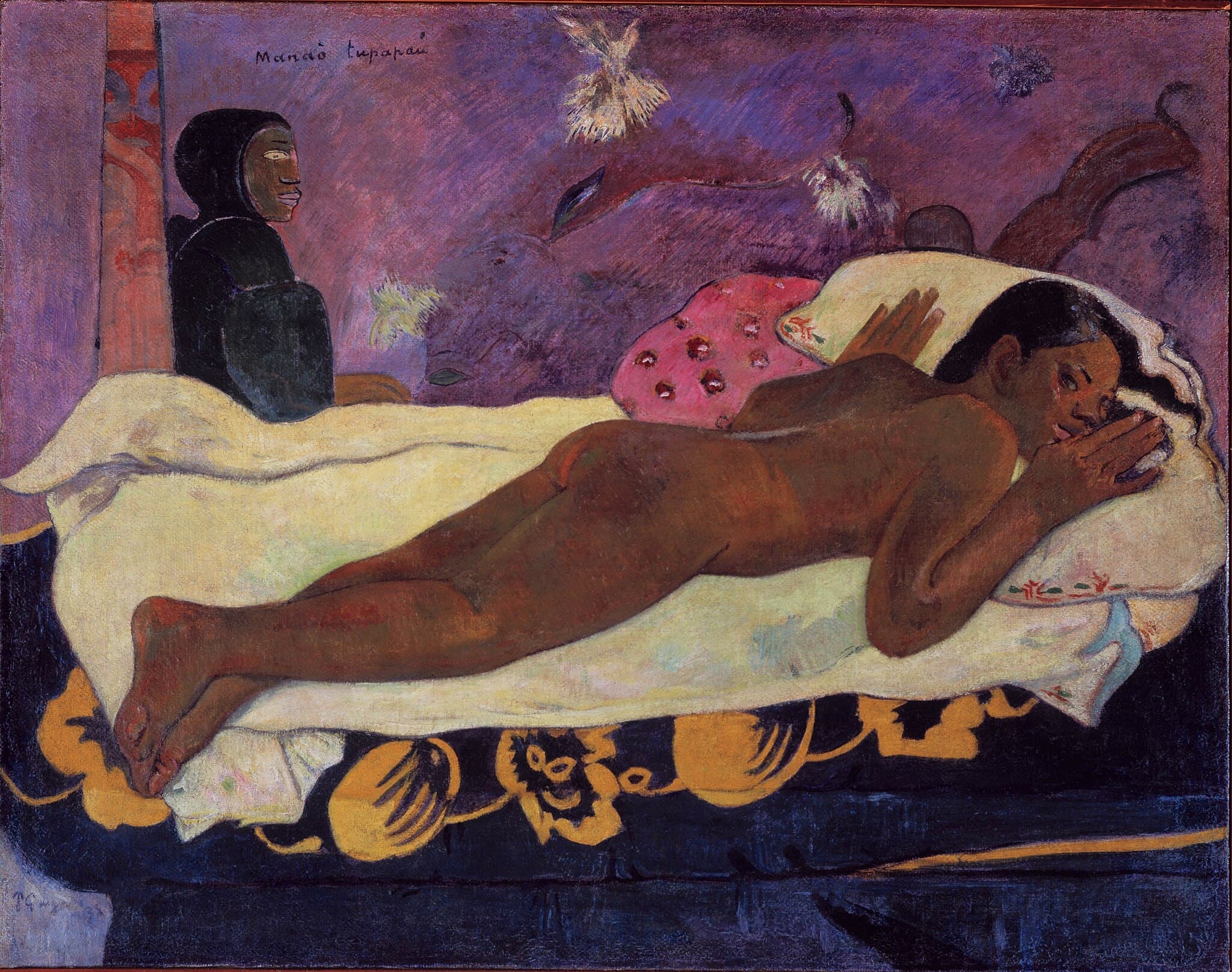
Spirit of the Dead Watching
Paul Gauguin, 1892 • Oil on jute mounted on canvas
Read full analysis of Spirit of the Dead Watching →Valuation Analysis
Conclusion: Spirit of the Dead Watching (Manao tupapau), 1892, is an A+ Gauguin masterpiece and a defining image of the artist’s first Tahiti period. It resides in the Buffalo AKG Art Museum and has not traded at a modern public auction, with its only known auction appearance being the artist’s own 1895 sale at Drouot where it was bought in [1]. Using direct period comparables and recent category records, we estimate a hypothetical fair‑market value of $170–230 million if offered under optimal conditions.
Benchmarks and comparables: The clearest proxy is the private sale of Nafea faa ipoipo? (When Will You Marry?) (1892) around 2014/2015 at approximately $210 million, as later confirmed via court filings and reporting [3]. At auction, Gauguin’s record stands at $105,730,000 for Maternité II (1899), sold in the Paul G. Allen Collection at Christie’s New York on November 9, 2022 [2]. Additional Tahiti‑period benchmarks include Te Poipoi (The Morning) (1892) at $39.24 million in 2007 [5] and Te Fare (La maison) (1892) at £20.325 million in 2017 [4]. These data points illustrate a bifurcated market: nine‑figure pricing for top‑tier figural Tahiti subjects versus mid‑eight figures (or lower) for secondary‑tier compositions.
Positioning of the subject picture: Spirit of the Dead Watching is among Gauguin’s most discussed and reproduced works—central to scholarship on the Tahiti I corpus, the representation of Teha’amana, and the artist’s primitivist lexicon. It is frequently ranked alongside Nafea faa ipoipo?, Vision after the Sermon, The Yellow Christ, and Where Do We Come From? What Are We? Where Are We Going? in surveys of the artist’s career. Its canonical status and extreme scarcity of direct peers in private hands justify an estimate near the upper band of Gauguin’s established market framework.
Market context and transaction mode: Post‑Impressionist blue chips continue to command deep, global demand at the trophy level. While the art market re‑balanced in 2024, high‑end Modern categories remained resilient and re‑strengthened into 2025 for museum‑quality, fresh material [6]. In that environment, a properly marketed sale with a strong third‑party guarantee could plausibly test or exceed the midpoint of this estimate; absent a guarantee or in a softer macro window, outcomes could skew toward the lower end.
Key sensitivities: Condition is pivotal, particularly given the work’s oil‑on‑jute construction, which can present structural considerations; a current conservation report would refine pricing. Museum deaccession policies, ethical frameworks, and transaction constraints can influence buyer pools and mechanics. Within these caveats, the combination of canonical significance, rarity, and strong comparables underpins a $170–230 million value indication for Spirit of the Dead Watching [1][2][3][4][5][6].
Key Valuation Factors
Art Historical Significance
High ImpactSpirit of the Dead Watching is a cornerstone of Gauguin’s Tahiti I period and a staple of art-historical discourse, taught and illustrated widely. It encapsulates the artist’s synthesis of Symbolism, color innovation, and narrative figuration, and is central to debates around primitivism and colonial gaze. The subject (Teha’amana), the spectral “tupapa’u” motif, and the painting’s formal daring place it among the most cited works in Gauguin scholarship. Works of this stature serve as cultural touchstones, commanding premium pricing that can exceed results for technically comparable but less iconic pictures.
Rarity and Supply
High ImpactTrue A‑tier Tahiti-period oils—especially marquee figural subjects from 1891–1894—rarely appear on the market and are predominantly held by museums. This structural scarcity concentrates demand and sets the stage for step‑function pricing when genuinely comparable works surface. The absence of modern auction exposure for Spirit of the Dead Watching, combined with its institutional status, underscores its extreme rarity. In valuation terms, scarcity at the top of Gauguin’s oeuvre justifies a significant premium versus secondary‑tier Tahiti works and non‑Tahitian periods.
Comparables and Market Benchmarks
High ImpactTwo anchors define the nine‑figure framework: the ~$210m private sale of Nafea faa ipoipo? (1892) and the $105.73m auction record for Maternité II (1899). Both are Polynesian‑themed figural masterworks and demonstrate deep capital for Gauguin’s peak narratives. Secondary Tahiti benchmarks (Te Poipoi, Te Fare) at mid‑eight figures confirm a steep pricing gradient between canonical icons and strong but less storied works. Given Spirit of the Dead Watching’s equal or greater art‑historical resonance, positioning it between the public auction record and the Nafea private benchmark is justified.
Provenance and Museum Status
Medium ImpactThe painting’s early provenance traces from Gauguin’s 1895 Drouot sale (bought in) through major dealers/collectors to A. Conger Goodyear and into the Buffalo AKG in 1965. Such depth of documentation supports confidence in attribution and title. Museum ownership both amplifies significance and complicates hypothetical sale mechanics (deaccession policies, ethical guidelines, and public scrutiny). While institutional status can narrow the immediate buyer pool in a real transaction, it also affirms the painting’s standing among the artist’s most important works—supportive of a premium valuation.
Condition and Materials
Medium ImpactExecuted in oil on jute (mounted), the work’s support can be structurally sensitive over time. For an A+ masterpiece, even routine conservation can move price materially at the margin; conversely, evidence of major structural intervention might compress bidding bands. A current condition report, technical imaging (IRR/X‑ray), and conservation history would be essential to fix a narrower range. In the absence of adverse findings, the estimate reflects the expectation that a canonical Gauguin held to museum standards will present within acceptable parameters for trophy‑level collectors.
Sale History
Hôtel Drouot, Paris
Offered in the artist’s own sale (catalogue no. 3); bought in (unsold). Subsequent placements via dealers; in Buffalo AKG since 1965.
Paul Gauguin's Market
Paul Gauguin is firmly in the blue‑chip canon of Post‑Impressionism, with sustained institutional support and global collector demand. His market is highly stratified: good works from Brittany and lesser Tahiti subjects can trade from six to mid‑eight figures, while the finest Polynesian figural masterworks achieve nine figures. The current auction record is $105.73 million for Maternité II (1899), set at Christie’s in 2022, while the most relevant private benchmark is Nafea faa ipoipo? (1892) at about $210 million. Supply of first‑rank Tahiti oils in private hands is extremely limited, which concentrates demand and supports step‑function pricing when peers surface.
Comparable Sales
Nafea faa ipoipo? (When Will You Marry?)
Paul Gauguin
Same year and Tahiti I period (1892), iconic figure composition centered on a Tahitian woman; closest market proxy to a top-tier Tahiti subject picture like Spirit of the Dead Watching.
$210.0M
2015, Private sale
~$283.4M adjusted
Maternité (II)
Paul Gauguin
Late Tahiti-period masterwork (1899) and current auction record for Gauguin; museum-caliber, narrative figural subject from the Polynesian corpus.
$105.7M
2022, Christie's New York
~$115.6M adjusted
Te Poipoi (The Morning)
Paul Gauguin
Same 1892 Tahiti year; important figural composition with Tahitian subjects; long a key public benchmark before the 2022 record.
$39.2M
2007, Sotheby's New York
~$60.5M adjusted
Te Fare (La maison)
Paul Gauguin
Same 1892 Tahiti period; though more architectural/landscape than figural, it is a strong period oil that helps frame pricing within the Tahiti corpus.
$25.3M
2017, Christie's London
~$33.0M adjusted
Te Bourao II
Paul Gauguin
Late Tahiti-period canvas (1897); smaller but instructive for period demand and pricing outside Anglo-American evening-sale venues.
$10.5M
2019, Artcurial Paris
~$13.2M adjusted
Current Market Trends
The broader Impressionist & Modern segment has remained a relative safe harbor through recent market normalization, with 2025 bringing renewed depth at the top for museum‑quality, fresh material. While 2024 saw selective bidding and thinner risk appetite, by 2025–2026 trophy‑level works again drew global competition, especially within late‑19th to early‑20th‑century masters. In this context, scarcity‑driven categories like top‑tier Gauguin remain well supported. For a work of this caliber, third‑party guarantees, optimal timing, and strong curatorial framing would be decisive in maximizing price discovery.
Study print
Study this painting as a print
Pair the full artwork with a museum-style study sheet focused on one meaningful detail.
Sources
- Buffalo AKG Art Museum – Collection entry: Manaò tupapaù (Spirit of the Dead Watching), 1892
- Christie’s Press – The Paul G. Allen Collection totals $1.62bn; Gauguin, Maternité II, $105.73m (Nov 9, 2022)
- The Boston Globe – Lawsuit reveals Gauguin painting sold for $210m, not $300m (2017)
- Christie’s – Impressionist & Surreal results feature (Te Fare, 2017)
- ArtsJournal (CultureGrrl) – Te Poipoi (The Morning) results, Sotheby’s New York (Nov 7, 2007)
- Art Basel & UBS – The Global Art Market Report 2025 (market overview for 2024–2025)