Eight Elvises

by Andy Warhol

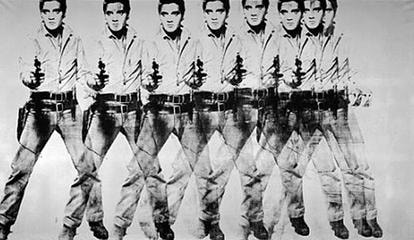
A sweeping frieze of eight overlapping, gun‑drawn cowboys marches across a silver field, their forms slipping and ghosting as if frames of a film. Warhol converts a singular star into a serial commodity, where mechanical misregistration and life‑size scale turn bravado into spectacle [1][2].
💰

Market Value

$150-210 million

How much is Eight Elvises worth?

Fast Facts

Year
1963
Medium
Silkscreen ink on silver-painted canvas
Dimensions
approx. 200 × 370 cm (c. 6.5 × 12 ft)
Location
Private collection
Eight Elvises by Andy Warhol (1963)

Click on any numbered symbol to learn more about its meaning

Meaning & Symbolism

Eight Elvises stretches a life‑size gunslinger across a panoramic, silver ground, each impression slightly offset so that legs, hips, and the outstretched pistol cascade in rhythmic echoes. The leftmost figure reads with the greatest clarity; as the sequence proceeds, the prints slip and thin, generating a blur that feels like stop‑motion “jump” between frames. That drift is not failure but argument: the very seams of reproduction—screen wear, uneven pulls, faint registries at the edges—are made visible to strip away painterly aura and replace it with a cool, industrial sheen. On the silver field, which doubles as both literal pigment and metaphorical movie screen, the star’s cowboy costume becomes a cipher—an instantly legible role that can be stamped again and again without loss of function 12. The pistol aimed outward turns confrontation into choreography: danger is flattened into a repeatable pose, a logo of bravado whose power scales with circulation rather than authenticity 34. Warhol’s seriality reframes the Western’s code of rugged, sovereign manhood as a mass‑media construct. Instead of a lone hero, we see eight near‑identical performers, their swagger synchronized across a production line. Where the genre myth promises singular virtue, Warhol supplies standardized masculinity, a commodity calibrated for maximum legibility at life scale. The faint, dissolving silhouettes on the right undercut permanence; fame expands as it erodes, its authority contingent on constant re‑impression. This tension—omnipresence versus instability—is amplified by the work’s installation logic from 1963: conceived as a wall‑to‑wall strip, the serial overlap created an immersive surround that overwhelmed like a theater screen, collapsing distance between viewer and spectacle 23. In this register, Eight Elvises does not narrate a gunfight; it performs the mechanics of celebrity. The composition’s rhythm—crisp to faded, heavy to light ink—functions like beats in a loop, replacing story with repetition, psychology with surface, originality with iteration 12. Technically, the piece codifies Warhol’s pivotal merger of painting, photography, and cinema. The silkscreen imports a found publicity image directly into the canvas and multiplies it with deliberate misregistration, yoking the authority of the camera to the scale and permanence of painting. The silver ground binds the work to Hollywood glamour and to Warhol’s own Silver Factory ethos, turning the canvas into both screen and mirror—reflective enough to implicate the viewer in the economy of looking. In that sense, the work is a feedback machine: it manufactures desire by repeating an image designed to be repeated. By foregrounding the press of ink, the slip of the screen, and the life‑size charge of the pose, Warhol builds a modern icon whose power is inseparable from its reproducibility. Eight Elvises thus stands as a keystone of Pop’s philosophy: culture is not merely represented; it is processed—copied, stacked, and broadcast—until spectacle itself becomes the subject of art 124.

Explore Deeper with AI

Ask questions about Eight Elvises

Popular questions:

Powered by AI • Get instant insights about this artwork

💬 Ask questions about this artwork!

Interpretations

Installation History & Cinematic Staging

Conceived for Ferus Gallery in 1963, the Elvis images were shipped as a printed roll and stretched to fill the rooms edge-to-edge, producing a wall-length frieze at life scale. This hanging strategy created a quasi-theatrical surround in which the viewer occupied the space of the movie audience and the firing line simultaneously. The slight overlaps and offsets engineered a jump-cut sensation akin to film frames, translating cinema’s temporal logic into painting’s spatial register. In Eight Elvises—cut from that composite strip—Warhol preserves this immersive, screen-like field on silver, turning installation into medium. Repetition isn’t mere décor; it is the exhibition’s structural device for overwhelming the gaze, collapsing distance between spectator and spectacle, and demonstrating how stardom is manufactured by saturation rather than by a single, definitive image 23.

Source: Whitney Museum (Richard Meyer); David McCarthy, The Art Bulletin

Masculinity as Mass-Produced Costume

Warhol extracts Elvis from a Flaming Star publicity still to expose Western masculinity as a choreographed code rather than a naturalized identity. The holster, stance, and leveled pistol function like ritualized emblems—legible at a glance and optimized for reproduction. Serial printing synchronizes swagger across eight bodies, displacing the myth of the lone, sovereign hero with an assembly line of performative bravado. Process artifacts—clogged screens, fading impressions—further unmask the “authentic” cowboy as a studio artifact. In McCarthy’s reading, the Ferus pairing of Elvis (front rooms) and Liz Taylor (rear) stages a gendered diptych where Hollywood’s masculine and feminine clichés are made and unmade by the same mechanical means, aligning Pop’s image factory with the spectacle of American mythmaking 3.

Source: David McCarthy, The Art Bulletin (2006)

Mechanical Aura and Filmic Time

Eight Elvises converts silkscreen “errors” into aesthetic evidence. Misregistration, uneven pulls, and thinning ink become visible seams that assert the work’s status as a manufactured object. As SFMOMA notes for the related Triple Elvis, the offset silhouettes mimic a frame-by-frame strobing, importing cinematic temporality into painting’s still field. The silver ground reads as the literalized “silver screen,” fusing Hollywood glamour with the reflective cool of Warhol’s Factory. Rather than conceal technique in painterly touch, Warhol displays the press of ink and the slip of the mesh as the new sublime: a cool, industrial aura that replaces uniqueness with circulation, and mastery with calibration. In Pop terms, the work is not simply an image of a star; it is a diagram of how images become stars through reproducible form 13.

Source: SFMOMA; David McCarthy, The Art Bulletin

Silver, Sainthood, and Secular Devotion

The reflective silver field evokes Hollywood’s glamour, but it also echoes the lit surfaces of Byzantine icons that marked Warhol’s Catholic upbringing. Auction catalog essays have long proposed Elvis as a secular saint: his front-facing, confrontational pose and repeated presence form a portable shrine to fame. Here, the pistol substitutes for saintly attributes, transfiguring violence into a ritual sign. Multiplication functions like a litany—an act of devotion performed through iteration—while the canvas’s mirror-like sheen implicates the viewer as participant, not bystander. Although interpretive rather than evidentiary, this devotional lens clarifies how Pop sacralizes the profane: silver becomes both screen and halo, and the gunslinger costume becomes vestment within a new, mass-media church of images 46.

Source: Christie’s catalog essay; The Andy Warhol Museum (biography)

Rarity, Invisibility, and the Economics of Aura

Paradoxically, a painting that thematizes infinite reproducibility has itself become scarce: not publicly exhibited since the 1960s and reportedly sold privately for about $100 million in 2008. This withdrawal from view concentrates market aura even as the image’s cultural power depends on circulation. The dialectic clarifies Pop’s economy: mass-media fame is built by ubiquity, while fine-art value snowballs through rarity and controlled access. Warhol’s serial Elvis thus operates on two intertwined channels—public saturation (posters, films, press) and private scarcity (unique configurations like Eight Elvises). The result is a feedback loop where the logic of reproduction (celebrity) and the logic of exclusivity (the art market) co-produce value, each amplifying the other’s mystique 25.

Source: Whitney Museum; The Independent (reporting Sarah Thornton, The Economist)

Authorship by Appropriation: From Publicity Still to Painting

Warhol’s image source—a promotional still from Flaming Star—makes authorship a question of selection, scale, and serial method rather than origination. By importing a camera-made icon into silkscreen and multiplying it at life size, Warhol grafts photographic authority onto painting while displacing traditional notions of invention. The painting asserts that in a media-saturated culture, creativity lies in processing: cropping, calibrating density, staging overlaps, and exploiting misregistration to reveal the system. In this frame, appropriation is not theft but theory—an analysis performed in ink on a silver ground that behaves like a screen. The artist becomes editor, printer, and choreographer of circulation, aligning Pop painting with the workflows of advertising and cinema 12.

Source: SFMOMA; Whitney Museum

Related Themes

About Andy Warhol

Andy Warhol (1928–1987) trained in pictorial design and built a successful career as a New York commercial illustrator before shifting to fine art. Around 1962 he moved from hand-painted images of consumer goods and celebrities to a serial practice that soon adopted photo-silkscreen, defining Pop Art’s cool, media-savvy aesthetic [2][5].
View all works by Andy Warhol

More by Andy Warhol

Silver Car Crash (Double Disaster) by Andy Warhol

Silver Car Crash (Double Disaster)

Andy Warhol (1963)

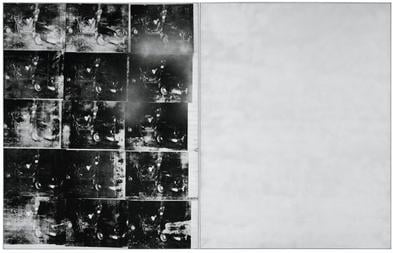
Silver Car Crash (Double Disaster) pairs a grid of uneven, black‑and‑white silkscreened crash images with a vast, nearly blank field of metallic silver, staging a battle between <strong>relentless spectacle</strong> and <strong>mute void</strong>. Warhol’s industrial repetition converts tragedy into a consumable pattern while the reflective panel withholds detail, forcing viewers to face the limits of representation and the cold afterglow of modern media <sup>[1]</sup><sup>[2]</sup>.

Triple Elvis [Ferus Type] by Andy Warhol

Triple Elvis [Ferus Type]

Andy Warhol (1963)

In Triple Elvis [Ferus Type] (1963), Andy Warhol multiplies a gunslinging movie idol across a cool, metallic field, turning a singular persona into a <strong>serial commodity</strong>. The sharply printed figure at center flanked by fading, <strong>ghosted</strong> doubles collapses still image, filmic motion, and mass reproduction into one charged surface <sup>[1]</sup><sup>[2]</sup>.

Turquoise Marilyn by Andy Warhol

Turquoise Marilyn

Andy Warhol (1964)

In Turquoise Marilyn, Andy Warhol converts a movie star’s face into a <strong>modern icon</strong>: a tightly cropped head floating in a flat <strong>turquoise</strong> field, its <strong>acidic yellow hair</strong>, turquoise eye shadow, and <strong>lipstick-red</strong> mouth stamped by silkscreen’s mechanical bite. The slight <strong>misregistration</strong> around eyes and hair produces a halo-like tremor, fusing <strong>glamour and ghostliness</strong> to expose celebrity as a manufactured surface <sup>[1]</sup><sup>[2]</sup>.

Four Marlons by Andy Warhol

Four Marlons

Andy Warhol (1966)

Four Marlons is a 1966 silkscreen by Andy Warhol that multiplies a single biker film-still into a tight 2×2 grid on raw linen. Its inky blacks against a tan, unprimed ground turn the glare of the headlamp, the angled handlebars, and the figure’s guarded pose into a <strong>repeatable icon</strong> of outlaw cool. Warhol’s seriality both <strong>amplifies and drains</strong> the image’s aura, exposing fame as a commodity pattern <sup>[1]</sup><sup>[3]</sup>.

Race Riot by Andy Warhol

Race Riot

Andy Warhol (1964)

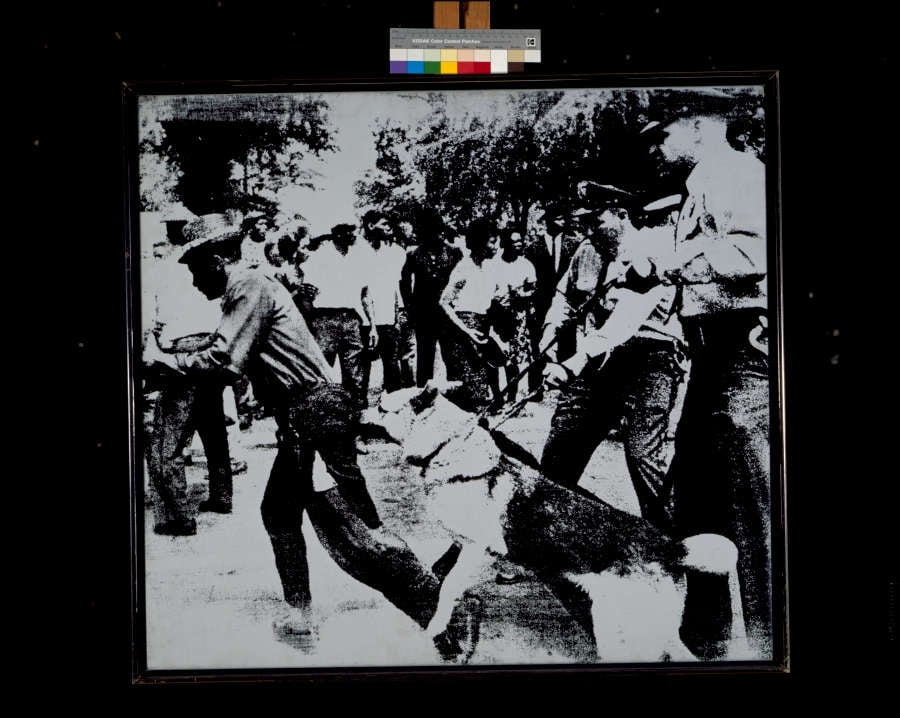
Race Riot crystallizes a split-second of state force: a police dog lunges while officers with batons surge and a ring of onlookers compresses the scene into a <strong>claustrophobic frieze</strong>. Warhol’s stark, high-contrast silkscreen translates a LIFE wire-photo into a <strong>mechanized emblem</strong> of American racial violence and its mass-media circulation <sup>[1]</sup><sup>[2]</sup>.
Sixty Last Suppers by Andy Warhol

Sixty Last Suppers

Andy Warhol (1986)

Andy Warhol’s Sixty Last Suppers multiplies Leonardo’s scene into a vast grid, turning a singular sacred image into <strong>serial</strong> signage. From afar it reads as an architectural surface; up close, silkscreen <strong>variations</strong>—blurs, darker panels, dropped ink—reassert the human trace <sup>[1]</sup><sup>[2]</sup>.