How Much Is Eight Elvises Worth?
Last updated: February 24, 2026
Quick Facts
- Methodology
- comparable analysis
Eight Elvises is a unique, trophy-level 1963 silver Elvis canvas by Warhol. Anchored by the widely reported ~$100m private sale in 2008 (≈$154m today) and bracketing against top Warhol benchmarks, a current fair value is $150–210 million, with auction positioning likely in the $120–180 million estimate band and upside if multiple bidders engage.
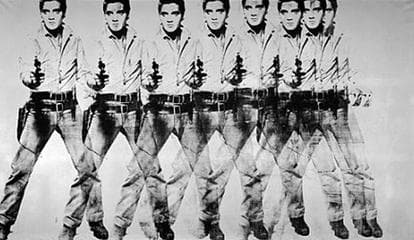
Eight Elvises
Andy Warhol, 1963 • Silkscreen ink on silver-painted canvas
Read full analysis of Eight Elvises →Valuation Analysis
Conclusion: Based on the documented ~$100 million private sale in 2008, inflation-adjusted to roughly the mid-$150 millions today, and on directly relevant comparables across Warhol’s top tier, Eight Elvises supports a current fair value of $150–210 million. This reflects its singular configuration, early 1963 date, and status among Warhol’s most iconic celebrity images.
Anchors and scarcity: The only publicly reported transaction is a private sale at about $100 million in 2008, brokered by Philippe Ségalot and reported the following year; the work has remained in private hands and largely out of public view since the 1960s [1]. Adjusted for CPI, that price alone implies a baseline around $150–155 million today, before accounting for the painting’s unique eight-fold configuration and trophy scarcity [5].
Comparable benchmarks: On the ceiling side, Warhol’s Shot Sage Blue Marilyn realized $195 million at Christie’s in May 2022, resetting the modern auction benchmark for the artist and confirming depth at the ultra‑trophy level [2]. Within the same 1963 core period, the Death and Disaster masterpieces have traded at $85.4 million (White Disaster, 2022) and $105.4 million (Silver Car Crash, 2013), establishing a robust floor for top early‑’60s Warhols [4]. Direct subject‑matter comps in the Elvis series reached $81.9 million for Triple Elvis [Ferus Type] (2014) and ~$37.0 million for Double Elvis [Ferus Type] (2012); inflation-adjusted, these sit far below a unique, monumental eight-image canvas, underscoring Eight Elvises’ superiority in rarity and scale [3].
Position in the oeuvre: The silver Elvis paintings, executed at the apex of Warhol’s breakthrough period, are canonical. Eight Elvises stands apart as a unique single‑canvas configuration; it embodies Warhol’s seriality, celebrity myth‑making, and silver screen metaphor with unmatched impact. While Marilyn imagery has slightly broader universal recognition, connoisseur demand for a singular, large‑scale 1963 Elvis can closely rival it—particularly given the near‑nonexistence of peer works.
Market dynamics and sale format: Today’s top-end market is selective but deep for truly best-of-series Pop icons. A private transaction would reasonably clear in the mid‑$100 millions, with ask/expectation aligning to this valuation range. At auction, houses would likely set a $120–180 million estimate to cultivate competition and leverage third‑party guarantees; two or more committed bidders could push the result into or above our range, as the 2022 Warhol record demonstrated [2].
Key sensitivities: Condition and presentation are decisive at this level; a pristine report would reinforce the upper half of the range. Confirmed, fully documented provenance from the 1960s through the 2008 transaction further underpins value. Given these factors and prevailing comps, $150–210 million represents a well‑supported present valuation for Eight Elvises [1][2][3][4][5].
Key Valuation Factors
Art Historical Significance
High ImpactEight Elvises sits at the heart of Warhol’s 1963 breakthrough, uniting the silver screen metaphor, serial repetition, and celebrity iconography that define his Pop project. As a unique, single‑canvas configuration from the canonical silver Elvis series, it represents a pinnacle of Warhol’s portraiture—arguably the purest fusion of image, myth, and mechanical process in his oeuvre. The work’s date aligns with Warhol’s most sought‑after early period (1962–1964), and its sustained scholarly attention across decades cements its status as a museum‑caliber touchstone. Within the trajectory of postwar American art, it signals the shift from Abstract Expressionism to media‑saturated Pop, giving it enduring art‑historical weight.
Rarity and Uniqueness
High ImpactAmong Warhol’s Elvis paintings, multiples such as Double and Triple Elvis appear occasionally, but a unique eight‑image composition on a single monumental silver canvas is essentially unmatched in the market. That singularity drives a significant scarcity premium relative to the more frequently traded Double/Triple examples. The fact that Eight Elvises has not been publicly exhibited since the 1960s adds to its aura and perceived rarity, while also meaningfully limiting comparable supply. In trophy collecting, this combination—best‑of‑series status and near‑nonexistence of peers—is a key driver of competition, particularly for buyers who prize uniqueness within a highly canonical subject and moment.
Subject and Iconography
High ImpactElvis is one of Warhol’s most resonant celebrity subjects, second only to Marilyn in broad cultural recognition. The silver ground evokes cinema and glamour, while the repetition suggests both stardom’s omnipresence and its industrial production. Eight-fold seriality heightens the visual impact and conceptual rigor, positioning this painting at the apex of the Elvis motif. Although Marilyn currently sets Warhol’s price ceiling, connoisseurs often regard a unique, monumental 1963 Elvis as on par in art‑historical stakes. This high‑signal iconography increases cross‑border demand and makes the work suitable for headline auctions or blue‑chip private placements with global buyers.
Comparables and Benchmarks
High ImpactKey market anchors include the ~$100m private sale of Eight Elvises in 2008 (≈$150–155m today), the $195m auction record for Shot Sage Blue Marilyn (2022), and early‑1960s masterworks like White Disaster ($85.4m, 2022) and Silver Car Crash ($105.4m, 2013). Within the same subject, Triple Elvis achieved $81.9m (2014), and Double Elvis examples have traded up to the ~$50m range. Together, these results bracket Eight Elvises within the highest echelon of Warhol’s market. Its unique scale and configuration justify a premium over Double/Triple examples, while remaining plausibly below the Marilyn record—supporting a $150–210m fair‑value range.
Condition, Provenance, and Visibility
Medium ImpactThe work’s long, discrete private ownership and widely reported 2008 private sale underpin its blue‑chip provenance. However, the painting has not been publicly exhibited since the 1960s, and no recent condition report is public. At this level, even minor conservation variables can affect bidding confidence and positioning within the estimate band. A clean, current condition report and strong technical imaging would likely push expectations toward the higher end of the range; conversely, any conservation complexity could temper peak bidding. Strategic re‑exhibition could also enhance market readiness and buyer familiarity ahead of a sale, especially in a marquee auction context.
Sale History
Eight Elvises has never been sold at public auction.
Andy Warhol's Market
Andy Warhol remains a cornerstone of the global postwar and contemporary market, with unmatched liquidity across paintings, works on paper, and editions. His top-tier paintings—especially 1962–64 icons such as Marilyn, Elvis, and the Death and Disaster series—attract deep, diversified demand from U.S., European, and APAC collectors. The 2022 $195 million Marilyn reset his auction record and reaffirmed appetite for absolute trophies. While the broader market has become more selective, the best Warhols remain reliable marquee anchors and benefit from extensive institutional visibility and scholarship. Prints and multiples continue to provide robust liquidity, reinforcing the brand’s market depth and on‑ramping new buyers to the category.
Comparable Sales
Triple Elvis [Ferus Type]
Andy Warhol
Same artist and subject (Elvis), same core period (1963), monumental silver ground; closest subject-matter proxy to Eight Elvises to appear publicly.
$81.9M
2014, Christie's New York
~$111.0M adjusted
Double Elvis [Ferus Type]
Andy Warhol
Same artist and subject (Elvis), 1963 Ferus-type silver canvas; establishes demand floor for the Elvis image at auction.
$37.0M
2012, Sotheby's New York
~$51.7M adjusted
Shot Sage Blue Marilyn
Andy Warhol
Same artist, iconic 1964 celebrity portrait at the very top of Warhol’s market; serves as an upper-bound benchmark for peak demand.
$195.0M
2022, Christie's New York
~$213.3M adjusted
Silver Car Crash (Double Disaster)
Andy Warhol
Same artist and year (1963), monumental single-canvas masterpiece from a top-tier series; historically used as a proxy for blue-chip early Warhol.
$105.4M
2013, Sotheby's New York
~$145.0M adjusted
White Disaster (White Car Crash 19 Times)
Andy Warhol
Same artist and core period (1963); large ‘Death and Disaster’ work confirming the demand floor for early-’60s Warhol icons in today’s market.
$85.4M
2022, Sotheby's New York
~$93.4M adjusted
Nine Marilyns
Andy Warhol
Same artist; early (1962) celebrity silkscreen grid establishing depth of bidding for prime early-’60s Warhol portraits.
$47.4M
2021, Sotheby's New York
~$56.0M adjusted
Current Market Trends
At the apex, the market has normalized from 2022’s peak but remains competitive for fresh, best‑of‑series blue chips. Houses are deploying disciplined estimates and third‑party guarantees, with strong results when image, period, scale, and provenance align. Warhol’s early‑1960s icons continue to command the highest confidence, supported by marquee precedents and cross‑regional demand. Buyers are valuation‑sensitive, but scarcity premiums for singular trophies persist. Private sales remain active, offering discretion and negotiated outcomes, while auctions can produce step‑outs when two or more committed bidders emerge. Against this backdrop, Eight Elvises’ uniqueness and canonical status place it squarely in the market’s most resilient segment.
Study print
Study this painting as a print
Pair the full artwork with a museum-style study sheet focused on one meaningful detail.
Sources
- The Independent – The $100m Warhol: Eight Elvises 'sold' in private sale (reporting Sarah Thornton/The Economist)
- Christie’s Press – Warhol’s Marilyn sells for $195 million (May 9, 2022)
- Christie’s Press – Post-War & Contemporary Evening Sale results (Triple Elvis $81,925,000)
- CBS News/AFP – Warhol’s White Disaster sells for $85.4 million at Sotheby’s (Nov. 16, 2022)
- U.S. Bureau of Labor Statistics – CPI Inflation Calculator