How Much Is Race Riot Worth?
Last updated: February 24, 2026
Quick Facts
- Last Sale
- $62.9M (2014, Christie's New York)
- Insurance Value
- $165.0M (Analyst recommendation (replacement value with 10% uplift over high estimate))
- Methodology
- comparable analysis
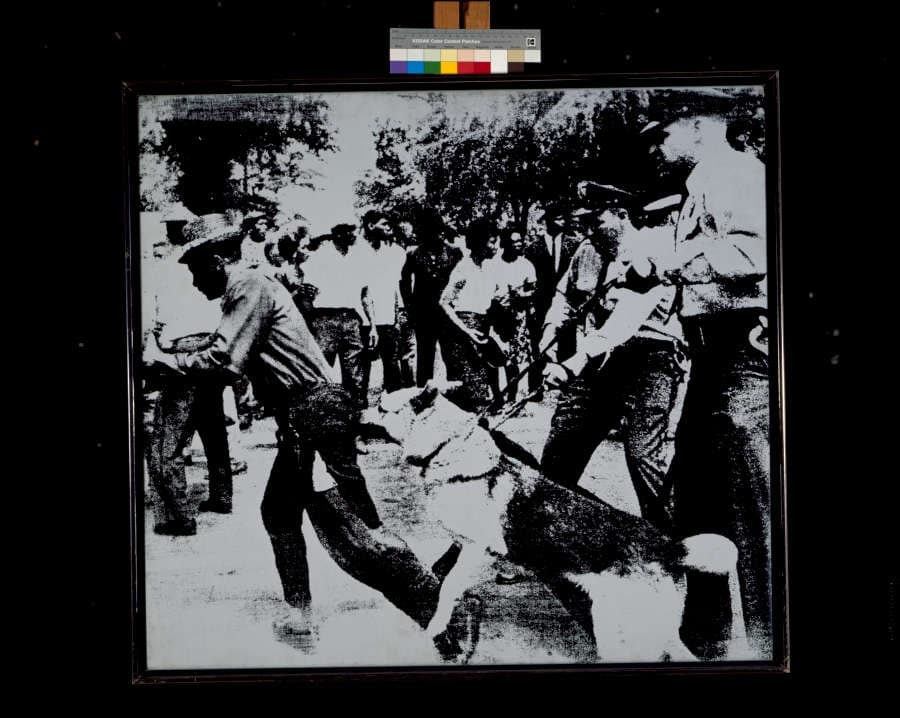
For a prime, four-panel 1964 Race Riot painting by Andy Warhol in excellent condition with strong provenance, we estimate fair market value at $100–150 million. This range is anchored by the work’s $62.885 million sale at Christie’s in 2014 and subsequent top-tier Death and Disaster comparables. Note: this valuation does not apply to the 1964 X + X editioned screenprint (Birmingham Race Riot), which typically trades in the low- to mid-four figures.
Valuation Analysis
Assumption and scope. This valuation addresses a prime, multi-panel 1964 Race Riot painting from Andy Warhol’s Death and Disaster series. It does not apply to the 1964 X + X editioned screenprint Birmingham Race Riot (F&S II.3), which is a low- to mid–four-figure object and not an appropriate comparable for unique paintings [5].
Comparable anchors. The most direct benchmark is the four-panel Race Riot sold at Christie’s New York on May 13, 2014 for $62,885,000 with premium [1]. Within the same series, high-profile auction comparables since then include White Disaster (White Car Crash 19 Times) at $85.4 million at Sotheby’s in 2022 [2] and Silver Car Crash (Double Disaster) at $105.4 million at Sotheby’s in 2013 [3]. These reinforce the sustained premium for early-1960s Disaster imagery and frame a logical value corridor for Race Riot today, allowing for inflation, relative subject weight, scale, condition, and provenance.
Cross-series check and market tone. As a cross-check on nine-figure appetite for prime 1960s Warhols, Flowers (1964) realized $35.5 million at Christie’s in 2024 [4]. Race Riot’s documentary gravity and critical centrality typically warrant a multiple over decorative or celebrity-focused series from the period. While the post-2022 market has normalized, blue-chip, institutionally canonized 1960s Warhols continue to attract focused bidding when fresh, with a pronounced flight to quality.
Resulting estimate. We synthesize these signals into a current fair market range of $100–150 million for a top-tier, four-panel Race Riot painting in excellent condition with sound, transparent provenance. Works with exceptional exhibition/publication histories or high-profile provenance may find competition above the top of the band in a supply-constrained cycle; conversely, condition issues (e.g., restoration, surface wear, fading) or encumbered provenance would compress value toward the low nine figures.
Critical distinctions. Single-panel Race Riot paintings would price below multi-panel exemplars on a per-work basis, and rare unique screenprints on Strathmore (circa 1963; UP-numbered) sit in a distinct, mid–six-figure cohort historically. The widely distributed 1964 X + X screenprint (20 × 24 in., edition 500) typically realizes low- to mid–four figures at auction and should not be conflated with the unique paintings [5].
Insurance guidance. For scheduling, we recommend an insurance (replacement) value at approximately $165 million—a 10% uplift over the high estimate to reflect replacement risk for a museum-grade, multi-panel example in today’s selective but quality-driven market.
Key Valuation Factors
Art Historical Significance
High ImpactRace Riot is a cornerstone of Warhol’s Death and Disaster corpus, created at the height of his 1960s experimentation and directly engaging the politics of race, media, and violence in America. The subject’s basis in contemporary photojournalism amplifies its conceptual thrust, placing it among Warhol’s most critically cited and institutionally collected themes. Within scholarship and museums, Race Riot stands alongside Car Crash and Electric Chair as emblematic of Warhol’s interrogation of spectacle and trauma. This centrality translates to durable demand among top-tier collectors and institutions, supporting nine-figure outcomes for the most compelling multi-panel examples. Its cultural relevance remains acute, sustaining a premium relative to many equally recognizable but less politically resonant Warhol subjects.
Rarity and Supply
High ImpactMulti-panel Race Riot paintings are scarce, with key examples held by major museums and long-term private collections, leading to prolonged periods with no direct like-for-like offerings. The 2014 Christie’s result underscores how infrequently prime works surface; absence of supply over many years typically supports robust bidding when a fresh, top-condition example emerges. This scarcity dynamic is magnified by the broader market’s ‘flight to quality’: as collectors become more selective, the concentration of capital on proven, historically important works increases. Simply put, there are few true substitutes for a museum-grade, four-panel Race Riot, limiting price elasticity on the downside and enabling step-changes in value when competition materializes.
Scale, Format, and Condition
High ImpactIn Warhol’s market, scale and seriality matter. Multi-panel Race Riot compositions command a premium over single-panel works due to their immersive scale and cumulative impact, which aligns with institutional exhibition standards and top private collectors’ preferences. Condition is equally crucial for 1960s silkscreens: factors such as surface integrity, saturation and registration of the silkscreen layers, original canvas/linen health, and the absence of significant restoration all bear directly on value. Works retaining crisp tonal contrasts and minimal conservation histories will sit at the top of the range, while overcleaning, abrasions, or structural interventions can materially reduce outcomes. Precise condition and conservation reports are therefore essential to refine the estimate.
Provenance and Exhibition History
Medium ImpactTransparent, high-caliber provenance—particularly prior ownership by notable collectors or galleries—and a meaningful exhibition and publication record (major retrospectives, catalogue raisonnés, peer-reviewed scholarship) add confidence and marketability, often tightening spreads and improving hammer odds. The 2014 Race Riot result also benefited from marquee-sale theatre and strong house positioning; similar curatorial framing can drive competitive tension again. Conversely, gaps or ambiguities in ownership history, or an absence of exhibition pedigree, may encourage buyer caution and necessitate pricing discipline. In today’s selective market, provenance and published visibility can be decisive differentiators between works that achieve the top of an estimate band and those that settle nearer the midpoint.
Sale History
Christie's New York
Christie's New York
Andy Warhol's Market
Andy Warhol remains a top-tier postwar artist with one of the deepest global collector bases and the strongest data-rich prints market of any blue-chip name. His auction record stands at $195 million for Shot Sage Blue Marilyn (2022), and multiple 1960s canvases regularly achieve eight- and nine-figure prices. The market has normalized from 2022’s peak, but liquidity for high-quality 1960s works remains robust, with disciplined bidding and a premium for museum-worthy examples. Warhol’s editions market is exceptionally active, with recent portfolio records underscoring continued demand for canonical imagery. Overall, he sits in the market’s most resilient cohort, supported by institutional visibility, scholarship, and cross-category collector appeal.
Comparable Sales
Race Riot (four panels)
Andy Warhol
Exact subject and format (1964 multi-panel painting) from Warhol’s Death and Disaster series; the definitive market benchmark for this subject.
$62.9M
2014, Christie's New York
~$84.0M adjusted
Silver Car Crash (Double Disaster) (1963)
Andy Warhol
Same Death and Disaster series; large multi-panel 1963 painting and a top-tier auction benchmark for Warhol’s disaster imagery.
$105.4M
2013, Sotheby's New York
~$143.1M adjusted
White Disaster (White Car Crash 19 Times) (1963)
Andy Warhol
Iconic Death and Disaster painting from 1963; closest like-for-like series comp in the recent market cycle.
$85.4M
2022, Sotheby's New York
~$92.2M adjusted
Flowers (1964)
Andy Warhol
Same artist and year; a prime 1960s painting that serves as a cross-series benchmark for demand at the blue-chip level.
$35.5M
2024, Christie's New York
~$35.9M adjusted
Sixteen Jackies (1964)
Andy Warhol
1964, multi-image serial composition tied to media and mortality; strong 1960s canvas providing a relevant market anchor near the series.
$25.9M
2023, Christie's New York
~$26.8M adjusted
Four Marlons (1966)
Andy Warhol
Large, multi-panel 1960s Warhol painting with high-profile 2014 result; helpful for gauging top-tier Warhol pricing adjacent to Death and Disaster.
$69.6M
2014, Christie's New York
~$93.0M adjusted
Current Market Trends
Since mid-2023 the auction market has favored quality over quantity, with buyers concentrating capital on fresh, blue-chip material and exercising discipline elsewhere. Supply at the $50m+ tier has been selective, but when prime 1960s works surface, competition persists—especially for series with strong institutional endorsement like Warhol’s Death and Disaster. Print markets remain lively, while the painting market shows a pronounced flight to quality and provenance. Macro headwinds and tighter financing temper opportunistic bidding, yet private sales and carefully staged evening consignments continue to clear at strong levels when works are well-priced and well-presented. In this context, a top-tier Race Riot commands a robust premium.
Study print
Study this painting as a print
Pair the full artwork with a museum-style study sheet focused on one meaningful detail.
Sources
- Los Angeles Times: Warhol’s ‘Race Riot’ sells for $62.9 million
- CBS News: Warhol’s ‘White Disaster’ sells for $85.4 million at Sotheby’s
- Reuters: Warhol’s ‘Silver Car Crash (Double Disaster)’ sells for $105.4 million
- Artnet News: Christie’s 20th Century Evening—Warhol ‘Flowers’ at $35.5m
- MoMA Collection: Birmingham Race Riot (X + X: Ten Works by Ten Painters)