Turquoise Marilyn

by Andy Warhol

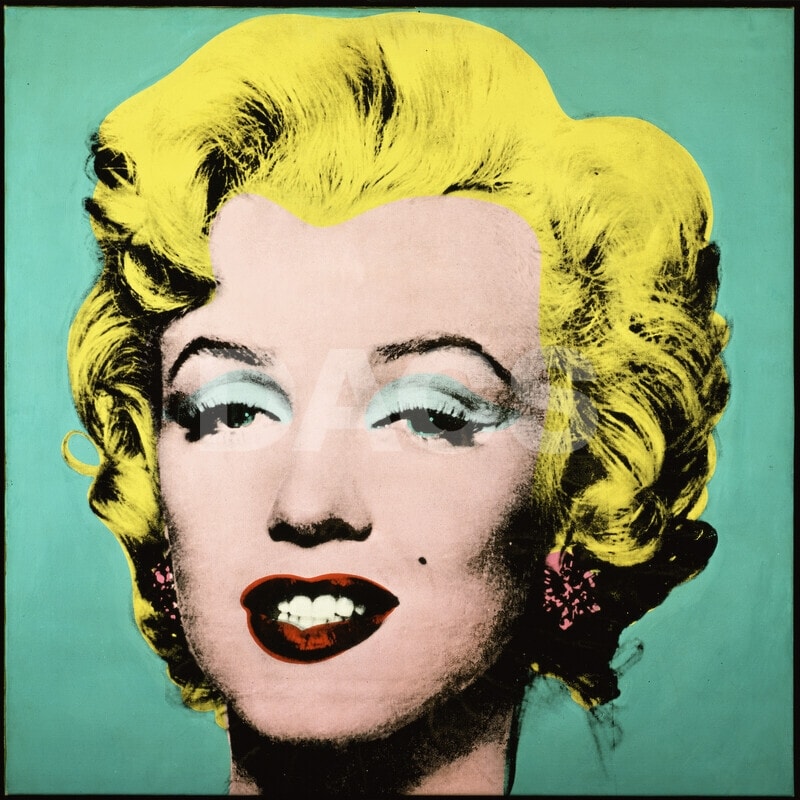
In Turquoise Marilyn, Andy Warhol converts a movie star’s face into a modern icon: a tightly cropped head floating in a flat turquoise field, its acidic yellow hair, turquoise eye shadow, and lipstick-red mouth stamped by silkscreen’s mechanical bite. The slight misregistration around eyes and hair produces a halo-like tremor, fusing glamour and ghostliness to expose celebrity as a manufactured surface [1][2].
💰

Market Value

$180–240 million

How much is Turquoise Marilyn worth?

Fast Facts

Year
1964
Medium
Synthetic polymer (acrylic) and silkscreen ink on canvas/linen
Dimensions
40 x 40 in. (101.6 x 101.6 cm)
Location
Private collection
Turquoise Marilyn by Andy Warhol (1964)

Click on any numbered symbol to learn more about its meaning

Meaning & Symbolism

Warhol builds Turquoise Marilyn from the Niagara publicity still, a studio image already optimized for circulation; by cropping the head to fill a 40-inch square and flooding it with a uniform turquoise ground, he strips away situational context, delivering only the brand’s signifiers—hair, lips, eyes, beauty mark—as if they were a trademark suite 68. The turquoise field and eyelids form a chromatic loop that fuses figure and ground, an advertising tactic that accelerates legibility at a glance. Rather than disguise the silkscreen’s industrial origins, Warhol amplifies them: the slightly offset blacks around the lashes and the hairline create a jittery aura that hovers between print error and halo, a secular analog to sacred radiance. This is not a psychological portrait; it is an emblem. The chalky pink skin and blazing yellow hair read as cosmetic codes, not flesh—proof that the image’s beauty is synthetically assembled, like packaging. In the mask-like stillness of the half-parted, enamel-bright mouth and the heavy-lidded stare, the picture courts seduction while withholding intimacy, staging the paradox of fame as maximum exposure and minimum knowledge 12. That paradox anchors why Turquoise Marilyn is important. Warhol’s Marilyn corpus emerges in the wake of the star’s death; even when repetition is not literal on the canvas, it is implicit in the work’s method—an image designed for serial reproduction now manufactured again as painting 1. In Turquoise Marilyn the saturated colors promise endless allure, yet the image’s black sinks—at the roots of the hair, under the chin, at the nostrils—whisper mortality into the sheen. Smarthistory has long noted how Warhol’s Marilyns function as modern icons, borrowing the frontal pose, flat field, and aura of veneration from Byzantine prototypes while replacing divinity with celebrity and liturgy with media ritual 12. Here the turquoise functions like a contemporary gold ground: it flattens space, isolates the head, and turns the face into an object of focused looking. But where a devotional icon channels presence, Warhol’s icon advertises absence: the person recedes into the mechanical screen. The small silkscreen slips—unique to each pull—insist that even the most standardized image carries differences without individuality, the Pop condition in miniature. As the unshot member of the famed 1964 group—its siblings literally punctured by a gun at the Factory—Turquoise Marilyn also upholds the mythos of survival and immaculate surface within a narrative of violation, underscoring how images of women, and images of fame, are consumed, damaged, and miraculously returned to display 347. In this tension between flawless print and ghostly residue, Warhol diagnoses a culture that both worships and wears out its icons, leaving behind a radiant, unsettling brand of desire and death.

Explore Deeper with AI

Ask questions about Turquoise Marilyn

Popular questions:

Powered by AI • Get instant insights about this artwork

💬 Ask questions about this artwork!

Interpretations

Iconology and Liturgical Space (Religious Lens)

Read as a contemporary icon, Turquoise Marilyn adapts the Byzantine grammar of veneration: a frontal bust, isolated against a radiant field that functions like a secular gold ground. The turquoise plane suspends the head outside narrative time, focusing attention as a devotional image would, yet the object of regard is a mass-media celebrity. Smarthistory situates Warhol’s Marilyns within this icon tradition, noting how the flat field, emblematic pose, and aura of reverence convert liturgical viewing into media ritual. The result is a paradoxical sacredness: an icon of absence, where mechanical screening displaces the person even as the image solicits worship-like looking 12.

Source: Smarthistory (Harris, Zucker; Tina Rivers Ryan) [1][2]

Process as Meaning (Technical/Material Lens)

Silkscreen ‘slips’—slight misregistrations that double the lashes and hairline—operate as an index of the industrial procedure. Rather than correcting them, Warhol amplifies process, producing a vibrating edge that hovers between printer’s error and halo. Art-historical accounts emphasize how such micro-variations across pulls demonstrate “differences without individuality,” collapsing uniqueness into the logic of the run. In Turquoise Marilyn, that jittery aura literalizes the image’s mechanical life while unsettling its perfection, a meta-commentary on how modern images are made, circulated, and minimally—yet tellingly—different each time 110.

Source: Artibus et Historiae (Jennifer Dyer); Smarthistory [10][1]

Brand Semiotics and Advertising Legibility (Media/Design Lens)

Warhol crops the Niagara still to deliver only the brand’s signifiers—hair, lips, eyes, beauty mark—packaged against a uniform field for instant recognition. The turquoise ground loops chromatically with the eyelids to fuse figure and ground, a tactic of advertising legibility that accelerates reading at a glance. This is not a psychological portrait but an emblem: a logo-like distillation of Monroe as consumable surface. Smarthistory and MoMA’s teaching materials underline how Pop compresses identity into reproducible signs; Turquoise Marilyn perfects this by turning cosmetic codes into the very structure of the image 13.

Source: Smarthistory; MoMA (context on source image and Pop strategies) [1][3]

Feminist Critique and the Violence of Looking

The 1964 ‘Shot Marilyns’ incident—four sister canvases punctured by a bullet—haunts Turquoise Marilyn’s immaculate surface. Its unshot status reads as a myth of untouched beauty within a narrative of violation, mirroring how images of women are consumed, damaged, and then miraculously returned to display. Smarthistory’s reading of Monroe’s face as a mask—emotionally flattened by mechanical means—aligns with feminist critiques of spectacle, where seduction is offered while intimacy is withheld. The work exposes a gendered economy of vision: allure is maximized as the subject recedes, and harm becomes part of the image’s cultural capital 163.

Source: Smarthistory; Wikipedia (Shot Marilyns, cross-checked); LA Times (historical context) [1][6][3]

Death-in-America and Pop Memento Mori (Thanatological Lens)

Warhol’s Marilyns emerge in the wake of Monroe’s death, tying glamour to mortality. Even in a single panel, repetition is conceptual: a publicity still designed for serial reproduction now re-enters the world as painting. The image’s saturated cosmetics promise endless allure, yet the black tonal sinks at roots, nostrils, and under-chin darken the sheen with elegiac undertones. Smarthistory links Warhol’s celebrity images to trauma and desensitization, where viewers oscillate between empathy and numbness; Turquoise Marilyn crystallizes that oscillation—an eternal face built from the very processes that erase the person it memorializes 12.

Source: Smarthistory (Death-in-America context) [1][2]

Related Themes

About Andy Warhol

Andy Warhol (1928–1987) trained in pictorial design and built a successful career as a New York commercial illustrator before shifting to fine art. Around 1962 he moved from hand-painted images of consumer goods and celebrities to a serial practice that soon adopted photo-silkscreen, defining Pop Art’s cool, media-savvy aesthetic [2][5].
View all works by Andy Warhol

More by Andy Warhol

Silver Car Crash (Double Disaster) by Andy Warhol

Silver Car Crash (Double Disaster)

Andy Warhol (1963)

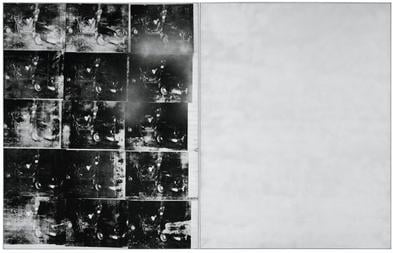
Silver Car Crash (Double Disaster) pairs a grid of uneven, black‑and‑white silkscreened crash images with a vast, nearly blank field of metallic silver, staging a battle between <strong>relentless spectacle</strong> and <strong>mute void</strong>. Warhol’s industrial repetition converts tragedy into a consumable pattern while the reflective panel withholds detail, forcing viewers to face the limits of representation and the cold afterglow of modern media <sup>[1]</sup><sup>[2]</sup>.

Eight Elvises by Andy Warhol

Eight Elvises

Andy Warhol (1963)

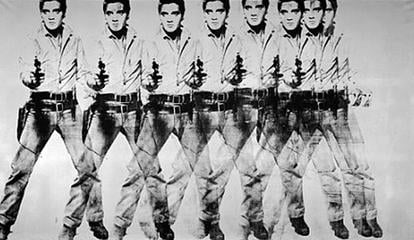
A sweeping frieze of eight overlapping, gun‑drawn cowboys marches across a silver field, their forms slipping and ghosting as if frames of a film. Warhol converts a singular star into a <strong>serial commodity</strong>, where <strong>mechanical misregistration</strong> and life‑size scale turn bravado into spectacle <sup>[1]</sup><sup>[2]</sup>.

Triple Elvis [Ferus Type] by Andy Warhol

Triple Elvis [Ferus Type]

Andy Warhol (1963)

In Triple Elvis [Ferus Type] (1963), Andy Warhol multiplies a gunslinging movie idol across a cool, metallic field, turning a singular persona into a <strong>serial commodity</strong>. The sharply printed figure at center flanked by fading, <strong>ghosted</strong> doubles collapses still image, filmic motion, and mass reproduction into one charged surface <sup>[1]</sup><sup>[2]</sup>.

Four Marlons by Andy Warhol

Four Marlons

Andy Warhol (1966)

Four Marlons is a 1966 silkscreen by Andy Warhol that multiplies a single biker film-still into a tight 2×2 grid on raw linen. Its inky blacks against a tan, unprimed ground turn the glare of the headlamp, the angled handlebars, and the figure’s guarded pose into a <strong>repeatable icon</strong> of outlaw cool. Warhol’s seriality both <strong>amplifies and drains</strong> the image’s aura, exposing fame as a commodity pattern <sup>[1]</sup><sup>[3]</sup>.

Race Riot by Andy Warhol

Race Riot

Andy Warhol (1964)

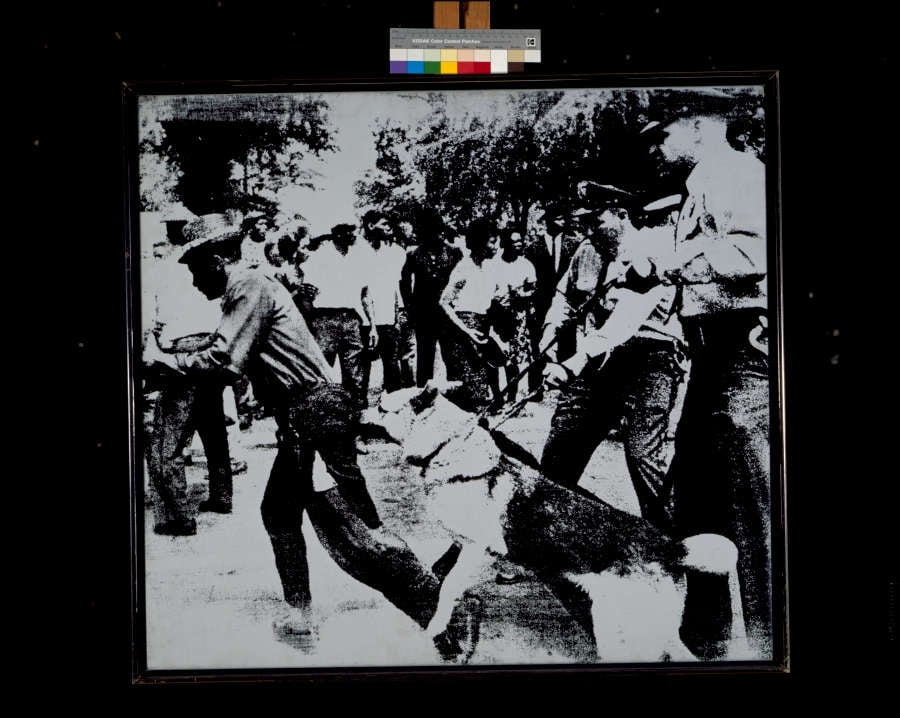
Race Riot crystallizes a split-second of state force: a police dog lunges while officers with batons surge and a ring of onlookers compresses the scene into a <strong>claustrophobic frieze</strong>. Warhol’s stark, high-contrast silkscreen translates a LIFE wire-photo into a <strong>mechanized emblem</strong> of American racial violence and its mass-media circulation <sup>[1]</sup><sup>[2]</sup>.
Sixty Last Suppers by Andy Warhol

Sixty Last Suppers

Andy Warhol (1986)

Andy Warhol’s Sixty Last Suppers multiplies Leonardo’s scene into a vast grid, turning a singular sacred image into <strong>serial</strong> signage. From afar it reads as an architectural surface; up close, silkscreen <strong>variations</strong>—blurs, darker panels, dropped ink—reassert the human trace <sup>[1]</sup><sup>[2]</sup>.