Triple Elvis [Ferus Type]

by Andy Warhol

In Triple Elvis [Ferus Type] (1963), Andy Warhol multiplies a gunslinging movie idol across a cool, metallic field, turning a singular persona into a serial commodity. The sharply printed figure at center flanked by fading, ghosted doubles collapses still image, filmic motion, and mass reproduction into one charged surface [1][2].
💰

Market Value

$110-150 million

How much is Triple Elvis [Ferus Type] worth?

Fast Facts

Year
1963
Medium
Silver paint and spray paint with black silkscreen ink on linen
Dimensions
82 1/4 × 118 1/2 in. (209.0 × 301.0 cm)
Location
San Francisco Museum of Modern Art (The Doris and Donald Fisher Collection), San Francisco
Triple Elvis [Ferus Type] by Andy Warhol (1963)

Click on any numbered symbol to learn more about its meaning

Meaning & Symbolism

Warhol builds a machine for making myth. Across a broad silver field, three life-size impressions of the same quick‑draw cowboy cascade left-to-right: one register lands with inky authority, while the flanking figures arrive as partial strikes, their contours drifting, their blacks thinned to mist. The belt, holster, and cocked pistol read instantly as Western tropes, but Warhol treats them as reproducible signs, not personal attributes. The silver ground behaves like cinema’s silver screen, flattening depth, reflecting ambient light, and fusing painting to movie culture’s glow. The shift from crisp central impression to peripheral ghosts simulates a shutter’s flicker or a reel’s jump-cut, so motion emerges without literal movement. What looks like expressive touch is, in fact, the visible artifact of silkscreen—misregistration, ink bleed, fading pulls—elevated into meaning. The work declares that celebrity images are not merely seen; they are printed, shipped, installed, and multiplied, their power surviving even as the strikes deteriorate 1235. That manufacturing logic is historical, not metaphorical. For the 1963 Ferus Gallery show, Warhol sent a roll of uncut, silvered canvas to Los Angeles; sections were cut and stretched to varying widths so that Elvises could line the walls edge-to-edge, engulfing viewers in a run of identical yet imperfect stars. “Ferus type” now names this corpus: black silkscreen over silver paint on linen, standardized in height, variable in width, and conceived to operate serially. In Triple Elvis [Ferus Type], the system condenses to three figures that read as successive frames collapsing into one still. The center figure’s firmly struck face, shirt seams, and weapon anchor the image’s commodity clarity; the flanking impressions drift and thin, modeling how photographs lose density in transmission yet remain legible—and desirable. Warhol thus retools American myth. The gun and swagger promise danger, but repetition domesticates menace into décor, a looped sign of masculinity that anyone can consume. The work insists that aura is not the opposite of reproduction; aura is reproduced. The more the image repeats, the more it is believed. Pop’s wager—that painting can mirror and expose the mass-media apparatus—finds a precise vehicle here, where silver evokes cinema, mechanical printing supplies the look of industry, and the Western costume telegraphs mythic Americana already coded by Hollywood publicity. The result is less a portrait than a functioning model of culture-as-circulation, showing how a figure becomes durable precisely by being endlessly copied 12345. The piece also clarifies Warhol’s own trajectory in 1963 toward silvered surfaces, screen-printed seriality, and film. The Elvis still he appropriated comes from a studio publicity image for a Western, meaning the source was already an instrument of distribution. By reprinting it at human scale, then staging uneven strikes that reveal the workings of the screen, Warhol turns exposure—the seam of the process—into the content. The cowboy’s lethal readiness doubles as media’s lethal efficiency: images draw, fire, and echo. That echo is the art. This is why institutions and markets alike have treated the Elvis series as canonical Pop: it welds medium, myth, and mechanism into a single, legible proposition about how modern icons are made and maintained. The silver field keeps the cinema in play; the serial figures keep the factory in view; the fading impressions keep the mortality of images—how they wear down and still persuade—at the surface. Triple Elvis [Ferus Type] diagnoses a culture where identity is spectacle and repetition is the engine of belief 1236.

Explore Deeper with AI

Ask questions about Triple Elvis [Ferus Type]

Popular questions:

Powered by AI • Get instant insights about this artwork

💬 Ask questions about this artwork!

Interpretations

Historical Context

In Los Angeles—Hollywood’s backyard—Warhol’s 1963 Ferus installation wrapped the gallery with edge‑to‑edge Elvises cut from a single roll, converting the white cube into a pseudo‑cinematic lobby of serial stardom. This was not just display but a choreography of viewing, compelling spectators to walk a corridor of repeating gunmen—an embodied lesson in how images inundate publics in movie houses and billboards. The choice of a Flaming Star publicity still means the source image already belonged to a distribution pipeline; Warhol simply scaled it up and made its transit visible. In this context, Triple Elvis [Ferus Type] reads as a portable fragment of that immersive perimeter, compressing an installation logic—quantity, continuity, engulfment—into one canvas 2.

Source: Whitney Museum (Richard Meyer) [audio transcript]

Formal Analysis

Silver spray and paint create a fluctuating, reflective field that toggles between screen and surface, while black ink impressions register at differing densities. These ‘good’ and ‘weak’ pulls reveal the indexical nature of silkscreen: mechanical repetition that still carries material contingency—ink load, pressure, and alignment. The drifting edges act like filmic motion blur, yet their cause is resolutely procedural (misregistration), not gestural expression. Spectators complete the image as the silver catches ambient light, a phenomenological nod to cinema’s projective glow. In short, the work binds reflectivity, seriality, and process into a single visual syntax that makes manufacture legible as form, not mere technique 134.

Source: SFMOMA; Seattle Art Museum; Sotheby’s

Symbolic Reading (Masculinity as Performance)

Elvis appears not as a biographical subject but in cowboy drag—belt, holster, drawn pistol—an outfit that condenses the U.S. West into a legible brand of masculinity. Repetition drains risk from the weapon, converting menace into décor; what remains is a consumable pose calibrated by studios and publicity. Warhol thus shifts the cowboy from frontier prowess to surface performance, a sign one wears and markets. In this key, Triple Elvis diagnoses the gender politics of mass media: masculinity is circulated as an image-regime, stabilized by sameness, and prized for its reproducibility more than its authenticity 57.

Source: Christie’s catalogue essays; Western Art & Architecture

Medium Reflexivity & Authorship

By sourcing a studio publicity still, Warhol collapses fine art into the workflows of advertising and cinema, reframing authorship as the orchestration of flows—photographic, industrial, commercial. The painting openly exhibits silkscreen’s seams, converting exposure, bleed, and misalignment into content; it is art about its own apparatus. That reflexivity extends to scale: life‑size figures act like human billboards, while the silver ground tethers painting to the theater’s ‘silver screen.’ Authorship here means curating and iterating a circulating file until its legibility hardens into myth—an argument about how icons are made, not who first made them 26.

Source: Whitney Museum (Richard Meyer); Christie’s feature essay

Reception & Market Studies

Triple Elvis [Ferus Type] has become a bellwether of Pop’s market and museum canon, with one example selling for $81.9 million in 2014. That price point ratifies the work’s thesis: images gain aura through repetition and distribution, then are further valorized by institutional display and auction spectacle. The piece’s portability from gallery perimeter to private collection underscores a closed loop—mass culture feeds art, art reenters mass spectacle via headlines, and value accrues to the most circulated icons. Market reception thus functions as a final ‘pull’ of the screen: another strike that intensifies belief rather than exhausting it 69.

Source: Christie’s features; The Guardian (auction coverage)

Related Themes

About Andy Warhol

Andy Warhol (1928–1987) trained in pictorial design and built a successful career as a New York commercial illustrator before shifting to fine art. Around 1962 he moved from hand-painted images of consumer goods and celebrities to a serial practice that soon adopted photo-silkscreen, defining Pop Art’s cool, media-savvy aesthetic [2][5].
View all works by Andy Warhol

More by Andy Warhol

Silver Car Crash (Double Disaster) by Andy Warhol

Silver Car Crash (Double Disaster)

Andy Warhol (1963)

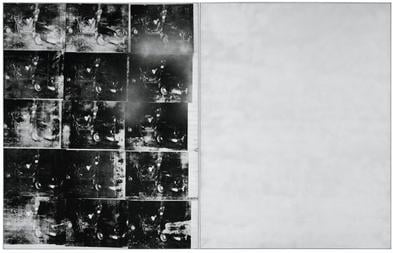
Silver Car Crash (Double Disaster) pairs a grid of uneven, black‑and‑white silkscreened crash images with a vast, nearly blank field of metallic silver, staging a battle between <strong>relentless spectacle</strong> and <strong>mute void</strong>. Warhol’s industrial repetition converts tragedy into a consumable pattern while the reflective panel withholds detail, forcing viewers to face the limits of representation and the cold afterglow of modern media <sup>[1]</sup><sup>[2]</sup>.

Eight Elvises by Andy Warhol

Eight Elvises

Andy Warhol (1963)

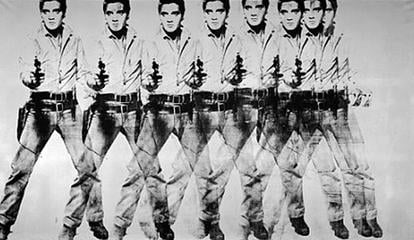
A sweeping frieze of eight overlapping, gun‑drawn cowboys marches across a silver field, their forms slipping and ghosting as if frames of a film. Warhol converts a singular star into a <strong>serial commodity</strong>, where <strong>mechanical misregistration</strong> and life‑size scale turn bravado into spectacle <sup>[1]</sup><sup>[2]</sup>.

Turquoise Marilyn by Andy Warhol

Turquoise Marilyn

Andy Warhol (1964)

In Turquoise Marilyn, Andy Warhol converts a movie star’s face into a <strong>modern icon</strong>: a tightly cropped head floating in a flat <strong>turquoise</strong> field, its <strong>acidic yellow hair</strong>, turquoise eye shadow, and <strong>lipstick-red</strong> mouth stamped by silkscreen’s mechanical bite. The slight <strong>misregistration</strong> around eyes and hair produces a halo-like tremor, fusing <strong>glamour and ghostliness</strong> to expose celebrity as a manufactured surface <sup>[1]</sup><sup>[2]</sup>.

Four Marlons by Andy Warhol

Four Marlons

Andy Warhol (1966)

Four Marlons is a 1966 silkscreen by Andy Warhol that multiplies a single biker film-still into a tight 2×2 grid on raw linen. Its inky blacks against a tan, unprimed ground turn the glare of the headlamp, the angled handlebars, and the figure’s guarded pose into a <strong>repeatable icon</strong> of outlaw cool. Warhol’s seriality both <strong>amplifies and drains</strong> the image’s aura, exposing fame as a commodity pattern <sup>[1]</sup><sup>[3]</sup>.

Race Riot by Andy Warhol

Race Riot

Andy Warhol (1964)

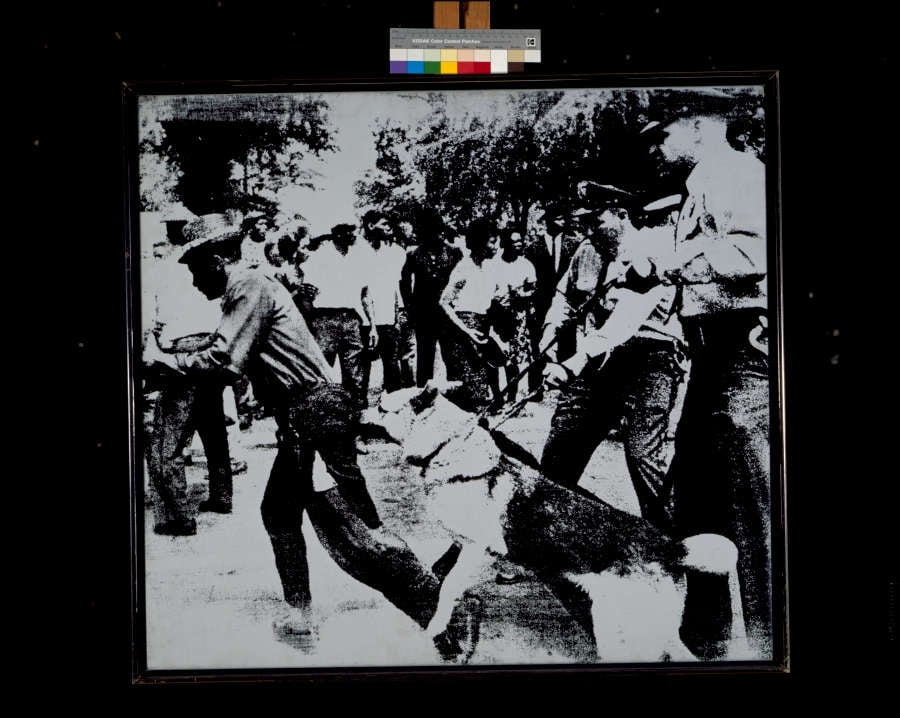
Race Riot crystallizes a split-second of state force: a police dog lunges while officers with batons surge and a ring of onlookers compresses the scene into a <strong>claustrophobic frieze</strong>. Warhol’s stark, high-contrast silkscreen translates a LIFE wire-photo into a <strong>mechanized emblem</strong> of American racial violence and its mass-media circulation <sup>[1]</sup><sup>[2]</sup>.
Sixty Last Suppers by Andy Warhol

Sixty Last Suppers

Andy Warhol (1986)

Andy Warhol’s Sixty Last Suppers multiplies Leonardo’s scene into a vast grid, turning a singular sacred image into <strong>serial</strong> signage. From afar it reads as an architectural surface; up close, silkscreen <strong>variations</strong>—blurs, darker panels, dropped ink—reassert the human trace <sup>[1]</sup><sup>[2]</sup>.