Sixty Last Suppers

by Andy Warhol

Andy Warhol’s Sixty Last Suppers multiplies Leonardo’s scene into a vast grid, turning a singular sacred image into serial signage. From afar it reads as an architectural surface; up close, silkscreen variations—blurs, darker panels, dropped ink—reassert the human trace [1][2].
💰

Market Value

$70-95 million

How much is Sixty Last Suppers worth?

Fast Facts

Year
1986
Medium
Acrylic and silkscreen ink on linen/canvas
Dimensions
116 × 393 in (294.6 × 998.2 cm)
Location
Private collection
Sixty Last Suppers by Andy Warhol (1986)

Click on any numbered symbol to learn more about its meaning

Meaning & Symbolism

Sixty Last Suppers replaces the singularity of Leonardo’s Last Supper with the logic of seriality. Warhol silkscreens the same black‑and‑white reproduction sixty times across a rigid grid, producing a field that reads less like a narrative painting than a bank of identical screens 2. At distance, the regimented rectangles merge into a monumental facade, flattening drama into pattern. Yet proximity undoes that flattening: slight misregistrations, denser patches of ink, occasional blur and dropouts fracture sameness, so that each Christ and each Judas is minutely different—an index of the hand inside the machine 12. Warhol leverages this tension to probe aura under mechanical reproduction: the image is emptied by overexposure and simultaneously intensified by accumulation. The Eucharistic table, repeated line-by-line, becomes a visual litany, where meaning accrues by counting rather than by singular revelation 2. The grid doubles as a metaphor for 1980s broadcast culture. Each panel resembles a TV monitor: a backlit rectangle holding a paused transmission of betrayal and communion 2. By freezing the scene sixty times, Warhol “locks” the sacred in mass-media time, making Leonardo’s Renaissance perspective collide with the modern insistence on surface. The work thus reads as an argument about mediation: most viewers know Leonardo through prints, photographs, and screens—not the fragile mural itself. Warhol adopts a 19th‑century engraving source and amplifies the distance between original and copy to expose how devotion now travels via reproductions 2. Visually, the grid’s slight tonal drift—the darker block here, the softer edge there—becomes a pulse, like static in a broadcast or noise in a data stream, reminding us that even systems of perfect sameness generate difference. In this way, the piece stages the paradox of faith in a culture of images: belief must pass through pixels and halftones. The late date of 1986 sharpens the work’s existential charge. Installed at mural scale, the sixty scenes echo not only supermarket displays but also memorial walls; the repetition of Christ’s blessing and foreknowledge of death reads against a decade shadowed by illness and stigma 2. Warhol’s lifelong, if private, Byzantine Catholic practice underwrites the work’s refusal of simple irony: seriality becomes a form of prayer, and Pop becomes a vehicle for revelation rather than its negation 3. The grid’s oscillation between cool pattern and trembling particularity suggests a theology of attention: the universal and the individual held together, like a congregation made of singular bodies. In the end, Sixty Last Suppers is a final reckoning with the power—and cost—of visibility. By translating the most reproduced supper in history into an overwhelming field of sameness, Warhol asks whether sanctity can survive the marketplace—and answers, with each imperfect print, that grace persists precisely in the variations the machine cannot smooth away 12.

Explore Deeper with AI

Ask questions about Sixty Last Suppers

Popular questions:

Powered by AI • Get instant insights about this artwork

💬 Ask questions about this artwork!

Interpretations

Historical Context

Conceived for Alexander Iolas’s Milan project, Warhol’s Last Supper cycle was exhibited across from Leonardo’s mural—an intentional, site‑specific dialogue between Renaissance wall painting and late‑20th‑century image culture. Sixty Last Suppers, made in 1986, belongs to this terminal phase and reads against the decade’s somber mood: the AIDS crisis, public stigma, and communal mourning. The serial Eucharist becomes a civic register—an abstracted memorial wall—where the liturgy of “body and blood” collides with the spectacle of mass media. One month after the Milan opening, Warhol died unexpectedly, lending the work a retrospective fatal clarity. Its cool grandeur and repetitive devotion operate as both cultural seismograph and private reckoning, binding Pop’s surfaces to mortality’s pressure and the politics of visibility in the 1980s 24.

Source: Gagosian Quarterly (Jessica Beck); UPI Obituary

Formal Analysis (Media Wall and Silkscreen ‘Noise’)

The regimented grid behaves like a bank of TV monitors: sixty backlit rectangles, each a paused transmission of Leonardo’s scene. From afar, the array coalesces into a monumental facade; up close, silkscreen artifacts—misregistration, ink pooling, dropout—introduce a low hum of difference. This calibrated noise enlivens sameness, producing an index of the hand within the machine and complicating Pop’s reputation for impersonal flatness. Warhol sutures Renaissance perspective to a modernist insistence on surface, making the piece oscillate between image-depth and screen-flatness. The result is a reflexive portrait of viewing in the broadcast age: attention toggles, scanlines shimmer, and devotion competes with the flicker of serial display, as if sanctity were always already formatted for the monitor 25.

Source: Gagosian Quarterly (Jessica Beck); Whitney Museum (Donna De Salvo)

Theological Reading (Devotion in Pop Form)

Warhol’s private Byzantine Catholicism underwrites the work’s refusal of easy irony. Repetition functions as devotion: the sixty tables form a visual rosary, a litany where meaning accrues through counting rather than singular revelation. This aligns Pop seriality with Catholic ritual, reframing appropriation as a technology of prayer rather than mere détournement. The icon is not reinvented but re‑circulated, acknowledging that contemporary piety moves through copies. In this reading, the grid is less factory than congregation: a many‑voiced image holding “the universal and the individual” in tension. Warhol’s late turn to overt sacred subjects thus appears not as postmodern blankness, but as a sincere—if media‑savvy—pursuit of revelation through repetition 367.

Source: The Andy Warhol Museum; Brooklyn Museum (Revelation); Jane D. Dillenberger

Mediation & Reproduction (After the Engraving)

Warhol works not from Leonardo’s fragile mural but from a 19th‑century engraving, emphasizing that most modern encounters with the Last Supper are already second‑ or third‑order. By multiplying that reproduction, he converts loss into method: aura is both evacuated by overexposure and intensified by accumulation. The piece stages a pedagogy of looking in the age of mechanical reproduction, where belief must pass through halftone grain and serial grids. This is medium reflexivity in devotional drag—art that teaches how images travel and change. In parallel works and museum examples from the series, the sober, camera‑like tonalities underscore the shift from wall painting to printed image, from site to circulation, from unique fresco to iterable screen 28.

Source: Gagosian Quarterly (Jessica Beck); MoMA Collection (The Last Supper, 1986)

Restoration, Patina, and Time

Warhol’s Last Suppers intersect conservation debates around Leonardo’s heavily restored mural. Curators note that Warhol gravitated to the image in its deteriorated, mediated forms, effectively embracing the work’s historical patina as content. Sixty Last Suppers doubles down on this by treating degradation—blur, tonal drift, partial legibility—as a theological and art‑historical proposition: sacred history survives through damage and transmission. The accumulation of slightly altered impressions echoes the fresco’s layered restorations but transposes them into a transparent, industrial procedure. Warhol thus reframes the question of fidelity: not “Can we recover an original?” but “How does time write itself into images we love?” The answer is legible in every imperfect screen 52.

Source: Whitney Museum (Donna De Salvo); Gagosian Quarterly (Jessica Beck)

Market, Sanctity, and the Commodity Image

By 2017, Sixty Last Suppers fetched over $60 million at auction, confirming the work’s status as both sacred image and blue‑chip commodity. This market apotheosis intensifies Warhol’s own provocation—whether “sanctity can survive the marketplace.” The painting’s wholesale seriality courts commodity logic (batch, unit, grid) even as devotional repetition resists pure exchangeability. Installed at near‑architectural scale, it wavers between supermarket display and reliquary wall. The price history becomes part of the artwork’s interpretive field, a postscript in which Pop’s factory meets the ritual economy of relics and offerings. In that collision, Warhol proposes a paradox: the image is purified not by escaping commerce but by revealing, with each variable impression, how grace leaks through standardized forms 1102.

Source: Christie’s (lot record and press); Gagosian Quarterly (Jessica Beck)

Related Themes

About Andy Warhol

Andy Warhol (1928–1987) trained in pictorial design and built a successful career as a New York commercial illustrator before shifting to fine art. Around 1962 he moved from hand-painted images of consumer goods and celebrities to a serial practice that soon adopted photo-silkscreen, defining Pop Art’s cool, media-savvy aesthetic [2][5].
View all works by Andy Warhol

More by Andy Warhol

Silver Car Crash (Double Disaster) by Andy Warhol

Silver Car Crash (Double Disaster)

Andy Warhol (1963)

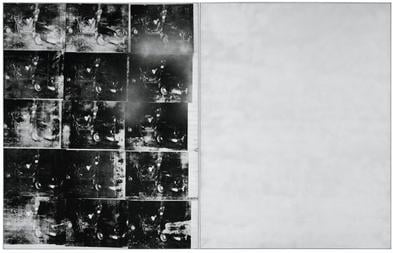
Silver Car Crash (Double Disaster) pairs a grid of uneven, black‑and‑white silkscreened crash images with a vast, nearly blank field of metallic silver, staging a battle between <strong>relentless spectacle</strong> and <strong>mute void</strong>. Warhol’s industrial repetition converts tragedy into a consumable pattern while the reflective panel withholds detail, forcing viewers to face the limits of representation and the cold afterglow of modern media <sup>[1]</sup><sup>[2]</sup>.

Eight Elvises by Andy Warhol

Eight Elvises

Andy Warhol (1963)

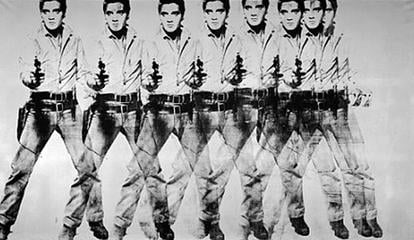
A sweeping frieze of eight overlapping, gun‑drawn cowboys marches across a silver field, their forms slipping and ghosting as if frames of a film. Warhol converts a singular star into a <strong>serial commodity</strong>, where <strong>mechanical misregistration</strong> and life‑size scale turn bravado into spectacle <sup>[1]</sup><sup>[2]</sup>.

Triple Elvis [Ferus Type] by Andy Warhol

Triple Elvis [Ferus Type]

Andy Warhol (1963)

In Triple Elvis [Ferus Type] (1963), Andy Warhol multiplies a gunslinging movie idol across a cool, metallic field, turning a singular persona into a <strong>serial commodity</strong>. The sharply printed figure at center flanked by fading, <strong>ghosted</strong> doubles collapses still image, filmic motion, and mass reproduction into one charged surface <sup>[1]</sup><sup>[2]</sup>.
Turquoise Marilyn by Andy Warhol

Turquoise Marilyn

Andy Warhol (1964)

In Turquoise Marilyn, Andy Warhol converts a movie star’s face into a <strong>modern icon</strong>: a tightly cropped head floating in a flat <strong>turquoise</strong> field, its <strong>acidic yellow hair</strong>, turquoise eye shadow, and <strong>lipstick-red</strong> mouth stamped by silkscreen’s mechanical bite. The slight <strong>misregistration</strong> around eyes and hair produces a halo-like tremor, fusing <strong>glamour and ghostliness</strong> to expose celebrity as a manufactured surface <sup>[1]</sup><sup>[2]</sup>.

Four Marlons by Andy Warhol

Four Marlons

Andy Warhol (1966)

Four Marlons is a 1966 silkscreen by Andy Warhol that multiplies a single biker film-still into a tight 2×2 grid on raw linen. Its inky blacks against a tan, unprimed ground turn the glare of the headlamp, the angled handlebars, and the figure’s guarded pose into a <strong>repeatable icon</strong> of outlaw cool. Warhol’s seriality both <strong>amplifies and drains</strong> the image’s aura, exposing fame as a commodity pattern <sup>[1]</sup><sup>[3]</sup>.

Race Riot by Andy Warhol

Race Riot

Andy Warhol (1964)

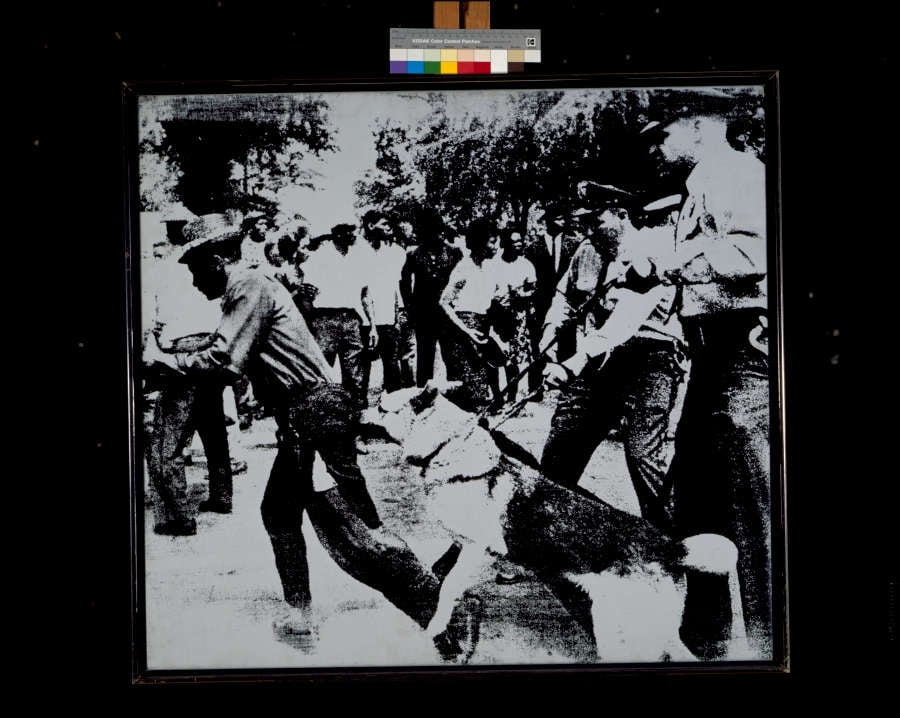
Race Riot crystallizes a split-second of state force: a police dog lunges while officers with batons surge and a ring of onlookers compresses the scene into a <strong>claustrophobic frieze</strong>. Warhol’s stark, high-contrast silkscreen translates a LIFE wire-photo into a <strong>mechanized emblem</strong> of American racial violence and its mass-media circulation <sup>[1]</sup><sup>[2]</sup>.