Liberty Leading the People
Study print
Prefer the curated version?
View the study print we made for this artwork, pairing the full painting with a close reading of one meaningful detail.

Study Print Studio
Create a personal study print
Build a companion study sheet around the part of this painting that speaks to you most. Choose a detail, shape an interpretation, and walk away with something personal and display-worthy.
Fast Facts
- Year
- 1830
- Medium
- Oil on canvas
- Dimensions
- 260 x 325 cm
- Location
- Louvre Museum, Paris
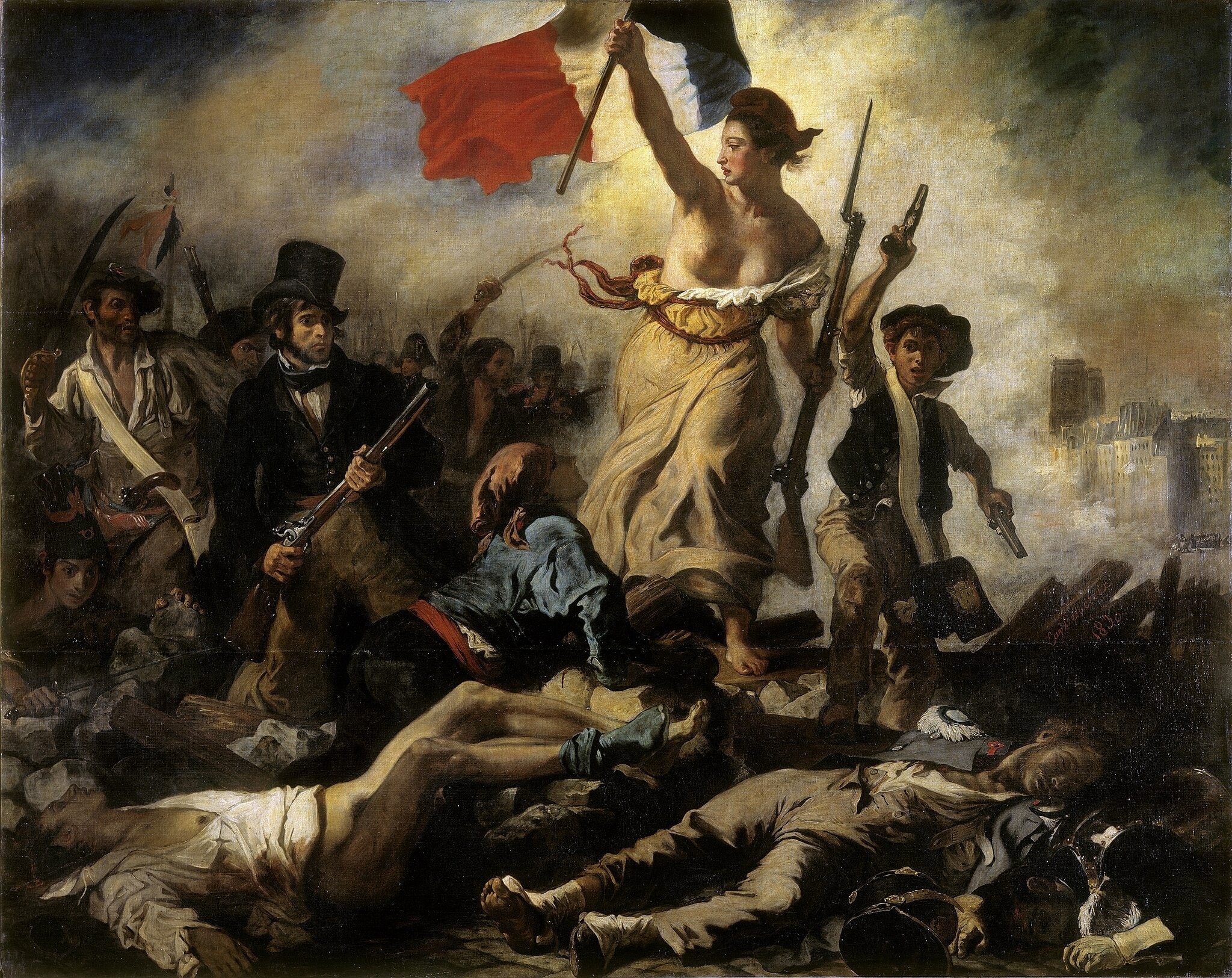
Click on any numbered symbol to learn more about its meaning
Meaning & Symbolism
Explore Deeper with AI
Ask questions about Liberty Leading the People
Popular questions:
Powered by AI • Get instant insights about this artwork
Interpretations
Formal-Technical Lens: Chromatic Rhetoric After Restoration
Source: Louvre (via Guardian restoration report); Smarthistory
Religious-Political Reading: Notre-Dame as Secular Altar
Source: Smarthistory
Social History: Staging Class as Legitimacy
Source: Smarthistory; Britannica
Gender-Iconographic Analysis: The Politics of the Allegorical Body
Source: Smarthistory; Élysée (Marianne)
Reception & Power: When Images Threaten Regimes
Source: Britannica
Childhood & Risk: The Boy with Pistols Beyond Gavroche
Source: Smarthistory
Explore Specific Elements
Dive deeper into individual scenes and details within Liberty Leading the People.
Marianne's Bared Breast
Marianne’s bared breast is Delacroix’s clearest signal that the central figure is not a literal barricade fighter but Liberty herself—an antique, allegorical presence striding into modern Paris. Framed by smoke and the tricolor, the exposed torso anchors the painting’s fusion of myth and news, translating a July 1830 street battle into a timeless image of republican freedom.
The Boy with Pistols
A wiry street boy sprints across the barricade, a pistol in each fist, his shout catching the viewer’s eye as surely as Liberty’s flag. More than a colorful extra, he is Delacroix’s urgent proof that modern revolution was fought by the city’s youth, not only by heroes in marble. After the Louvre’s restoration, his placement ahead of Liberty confirms him as a driving spark of the charge [1].
The Tricolor Flag
Delacroix hoists the blue‑white‑red Tricolor as the painting’s rallying cry and visual summit. Born of revolution and reinstated in 1830, the flag in Liberty’s fist transforms street combat into a national allegory and fixes the scene in contemporary Paris.
The Fallen Bodies
At the viewer’s feet, a tangle of corpses forms the ground from which Liberty advances. These fallen bodies—both insurgents and royal troops—thrust death into our space and make sacrifice the literal base of the July Revolution’s triumph.