The Fallen Bodies in Liberty Leading the People
A closer look at this element in Eugene Delacroix's 1830 masterpiece
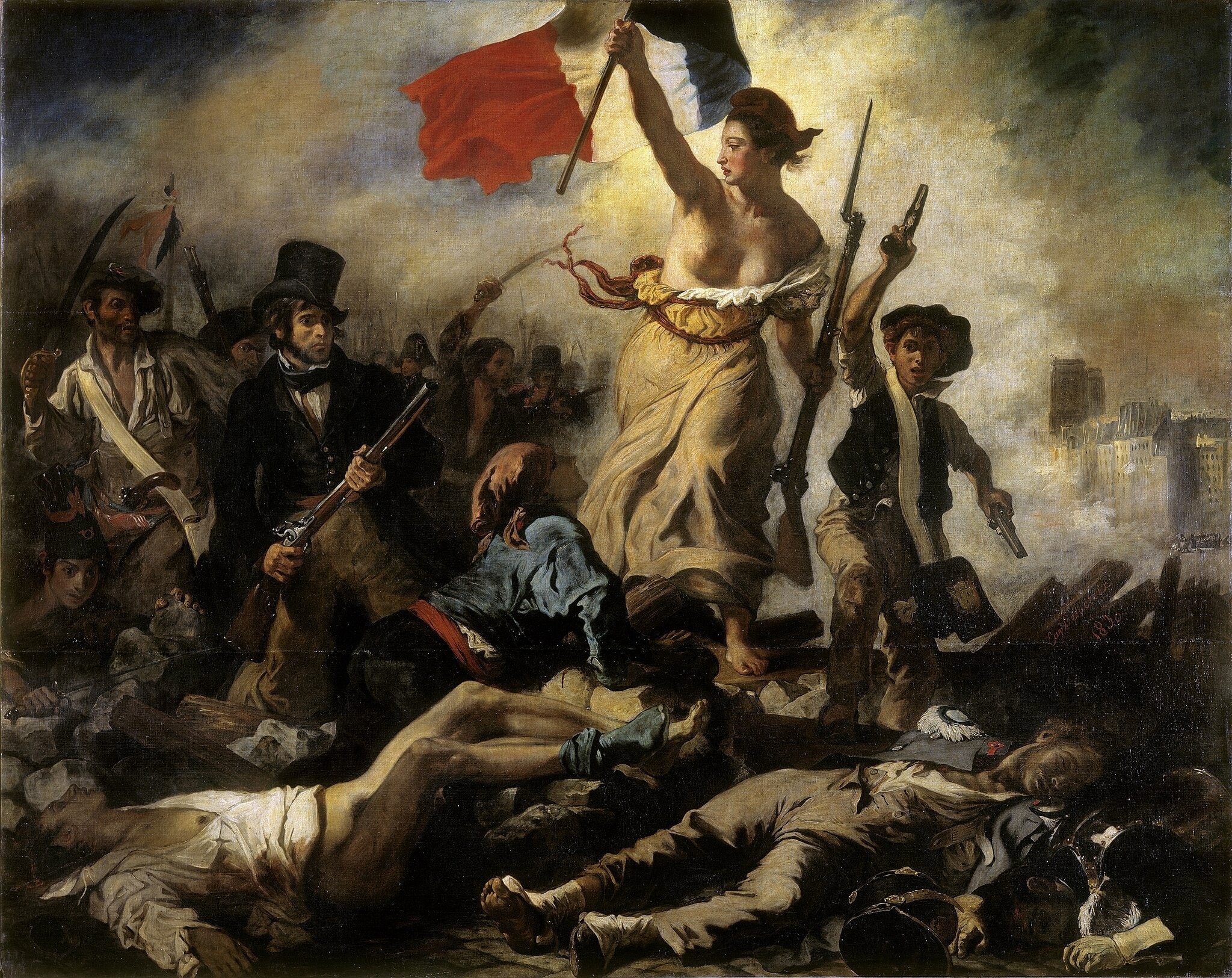
At the viewer’s feet, a tangle of corpses forms the ground from which Liberty advances. These fallen bodies—both insurgents and royal troops—thrust death into our space and make sacrifice the literal base of the July Revolution’s triumph.
Historical Context
Delacroix painted Liberty Leading the People in the autumn of 1830, only weeks after the July Revolution toppled Charles X. Determined to make a modern history painting, he wrote that although he had not fought, he would “paint for” his country—a pledge that shaped the canvas’s unflinching foreground of dead and dying figures 1. The fallen bodies are not generalized trophies of war; they are the fresh casualties of street fighting on Parisian barricades.
Delacroix anchors this immediacy by showing the dead of both camps. At the left lies a looted insurgent in a rumpled white shirt, nude from the waist down; to the right, two uniformed royal soldiers sprawl across the rubble, one in a grey-blue campaign greatcoat with white gaiters, another face-down with a white epaulette 2. Placing these corpses at the viewer’s feet rejects sanitized neoclassical heroics in favor of contemporary witness. The painting’s timing and subject explain their prominence: the revolution had just occurred, and Delacroix chose to stage its cost as the composition’s base 12.
Symbolic Meaning
The foreground dead operate as a concentrated memento mori for civic liberty. By juxtaposing a stripped insurgent with uniformed royal troops, Delacroix insists that liberty is purchased through sacrifice on both sides; the nation’s renewal is literally built over shared loss 2. Their head‑to‑toe placement across the lower edge makes death the threshold Liberty must cross—and that the viewer must face—balancing exhilaration with reckoning 12.
Delacroix also folds allegory into reality. The classical, studio-derived “Hector” pose of the cadaver at left echoes antique heroism, yet the figure remains brutally modern and unidealized 2. This fusion keeps Liberty’s allegorical stride credible rather than propagandistic: the goddess walks among real corpses, not mythic abstractions 1. Contemporary reception recognized the charge of this decision; a legitimist critic derided the painting’s “spectres cadavéreux,” inadvertently confirming that the shocking dead were central to its political force 3. Preparatory sheets with sprawled bodies—likely drawn from memory of street casualties—show how deliberately Delacroix crafted this modern iconography of sacrifice 5.
Artistic Technique
Delacroix builds the corpses into the horizontal base of a pyramidal design that rises through the fighters to the tricolor at the apex. Aggressive foreshortening projects limbs into the viewer’s space, intensifying immediacy and forcing confrontation 1.
Color locks form to meaning. After the 2023–24 restoration clarified the canvas, the dead at our feet stage decisive contrasts of blue, white, and red—the white shirt, blue cloth, and bloodied reds and sashes—binding the chromatic argument of the nation across the rubble. Removal of thick, yellowed varnish also revealed crisp foreground minutiae (such as a scuffed boot), enriching the realism of the corpse‑strewn ground 4.
Connection to the Whole
The fallen bodies are the painting’s structural and ethical ground. As a grim pedestal, they elevate Liberty’s stride while reminding viewers that triumph rests on mortality 6. Their immediacy pushes the scene into our space, transforming a victory image into a modern meditation on revolutionary cost 1.
They also unify allegory and actuality: Liberty’s ideal body is inseparable from the tangible dead beneath her. Chromatically, the corpses help articulate Delacroix’s disciplined blue‑white‑red orchestration, so that even the rubble and bodies “speak” the tricolor that crowns the composition—sealing the work’s claim as a political painting grounded in lived experience 41.
Explore More from This Painting
This detail is one part of Liberty Leading the People. Use the links below to return to the full interpretation, browse the full set of details, or view the painting's valuation if available.
Sources
- Smarthistory – Delacroix, Liberty Leading the People
- Histoire par l’image – Iconography, uniforms, ‘Hector’ cadaver
- Persée – 1831 reception; “spectres cadavéreux”
- Musée du Louvre press release – 2023–24 restoration; palette; clarified details
- The Metropolitan Museum of Art – Figure Studies related to ‘Liberty Leading the People’
- Wikipedia – Liberty Leading the People (composition; corpses as pedestal)