The Boy with Pistols in Liberty Leading the People
A closer look at this element in Eugene Delacroix's 1830 masterpiece
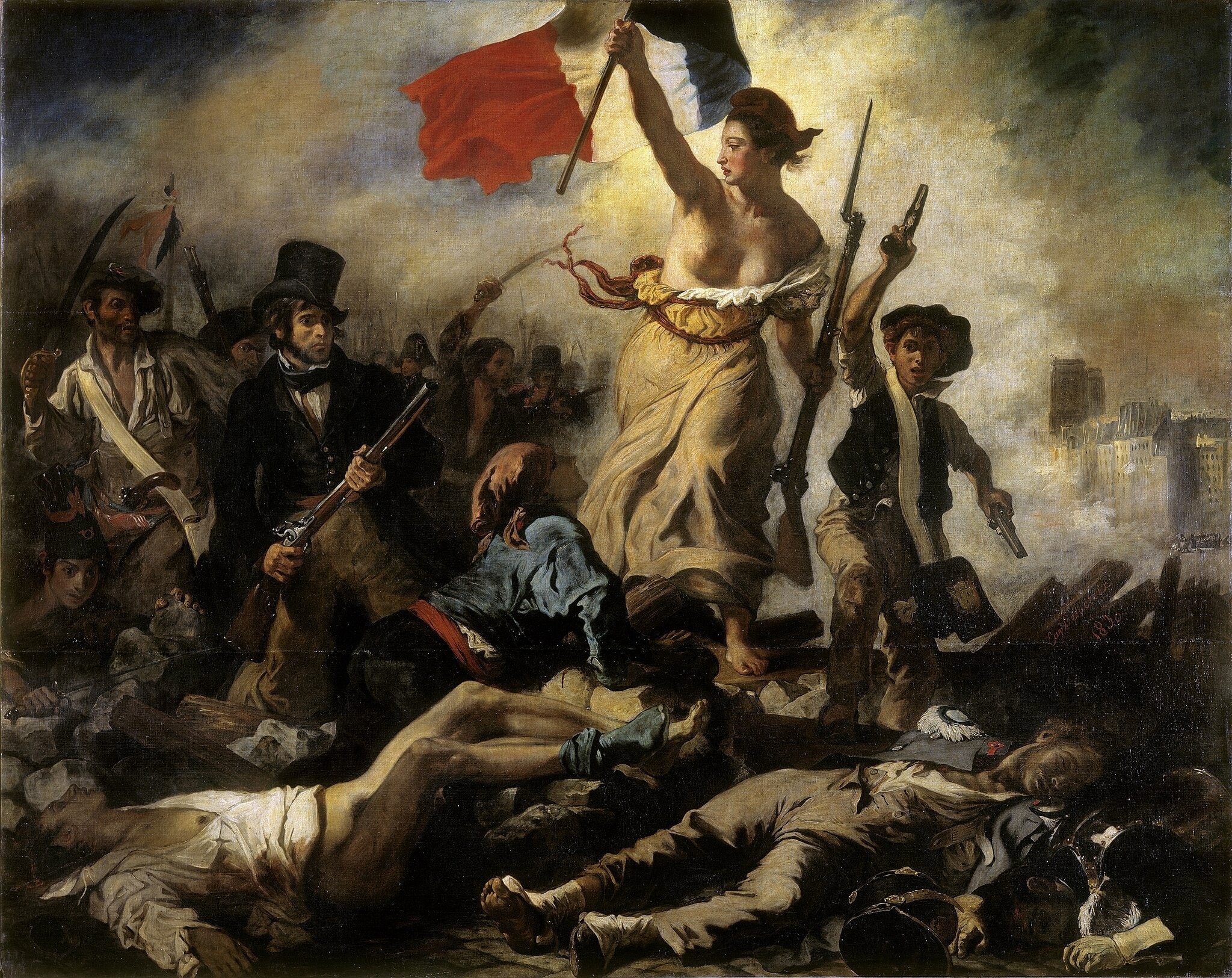
A wiry street boy sprints across the barricade, a pistol in each fist, his shout catching the viewer’s eye as surely as Liberty’s flag. More than a colorful extra, he is Delacroix’s urgent proof that modern revolution was fought by the city’s youth, not only by heroes in marble. After the Louvre’s restoration, his placement ahead of Liberty confirms him as a driving spark of the charge [1].
Historical Context
Delacroix painted Liberty Leading the People in the immediate aftermath of the July Revolution of 1830, declaring his aim to depict a "modern subject"—the Paris barricade. The pistol‑armed boy embodies the presence of youths in those street fights and anchors the painting’s claim to contemporaneity. He is not a portrait but a recognizable urban type: the Paris gamin or schoolboy, marked by small stature, cap, and satchel 2.
Curators at the Louvre confirm that, once discolored varnish was removed in 2023–24, the boy’s true position became unmistakable: he runs in front of Liberty, not beside her. That spatial clarification sharpens his role as an active forerunner in the assault, intensifying the painting’s headlong thrust toward the viewer 1. Delacroix’s casting of figures—worker, bourgeois, student, and child—was conceived to represent the cross‑class coalition that overthrew Charles X. Within that roster, the boy signals the revolutionary engagement of the youngest Parisians, aligning Delacroix’s art with eyewitness accounts and with the city’s lived experience of 1830 2.
Symbolic Meaning
The pistol‑wielding child condenses a potent nineteenth‑century idea: the gamin de Paris as the people’s quicksilver, insurgent energy. In visual culture of the period, this figure oscillates between enfant du peuple and enfant de la patrie—the child of the urban poor and the child of the nation. Marilyn Brown argues that Delacroix elevates this type from bystander to protagonist; his stepping foot and uplifted pistols catalyze the collective rush, making the revolutionary child the scene’s spark plug 4.
His direct address—mouth open, eyes alert—personalizes political fervor and turns spectators into participants, a calculated bridge between allegory and actuality 23. Later viewers linked him to Victor Hugo’s Gavroche, evidence of the motif’s afterlife as the emblem of insurgent youth; the Louvre stresses that this nickname is retrospective to the painting, not its source 13. Read as a schoolboy by his cap and satchel, he embodies the modern capital’s streetwise minors who learned fast, moved fast, and, in 1830, fought fast—an image that lets Delacroix fuse national ideal with street reality in a single, unforgettable child 52.
Artistic Technique
Delacroix sets the boy on the picture’s leading plane, now legible post‑restoration, so his forward stride bites into our space and drives the diagonal surge 1. Within an austere range of colored grays, the waistcoat carries the composition’s deepest black, making the child a tonal fulcrum at the vanguard while the tricolor ignites surrounding hues 1. Open, vigorous brushwork models his swinging arms and fluttering scarf, privileging energy over contour in classic Romantic fashion 3. Details—two cavalry pistols, the small cap and satchel that tag him as a schoolboy—fix him as a vivid type rather than an individual portrait, sharpening the scene’s documentary bite even as it remains painterly and improvisatory 6.
Connection to the Whole
Structurally, the boy anchors the right base of Delacroix’s pyramid: corpses in the foreground, advancing figures on the slope, Liberty at the apex. His planted foot and twin pistols swing the eye up and left into Liberty’s wake, tightening the composition’s diagonal attack 71. Chromatically, his blacks and sharp contrasts puncture the smoky field, echoing and relaying the red‑white‑blue triad that strings across sash, flag, and sky 1.
Narratively, he completes the painting’s civic ensemble—worker, bourgeois, student, child—so that Liberty is not an abstraction but a leader guiding an actual people across the barricade 3. By letting a child charge first, Delacroix welds modern urban reality to national myth in a single, forward‑hurtling figure.
Explore More from This Painting
This detail is one part of Liberty Leading the People. Use the links below to return to the full interpretation, browse the full set of details, or view the painting's valuation if available.
Sources
- Musée du Louvre — La restauration de la Liberté rend justice au travail d’un coloriste de génie (2024)
- Musée du Louvre — Des clefs pour découvrir le Louvre – Première visite (work fiche on Liberty)
- Smarthistory — Eugène Delacroix, Liberty Leading the People
- H‑France Review — Suzanne Singletary on Marilyn Brown, The Gamin de Paris in Nineteenth‑Century Visual Culture
- Encyclopedia Britannica — Liberty Leading the People
- Heidelberg University ArtDok — Jonker, On asp and cobra (details on the gamin and cavalry pistols)
- EBSCO Research Starters — Liberty Leading the People (composition and pyramid analysis)