The Tricolor Flag in Liberty Leading the People
A closer look at this element in Eugene Delacroix's 1830 masterpiece
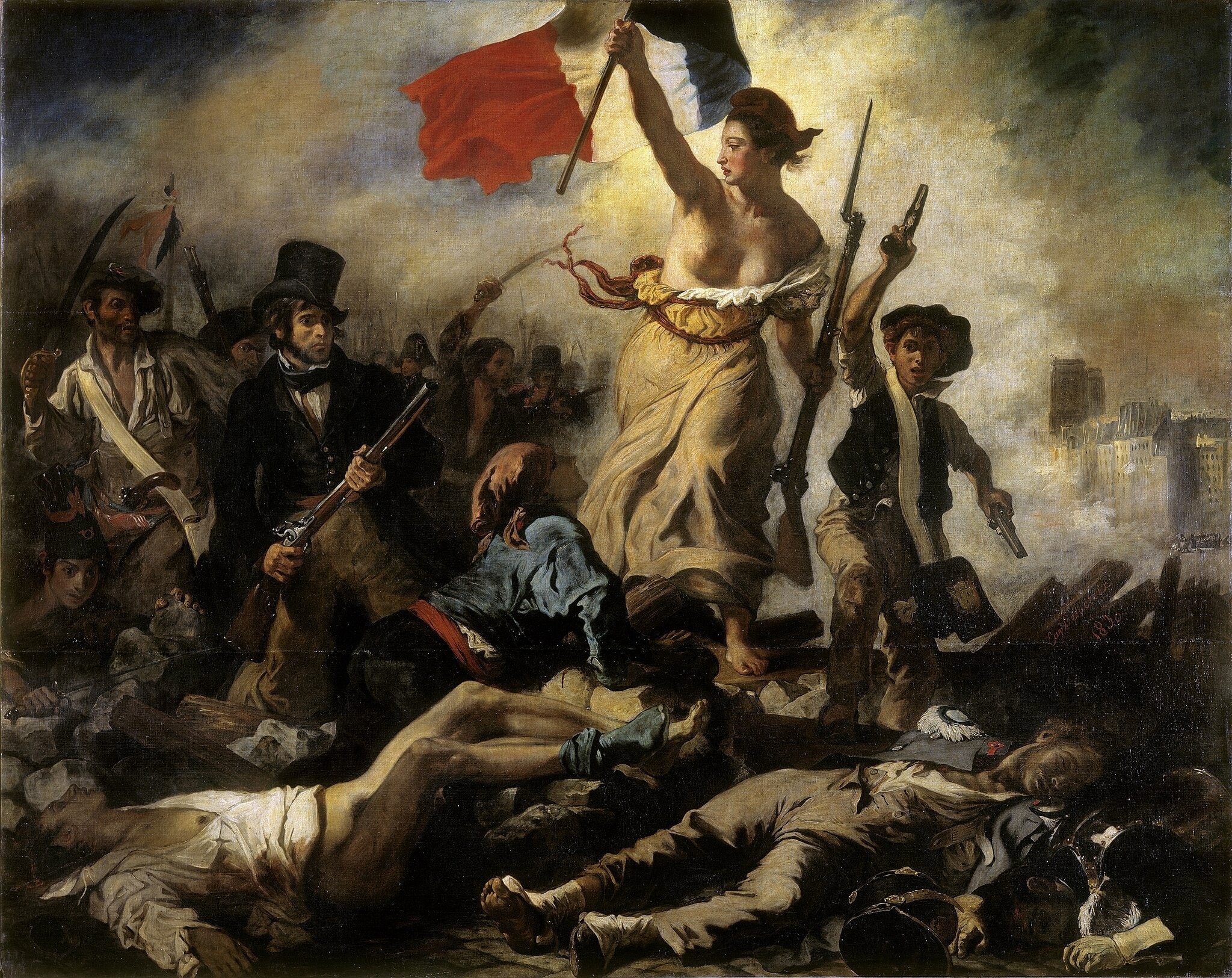
Delacroix hoists the blue‑white‑red Tricolor as the painting’s rallying cry and visual summit. Born of revolution and reinstated in 1830, the flag in Liberty’s fist transforms street combat into a national allegory and fixes the scene in contemporary Paris.
Historical Context
Delacroix painted Liberty Leading the People within months of the July Revolution of 1830, when Parisians toppled the Bourbon regime and the long‑censored tricolor again became France’s national emblem. The Louvre explains that the artist conceived a pyramidal composition whose “crowning” point is the flag that Liberty thrusts skyward—a choice tied to the political reality of the moment and to Delacroix’s own patriotic resolve 1.
Rather than revisiting 1789, the canvas depicts the “Trois Glorieuses” of July 27–29, 1830. Delacroix identifies the event as unmistakably contemporary by giving Liberty the national colors and by echoing them as a tiny standard set against the Parisian skyline, binding the uprising to the city itself. Panorama de l’art underscores how the reinstated tricolor marks the insurgents’ victory and functions as the painting’s apex, cutting sharply against a veil of white smoke 2.
Symbolic Meaning
The Tricolor fuses Paris’s blue and red with the monarchy’s white, a synthesis codified in the Revolution and revived in 1830; it embodies a unified nation rather than a partisan faction 3. In Delacroix’s image, that history is activated: Liberty’s raised banner stands for French sovereignty reclaimed after the Bourbon white flag, aligning the scene with the new political order of July while summoning the collective memory of revolutionary citizenship 37.
Scholars describe the flag here as a “symbol of struggle” rising like a flame from darkness to light—the sign that turns reportage into allegory and binds Liberty to the people she leads 4. Delacroix doubles the emblem on one tower of Notre‑Dame, inserting revolutionary color into a monument of tradition and signaling the transformation of Paris’s very symbols 5. The Tricolor thus carries a double charge: as a concrete national standard re‑adopted in 1830 and as the picture’s allegorical key, it proclaims victory, unity, and popular sovereignty while anchoring the narrative in lived history 26.
Artistic Technique
Delacroix engineers a pyramidal composition that rises from the barricade to Liberty and culminates in the flag, ensuring it commands the eye 1. His “chromatic asceticism” excludes green, orange, and violet and builds the scene from cool greys so the blue‑white‑red can ring across the canvas without competition 1.
After the 2023–24 cleaning, the painting’s restored coolness further sharpens the tricolor’s clarity and its ties to the smoky sky and uniforms 89. Greys knit the surface while repeated color accents—cockades, sashes, a shirt—echo the flag’s hues and rhythmically bind the crowd to Liberty’s standard, a strategy Histoire par l’image notes as exalting the red of the banner 4.
Connection to the Whole
As the composition’s apex, the Tricolor organizes bodies, diagonals, and light, converting a heap of casualties and chaotic motion into an upward‑driving national allegory 1. Its thrust fixes the painting’s direction—forward and skyward—so that Liberty’s stride reads as a collective summons rather than a solitary gesture.
The small flag on Notre‑Dame “rhymes” with the main banner, locating sovereignty in Paris and synchronizing near and far, figure and city, event and emblem 26. The flag is therefore both guide and goal: the visual device that orients the eye and the political sign that declares the people’s victory and the nation restored.
Explore More from This Painting
This detail is one part of Liberty Leading the People. Use the links below to return to the full interpretation, browse the full set of details, or view the painting's valuation if available.
Sources
- Louvre – Restoration interview and analysis of composition and color (pyramid; chromatic asceticism)
- Panorama de l’art (RMN–Grand Palais/INHA) – Analysis of the 1830 context and flag at the apex
- Elysée – History and symbolism of the French Tricolor (colors and national meaning)
- Histoire par l’image (RMN–Grand Palais/INHA) – Symbol of struggle; grey tonality exalting the red; color echoes
- Smarthistory – Essay noting the tricolor on Notre‑Dame and the fusion of allegory and politics
- Britannica – Overview highlighting the re‑raising of the tricolor on Notre‑Dame during the July Days
- The Metropolitan Museum of Art – Delacroix (2018) exhibition catalogue
- Louvre Collections (RF 129) – Object record and note on the restoration’s cooling of the palette
- Artnet News – Report on the 2023–24 restoration and its emphasis on the tricolor’s chroma