Marianne's Bared Breast in Liberty Leading the People
A closer look at this element in Eugene Delacroix's 1830 masterpiece
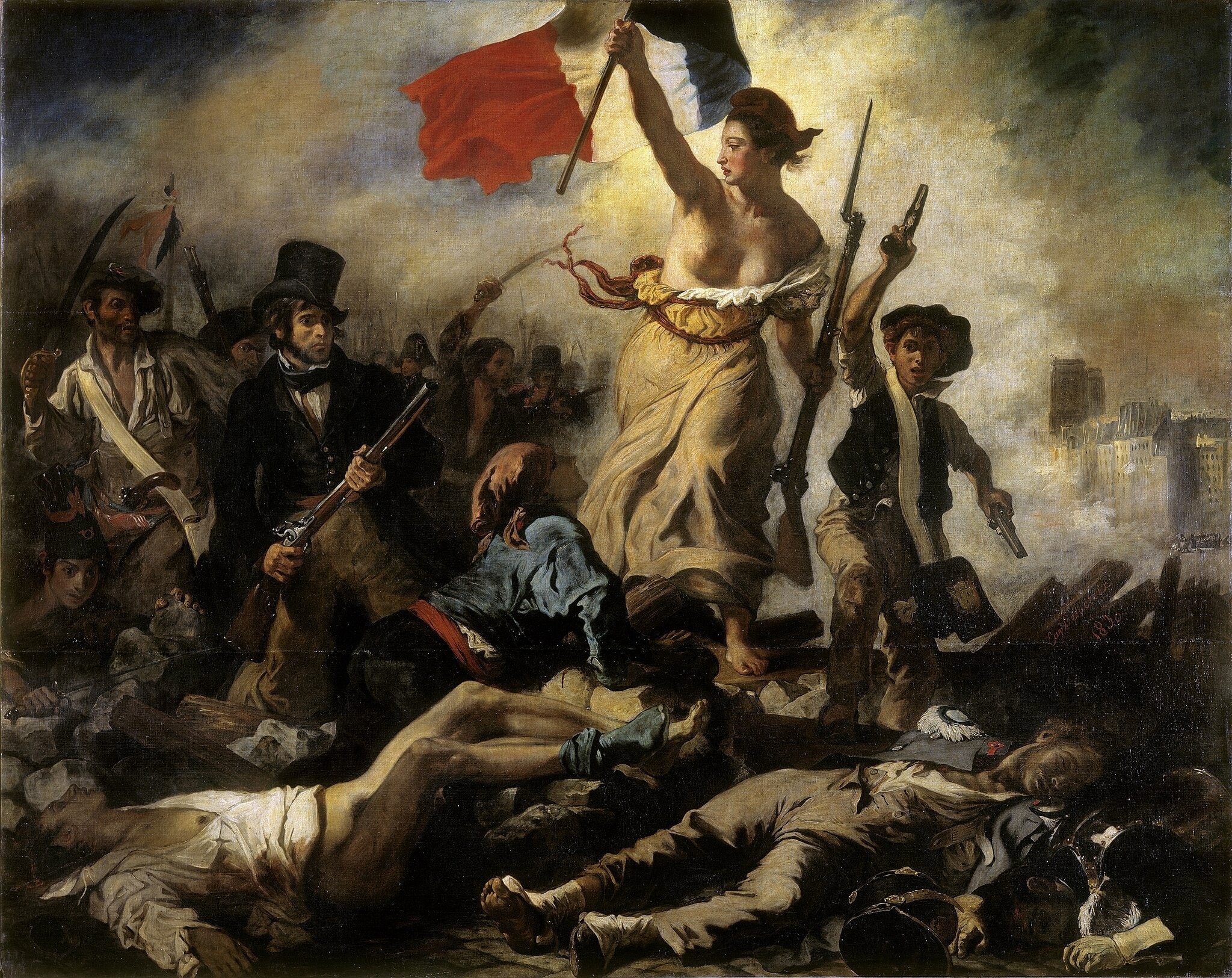
Marianne’s bared breast is Delacroix’s clearest signal that the central figure is not a literal barricade fighter but Liberty herself—an antique, allegorical presence striding into modern Paris. Framed by smoke and the tricolor, the exposed torso anchors the painting’s fusion of myth and news, translating a July 1830 street battle into a timeless image of republican freedom.
Historical Context
Delacroix painted Liberty Leading the People within months of the July Revolution of 1830 and exhibited it at the Salon of 1831, transforming a recent Paris uprising into a monumental history painting 1. To commemorate the event yet give it permanence, he centered the scene on an allegorical heroine whose attributes—the Phrygian cap, forward stride, and partially nude torso—announce Liberty rather than a specific woman from the crowd 1.
The Louvre describes this as a deliberate hybrid of modern history and classical allegory: a contemporary melee animated by an idealized, monumental figure 2. The bared breast is essential to that strategy, importing the visual language of antiquity into a present-tense subject so the Revolution reads as part of an enduring republican tradition. By installing this timeless body within gritty urban combat, Delacroix made the picture legible to Salon viewers as both eyewitness history and an emblem of the nation’s political ideals 12.
Symbolic Meaning
The exposed breast codes the figure as a classical allegory, aligning the July Revolution with ancient Greece and the Roman republican tradition; it tells viewers they are seeing Liberty herself, not a portrait of a Parisian combatant 1. French museum scholarship also links this nudity to the lineage of ancient Victories and goddess types—an idealizing device that elevates her status while she remains close to the people on the barricade 3.
Within French republican iconography, Marianne’s uncovered breast can signify civic nurture—the République nourricière, a maternal state that sustains its citizens—shading the figure’s meaning toward protection and generosity rather than erotic display 5. Delacroix had already deployed a comparable allegorical woman with a bared breast in Greece on the Ruins of Missolonghi (1826) to embody a nation, underscoring that the motif served a symbolic program across his work 7.
Contemporary historians emphasize that this is an artistic code of allegory, not a literal statement about women’s dress or public morality; the breast functions as an instantly legible badge of Liberty and a bridge between modern politics and timeless republican ideals 6.
Artistic Technique
Delacroix drives the composition forward in a pyramidal mass, lighting Liberty from the right so her head and chest cut sharply against pale smoke; the eye lands on the modeled torso before following her upraised arm to the flag 3. Antique drapery slides just beneath the breasts—drapé à l’antique—which heightens the emphasis on the exposed form 34.
His rapid, visible brushwork and smoky, ocher-gray range intensify immediacy while letting the warm flesh act as a chromatic accent within the battlefield tonality 4. Conservation has clarified the palette around the bust: the robe was painted gray and later veiled with yellow in varying densities, a cooling that rebalances the flesh tones and the dominance of the tricolor 2.
Connection to the Whole
The bared breast is the painting’s conceptual and visual keystone. It secures Liberty’s double identity—as timeless allegory and as a woman of the people—and crystallizes Delacroix’s fusion of myth with reportage at the apex of the triangular composition 13. From this luminous center, the viewer’s gaze rises along her arm to the flag, binding body and banner into a single message of revolt and citizenship.
Color and light reinforce that role: the modeled flesh answers the pale smoke and echoes the red‑white‑blue rhythms dispersed across the scene. After the 2024 conservation, these relationships read with greater clarity, so the torso glows as the picture’s center without overwhelming the tricolor that crowns it 23.
Explore More from This Painting
This detail is one part of Liberty Leading the People. Use the links below to return to the full interpretation, browse the full set of details, or view the painting's valuation if available.
Sources
- Smarthistory – Delacroix, Liberty Leading the People (analysis and transcript)
- Musée du Louvre – Conservation and curatorial note on Liberty Leading the People (2024)
- Histoire par l’image – La Liberté guidant le peuple (analysis of composition, symbolism, and reception)
- Panorama de l’Art – La Liberté guidant le peuple (curatorial analysis of style and handling)
- Vie Publique – Iconographie de Marianne (attributes, including the nourishing breast)
- El País (English) – Modern interpretation of Marianne’s bare breast as an allegorical code
- Smarthistory – Delacroix, Greece on the Ruins of Missolonghi (1826)