Venus of Urbino
by Titian
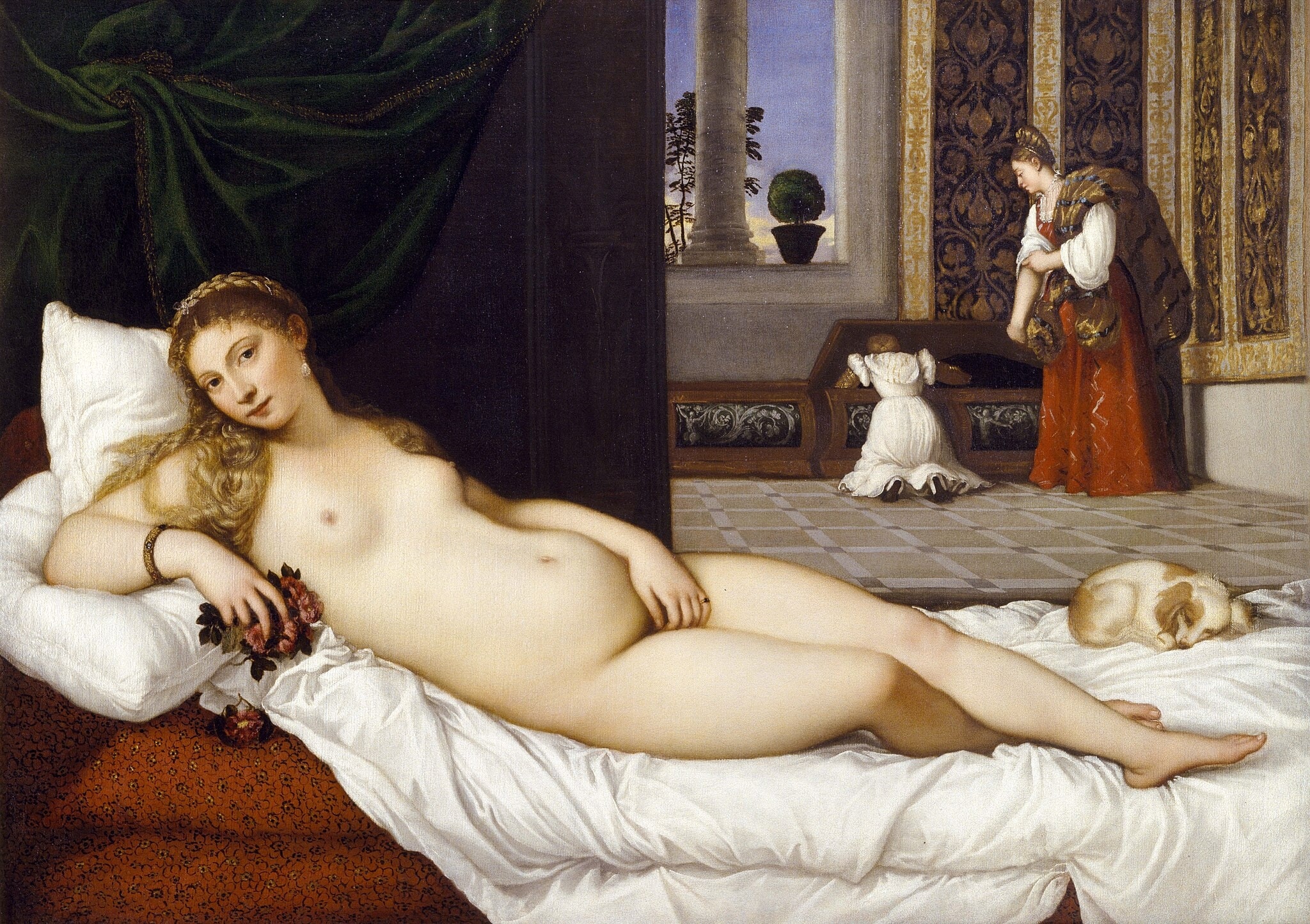
Titian’s Venus of Urbino turns the mythic goddess into an ideal bride, merging frank eroticism with the codes of marital fidelity. In a Venetian bedroom, the nude’s direct gaze, roses, sleeping lapdog, and attendants at a cassone bind desire to domestic virtue and fertility [1][2].
Study Print Studio
Create a personal study print
Build a companion study sheet around the part of this painting that speaks to you most. Choose a detail, shape an interpretation, and walk away with something personal and display-worthy.
Fast Facts
- Year
- 1538
- Medium
- Oil on canvas
- Dimensions
- 119 × 165 cm
Click on any numbered symbol to learn more about its meaning
Meaning & Symbolism
Titian stages a poised negotiation between erotic candor and conjugal order. The woman’s pale body, laid diagonally across cool white sheets, forms the painting’s structural axis; the walls’ orthogonals and the mattress seam converge toward her hand resting at the mons, transforming the classical pudica cue into a frank signal of sexual readiness framed for legitimate, fruitful union 2. In her other hand she cradles red roses—attributes of Venus and emblems of love—while a fine green curtain pools behind her, a theatrical veil that both conceals and reveals the bed, acknowledging the picture’s private, sensual function 12. The lapdog asleep at her feet, a conventional sign of fidelity, tempers the charge of her gaze, which meets the viewer without coyness, asserting sanctioned intimacy rather than illicit display 12.
The rear room secures the bridal reading. Two attendants rummage a richly inlaid cassone, the bridal chest tied to trousseau and dowry; the blue‑gold dress they handle implies imminent dressing or undressing within elite domestic ritual 12. On the windowsill sits a potted myrtle—plant of Venus and of marriage—backed by a column and a cool dawn sky, a vista that breathes duration and civic order into the private scene 12. Titian’s chromatic orchestration—rosy flesh against white linen, deep green drapery, and crimson cushions—converts touch into sight, making texture the vehicle of meaning: desire is tangible yet housed within the decorum of a patrician home. Rona Goffen’s influential account situates the hand’s gesture within Renaissance medical thought that female pleasure aided conception, thus binding erotic pleasure to procreation and casting the figure as the ideal wife rather than a courtesan masquerading as a goddess 2. The painting therefore reads as a guide to married love: beauty, chastity, and sexuality harmonized in a chamber where desire becomes duty and joy.
This domestication of myth is also a strategic modernization of the reclining Venus tradition. Where Giorgione’s Sleeping Venus turns the goddess into a dream beyond reach, Titian wakes her, brings her indoors, and makes her look back—an innovation that recasts the viewer’s role from distant spectator to acknowledged partner within a moralized script of possession and fidelity 26. The documented 1538 purchase by Guidobaldo II della Rovere roots the canvas in courtly life, where such imagery served as both erotic luxury and marital instruction 1. Its afterlife confirms the formula’s potency: Manet’s Olympia would quote the pose to expose modern sexual commerce, proving how Titian’s union of myth, marriage, and looking became the template to accept, reject, or subvert 4. In sum, Venus of Urbino perfects the Venetian art of colorito to craft a persuasive naturalism whose narrative is not mythic adventure but the social script of elite marriage—sensuous, fertile, and faithful—made visible in the very textures of bed, body, and home 123.
Explore Deeper with AI
Ask questions about Venus of Urbino
Popular questions:
Powered by AI • Get instant insights about this artwork
💬 Ask questions about this artwork!
Interpretations
Material Culture & Nuptial Ritual
The rear chamber reads as an inventory of marriage objects: cassoni tied to dowry, attendants managing sumptuous garments, and a potted myrtle—each a material sign of conjugality. Even the small lapdog, often a fidelity emblem, localizes the scene in della Rovere circles per the Uffizi’s note, binding private eros to specific courtly identity. These items do more than decorate; they choreograph a rite of passage in which the bride’s body is the ultimate ‘gift’ and guarantor of patrimony. The painting thus participates in the domestic theater of status, where textiles, containers, and plants articulate social reproduction as carefully as flesh does biological reproduction 12.
Source: Uffizi Galleries; Smarthistory
Formal Analysis: Colorito as Tactile Optics
Titian converts touch into sight through a bravura of colorito: rosy flesh modulates against chill whites and saturated greens, while the diagonal nude aligns with wall orthogonals to focus vision on the pelvic axis. The painter’s sfumato handling collapses edges so that fabric, skin, and air seem to share one humid medium, a sensory fusion that naturalizes eroticism as a visual “fact.” The bed seam and panel lines operate like sightlines, guiding the eye to the hand’s charged locus. In this reading, form is argument: chromatic intervals and soft modeling make desire legible without recourse to narrative, turning the canvas into a device that stages, measures, and legitimates looking within domestic space 2.
Source: Smarthistory
Medical-Erotic Lens: Pleasure as Procreative Duty
Rona Goffen’s influential thesis reframes the hand’s gesture not as modesty but as the activation of pleasure within Renaissance medical beliefs that female orgasm aided conception. In this matrix, the nude’s self‑touch, roses, and myrtle form a semiotics of fertility rather than licentious display. The pictorial center thus aligns with the era’s learned discourses: erotic stimulation becomes a therapeutic, even ethical, component of marital sex. The painting’s persuasive naturalism works to normalize this doctrine in elite culture—pleasure becomes a function of conjugal responsibility. Titian’s Venus is less a courtesan fantasy than an “ideal wife” whose arousal is the engine of legitimate lineage 23.
Source: Rona Goffen (Cambridge, 1997); synthesized via Smarthistory
Courtly Politics: Urbino, Display, and Dynasty
A 1538 letter records Guidobaldo II della Rovere purchasing the “nude woman” from Titian, situating the canvas in the Urbino court’s culture of refined display. Beyond private delectation, such a work functioned as soft power: it codified elite mores (fidelity, fecundity) and signaled dynastic ambitions through the domestication of myth. Titian’s service to major courts and emperors sharpened his ability to fold sensual luxury into political imagery. Here, the disciplined interior and controlled gaze rehearse governance as much as intimacy—orderly space, orderly body, orderly lineage. The patrician bedroom becomes a micro‑polity where erotic consent is aligned with civic stability and family strategy 146.
Source: Uffizi Galleries; Britannica; National Gallery (London)
Reception & Appropriation: From Venus to Olympia
Manet’s Olympia cannily quotes Titian’s pose to expose modern transactions of sex, stripping away myth and swapping the faithful dog for a bristling cat. This act of appropriation clarifies what Titian achieved: he fused erotic availability with marriage ideology so persuasively that later artists could weaponize the template by untying its moral knots. Olympia’s confrontational gaze and studio‑bright palette lay bare the economic and racialized structures occluded by Venetian softness. Reading Urbino through Olympia thus reveals the original’s conditional contract of looking: a domesticated invitation that depends on myth and class decorum—precisely what Manet overturns to jolt the modern viewer 25.
Source: Musée d’Orsay; Smarthistory
Poetics of the Belle Donna: Idealization and Slippage
David Rosand and others situate the canvas within the Venetian genre of the belle donna, where portraits of ideal beauty slide toward allegory and back again. In this lens, Venus is both someone and no one: a composite type whose hairstyle, pearls, and painterly finish encode desirability more than identity. Such aestheticized anonymity courts pleasurable ambiguity—bride, goddess, courtesan—while the painter’s artifice (soft transitions, sumptuous color) becomes the guarantor of ideality. Rather than pin a single referent, the image performs a calibrated oscillation that flatters the beholder’s gaze and taste, making aesthetic refinement itself the subject of possession 23.
Source: Rona Goffen (ed.), Titian’s “Venus of Urbino” (essays incl. Rosand); Smarthistory
Related Themes
About Titian
Titian (c. 1488/90–1576), the leading painter of 16th‑century Venice, transformed European painting through color‑driven modeling and poetic invention, serving elite patrons across Italy and Habsburg courts. His collaborations with the della Rovere of Urbino provided a key context for this canvas [5].
View all works by Titian →