Girl Arranging Her Hair

by Mary Cassatt

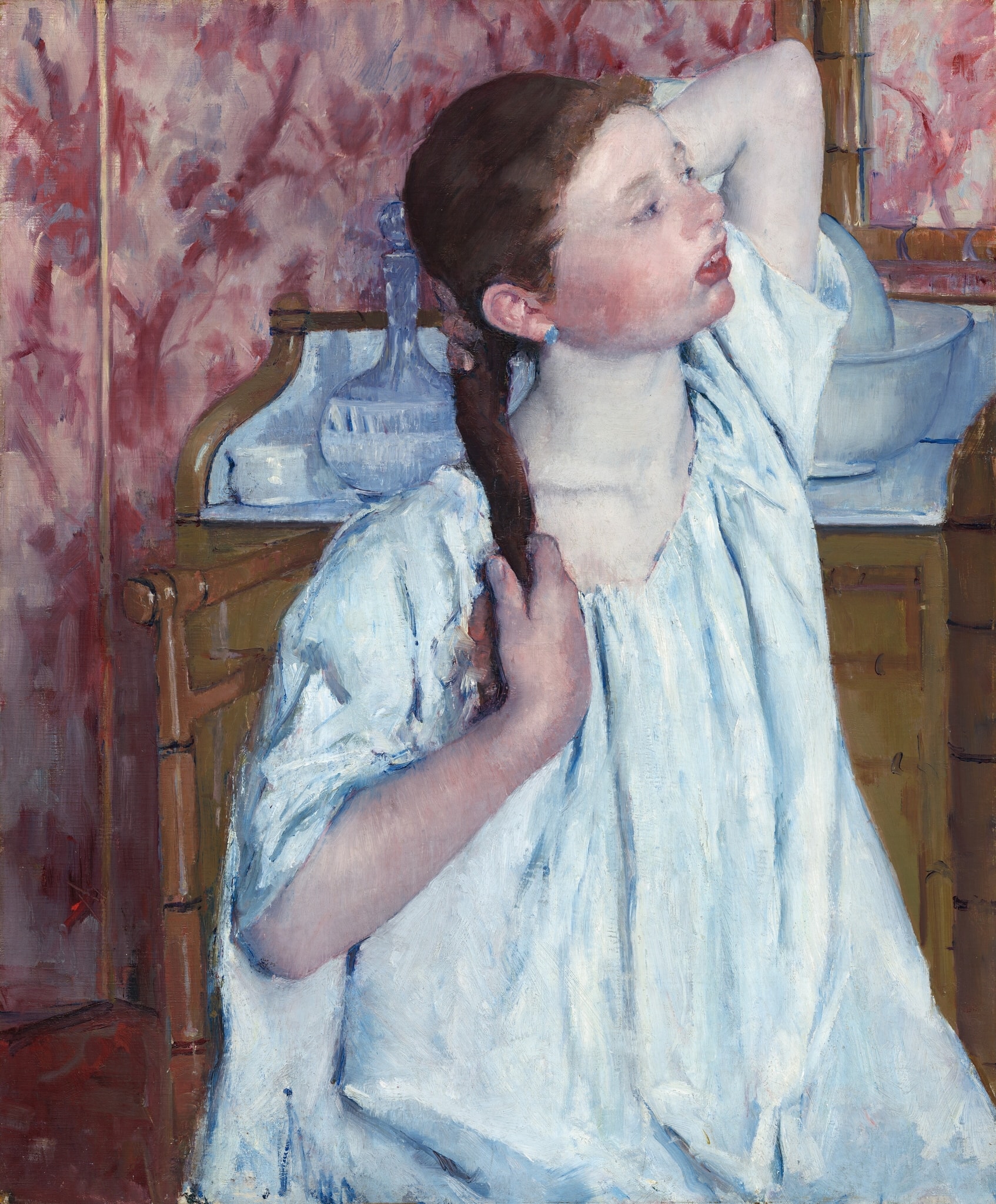
Mary Cassatt’s Girl Arranging Her Hair crystallizes a private rite of self‑regard into modern painting. Cool, broken strokes of the pale chemise meet the warm, patterned wall and bamboo furniture, staging a quiet drama of autonomy rather than display [1]. Exhibited in 1886, the work reframes the toilette as lived experience within Impressionism’s language of immediacy [2].
💰

Market Value

$8–12 million

How much is Girl Arranging Her Hair worth?

Fast Facts

Year
1886
Medium
Oil on canvas
Dimensions
75.1 × 62.5 cm
Location
National Gallery of Art, Washington
Girl Arranging Her Hair by Mary Cassatt (1886)

Click on any numbered symbol to learn more about its meaning

Meaning & Symbolism

Cassatt constructs autonomy through composition, gesture, and facture. The girl’s body turns in three‑quarter profile, her left arm arcing behind her head while the right hand gathers the thick braid—a canonical toilette signal transformed into self‑fashioning under her own control. The mirror’s presence is stated yet withheld: a bamboo frame edges the upper right, but the reflected face is denied, blocking the viewer’s access to the frontal image that would convert the scene into display 1. This anti‑voyeuristic crop, familiar in women Impressionists’ strategies, places the viewer within the room but outside the girl’s purpose; our look is contingent, hers is primary 4. Color and touch support the claim. Cassatt calibrates cool, light‑catching blues in the voluminous chemise against the “fantastic” pink‑mauve wallpaper and honeyed wood, so warmth shelters rather than engulfs the figure 1. The visible, broken brushwork—especially where light skims the flushed cheek, ear, and the slightly parted lips—privileges living presence over ideal polish, a modern refusal of academic finish that keeps attention on sensation and thought rather than ornament. Cassatt’s iconography retools familiar props. The porcelain basin and ewer, and the small glass bottle on the washstand, are classic toilette furnishings that historically doubled as emblems of cleanliness or, in male hands, as cues to vanity and erotic privacy. Here they read as neutral tools of self‑care, anchoring a scene of peaceful self‑regard and daily renewal rather than moralized spectacle 14. Crucially, Cassatt’s sitter is not idealized; the National Gallery underscores her ruddy complexion, large teeth, and recessed chin—features that diverge from period beauty canons 1. This refusal of ideal beauty is not incidental: it fuses ethics and form, insisting that modern subjectivity is credible only when it admits texture, asymmetry, and the unguarded pause between movements. The blue earring’s cool flash, the thick braid dragged taut in the hand, and the chemise bunched along the forearm all choreograph a body thinking through touch—a mind in the act of arranging itself. Why Girl Arranging Her Hair is important also emerges from its historical arc. Shown at the Eighth Impressionist Exhibition in 1886 as Etude, the painting stood at the close of the movement’s independent shows, where Cassatt had been a central figure 2. Edgar Degas acquired it directly after that exhibition and kept it for decades; after his death, the canvas was even misattributed to him, a telling case of how thoroughly Cassatt mastered—and redirected—subjects that fascinated her colleague 13. Yet the authorship embedded in the image is unmistakable: the empathetic refusal of voyeurism, the lateral placement that maintains the sitter’s autonomy, and the synthesis of decorative field with a solidly modeled figure are all Cassatt’s signatures. In sum, the painting is not a moment stolen from privacy but a compact made with it, a modern contract in which looking is permitted only to the extent that it honors the sitter’s absorption. That is the enduring meaning of Girl Arranging Her Hair—and the reason it remains a touchstone for readings of gender, gaze, and modern life within Impressionism 14.

Explore Deeper with AI

Ask questions about Girl Arranging Her Hair

Popular questions:

Powered by AI • Get instant insights about this artwork

💬 Ask questions about this artwork!

Interpretations

Feminist Gaze: The Withheld Mirror

Cassatt’s composition performs an anti‑voyeuristic maneuver: the bamboo‑framed mirror is acknowledged yet refuses us the trophy of a frontal reflection. Historically, mirrors in toilette scenes served as emblems of vanity and as conduits for the male, possessive gaze. By cropping the reflection away, Cassatt reassigns the scene’s purpose from display to private intent; our look becomes contingent on the sitter’s autonomous action rather than the reverse. This aligns with strategies identified in women Impressionists—compare Morisot’s blurring and obstruction of reflective surfaces—which frustrate scopophilic expectations and foreground the sitter’s absorbed self‑fashioning. The result is not puritanical denial but a calibrated ethics of looking: the viewer is present, yet permission to see is constantly negotiated by the painting’s refusals and sidesteps 14.

Source: National Gallery of Art; Art Institute of Chicago (Morisot essay)

Reception & Authorship: Degas’s Shadow

The painting’s early life dramatizes the politics of authorship in Impressionism. Exhibited in 1886 as Etude, it was bought by Degas and kept for decades; following his death it was even misattributed to him—a telling index of how powerfully Cassatt mastered a subject associated with her colleague 23. That misreading reveals more about reception than facture: collectors and executors defaulted to Degas’s brand, occluding the distinctive ethics of looking Cassatt builds here (her lateral placement, withheld reflection, and empathetic presence). Reattributing the work to Cassatt restores a narrative in which she is not the follower but the reformer of the toilette motif, absorbing Degas’s formal acuity while redirecting its social meaning. Provenance thus becomes a lens on gendered credit and modernist influence 13.

Source: National Gallery of Art; Washington Post (Sebastian Smee)

Formal Analysis: Pattern, Palette, and Presence

Cassatt fuses a decorative field with a palpably modeled figure. The chemise’s cool, light‑catching blues hold their own against “fantastic” pink‑mauve wallpaper and warm wood, so chromatic heat shelters, not engulfs, the sitter. This chromatic architecture isolates the micro‑events of touch—flushed cheek, rimmed ear, slightly parted lips—where broken strokes register living skin rather than ideal polish. The earring’s blue glint and the taut, dragged braid articulate a rhythm of haptic accents across the silhouette, guiding the eye through arcs of action instead of ornamental detail. Formally, Cassatt reconciles Impressionist optical freshness with sculptural clarity, creating a pictorial habitat in which pattern frames attention rather than siphons it away—an ethics of form that sustains the work’s claim to presence over prettiness 1.

Source: National Gallery of Art

Iconography Recast: Toilette without Vanitas

The washstand ensemble—porcelain ewer and basin, small glass bottle—anchors the toilette tradition but Cassatt drains it of its usual vanitas charge. In Rococo and 19th‑century precedent, such props toggled between cleanliness and eroticized vanity; here they read as neutral instruments of daily renewal, subordinated to the girl’s concentrated task. The key is the absent reflection: by denying a mirrored face, Cassatt cuts the feedback loop that would convert grooming into spectacle. Comparative feminist readings of Morisot’s toilette imagery clarify the tactic: obstructing or blurring mirrors disarms the possessive gaze, relocating meaning in the sitter’s embodied labor of self‑care. Cassatt’s iconography thus shifts from moralized allegory to modern subjectivity, where tools signify use-value, not vice 14.

Source: National Gallery of Art; Art Institute of Chicago (Morisot essay)

Comparative Lens: With and Against Degas

Subject, angle, and interior might recall Degas, but Cassatt redirects the genre’s ethics. Degas often cultivated a cool, observational distance in bathing and coiffure scenes; Cassatt installs the viewer beside, not over, the sitter, and replaces performance with peaceful self‑regard. The painting’s later confusion as a Degas underscores her fluency in shared formal vocabularies (cropping, oblique viewpoints, studio light), yet the contract with privacy—the non‑ideal physiognomy, the withheld reflection—bears Cassatt’s signature. Reading the canvas comparatively reveals a crucial modernist divergence: the same motif can sustain different social meanings depending on how composition structures permission and proximity. Cassatt’s choice authorizes presence without possession, a counter‑tradition within Impressionism that is hers 13.

Source: National Gallery of Art; Washington Post (Sebastian Smee)

Related Themes

About Mary Cassatt

Mary Cassatt (1844–1926) was an American painter who settled in Paris, exhibited with the Impressionists, and became a key conduit for introducing their art to U.S. collectors. After 1890 she adopted japoniste flatness, bold patterning, and strong design, focusing on modern women’s lives—especially mother‑and‑child subjects—until failing eyesight curtailed her work by 1914 [4].
View all works by Mary Cassatt

More by Mary Cassatt

Woman in Black at the Opera by Mary Cassatt

Woman in Black at the Opera

Mary Cassatt (1878)

Mary Cassatt’s Woman in Black at the Opera stages a taut drama of vision and visibility. A woman in <strong>black attire</strong> raises <strong>opera glasses</strong> while a distant man aims his own at her, setting off a chain of looks that makes public leisure a site of <strong>power, agency, and surveillance</strong> <sup>[1]</sup><sup>[2]</sup>.

The Tea by Mary Cassatt

The Tea

Mary Cassatt (about 1880)

Mary Cassatt’s The Tea stages a poised, interior <strong>drama of manners</strong>: two women sit close yet feel apart, one thoughtful, the other raising a cup that <strong>veils her face</strong>. A gleaming, oversized <strong>silver tea service</strong> commands the foreground, its reflections turning ritual objects into actors in the scene <sup>[1]</sup>. The shallow, cropped room—striped wall, gilt mirror, marble mantel—compresses the atmosphere into <strong>intimacy edged by restraint</strong>.

Little Girl in a Big Straw Hat and a Pinafore by Mary Cassatt

Little Girl in a Big Straw Hat and a Pinafore

Mary Cassatt (c. 1886)

Mary Cassatt’s Little Girl in a Big Straw Hat and a Pinafore distills childhood into a quiet drama of <strong>interiority</strong> and <strong>constraint</strong>. The oversized straw hat and plain pinafore bracket a flushed face, downcast eyes, and <strong>clasped hands</strong>, turning a simple pose into a study of modern self‑consciousness <sup>[1]</sup>. Cassatt’s cool grays and swift, luminous strokes make mood—not costume—the subject.

Breakfast in Bed by Mary Cassatt

Breakfast in Bed

Mary Cassatt (1897)

Breakfast in Bed distills a <strong>tender modern intimacy</strong> into a tightly cropped sanctuary of rumpled white linens, protective embrace, and interrupted routine. Mary Cassatt uses <strong>cool light</strong> against <strong>warm flesh</strong> to anchor attention on the mother’s encircling arm and the child’s outward gaze, fusing care, curiosity, and the rhythms of <strong>everyday modern life</strong> <sup>[1]</sup><sup>[2]</sup>.

Young Mother Sewing by Mary Cassatt

Young Mother Sewing

Mary Cassatt (1900)

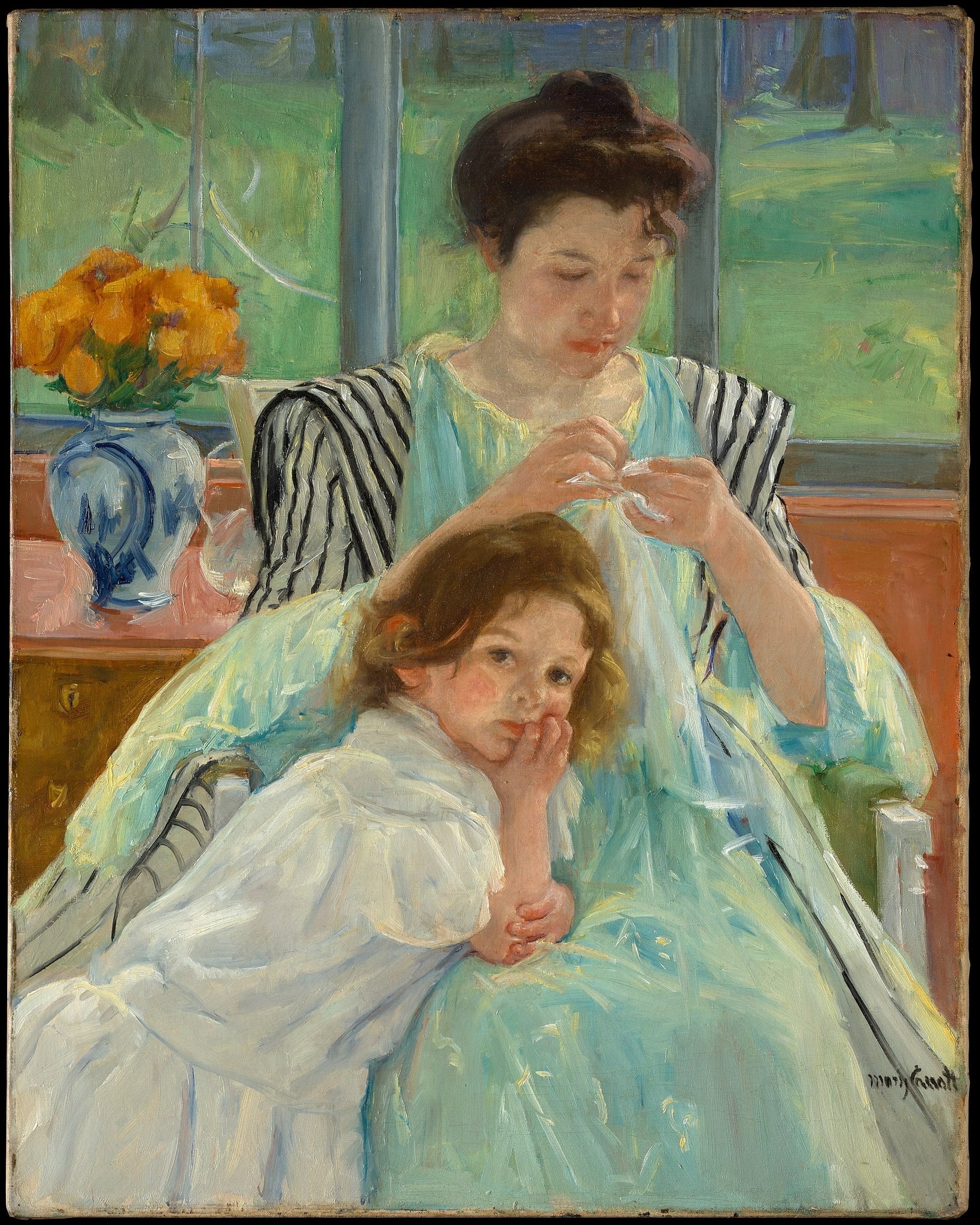
Mary Cassatt’s Young Mother Sewing centers the quiet <strong>labor of care</strong>: a mother steadies pale fabric while a child in white leans into her, eyes meeting ours. Cool <strong>greens and blues</strong> bathe the figures as striped sleeves and chair arms rhythmically return attention to the mother’s working hands, while a burst of <strong>orange blossoms</strong> by the window anchors interior life against the world outside <sup>[1]</sup>.
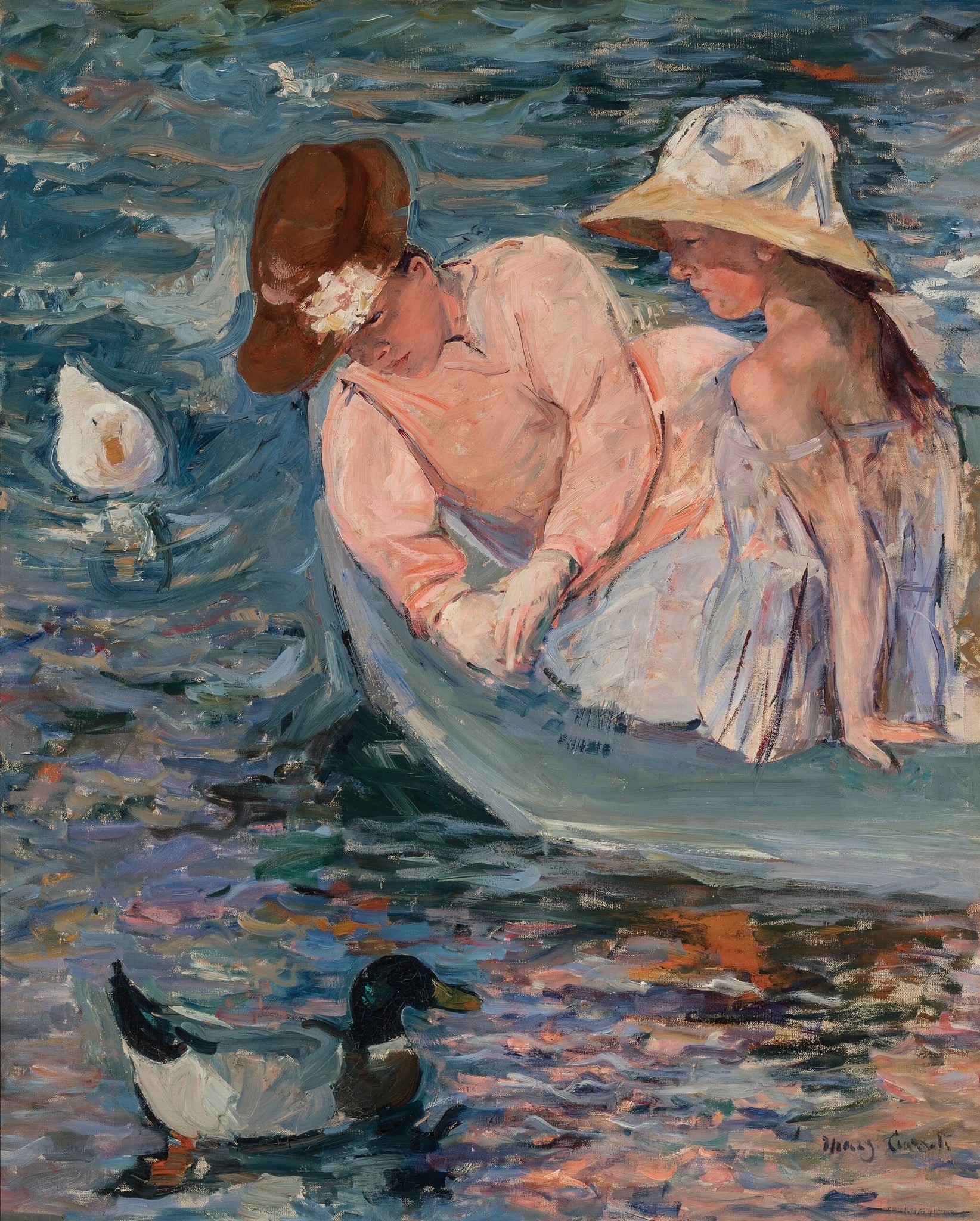
Children Playing on the Beach by Mary Cassatt

Children Playing on the Beach

Mary Cassatt (1884)

In Children Playing on the Beach, Mary Cassatt brings the viewer down to a child’s eye level, granting everyday play the weight of <strong>serious, self-contained work</strong>. The cool horizon and tiny boats open onto <strong>modern space and possibility</strong>, while the cropped, tilted foreground seals us inside the children’s focused world <sup>[1]</sup>.