How Much Is Girl Arranging Her Hair Worth?
Last updated: February 22, 2026
Quick Facts
- Insurance Value
- $16.0M (Comparable analysis (this report))
- Methodology
- comparable analysis
Hypothetical fair‑market value for Mary Cassatt’s Girl Arranging Her Hair (1886) is $8–12 million. This range reflects its prime‑period date, fully realized oil medium, canonical subject, and exceptional ex‑Degas/Havemeyer provenance, benchmarked against Cassatt’s top public results and peer masterworks. Replacement (insurance) value is indicated at approximately $16 million, recognizing extreme scarcity and institutional caliber.
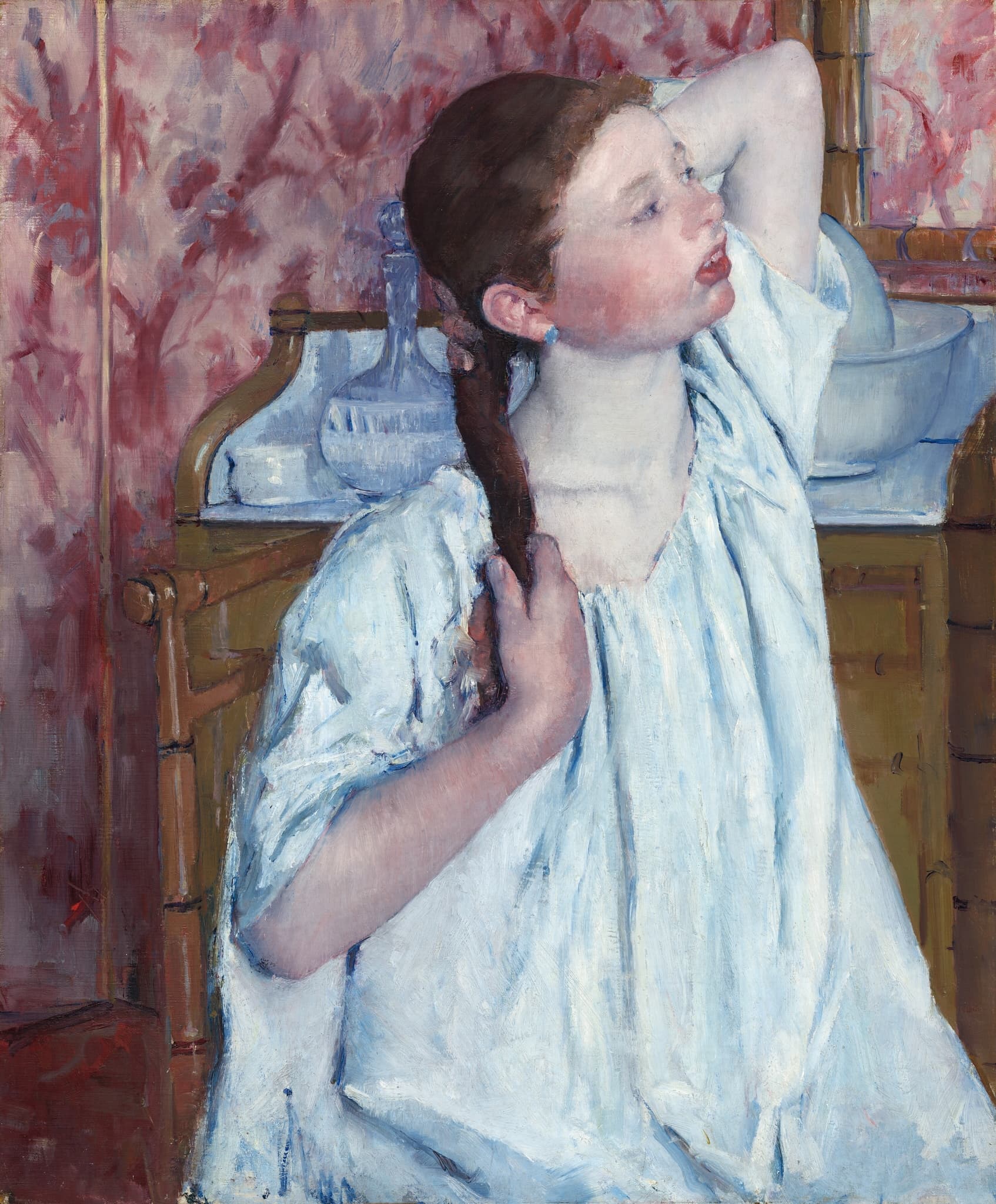
Girl Arranging Her Hair
Mary Cassatt, 1886 • Oil on canvas
Read full analysis of Girl Arranging Her Hair →Valuation Analysis
Conclusion: Based on recent public benchmarks for Mary Cassatt, peer comparables, and the work’s exceptional attributes, a reasoned hypothetical auction fair‑market value for Girl Arranging Her Hair (1886; oil on canvas, 75.1 × 62.5 cm) is $8–12 million, with stretch potential above that range only in trophy‑level, competitive conditions. An insurance/replacement indication of ~$16 million is appropriate, reflecting extreme scarcity of like‑for‑like substitutes and the painting’s museum‑caliber status.
Why this range: The painting unites a prime 1886 date, a quintessential Cassatt subject (an intimate depiction of a child at her toilette), and a finished oil of substantial scale—factors that command a premium over the artist’s more frequently traded works on paper. Its provenance and exhibition pedigree are exceptional: formerly in Edgar Degas’s collection, sold from his atelier sale in 1918, then owned by Louisine Havemeyer, and later by Chester Dale before entering the National Gallery of Art (Washington), where it is a well‑known collection highlight and was exhibited at the 1886 Impressionist exhibition in Paris [1].
Market anchors: Cassatt’s current auction record is $7,489,000 (Christie’s, 2022) for Young Lady in a Loge, Gazing to Right, a prime‑period pastel—evidence that best‑in‑class Cassatts can command high prices even off‑canvas [2]. For oils, a modern‑era benchmark is Children Playing with a Dog at $4,812,500 in 2018 (Christie’s), with an earlier peak near $6.2 million in 2007, underscoring demand for strong, finished oils with desirable subjects [3]. Girl Arranging Her Hair—earlier, more canonical in period, and endowed with superior provenance and exhibition history—warrants placement above these oil comparables and in the vicinity of (or above) the 2022 pastel record on a like‑for‑like FMV basis.
Cross‑artist headroom: The female Impressionist market has demonstrated capacity for eight‑figure prices at auction, as seen with Berthe Morisot’s Après le déjeuner, which realized roughly $10.9 million in 2013 [5]. This suggests plausible upside for a museum‑caliber Cassatt oil in a marquee setting with deep competition, though realizing such a result would depend on sale orchestration, guarantees, and bidder depth.
Context and caveats: The painting has not traded publicly in the modern auction era; valuation is therefore extrapolated from comparables and adjusted for prime attributes, scarcity, and institutional recognition. Condition, presentation, and market timing could move outcomes within or beyond the indicated corridor. Base‑case FMV: $8–12 million; stretch scenario: low‑ to mid‑eight figures if multiple motivated bidders converge. Replacement value: ~$16 million, acknowledging that sourcing a like example would be extraordinarily difficult [1][2][3].
Key Valuation Factors
Art Historical Significance
High ImpactPainted in 1886, Girl Arranging Her Hair sits squarely in Cassatt’s prime Impressionist phase and distills her signature investigation of domestic intimacy and modern childhood. While not among the handful of most frequently anthologized mother-and-child icons, it is a widely reproduced, institutionally prominent single-figure child composition that captures the artist’s mature facture and psychological acuity. Its inclusion in the 1886 Impressionist exhibition places it in the nucleus of the movement’s public evolution, and its long-term presence at the National Gallery of Art has further cemented its scholarly and public profile. These attributes strongly support valuation above most late-period oils and in line with the artist’s most desirable core subjects.
Prime Medium, Date, and Subject
High ImpactCassatt’s fully realized oils from the mid- to late-1880s are markedly scarcer at auction than her works on paper. This canvas is substantial in size and presents a quintessential subject—an intimate grooming moment—rendered with sensitive light, color, and brushwork emblematic of the artist’s best period. Relative to later child subjects (often 1900s), prime-1880s oils carry a premium given their closer proximity to the Impressionist group’s apex. Collectors seeking museum-quality examples prioritize the combination of prime date, finished oil execution, and iconic thematic content, all of which are present here and warrant positioning the work near or above the artist’s current auction record.
Provenance and Exhibition History
High ImpactThe painting’s chain of ownership is exceptional: ex-Edgar Degas (sold in his 1918 atelier sale), acquired by the pivotal American collector Louisine Havemeyer, then by Chester Dale before entering the National Gallery of Art. Its exhibition at the 1886 Impressionist exhibition and subsequent gallery and museum showings add rare documentary richness. Such provenance both validates authenticity and quality and enhances desirability among institutions and private collectors. Works with this kind of storied lineage and marquee exhibition history trade at a premium, particularly when aligned with a prime-period date and finished oil medium. Provenance also supports an elevated insurance assessment due to irreplaceability.
Market Liquidity and Supply
Medium ImpactCassatt’s market is deep and international, yet true, museum-caliber prime-period oils are tightly held and seldom offered publicly. While her best pastels can meet or exceed many oils at auction, collectors will pay material premiums for rare, canonical 1880s oils—especially those with top-tier provenance and exhibition records. This scarcity underpins the $8–12 million FMV range and the ~$16 million insurance indication. However, because very few close substitutes trade, realized prices are sensitive to timing, venue, guarantees, and the presence of multiple motivated bidders. In average conditions, the base range is appropriate; in peak, trophy-oriented environments, stretch outcomes are plausible but not assured.
Sale History
Girl Arranging Her Hair has never been sold at public auction.
Mary Cassatt's Market
Mary Cassatt is a blue‑chip Impressionist with strong institutional demand in the U.S. and abroad. Her most coveted works cluster into two groups: prime‑period oils (late 1870s–1880s) and outstanding pastels of modern women and children. The current auction record is $7,489,000 for a prime‑period pastel (Christie’s, 2022), illustrating that best‑in‑class images can push the artist’s ceiling even off‑canvas. Major oils have realized $4.8 million in 2018, with an earlier peak near $6.2 million in 2007, indicating durable appetite for finished child and mother‑and‑child subjects. Supply of canonical 1880s oils is extremely limited; when they surface under marquee conditions, competitive bidding can challenge prior highs. Overall, the market is selective but robust for top‑tier examples.
Comparable Sales
Young Lady in a Loge, Gazing to Right
Mary Cassatt
Same artist; prime-period, signature theme of modern womanhood. Though a pastel, it is the current Cassatt auction record and establishes an upper bound for blue-chip Cassatts.
$7.5M
2022, Christie's New York
~$8.1M adjusted
Children Playing with a Dog
Mary Cassatt
Same artist; substantial oil on canvas and a leading public benchmark for Cassatt oils in the modern era. Indicates market depth for finished, desirable oils.
$4.8M
2018, Christie's New York
~$6.1M adjusted
Children Playing with a Dog
Mary Cassatt
Same artist; same painting as above at its earlier peak price. Useful for bracketing upside in strong market conditions for major Cassatt oils.
$6.2M
2007, Christie's New York
~$9.5M adjusted
Children Playing with a Cat
Mary Cassatt
Same artist; late but attractive oil with child subject. Anchors the mid-range for Cassatt oils and demonstrates liquidity outside of top-tier masterpieces.
$2.2M
2020, Sotheby's New York
~$2.7M adjusted
Après le déjeuner
Berthe Morisot
Peer ‘Woman Impressionist’ masterwork (prime 1880s oil) showing market headroom for museum-caliber, canonical female Impressionist paintings.
$10.9M
2013, Christie's London
~$14.8M adjusted
Current Market Trends
Impressionist and Modern markets have become more selective since 2023, rewarding historical blue‑chips and museum‑caliber works while showing caution toward secondary material. Top‑end sales in 2025 demonstrated deep competition for canonical pictures, with strong institutional and private participation and increased use of third‑party guarantees. Within this context, Cassatt’s strongest images—especially prime‑period oils—benefit from scarcity and renewed institutional attention. While broader liquidity may be uneven, the combination of compelling subject, exhibition pedigree, and provenance remains a powerful catalyst for outperformance. Against this disciplined backdrop, Girl Arranging Her Hair supports an $8–12 million FMV range, with eight‑figure stretch potential under peak marquee conditions.
Study print
Study this painting as a print
Pair the full artwork with a museum-style study sheet focused on one meaningful detail.
Sources
- National Gallery of Art (Washington): Girl Arranging Her Hair object record
- Christie’s Press Release – The Ann & Gordon Getty Collection: Cassatt record (2022)
- Christie’s Artist Page – Mary Cassatt (includes 2018 oil benchmark)
- Sotheby’s New York – Children Playing with a Cat (2020) lot page/press context
- Christie’s London – Berthe Morisot, Après le déjeuner (2013) post‑sale release