The Theater Box

by Pierre-Auguste Renoir

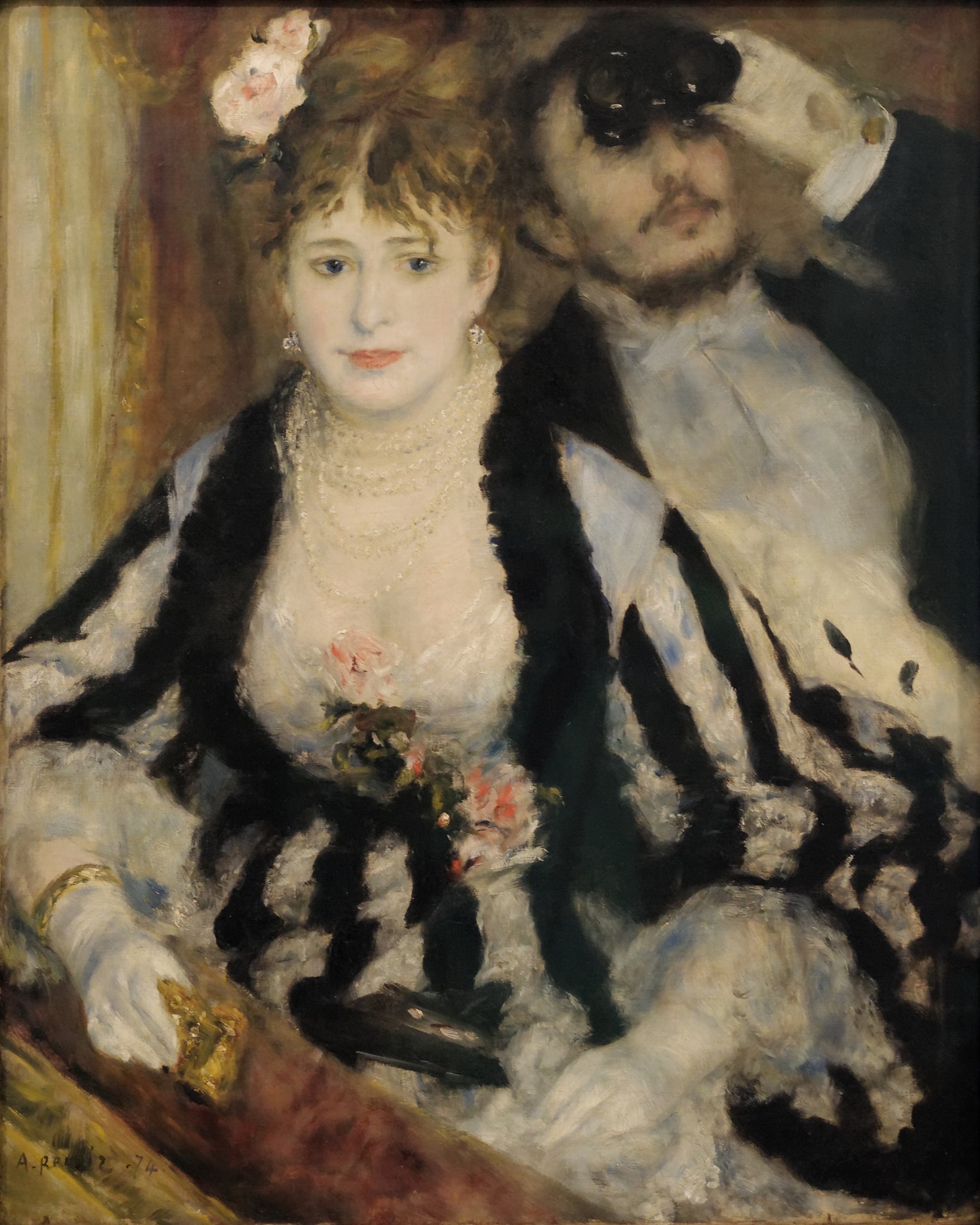
Renoir’s The Theater Box turns a plush loge into a stage where seeing becomes the performance. A luminous woman—pearls, pale gloves, black‑and‑white stripes—faces us, while her companion scans the auditorium through opera glasses. The painting crystallizes Parisian modernity and the choreography of the gaze [1][5].

Fast Facts

Year
1874
Medium
Oil on canvas
Dimensions
80 × 63.5 cm
Location
The Courtauld, London
The Theater Box by Pierre-Auguste Renoir (1874) featuring Raised opera glasses (binoculars), Idle opera glasses (lorgnette), Closed fan, Pearls and earrings

Click on any numbered symbol to learn more about its meaning

Meaning & Symbolism

Renoir builds a drama of looking with precise props and poses. The woman’s small gold opera glasses lie idle on the rail beside her closed fan, while she offers her direct, composed gaze to us; behind her, the man lifts dark binoculars and peers outward, his head tilted, his features blurred into shadow. This asymmetry establishes a hierarchy of sight: he is the roving observer; she becomes the observed—yet she also commands the front of the box as if it were her own stage. The black‑and‑white striped gown, threaded with roses and trimmed in dark fur, amplifies her visibility under gaslight, while ropes of pearls and glinting earrings punctuate the soft haze of lace and skin. Renoir’s creamy brushwork and opalescent light do not simply describe textures; they enact the sensual economy of the theater, where luxury is meant to be seen—and to be seen seeing 146. As a result, the composition converts a night at the playhouse into an allegory of modern spectatorship: stage, audience, and passerby collapse into a single charged encounter at the lip of the box 57. That encounter is knowingly constructed. Research shows Renoir staged the scene in his studio with Nini Lopez and his brother Edmond, fine‑tuning details later revealed by technical study—an admission that the naturalness of the moment is a crafted fiction 134. This fabrication intensifies the painting’s thematic bite: the woman’s poised frontality, the unused glasses and fan, the meticulously fashionable toilette, all signal a performance of status as much as an evening’s entertainment. Period accessories become semiotic devices. Gloves and fan encode propriety and flirtation; the opera glasses symbolize surveillance and desire; the pearls—striking with a demi‑toilette—accent the décolleté, literalizing display 46. Feminist readings have long noted how male artists often cast women as spectacles within urban leisure spaces; here, Renoir both indulges and complicates that convention. Her calm, knowing look refuses to be merely consumed, returning the gaze to us and making our spectatorship part of the picture’s social game 7. Placed in the crucible year of 1874 and shown with the Impressionists, The Theater Box demonstrates how the movement anchored itself in present‑tense life, translating gaslit brilliance and tactile abundance into a language of quick, loaded strokes 125. The thick black accents of the gown cut against milky flesh tones and satiny whites, a high‑contrast rhythm that mimics the theater’s alternating glare and shadow. Plush paint makes luxury palpable—fur, velvet rail, satin glove—yet the scene remains morally and socially ambiguous, a quality contemporaries sensed and that later critics have prized: it is at once celebration, critique, and mirror of Parisian sociability 36. In one compact image, Renoir captures how modern identity is assembled in public—through costume, posture, and reciprocal looking—rendering the loge a microcosm of the city’s visual marketplace. That enduring clarity of purpose is the meaning of The Theater Box and the reason it remains a keystone of Impressionist modernity 15.

Explore Deeper with AI

Ask questions about The Theater Box

Popular questions:

Powered by AI • Get instant insights about this artwork

💬 Ask questions about this artwork!

Interpretations

Fashion Optics under Gaslight

Read through fashion history, La Loge is engineered for visibility: the black‑and‑white stripes spike contrast, the pearls accent the décolleté, and the glove–fan–glasses triad choreographs propriety, flirtation, and surveillance. Under gaslight, such materials “perform” by catching and diffusing glare, making the wearer legible across the auditorium. Aileen Ribeiro’s analysis ties these choices to Paris’s couture discourse circa 1874, when stripes and gauzy whites were à la mode and semiotically charged. Renoir’s creamy handling doubles as textile description and display technology, translating sheen, nap, and lace into painterly effects that advertise chic as social currency. The loge thus operates like a runway: a site where dress codes produce status and desire in real time 41.

Source: Aileen Ribeiro via FIT Fashion History Timeline; Courtauld Gallery

Feminist Spectatorship and the Returned Gaze

Griselda Pollock’s lens clarifies the painting’s gendered optics: the man wields opera glasses as an instrument of urban scanning while the woman is placed frontally to be scanned. Yet her cool, direct look returns vision outward, snagging viewers and folding them into the spectacle. Compared with Mary Cassatt’s loge scenes, where women actively look, Renoir both indulges and complicates the male-gaze convention—her agency is performative and contingent, signaled as much by unused glasses as by her command of the box’s edge. The picture becomes a social machine of looking, staging power relations while exposing their codes, a sophisticated play between objectification and self‑presentation that places the audience’s desire under scrutiny 61.

Source: Griselda Pollock; Courtauld Gallery

Studio Fictions and Theatrical Construction

Technical and archival research shows Renoir built this scene in the studio with Nini Lopez and his brother Edmond, revising small details later detected by X‑ray. That admission of fabrication reframes the canvas as a modern tableau vivant—a staged fiction masquerading as spontaneity. Theatrical props (fan, glasses) and the loge’s balustrade read like set pieces; painterly bravura supplies the mise‑en‑scène. Rather than mere realism, Renoir practices constructed naturalism, a mode aligned with photography’s posed portraits and the period’s taste for spectacle. The result is mimesis with a wink: an image that confesses its artifice even as it seduces, aligning Impressionism with the dramaturgy of urban display 34.

Source: Courtauld Exhibition Catalogue (2008); FIT Fashion History Timeline

Leisure Economies and Class Display

Following Robert L. Herbert, the loge is a node in Paris’s leisure economy, where public amusements metabolize money into visibility. Prime seating, couture, and gleam are commodities of social distinction; spectatorship itself becomes a transaction—one sees and is seen. Renoir registers this modern market in tactile paint (fur, satin, velvet) and in the choreography of devices that manage attention. The picture spatializes class through position (front of the box), materials (luxury textiles), and optical privilege (opera glasses). What looks like an intimate vignette is a diagram of urban circulation—of capital, desire, and image—making La Loge a compact study in how bourgeois identity is assembled before a crowd 51.

Source: Robert L. Herbert; Courtauld Gallery

Reception and Moral Ambiguity

John House notes that critics read La Loge with ambivalence—as both dazzling and morally slippery—an effect Renoir courts by fusing sensual paint with coded signs of flirtation and display. Later commentators have prized this ambiguity as a hallmark of Impressionist modernity: a surface celebration of chic that also mirrors its social costs. Christie’s scholarship threads period responses to theater-going as a site of vanity and surveillance; the painting’s brilliance is to make pleasure and critique indistinguishable, like glare and shadow under gaslight. This double register gives the work its staying power: it flatters the eye while unsettling the viewer’s role in the spectacle it depicts 37.

Source: John House (Courtauld Catalogue); Christie’s scholarly essay

Related Themes

About Pierre-Auguste Renoir

Pierre-Auguste Renoir (1841–1919) emerged from craft training into the avant-garde circle around Monet, Sisley, and Bazille, helping to found Impressionism. In the mid‑1870s he focused on outdoor scenes of modern leisure in and around Montmartre, using dappled light and high-chroma color to capture transient sensations [1][2][5].
View all works by Pierre-Auguste Renoir

More by Pierre-Auguste Renoir
In the Garden by Pierre-Auguste Renoir

In the Garden

Pierre-Auguste Renoir (1885)

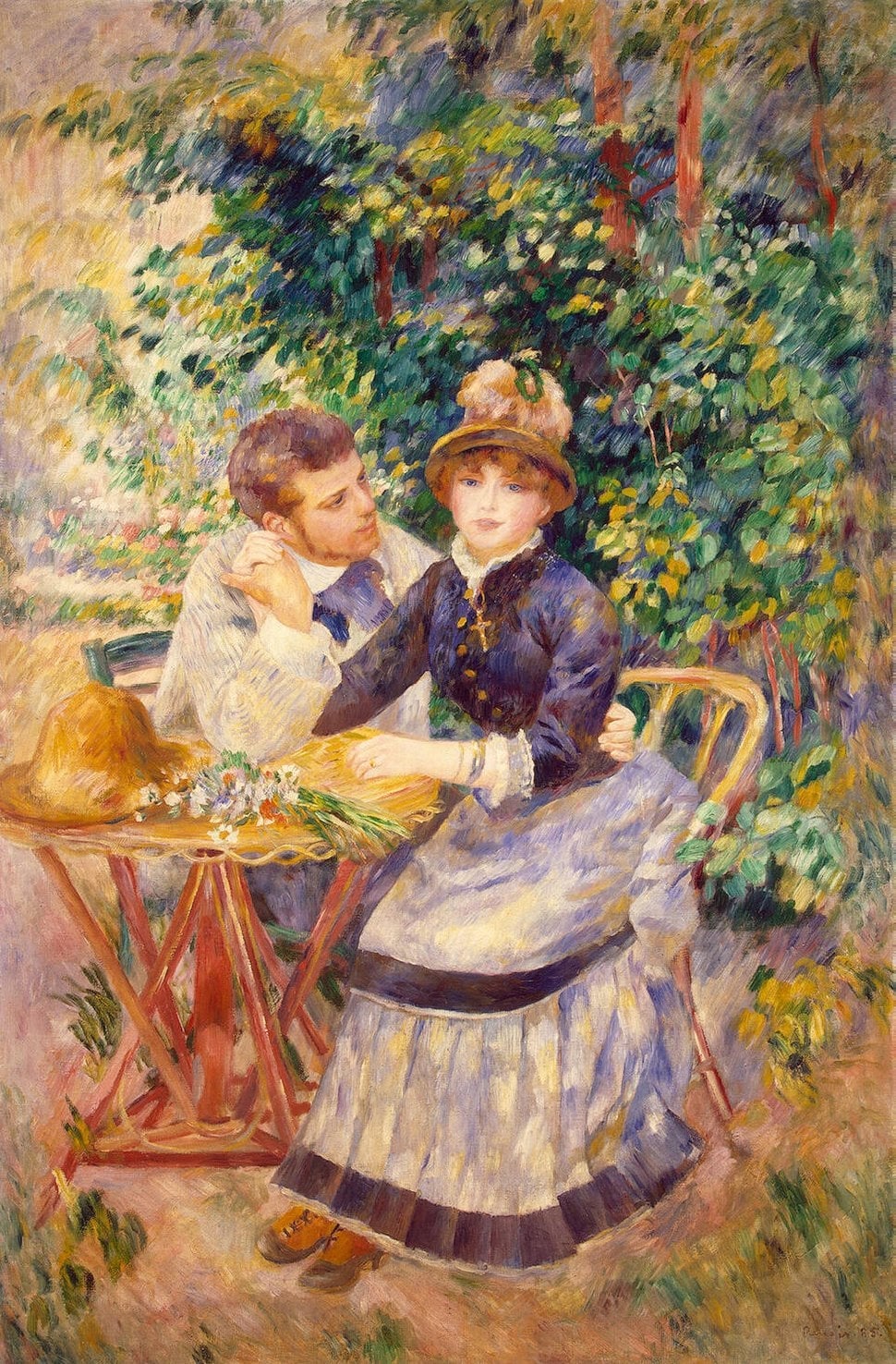
In the Garden presents a charged pause in modern leisure: a young couple at a café table under a living arbor of leaves. Their lightly clasped hands and the bouquet on the tabletop signal courtship, while her calm, front-facing gaze checks his lean. Renoir’s flickering brushwork fuses figures and foliage, rendering love as a <strong>transitory, luminous sensation</strong> <sup>[1]</sup><sup>[3]</sup>.
Young Girls at the Piano by Pierre-Auguste Renoir

Young Girls at the Piano

Pierre-Auguste Renoir (1892)

Renoir’s Young Girls at the Piano turns a quiet lesson into a scene of <strong>attunement</strong> and <strong>bourgeois grace</strong>. Two adolescents—one seated at the keys, the other leaning to guide the score—embody harmony between discipline and delight, rendered in Renoir’s late, <strong>luminous</strong> touch <sup>[1]</sup><sup>[2]</sup>.

Pont Neuf Paris by Pierre-Auguste Renoir

Pont Neuf Paris

Pierre-Auguste Renoir (1872)

In Pont Neuf Paris, Pierre-Auguste Renoir turns the oldest bridge in Paris into a stage where <strong>light</strong> and <strong>movement</strong> bind a city back together. From a high perch, he orchestrates crowds, carriages, gas lamps, the rippling Seine, and a fluttering <strong>tricolor</strong> so that everyday bustle reads as civic grace <sup>[1]</sup>.

The Large Bathers by Pierre-Auguste Renoir

The Large Bathers

Pierre-Auguste Renoir (1884–1887)

Pierre-Auguste Renoir’s The Large Bathers unites modern bodies with a pastoral grove to stage an <strong>Arcadian ideal</strong>. Three monumental nudes form interlocking curves and triangles while two background figures splash and groom, fusing <strong>sensual warmth</strong> with <strong>classical order</strong> <sup>[1]</sup><sup>[2]</sup>.

After the Luncheon by Pierre-Auguste Renoir

After the Luncheon

Pierre-Auguste Renoir (1879)

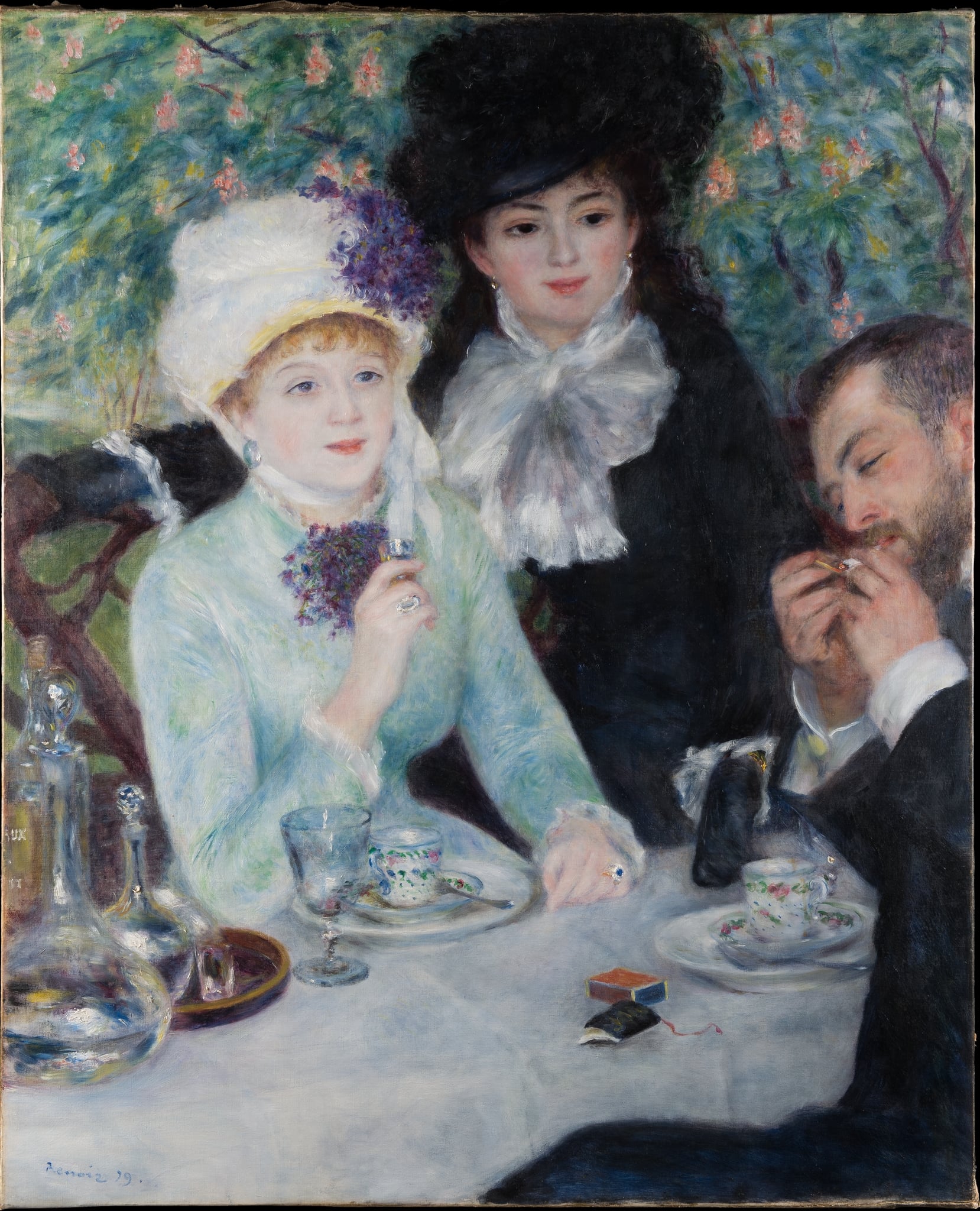
After the Luncheon crystallizes a <strong>suspended instant</strong> of Parisian leisure: coffee finished, glasses dappled with light, and a cigarette just being lit. Renoir’s <strong>shimmering brushwork</strong> and the trellised spring foliage turn the scene into a tapestry of conviviality where time briefly pauses.
The Loge by Pierre-Auguste Renoir

The Loge

Pierre-Auguste Renoir (1874)

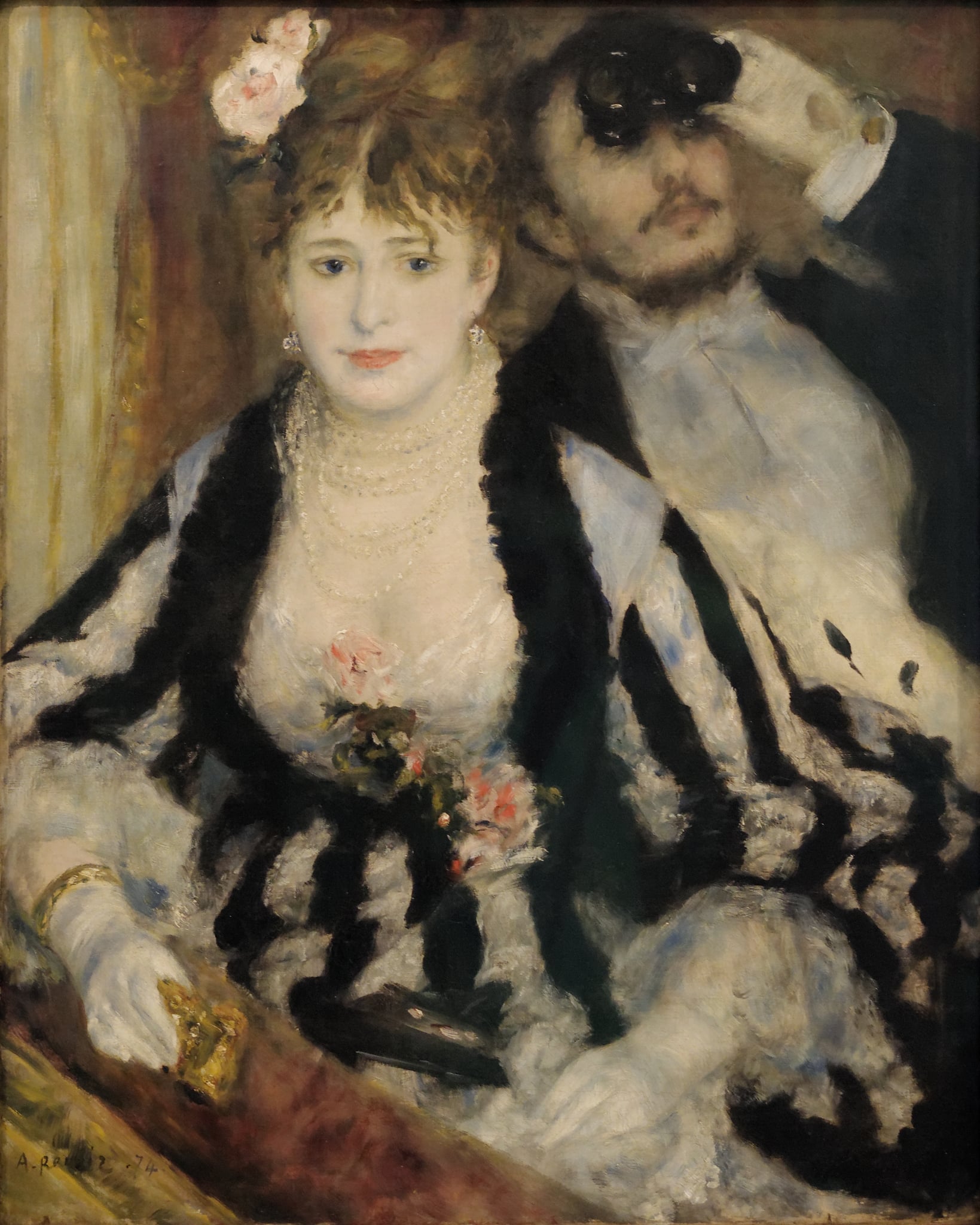
Renoir’s The Loge (1874) turns an opera box into a <strong>stage of looking</strong>, where a woman meets our gaze while her companion scans the crowd through binoculars. The painting’s <strong>frame-within-a-frame</strong> and glittering fashion make modern Parisian leisure both alluring and self-conscious, turning spectators into spectacles <sup>[1]</sup><sup>[2]</sup>.