The Oath of the Horatii
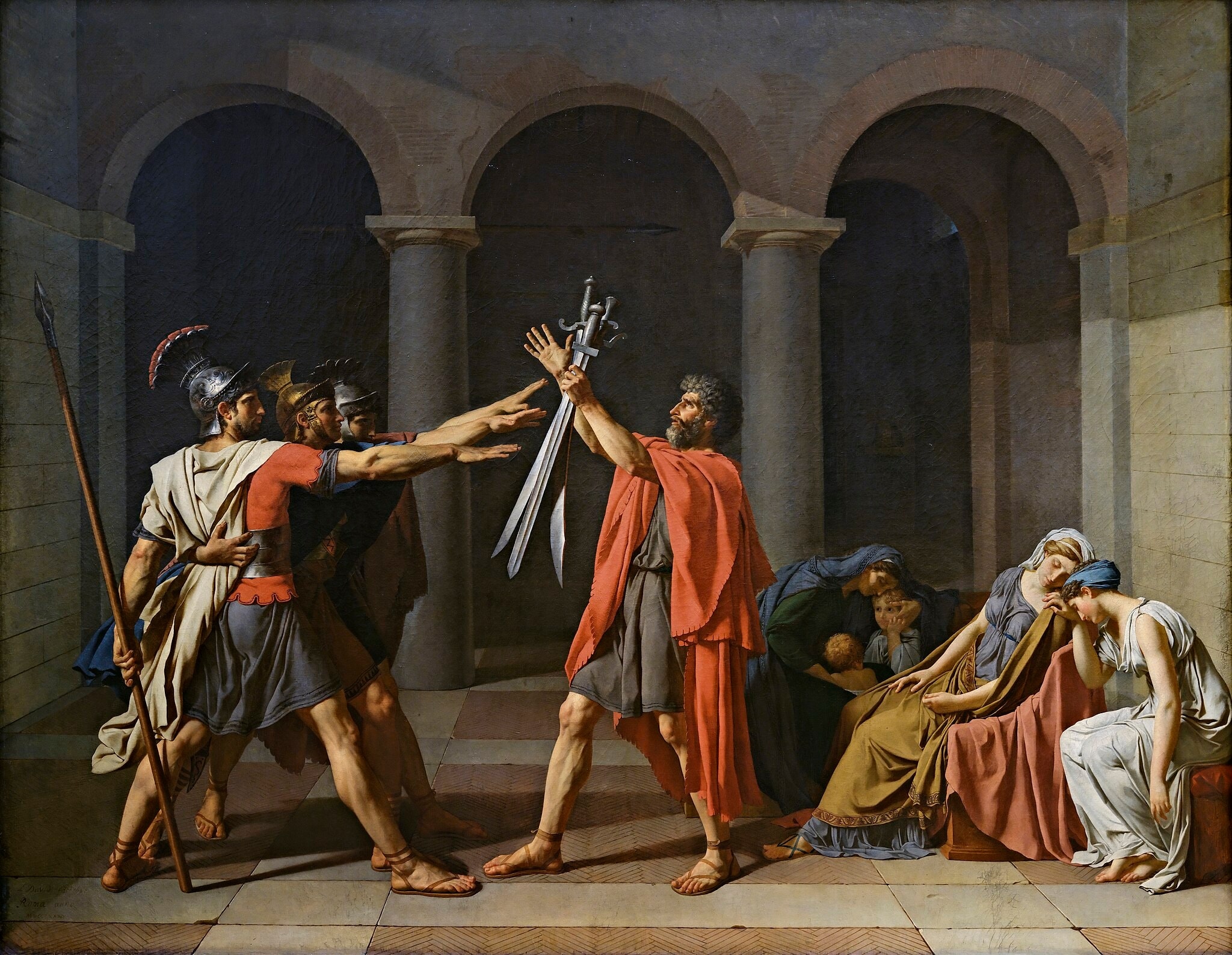
In The Oath of the Horatii, Jacques-Louis David crystallizes civic duty over private feeling: three Roman brothers extend their arms to swear allegiance as their father raises three swords at the perspectival center. The painting’s severe geometry, austere architecture, and polarized groups of rectilinear men and curving mourners stage a manifesto of Neoclassical virtue and republican resolve [1][2][3].
Fast Facts
- Year
- 1784 (exhibited 1785)
- Medium
- Oil on canvas
- Dimensions
- 329.8 × 424.8 cm
- Location
- Musée du Louvre, Paris
Click on any numbered symbol to learn more about its meaning
Meaning & Symbolism
David builds a rigorous moral architecture and then locks the figures into it. The three barrel arches and Tuscan columns divide the canvas into a triad—brothers, father, and women—while the tiled floor drives perspective to the father’s upraised fist clutching three blades. That vanishing-point nexus turns the steel into both visual magnet and ethical command: the city’s claim over its sons. The brothers’ synchronized, outstretched arms read as a single rectilinear vector, their shins, forearms, and spears echoing one another to diagram unanimity; even the red and steel palette tightens the rhetoric into severity. Raking light sculpts their anatomy into planes and edges, making their choice not a feeling but a form—precise, public, and binding 2.
Against this, David stages cost, not counterargument. The right-hand group collapses into curving silhouettes and shadow: bowed necks, interlaced hands, and softened fabrics. Their arc of grief bends away from the swords, registering the price of the oath without shaking its authority. Scholars have long noted that the families are intermarried with the enemy; by placing these women in muted color and shade, David folds tragedy into the moral program while keeping the drama’s center of gravity on duty. The opposition of straight to curved, lit to shadowed, upright to slumped encodes a gendered Enlightenment divide—men as citizens in the res publica, women as keepers of private feeling—yet the mourners’ presence insists that virtue exacts a human toll 23.
The painting’s didactic clarity is the point, not a byproduct. Commissioned for the Bourbon crown and painted in Rome in 1784, the work was conceived as an exemplum virtutis—an image that teaches by staging choice as destiny 13. David sharpened Livy by inventing the oath so viewers would confront the instant where personal ties are sacrificed to the polity. The triadic logic proliferates—three brothers, three swords, three arches—so that repetition itself becomes an ethical drumbeat. At the Salon of 1785, this legibility read as cultural revolt against Rococo softness: heavy masonry replaces gilded arabesque; disciplined gesture replaces flirtatious play; a republican grammar of lines and blocks replaces aristocratic ornament 24. In Thomas Crow’s influential account, the picture’s public presentation and fervid reception helped redefine painting as a civic medium, resonant with pre-Revolutionary radicalism that sought virtue in the arena of the people rather than the boudoir of the court 4.
Form and meaning are indivisible here. The father’s stance—feet braced, scarlet cloak forming a wedge—mediates between zeal and sorrow, embodying law’s impersonal voice; his hands spreadeagle the swords like a fan of fate, while the brothers’ arms answer with a visual chorus. Such choreography converts history into moral theater: a script of stoic heroism written in contours and light. The work’s endurance lies in this fusion. It does not merely depict Romans; it engineers a modern spectator who reads space, gesture, and light as arguments about citizenship. That is why the painting became a touchstone for Neoclassicism and a precursor to Revolutionary iconography, establishing a template for political art in which clarity itself is an ethical claim 124.
Explore Deeper with AI
Ask questions about The Oath of the Horatii
Popular questions:
Powered by AI • Get instant insights about this artwork
💬 Ask questions about this artwork!
Interpretations
Formal Analysis: Architecture as Civic Machine
David’s unornamented arcade and Tuscan order do more than supply period décor—they function as a discipline of vision. The three arches partition bodies into roles, while the shallow, stone interior compresses figures against the picture plane like a classical relief, prioritizing contour, silhouette, and unequivocal gesture. A raking light models anatomy into planes, sharpening the rectilinear syntax of the brothers against the soft chiaroscuro of the women. This stony, modular space turns the father’s raised swords into a perspectival hinge, so that architecture performs ethics: order, hierarchy, and the subordination of the private to the public. The result is an optical regime of civic legibility, where form enforces meaning and the spectator is trained to read virtue as line, edge, and axis 2.
Source: Smarthistory
Symbolic Reading: Inventing the ‘Pregnant Moment’
Livy never describes an oath; David invents it to conjure a “pregnant moment” where personal love is staked against the polity. By forging this decisive instant, he compresses narrative time into an ethical absolute: three blades, three brothers, three arches—the multiplication of “threes” beats like a civic drum. Crucially, this was a royal commission; the Bourbon state sought exemplary history painting. Yet David’s episode-choice sharpens exemplum into ideology, instructing viewers to value public duty over familial bonds. The invented oath operates as a visual syllogism—premises (Rome, brothers, arms) compel a conclusion (sacrifice), with no discursive remainder. In this calculus, invention is not deviation but an ethical instrument, making Neoclassical “clarity” a tool of moral engineering 1.
Source: Musée du Louvre (curatorial text)
Historical Context: Salon, Spectatorship, and the Public Sphere
At the 1785 Salon, The Oath of the Horatii met a burgeoning urban public attuned to civic discourse. Thomas Crow argues that such exhibitions re-sited elite history painting within the public sphere, where pamphlets, prints, and salon gossip amplified images into political events. David’s legible rhetoric—frontal staging, disciplined gesture—was not merely stylistic; it optimized the work for mass reading in a crowded hall, enabling rapid uptake and polemical reuse. In this frame, the painting becomes a prototype of modern political art: conceived for spectators who debate, identify, and mobilize. Its success helped recalibrate patronage away from courtly taste toward publics whose appetite for virtue and civic exempla prefigured Revolutionary energies 4.
Source: Thomas E. Crow
Gendered Politics: The Shadow Archive of Loss
The right-hand group is often taken as mere counterweight; read more closely, it is a shadow archive of the costs the main plot suppresses. Their intertwined bodies and bowed heads foreshadow Camilla’s fate in Livy, inscribing private catastrophe into the very fabric of the scene. Chromatic muting and recessed placement do not erase this knowledge; they stage it as a counter-tempo to the men’s linear beat. Such design encodes Enlightenment gender ideology—men as civic agents, women as affective custodians—yet the women’s presence haunts the oath, insisting that virtue entails mourning. David thereby binds Neoclassical clarity to an ethics of aftermath: what seems exemplary on the left is bereavement on the right, a dialectic the painting never fully resolves 23.
Source: Smarthistory; Britannica
Stylistic Polemic: Anti‑Rococo as Ideology
The canvas functions as an anti‑Rococo manifesto. Against curvilinear arabesque, pearly palettes, and flirtatious boudoir scenes, David offers masonry, orthogonals, and a restricted range of iron, stone, and blood red. This is more than taste reform: it asserts that moral content demands austere form. The brutal clarity of contour and the suppression of decorative excess rebrand history painting as a civic instrument, repudiating ancien‑régime ornament as ethical evasion. At the Salon, this stylistic turn read as cultural revolt: a return to Roman gravity that repositions beauty as virtue’s servant, not pleasure’s. In effect, style becomes stance; the picture’s Neoclassicism is a program, not a veneer 23.
Source: Smarthistory; Britannica
Related Themes
About Jacques-Louis David
Jacques-Louis David (1748–1825) led the Neoclassical movement, turning classical form into Enlightenment politics; he later became the Revolution’s foremost painter and, under Napoleon, the empire’s visual strategist. Trained in Rome after winning the Prix de Rome, he shaped a generation of artists and defined history painting’s civic mission [5].
View all works by Jacques-Louis David →