The Death of Marat

by Jacques-Louis David

The Death of Marat turns a private murder into a secular martyrdom: Marat’s idealized body slumps in a bath, a pleading letter in his hand, a quill slipping from the other beside a bloodied knife and inkwell. Against a vast dark void, David’s calm light and austere geometry elevate humble objects—the green baize plank and the crate inscribed “À MARAT, DAVID, L’AN DEUX”—into civic emblems [1][2][3].

Fast Facts

Year
1793
Medium
Oil on canvas
Dimensions
165 × 128 cm
Location
Royal Museums of Fine Arts of Belgium, Brussels
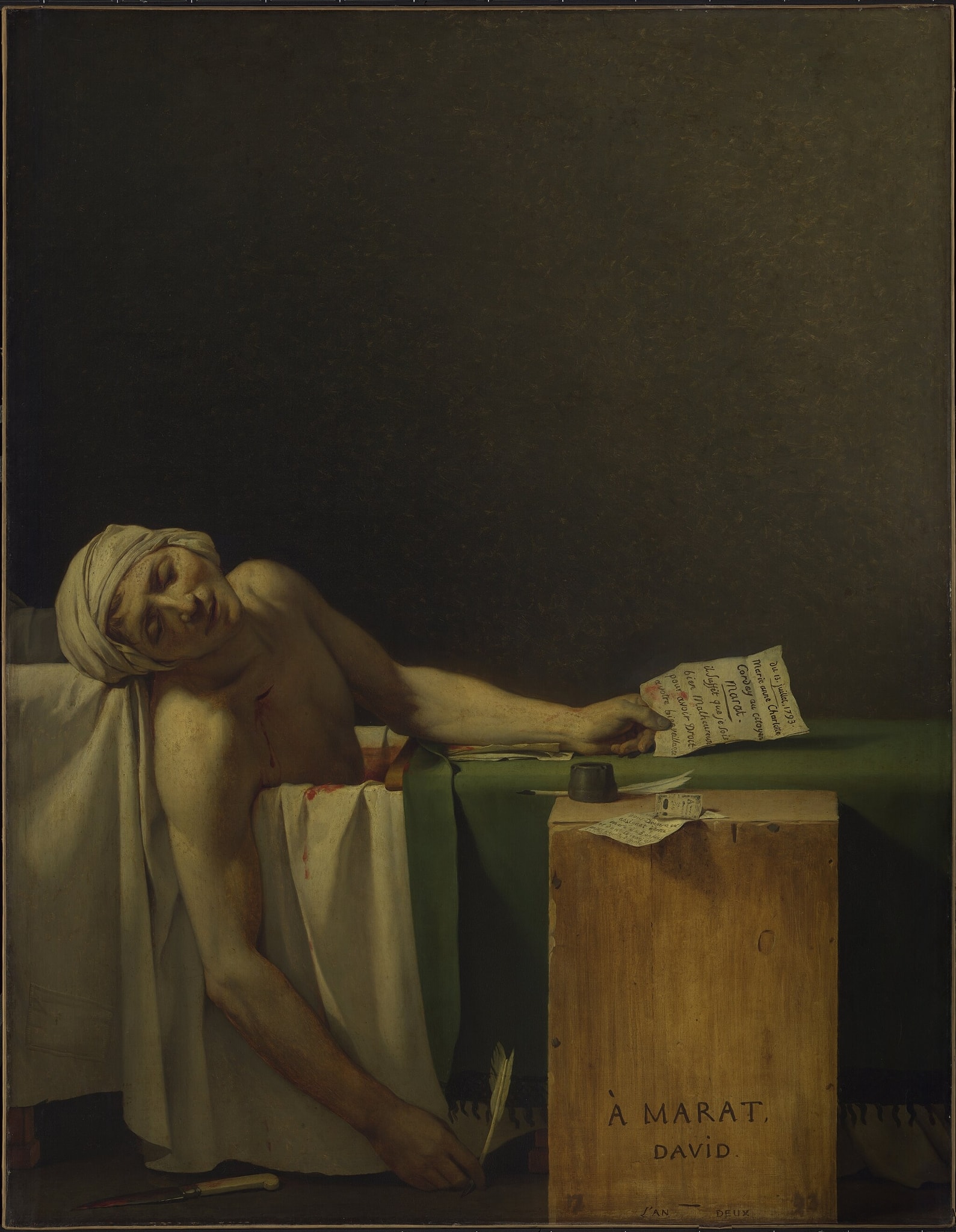
The Death of Marat by Jacques-Louis David (1793) featuring Charlotte Corday’s letter, Quill pen, Bloodied knife, Green baize writing plank

Click on any numbered symbol to learn more about its meaning

Meaning & Symbolism

David builds the painting’s authority by grafting Christian visual memory onto revolutionary subject matter. Marat’s gently arched, downward-tilted head and exposed torso recall a Pietà or Entombment, yet the scene is stripped of halos, angels, or altars. Instead, the eye meets a blank upper field that cancels narrative bustle and reads like a civic no‑space, a stage for meaning rather than description 3. The light falls with sculptural clarity on the corpse, the green baize writing plank, and the wooden crate that doubles as an epitaph—“À MARAT / DAVID / L’AN DEUX”—dating the work to the new revolutionary calendar and turning rough wood into a surrogate tombstone 123. The image therefore declares: sanctity has migrated from church to polity. It is not miracle but message that consecrates the dead. That message is carried by the painting’s textual props. In Marat’s right hand, David makes legible the billet attributed to Charlotte Corday—its supplicating tone (“il suffit que je sois bien malheureuse…”) foregrounds Marat’s supposed benevolence and her ruse 3. On the plank lie an inkwell and loose papers, including an assignat; below, the quill slips from Marat’s left hand toward a blood‑spotted knife on the floor. The pairing sets up a moral opposition: pen versus blade, persuasion versus treachery. David’s dedication inscribed on the crate functions as an epitaph within the picture, certifying the death as public sacrifice rather than private catastrophe 123. Technical studies show that David adjusted details—the placement of letter and quill, the openness of the eyes—underscoring a pragmatic, propagandistic craft aimed at maximum legibility and pathos 5. Even the near-bloodless stab wound and the neat head wrap (a nod to Marat’s medicated baths) are idealized to serve rhetoric over forensics, converting messy assassination into serene martyrdom 34. The painting’s political eloquence rests on its austere simplicity. By emptying the background, restricting the palette, and monumentalizing humble things—the tub, the crate, the green cloth—David models republican virtue as plainness opposed to ancien‑régime luxury 23. Displayed before the National Convention alongside the now‑lost Le Peletier, the work operated as a cult image for revolutionary mourning and resolve, collapsing portrait, history painting, and devotional form into one 2. For later viewers, this fusion has marked the canvas as a threshold image of modernity: as T. J. Clark argues, it takes “the stuff of politics as its material” without transmuting it into allegory, inventing a new kind of public image whose claim on us is ethical as much as aesthetic 8. In short, the meaning of The Death of Marat is the consecration of political conviction through art; why The Death of Marat is important is that it shows how painting can manufacture civic myth, create consensus in crisis, and still, in its stark quiet, make room for grief 237.

Explore Deeper with AI

Ask questions about The Death of Marat

Popular questions:

Powered by AI • Get instant insights about this artwork

💬 Ask questions about this artwork!

Interpretations

Material/Technical Revisions as Rhetoric

Scientific imaging reveals that David engineered the scene for maximum legibility. Infrared and multispectral studies show he shifted the letter and quill between hands, considered more open eyes, and derived Marat’s right hand from his own earlier Hector—practical borrowings to refine diction and pathos 4. Such edits were not indecision but propagandistic optimization: the pen’s glide toward the knife had to read at a glance; the billet had to be legible; the head’s tilt had to echo a sacred prototype without seeming theatrical. Technical hypotheses about later concealment under white lead also attest to the painting’s fraught political afterlife. In other words, the work’s authority is not merely iconographic; it is built in the workshop’s iterative craft, where compositional micro‑decisions convert assassination into doctrine 4.

Source: npj Heritage Science (Nature Research)

Formal Austerity as Civic Theater

The painting’s blank upper field and restricted palette construct a new kind of public image that theatricalizes plainness. By deleting décor and narrative bustle, David turns the tub, plank, and rough crate into monumental actors on a voidlike stage; the result is a secular liturgy of looking, calibrated for assembly‑room display before the Convention 23. This anti‑Baroque spareness positions republican virtue as anti‑luxury and enforces a singular optical command: eye to body, body to text, text to polity. As a pendant to the lost Le Peletier, Marat operated like a cult image of mourning, designed for collective rites rather than private devotion 2. The void is thus not absence but civic space, an architecture of attention that replaces chapels with chambers 23.

Source: Louvre Museum; Smarthistory

Textual Politics: The Image as Archive

David embeds a mini‑archive in the picture: Corday’s billet, an assignat, scattered notes, the painter’s own carved dedication. These paratexts do narrative work that altarpieces once handled with angels and scrolls. As Dorothy Johnson notes, such interleaved texts structure the painting’s rhetoric—evidence (the billet), function (journalistic tools), and testimony (David’s epitaph) cohere into martyr‑narrative 6. The letter’s supplicating tone shapes Marat’s persona as benevolent victim; the assignat indexes the Revolution’s administrative modernity; the crate inscription canonizes the death in civic time 236. Rather than illustrate theology, David curates documents, making the painting behave like a public dossier that secures belief not by miracle but by paperwork.

Source: Dorothy Johnson, CAA Reviews; Louvre Museum; Smarthistory

Secular Time and Revolutionary Value

The epitaph’s “L’AN DEUX” and the visible assignat bind Marat’s body to new regimes of time and value. The Revolutionary calendar rejects sacred chronology; the paper currency rejects metallic, monarchic guarantees. David fuses both into an image where timekeeping and money become civic sacraments, consecrated on a rough wooden altar 123. The painting thus narrates more than a death: it pictures the invention of a polity, in which administrative reforms (calendrical, fiscal, bureaucratic) are felt as intimate realities—ink on skin, paper in hand, inscription on wood. In this key, the tub reads as a provisional republic: a container for fragile bodies and fragile promises, stabilized by writing and witnessed by a public 23.

Source: RMFAB (Royal Museums of Fine Arts of Belgium); Louvre Museum; Smarthistory

Gendered Ruse, Moral Optics

Staged around Corday’s deceptive billet, the composition scripts a gendered drama: feminine supplication as mask for lethal intent, set against Marat’s masculine public writing. The contrast “pen versus blade” moralizes the opposition as persuasion versus treachery, assigning guile to the assassin and benevolence to the victim 356. Yet David suppresses gore and personal chaos to avoid sensationalism, stabilizing the female “ruse” as a didactic foil rather than a melodramatic spectacle. Within revolutionary visual culture, this coding buttresses a politics of virtue under threat, where the feminine body is both messenger and menace, and where the picture’s ethical claim must out‑argue the crime it mourns 356.

Source: Smarthistory; Encyclopaedia Britannica; Dorothy Johnson, CAA Reviews

Modern Public Image: Ethics without Allegory

Following T. J. Clark, Marat reads as a threshold of modernity: an image that takes “the stuff of politics” as its very material, refusing to sublimate it into classical allegory 7. The effect is an ethical demand addressed to viewers—not an emblem decoded in books but a body, tools, papers, and a date presented as historical proof. Later historians (e.g., Thomas Crow) track how the work’s grammar—void, caption, corpse, inscription—remains legible across modern protest, sustaining its charge as a talisman of dissent 8. David invents a format where art’s authority comes from public reason and reproducible signs, making Marat less a mythic hero than a prototype for the modern civic image.

Source: T. J. Clark, Farewell to an Idea (via summary quoting); Thomas Crow

Related Themes

About Jacques-Louis David

Jacques-Louis David (1748–1825) led the Neoclassical movement, turning classical form into Enlightenment politics; he later became the Revolution’s foremost painter and, under Napoleon, the empire’s visual strategist. Trained in Rome after winning the Prix de Rome, he shaped a generation of artists and defined history painting’s civic mission [5].
View all works by Jacques-Louis David

More by Jacques-Louis David