Judith Slaying Holofernes
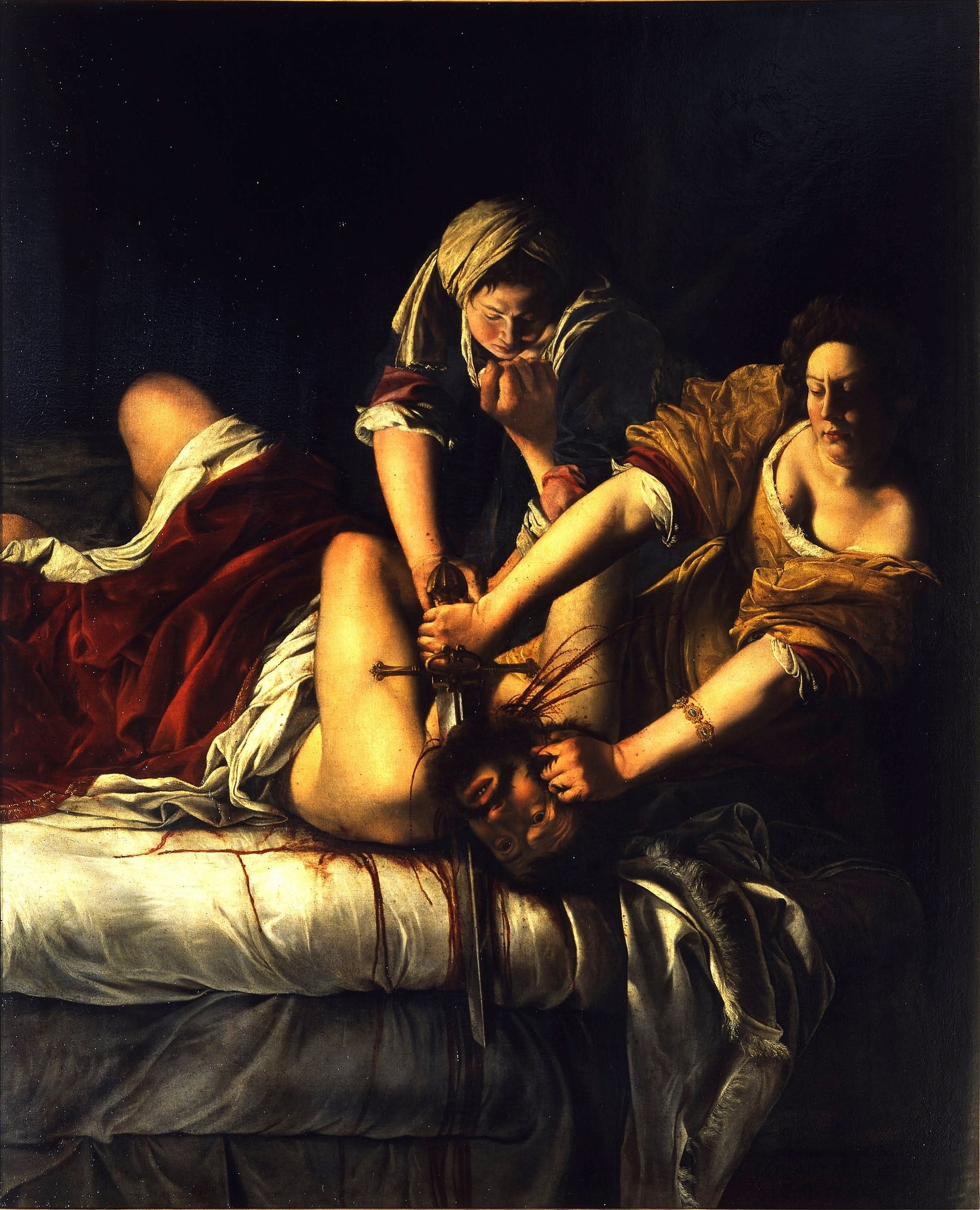
Artemisia Gentileschi’s Judith Slaying Holofernes hurls us into the fatal instant when Judith and her maid overpower the Assyrian general. In a void of darkness, a hard light chisels out straining arms, a heavy sword, and blood darkening the white sheets—an image of justice enacted through female collaboration [1][2].
Fast Facts
- Year
- c. 1612–13
- Medium
- Oil on canvas
- Dimensions
- 158.8 × 125.5 cm
- Location
- Museo e Real Bosco di Capodimonte, Naples
Click on any numbered symbol to learn more about its meaning
Meaning & Symbolism
Gentileschi composes the scene as a machine of inevitability. Judith’s forearms, the sword’s diagonal, and the maid’s bracing grip lock together like intermeshing gears, converting will into force. The white sheets, chosen precisely because they show the cost of action, bear thick, downward streams of blood; the stain also marks Judith’s bodice, asserting that justice is achieved through contact, not from a safe remove 12. The red drapery piled at the left signals sanctioned sacrifice, framing the act as salvific violence rather than private vengeance. Tenebrist lighting isolates the trio against engulfing dark, staging revelation—the fall of a tyrant—within a world otherwise ruled by shadow 1.
Unlike decorous precedents, Gentileschi assigns the maid a decisive, interior role: she pins Holofernes with body weight and clasped hands, making the kill a two‑woman operation. Capodimonte stresses that this active, in‑the‑tent Abra is Artemisia’s invention, intensifying the theme of female solidarity beyond the biblical text 2. The sword—often identified as a heavy, curved scimitar in Artemisia’s Florentine version—here reads as a tool, not an emblem; its mass and the women’s straining tendons insist on the physics of beheading, an honesty that shocked early viewers and still compels today 12. Scholars from Garrard onward have read this refusal of prettified violence as a conscious centering of women as agents of history, while others caution against reducing it to autobiography alone; either way, the picture relocates heroism from emblematic pose to embodied action 345.
Formally, the painting weaponizes Baroque naturalism to bind ethics to optics. The viewer’s eye rides the luminous wedge of linen up to the knot of hands where steel meets throat, then back along the maid’s arm to Judith’s focused profile. Every element—light as disclosure, darkness as threat, white as virtue stained but not undone—serves a single claim: oppression ends only when the virtuous act together with uncompromising realism. That is why Judith Slaying Holofernes is important: it fuses biblical narrative, Caravaggesque truth‑to‑nature, and a radical allocation of agency into one of the Baroque’s most commanding images of justice achieved through shared resolve 1245.
Explore Deeper with AI
Ask questions about Judith Slaying Holofernes
Popular questions:
Powered by AI • Get instant insights about this artwork
💬 Ask questions about this artwork!
Interpretations
Patronage & Court Politics
Read through Medici patronage, the picture’s violent naturalism is not anti‑court but theatrically useful to it: a shock image of tyrannicide aligned with princely self‑fashioning as guarantor of justice. Completed c.1620 and shipped to Florence, the work’s payment lagged after Cosimo II’s death until Galileo advocated for Artemisia—evidence of her savvy court networks as much as her talent 1. Keith Christiansen situates Artemisia within courtly Caravaggesque practice, where spectacular truth‑to‑nature functioned as state rhetoric 3. The result is a painting that doubles as moral exemplum and Medicean stagecraft—blood as proof, light as legitimation—asserting that sovereign order resumes when tyranny is cut short, literally and politically 13.
Source: Uffizi Galleries; Keith Christiansen (Metropolitan Museum of Art)
Comparative Iconography: Beyond Caravaggio
Against Caravaggio’s decorous Judith, Artemisia intensifies proximate struggle: the maid braces Holofernes with interlocked hands and body weight, an intervention the Capodimonte text calls Artemisia’s invention 2. This makes the beheading a two‑woman operation, displacing the single-hero paradigm and redistributing agency across a coordinated duo. Christiansen notes how Caravaggesque tenebrism becomes in Artemisia a compositional ethics—diagonals and torque that visualize joint resolve rather than sudden shock 3. The change is not cosmetic; it recasts the narrative’s power structure, anchoring deliverance in collaboration and in the physics of labor, rather than in an isolated act of virtuoso individualism 23.
Source: Museo e Real Bosco di Capodimonte; Keith Christiansen
Technique, Physiology, and Early Science
Artemisia’s fidelity to bodily mechanics—the scimitar’s mass, taut forearm flexors, compressive pinning—foregrounds operation over ornament 1. The Uffizi notes the weapon as a scimitar and the arterial jets staining linen and bodice, details that register both optical acuity and moral cost 1. A recent essay speculates that the painting’s arcs of blood echo contemporary knowledge of projectile motion circulating in Medicean circles via Galileo—a stimulating but unproven link that nonetheless underscores Artemisia’s orientation toward observable phenomena 7. Either way, the canvas unites craft and empiricism: a Baroque laboratory where truth-to-nature is the conduit for truth-to-justice 17.
Source: Uffizi Galleries; The Guardian (interpretive journalism on Galileo link)
Feminist Historiography and Its Limits
Mary D. Garrard’s foundational reading sees Judith as the female hero who punishes masculine wrongdoing, reframing Baroque history painting around women’s agency 4. Later debates urge caution: R. Ward Bissell embeds Artemisia’s choices in patronage and professional context, tempering strictly autobiographical narratives 5. Griselda Pollock further warns against reducing the work to revenge iconography, arguing for a broader politics of female collaboration and courage 6. Taken together, these positions enrich rather than cancel: the canvas is simultaneously a gendered intervention in the canon and a strategic performance within 17th‑century markets—a duality that its uncompromising physicality keeps in productive tension 456.
Source: Mary D. Garrard; R. Ward Bissell; National Gallery, London (summarizing Pollock’s stance)
Baroque Stagecraft: Light, Proximity, and Witness
Tenebrism here is not mood but forensic theater: raking light isolates the trio against engulfing dark so revelation happens at the instant steel meets throat 1. Christiansen describes how Caravaggesque naturalism becomes a system of persuasion—light as disclosure, dark as threat—forcing the viewer into the role of witness at point‑blank range 3. The pristine linens function as a calibrated ground for legible blood, converting color contrast into moral contrast; proximity makes abstraction impossible 1. In this choreography, spectatorship is ethically loaded: to look is to confront justice enacted, not allegory deferred. Baroque rhetoric becomes visual law, executed in paint 13.
Source: Uffizi Galleries; Keith Christiansen
Related Themes
About Artemisia Gentileschi
Artemisia Gentileschi (1593–1652/53) trained in Rome within Caravaggio’s orbit, became the first woman admitted to Florence’s Accademia delle Arti del Disegno in 1616, and worked for major patrons across Italy and in London. She is renowned for forceful history paintings that place women at the center of action [1][5][6].
View all works by Artemisia Gentileschi →