The Cup of Tea

by Mary Cassatt

Mary Cassatt’s The Cup of Tea distills a moment of bourgeois leisure into a study of poise, etiquette, and private reflection. A woman in a rose‑pink dress and bonnet, white‑gloved, balances a gold‑rimmed cup against the shimmer of Impressionist brushwork, while a green planter of pale blossoms echoes her pastel palette [1]. The work turns an ordinary ritual into a modern emblem of women’s experience.
💰

Market Value

$18-25 million

How much is The Cup of Tea worth?

Fast Facts

Year
ca. 1880–81
Medium
Oil on canvas
Dimensions
92.4 × 65.4 cm
Location
The Metropolitan Museum of Art, New York
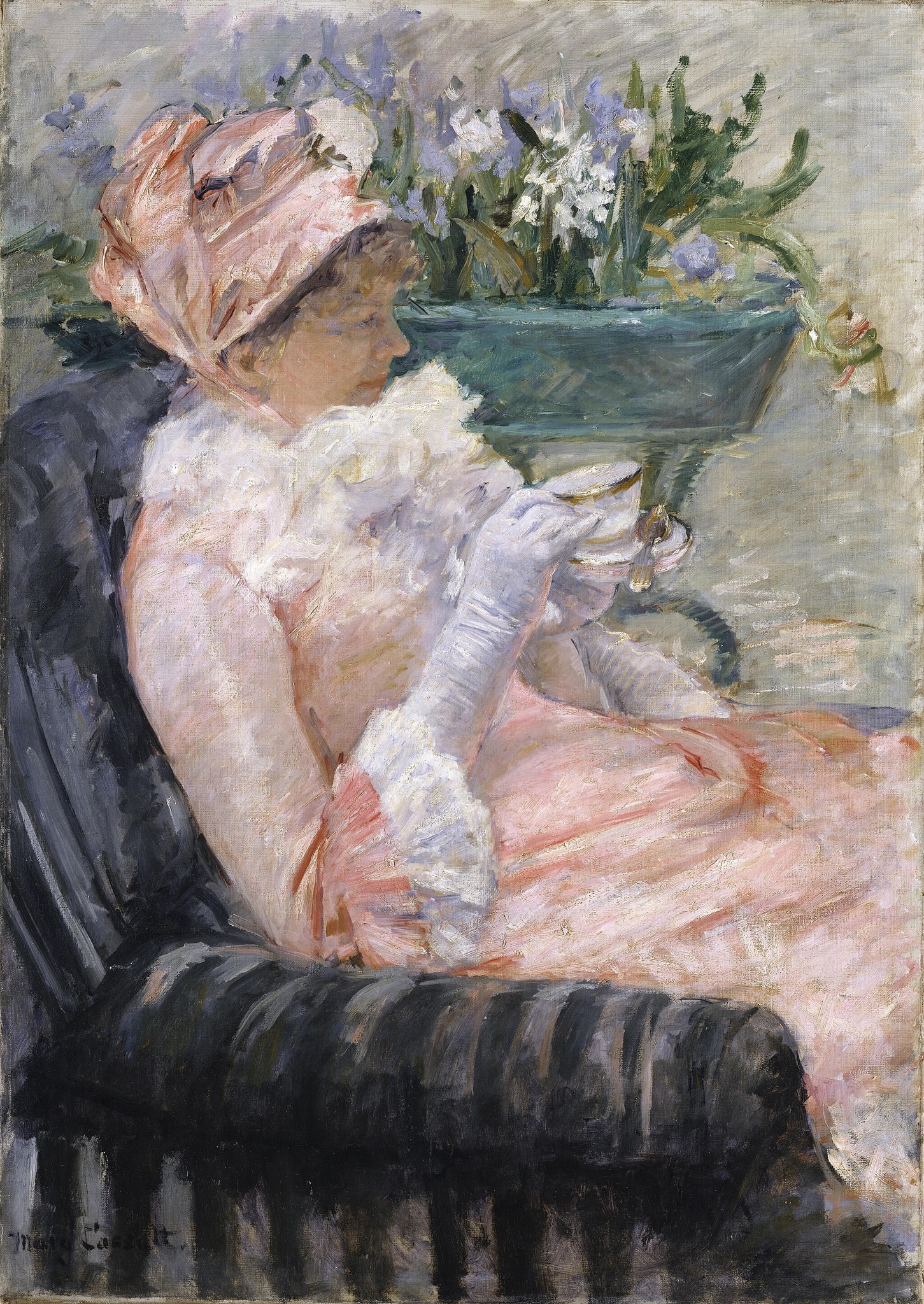
The Cup of Tea by Mary Cassatt (ca. 1880–81)

Click on any numbered symbol to learn more about its meaning

Meaning & Symbolism

Cassatt anchors the scene around the small, steady axis of the cup and saucer, held squarely by a white‑gloved hand. The sitter’s body, sheathed in a rose‑pink satin dress with a frothy white collar, reclines into a dark, striped chair whose deep blues and blacks counterpose the high‑keyed pastels of the figure. This chromatic opposition—dark upholstery versus luminous pinks and creams—enlivens the surface with complementary tensions typical of Impressionism, while also clarifying the painting’s drama: a composed self amid a flicker of sensation 1. Behind the profile, a long green planter spills pale blossoms in quick strokes; not botanically insisted upon, the flowers read as cultivated décor, a sign of domestic refinement that visually rhymes with the bonnet’s pink folds and the dress’s sheen 1. Cassatt’s loose handling dissolves edges—the ruffled collar, the bonnet’s pleats, even the sitter’s cheek—so that the figure emerges not by contour but by light. The effect is to render the pause between sips as a modern, perceptual event rather than a static portrait, in line with the painter’s alignment with Degas and the Impressionist circle during these years 12. Within this shimmering field, Cassatt stages the rituals of visiting—bonnet on, gloves unremoved, the glint of gold porcelain and a likely silver spoon—as legible emblems of class and propriety 15. Yet the cropped, side‑on view denies the viewer full access to the sitter’s face; etiquette is acknowledged, intimacy is protected. The striped chair rises like a dark proscenium around her, but the true performance is understated: a private interlude conducted in public code. In this way Cassatt reframes the gendered interior not merely as a zone of constraint but as a site of self‑possession. The sitter’s profile turns inward, attentive to the cup, while the brushwork’s vibration suggests thought in motion—consciousness passing across a surface of color. Tea, a codified social practice in the bourgeois home, becomes the painting’s metaphorical instrument: it synchronizes sociability and solitude, allowing Cassatt to depict a modern woman acting within, but not subsumed by, convention 5. This is why The Cup of Tea is important: it articulates a nuanced agency at the heart of everyday life, delivering psychological resonance without abandoning the Impressionist commitment to optical immediacy 12. Historically, the canvas belongs to Cassatt’s focused series on tea‑taking around 1880, a moment when she refined her interest in women’s spheres—drawing rooms, theaters, and boxes—into studies of habitual grace 15. Shown to acclaim in the 1881 Impressionist exhibition, the painting demonstrates her mature command of high‑keyed color and “scintillating” touch while eschewing anecdote for structure: the diagonal of the arm toward the cup; the counter‑diagonal of the planter; the enclosing curve of the chair 1. A related study confirms the period and the model’s role in this sequence, underscoring Cassatt’s deliberate exploration of pose, costume, and setting as vehicles of meaning 7. Rather than narrate an event, The Cup of Tea composes a modern ethics of attention. It argues—quietly, decisively—that the cultivated pause is not empty leisure but a space where identity is maintained, and where painting, like tea, is a refined ritual that clarifies the self within a changing world 125.

Explore Deeper with AI

Ask questions about The Cup of Tea

Popular questions:

Powered by AI • Get instant insights about this artwork

💬 Ask questions about this artwork!

Interpretations

Feminist Spatial Politics

Rather than depicting the parlor as a passive enclosure, Cassatt mobilizes the tea ritual to recode the interior as a field of agency. The sitter’s profile, partially withheld from direct confrontation, exemplifies what feminist historians identify as women’s negotiated visibility in modern interiors—poised between display and privacy. This is not a scene of subservience but of self‑governed attention, where etiquette becomes a protective screen for inwardness. Read alongside Cassatt’s related tea images, the painting tests how domestic sociability can sustain, rather than erode, a woman’s autonomy. The cropping and diagonal arm direct attention to action (the sip) over identity spectacle, resisting the period’s invasive spectatorship of the feminine. In this sense, the work enacts what scholars call a modern, gendered spectatorship in which the subject controls access to herself 13.

Source: MFA Boston; feminist scholarship referenced via museum interpretation

Material Culture and Class Codes

Cassatt’s still‑life indices—the gold‑rimmed cup, likely silver spoon, and the maintained gloves—operate as semiotic props of bourgeois refinement. In the period’s etiquette manuals and practice, tea service furnished an arena for taste, lineage, and the display of imported luxury goods. By isolating the cup as a visual axis, Cassatt elevates this material signifier into the picture’s conceptual hinge, where politeness rituals structure social access. The related canvas "The Tea" (MFA Boston) underscores how antique silver and fine porcelain served as status emblems, clarifying the broader series’ sociological stakes. Here, décor (planter, striped upholstery) rhymes chromatically with dress, fusing commodity display to self‑fashioning—a convergence typical of Impressionist interiors keyed to modern consumer culture 13.

Source: Museum of Fine Arts, Boston

Optical Structure and Degas’s Orbit

The picture’s “scintillating” light, contingent edges, and chromatic counterpoint (rose‑pink against dark blues) align with Cassatt’s mature Impressionist facture while revealing the structural discipline learned in Degas’s orbit. The diagonal of the forearm, the counter‑thrust of the planter, and the enveloping chair curvature create a lattice that stabilizes flicker into legibility. This is Impressionism as a constructed perception: color zones articulate volume; edges dissolve where light dominates, then reassert in hard accents (cup rim, glove seams). Such calibration joins Cassatt’s modern subject matter to a rigorously planned composition—neither anecdotal genre nor academic finish, but a third way that locates meaning in the choreography of looking itself 12.

Source: The Metropolitan Museum of Art; Heilbrunn Timeline of Art History

Exhibition History and Reception

Shown at the 1881 Impressionist exhibition, The Cup of Tea demonstrated to contemporaries that Cassatt could marry daring color to disciplined drawing. Period reviews split along familiar lines: admirers praised the "woman in the pink dress and bonnet" for chromatic unity and presence, while skeptics balked at the liberties of contour and hue—debates symptomatic of Impressionism’s contested visibility. The Met’s record confirms the painting’s positive notice in 1881, situating it within Cassatt’s peak alignment with the group. Later cataloging consolidated its date to ca. 1880–81, while secondary sources note earlier lists that never materialized into a 1879 showing—an instructive reminder that exhibition histories can be provisional, like the very perceptions Impressionism sought to fix 16.

Source: The Metropolitan Museum of Art; secondary synthesis of 1881 press

Serial Method and Studio Experiment

The painting emerges from a deliberate serial investigation of tea‑taking around 1880, in which pose, costume, and furnishing were tested across canvases and studies. A related study preserved in Stockholm documents the iterative refinement of Lydia’s profile and the arm‑to‑cup vector, showing Cassatt’s studio as a laboratory of micro‑adjustments rather than spontaneous chance. Seriality lets Cassatt parse how small shifts—bonnet tilt, chair pattern, flower value—inflect social meaning, effectively turning ritual into a variable. This practice anchors The Cup of Tea within a modernist logic of repetition with difference, where understanding accrues through comparative looking across the set, not from any single anecdotal narrative 14.

Source: Nationalmuseum (Sweden); The Metropolitan Museum of Art

Related Themes

About Mary Cassatt

Mary Cassatt (1844–1926) was an American painter who settled in Paris, exhibited with the Impressionists, and became a key conduit for introducing their art to U.S. collectors. After 1890 she adopted japoniste flatness, bold patterning, and strong design, focusing on modern women’s lives—especially mother‑and‑child subjects—until failing eyesight curtailed her work by 1914 [4].
View all works by Mary Cassatt

More by Mary Cassatt

Woman in Black at the Opera by Mary Cassatt

Woman in Black at the Opera

Mary Cassatt (1878)

Mary Cassatt’s Woman in Black at the Opera stages a taut drama of vision and visibility. A woman in <strong>black attire</strong> raises <strong>opera glasses</strong> while a distant man aims his own at her, setting off a chain of looks that makes public leisure a site of <strong>power, agency, and surveillance</strong> <sup>[1]</sup><sup>[2]</sup>.

The Tea by Mary Cassatt

The Tea

Mary Cassatt (about 1880)

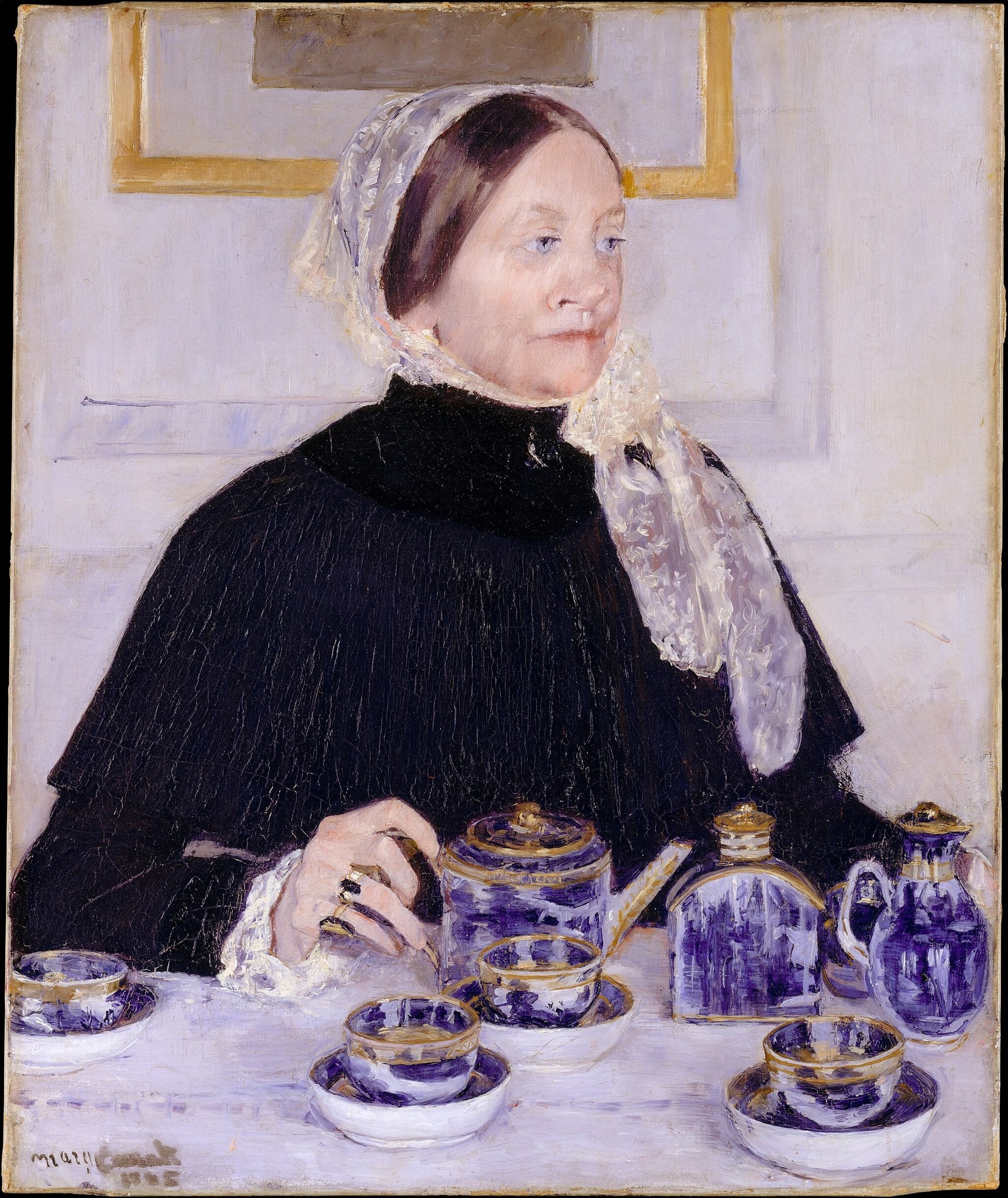
Mary Cassatt’s The Tea stages a poised, interior <strong>drama of manners</strong>: two women sit close yet feel apart, one thoughtful, the other raising a cup that <strong>veils her face</strong>. A gleaming, oversized <strong>silver tea service</strong> commands the foreground, its reflections turning ritual objects into actors in the scene <sup>[1]</sup>. The shallow, cropped room—striped wall, gilt mirror, marble mantel—compresses the atmosphere into <strong>intimacy edged by restraint</strong>.

Little Girl in a Big Straw Hat and a Pinafore by Mary Cassatt

Little Girl in a Big Straw Hat and a Pinafore

Mary Cassatt (c. 1886)

Mary Cassatt’s Little Girl in a Big Straw Hat and a Pinafore distills childhood into a quiet drama of <strong>interiority</strong> and <strong>constraint</strong>. The oversized straw hat and plain pinafore bracket a flushed face, downcast eyes, and <strong>clasped hands</strong>, turning a simple pose into a study of modern self‑consciousness <sup>[1]</sup>. Cassatt’s cool grays and swift, luminous strokes make mood—not costume—the subject.

Breakfast in Bed by Mary Cassatt

Breakfast in Bed

Mary Cassatt (1897)

Breakfast in Bed distills a <strong>tender modern intimacy</strong> into a tightly cropped sanctuary of rumpled white linens, protective embrace, and interrupted routine. Mary Cassatt uses <strong>cool light</strong> against <strong>warm flesh</strong> to anchor attention on the mother’s encircling arm and the child’s outward gaze, fusing care, curiosity, and the rhythms of <strong>everyday modern life</strong> <sup>[1]</sup><sup>[2]</sup>.

Young Mother Sewing by Mary Cassatt

Young Mother Sewing

Mary Cassatt (1900)

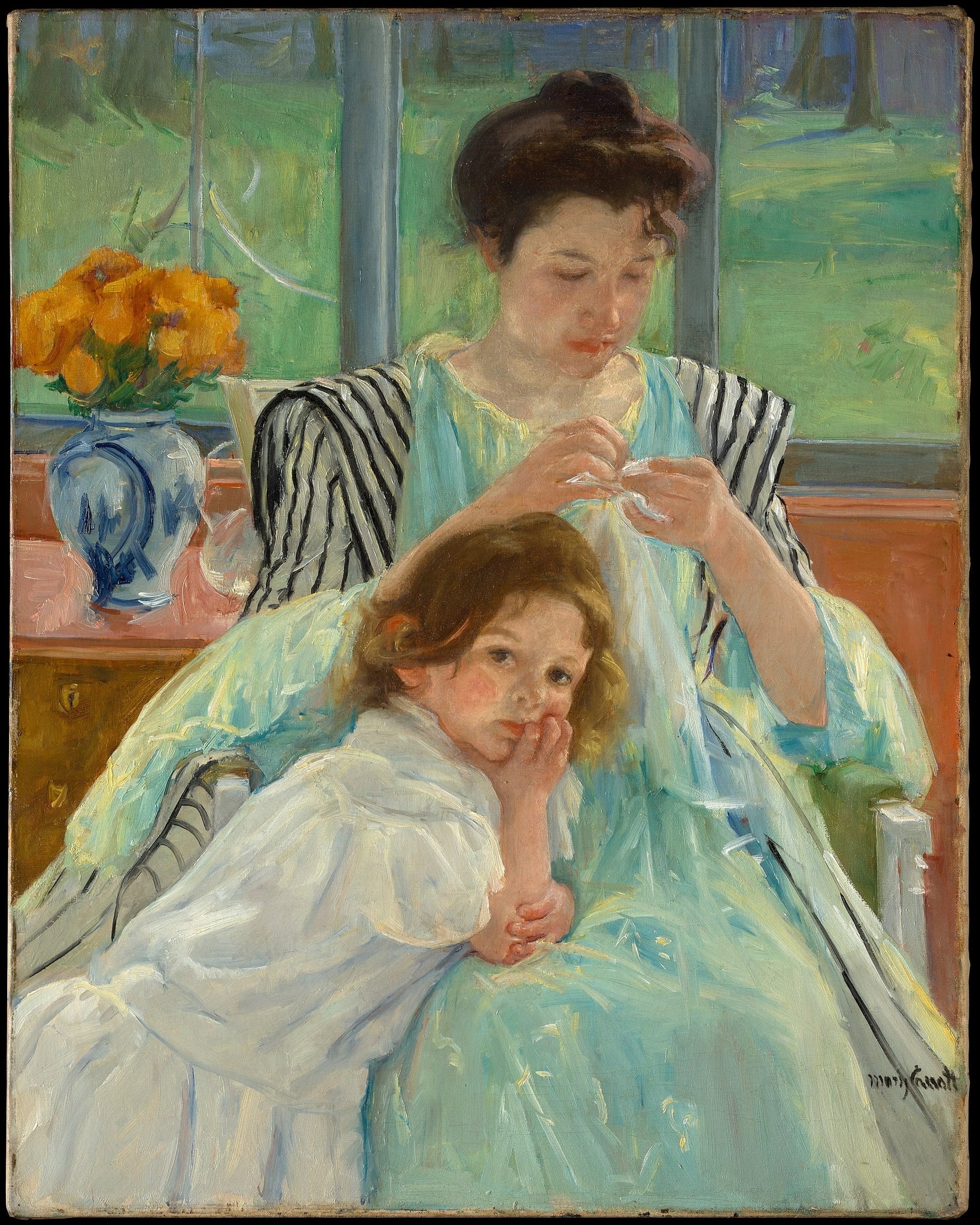
Mary Cassatt’s Young Mother Sewing centers the quiet <strong>labor of care</strong>: a mother steadies pale fabric while a child in white leans into her, eyes meeting ours. Cool <strong>greens and blues</strong> bathe the figures as striped sleeves and chair arms rhythmically return attention to the mother’s working hands, while a burst of <strong>orange blossoms</strong> by the window anchors interior life against the world outside <sup>[1]</sup>.
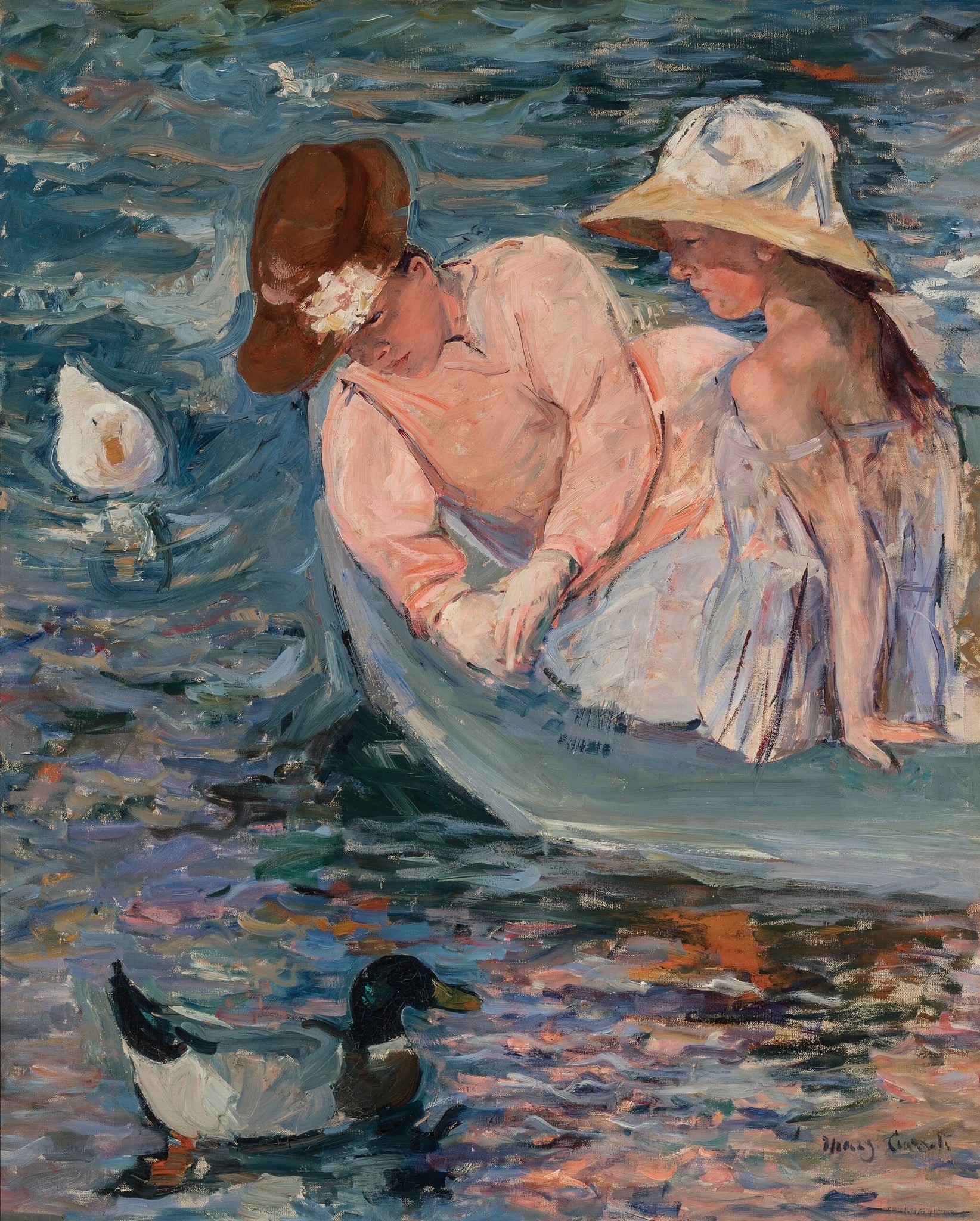
Children Playing on the Beach by Mary Cassatt

Children Playing on the Beach

Mary Cassatt (1884)

In Children Playing on the Beach, Mary Cassatt brings the viewer down to a child’s eye level, granting everyday play the weight of <strong>serious, self-contained work</strong>. The cool horizon and tiny boats open onto <strong>modern space and possibility</strong>, while the cropped, tilted foreground seals us inside the children’s focused world <sup>[1]</sup>.