How Much Is The Cup of Tea Worth?
Last updated: February 22, 2026
Quick Facts
- Methodology
- comparable analysis
Assuming excellent, unrestored condition and marquee-evening sale placement, we estimate Mary Cassatt’s The Cup of Tea at $18–25 million. The range reflects its prime 1880–81 date, iconic subject, 1881 Impressionist-exhibition pedigree, and the scarcity of comparable Cassatt oils—implying a new benchmark for the artist’s paintings.
Valuation Analysis
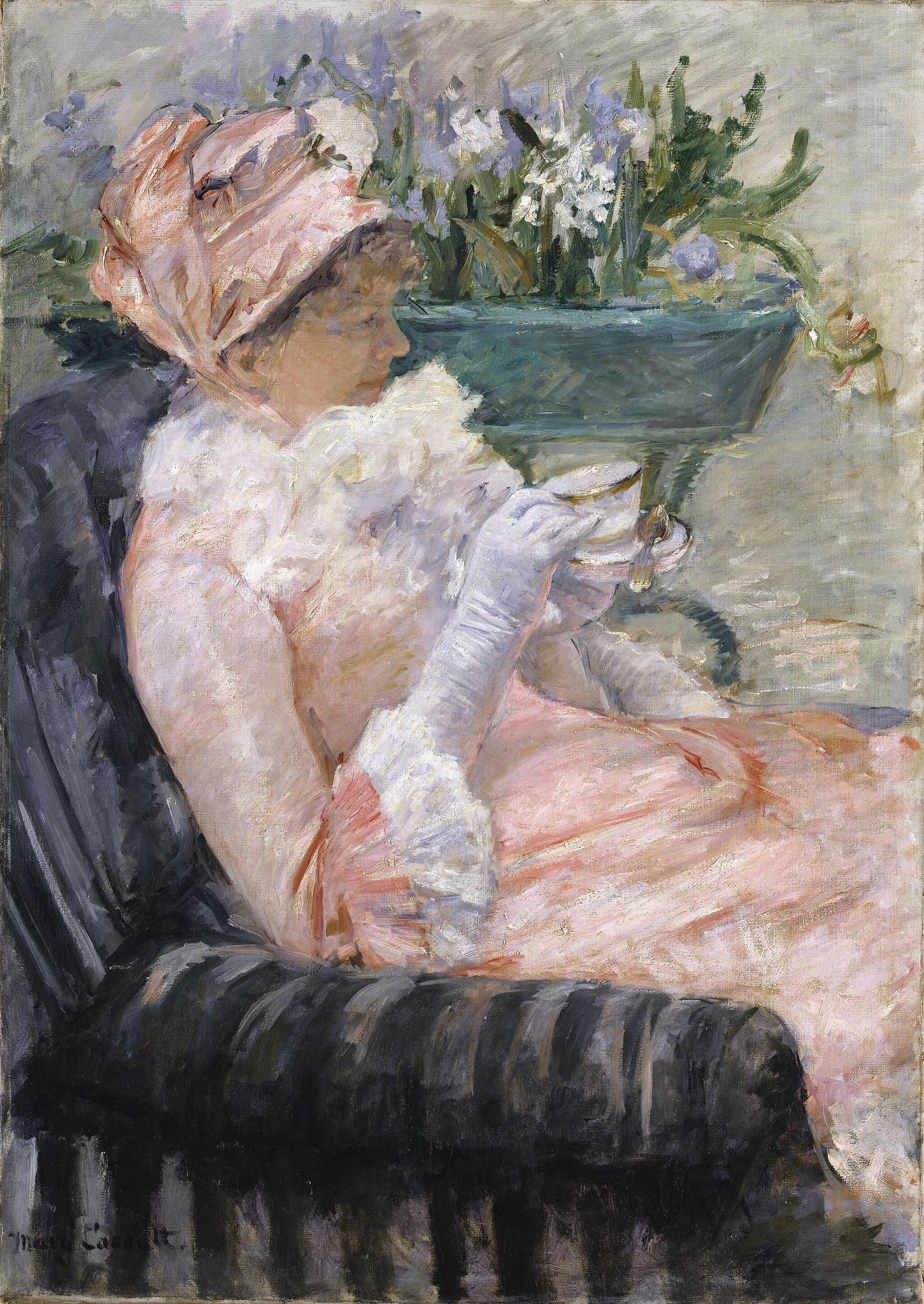
Work and significance. Mary Cassatt’s The Cup of Tea (ca. 1880–81; oil on canvas; 36 3/8 × 25 3/4 in) is a prime-period Impressionist interior modeled by the artist’s sister, Lydia, and was exhibited at the 1881 Impressionist exhibition. Long canonized in the collection of The Metropolitan Museum of Art (accession 22.16.17), the picture is widely reproduced and emblematic of Cassatt’s exploration of modern bourgeois femininity—placing it among the most resonant single-figure interiors in her oeuvre [1].
Market benchmarks. Public auction records for Cassatt skew toward works on paper; the standing artist auction record is $7.489 million for Young Lady in a Loge, Gazing to Right (1878–79), a museum-caliber pastel sold from the Ann & Gordon Getty Collection in 2022 [2]. That result eclipsed Cassatt’s prior overall high water mark, widely reported as c.$6.2 million for an oil in 2007, underscoring both the depth of demand for iconic imagery and the rarity of opportunities at the very top of her market [7]. High-quality oils have achieved up to $4.8 million in the late 2010s (e.g., Children Playing with a Dog, 2018) [5], while a smaller early oil realized €1.216 million in Paris in 2023—illustrating the step-change in value created by subject, scale, and sale context [6].
Context and timing. Despite a 12% contraction in global art sales in 2024 (with >$10m lots down sharply), blue-chip late-19th/early-20th century material proved resilient, and trophy demand rebounded in late 2025 [4]. Artnet’s 2024 review of the Impressionism market notes Cassatt’s consistent demand and underrepresentation in top-line totals relative to male peers, with masterpiece-level supply unusually scarce [3]. Against that backdrop—and amid heightened curatorial attention (including recent and centenary-adjacent programming)—a fresh, prime-period, museum-level Cassatt oil positioned as a marquee lot could attract cross-category bidding and break through prior public oil benchmarks.
Conclusion and range. On a comparable and qualitative basis, The Cup of Tea warrants a substantial “masterpiece premium” over public oil comparables, driven by its prime 1880–81 date, iconic subject, scale, exhibition history, and visibility. Our concluded fair-market value, if hypothetically offered today in a top-tier evening sale with strong global marketing and third-party interest, is $18–25 million. This presumes excellent, largely original condition and no material structural concerns. Downside sensitivities (lining, abrasion, significant restoration, or suboptimal sale context) could pull the outcome toward the low-to-mid teens; conversely, pristine condition, marquee placement, and competitive underwriting could push the result to, or slightly above, the top of the range [1][2][3][4][5][6][7].
Key Valuation Factors
Art Historical Significance
High ImpactPainted ca. 1880–81 and shown in the 1881 Impressionist exhibition, The Cup of Tea is a signature image of modern bourgeois womanhood by Cassatt at the height of her Impressionist phase. The sitter (Lydia Cassatt), refined interior setting, and bravura handling make it one of the most frequently reproduced and discussed works in the artist’s canon. This level of art-historical prominence typically commands a substantial premium over otherwise comparable works by date and medium, as collectors pay for canonical status, literature visibility, and the likelihood of continued scholarly and exhibition demand.
Period and Subject Desirability
High ImpactCassatt’s market is strongest for late-1870s to mid-1880s Impressionist oils and for iconic subjects such as loge scenes and intimate bourgeois interiors. The Cup of Tea aligns perfectly with this demand profile: prime period, elegant interior, and a psychologically acute portrayal of a fashionable woman at tea. Works hitting this trifecta are scarce in private hands and command substantial premiums relative to later oils or less definitive subjects, as evidenced by the broader pricing spread between top-tier images and routine day-sale material.
Scale, Visibility, and Exhibition History
High ImpactAt roughly 36 × 26 inches, the painting has a substantial, display-ready presence that suits contemporary collecting spaces. Its inclusion in the 1881 Impressionist exhibition and long tenure at The Met contribute to unrivaled visibility and confirm its canonical status. Such factors increase confidence among bidders, support museum-quality positioning by auction houses, and enhance marketing impact. Collectors often pay a premium for works that are both historically exhibited and immediately recognizable within the artist’s oeuvre.
Provenance and Canonization
High ImpactThe work’s early association with leading American collectors and its 1922 entry into The Metropolitan Museum of Art confer a level of institutional endorsement rarely matched. While museum ownership removes the work from normal market circulation, it also signals that the painting is among the artist’s finest. In a hypothetical deaccession scenario, this canonization would bolster buyer confidence and justify a significant premium over otherwise similar works lacking such distinguished provenance and institutional validation.
Market Liquidity for Cassatt Oils
Medium ImpactCassatt’s top public prices have often been achieved by works on paper, with the current auction record at $7.489m for a pastel (2022). Quality oils are rarer but historically have traded publicly below $10m, reflecting limited supply and conservative auction estimates. A masterpiece-level early oil can exceed these benchmarks, but execution risk remains tied to condition, sale context, and macro liquidity. Consequently, while the subject and period warrant an aggressive stance, the valuation prudently embeds a range to accommodate market depth and variability.
Sale History
The Cup of Tea has never been sold at public auction.
Mary Cassatt's Market
Mary Cassatt is a blue-chip American Impressionist with a deep U.S. and international collector base. The market is bifurcated: prints and pastels provide liquidity in the mid- to high-six figures, while prime-period oils are scarce and can command multi-million-dollar prices when quality and provenance align. Her standing has been reinforced by major institutional exhibitions and fresh scholarship, although headline auction records for paintings remain below those of male Impressionist peers. The artist’s overall record (for a pastel) is $7.489 million, and strong late-2010s oil results around $4–5 million indicate the public baseline for notable paintings; masterpieces with iconic subjects and prime dates can reasonably transcend these levels under optimal conditions.
Comparable Sales
Young Lady in a Loge, Gazing to Right
Mary Cassatt
Prime-period (late 1870s) iconic interior of modern life by Cassatt; museum-caliber image and current artist auction record. While a work on paper (not oil), it is thematically and chronologically close to The Cup of Tea and indicates the top end of public demand for blue‑chip Cassatt imagery.
$7.5M
2022, Christie's New York (Ann & Gordon Getty Collection)
~$8.3M adjusted
Children Playing with a Dog
Mary Cassatt
Cassatt oil painting with strong result; helps set the recent public range for quality oils. Later date (1907) and domestic subject make it slightly less aligned than The Cup of Tea’s early‑1880s, exhibition‑history interior, but it is a key oil benchmark.
$4.8M
2018, Christie's New York (American Art)
~$6.2M adjusted
A Goodnight Hug (pastel)
Mary Cassatt
High‑value Cassatt work on paper featuring an intimate, signature theme (mother/child). Not an oil, but a top‑tier public price in the recent cycle that illustrates ceiling demand for important Cassatt subjects.
$4.5M
2018, Sotheby's New York (Evening Sale)
~$5.8M adjusted
Portrait de jeune femme au chapeau blanc
Mary Cassatt
Cassatt oil from 1879—chronologically adjacent to The Cup of Tea—showing demand for early oils. Smaller, simpler composition and regional sale context yield a much lower price, but it is a clean, recent period‑neighbor oil comp.
$1.3M
2023, Ader, Hôtel Drouot (Paris)
~$1.4M adjusted
Baby Charles Looking Over His Mother’s Shoulder (No. 3)
Mary Cassatt
Cassatt oil on canvas with a classic maternal theme; helps anchor pricing for good‑quality oils in the public market. Later date (1900) and day‑sale context make it a more conservative benchmark than an early‑1880s, exhibition‑history interior like The Cup of Tea.
$1.6M
2021, Sotheby's New York (American Art)
~$1.9M adjusted
Current Market Trends
After a cautious 2024 marked by a 12% decline in global art sales and fewer >$10m transactions, late-2025 evening sales showed renewed appetite for top-tier blue-chip works. Impressionism remained resilient across the cycle, buoyed by enduring collector confidence and the 150th-anniversary spotlight; women Impressionists, including Cassatt, saw steady demand but limited masterpiece supply. As of early 2026, conditions favor well-marketed, canonical works with ironclad provenance. That backdrop, combined with centenary-related institutional attention, supports competitive bidding for a museum-level Cassatt oil—while still warranting a prudent range to account for condition sensitivity and execution risk.
Study print
Study this painting as a print
Pair the full artwork with a museum-style study sheet focused on one meaningful detail.
Sources
- The Metropolitan Museum of Art – Object record: Mary Cassatt, The Cup of Tea
- Christie’s – Ann & Gordon Getty Collection: Mary Cassatt, Young Lady in a Loge, Gazing to Right (2022)
- Artnet News – Impressionism at 150: What the data say about the market (2024)
- The Art Newspaper – Global art sales fell 12% in 2024: Art Basel/UBS Report (2025)
- Christie’s – Mary Cassatt artist page (noting 2018 oil result at $4,812,500)
- The Art Newspaper (FR) – Ader sale: Cassatt oil at €1.216m (Nov 24, 2023)
- Artnet News – Getty Collection evening sale at Christie’s sets Cassatt record (2022)