Bacchus

by Caravaggio

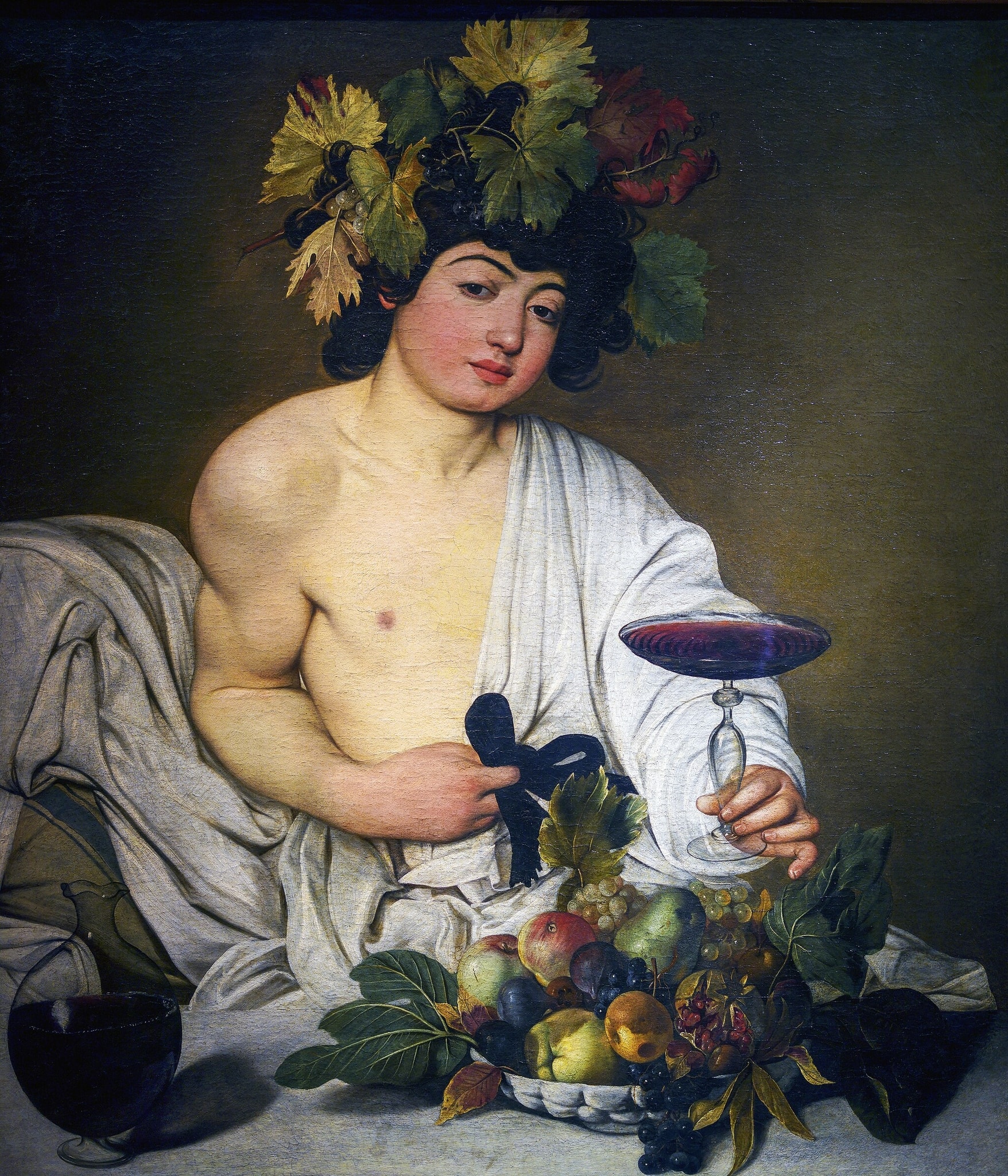
Caravaggio’s Bacchus stages a human-scaled god who offers wine with disarming immediacy, yoking sensual invitation to vanitas warning. The tilted goblet, blemished fruit, and wilting leaves insist that abundance and youth are precarious. A private Roman milieu under Cardinal del Monte shaped this refined, provocative image [1][2].

Fast Facts

Year
c. 1598
Medium
Oil on canvas
Dimensions
95 × 85 cm
Location
Uffizi Galleries, Florence
Bacchus by Caravaggio (c. 1598) featuring Tilted wine goblet, Vine-leaf crown, Blemished fruit and wilting leaves, Split pomegranate

Click on any numbered symbol to learn more about its meaning

Meaning & Symbolism

Caravaggio constructs Bacchus as an act of address. The youth, laurelled with vine leaves already yellowing at the edges, meets us with parted lips and extends a shallow glass whose wine surface noticeably tilts—an engineered imbalance that converts hospitality into a thesis about instability. On the stone slab, a wicker bowl teems with grapes, figs, pears, apples, and a split pomegranate; several skins are bruised, leaves curl and brown, and a few grapes have begun to shrivel. This is not incidental detail but the argument of the picture: abundance tips toward rot, intoxication toward vertigo, and beauty toward time. In Caravaggio’s early Roman language, the still life is a moral counterpoint to the body it frames, a vanitas folded into seduction. The decanter at lower left echoes the offered chalice, binding private conviviality to ritual gesture; within its glass, scholarship has long noted a tiny reflected figure—likely the painter at the easel—an optical signature of his practice and a witty confession that the whole scene is staged “from life” for us, right now 1256. The body’s rhetoric is equally programmatic. Caravaggio models the torso with cold light against a neutral ground, a Lombard clarity that sharpens the real over the ideal, even as the pose nods to classical prototypes. The black waist ribbon, idly handled, sexualizes the invitation without allegorical overreach, while the slipping white drapery exposes a pale shoulder that dramatizes touch and temperature as much as sight. This “present-tense” naturalism is the engine of the painting’s meaning: Bacchus is not a remote Olympian but a youth within arm’s length, collapsing sacred myth into a human offer of wine, company, and risk. Uffizi curators have framed the scene as a Horatian call to convivial moderation; critics have also traced a homoerotic address shaped by del Monte’s cultivated, private context. Both readings clarify why Bacchus is important: it is a test case for how Baroque painting could make classical culture intimate, morally ambivalent, and socially coded at once 13. A minority theological strand has proposed a latent Eucharistic resonance—grapes, blood, the proffered cup—but even without doctrinal closure, the picture thrives on such doubleness: profane festivity thickened by sacred echo, tactile realism edged by memento mori 14. Formally, the work crystallizes Caravaggio’s larger revolution. He compresses space to table depth, anchors objects with tactile weight, and uses chiaroscuro not as a theatrical effect but as a truth claim—light reveals, shadow withholds, time corrodes. Within del Monte’s household, where music, learned wit, and intimate display were prized, such a half-length myth performed as conversation piece and ethical prompt, a mirror for measured pleasure amid excess. In the European story of painting, Bacchus catalyzed a generation of Caravaggisti who learned from its immediacy: the close view, the cut fruit, the breath-warm face. The painting’s lasting point is exact and unsentimental: delight is real, and so is its brevity. The god’s offer stands; the tilted wine tells you what accepting costs 123.

Explore Deeper with AI

Ask questions about Bacchus

Popular questions:

Powered by AI • Get instant insights about this artwork

💬 Ask questions about this artwork!

Interpretations

Patronage & Coded Sociability

Read within Cardinal del Monte’s domestic milieu, Bacchus functions as an elite instrument of sociability—an image designed for witty exchange, music‑suffused evenings, and the testing of taste. The half‑length format and intimate scale align with conversation pieces cultivated in Palazzo Madama, where classical revival met urbane play 3. Within that setting, the youth’s address shades into homoerotic invitation, a reading long associated with Caravaggio’s early half‑lengths and the patron’s circle 4. The painting thus mediates between etiquette and desire: a refined offer of wine that doubles as social performance and erotic code. The still life’s blemishes temper hedonism with ethical scrutiny, staging moderation as a courtly virtue while acknowledging the thrill of transgression—precisely the paradox prized by del Monte’s learned coterie 134.

Source: Uffizi Galleries; Franca Trinchieri Camiz (Metropolitan Museum Journal); Donald Posner

Optics, Authorship & The Carafe

The tiny figure reflected in the glass carafe makes Bacchus a meditation on authorship and the mechanics of seeing. Christiansen tied this to Caravaggio’s practice of working “davanti del naturale,” with mirrors enabling meticulous transcription of effects and self‑reflexive insertions 2. Technical imaging has repeatedly visualized the reflection, but rather than a sudden “discovery,” it confirms a long‑noticed optical signature that folds the painter—and the act of painting—into the fiction 16. This minute cameo reframes the offered goblet as a staged performance about truth and artifice: a display of virtuoso mimesis that advertises its own construction. In del Monte’s circle, such visual wit would read as an urbane boast—a painter’s calling card hidden in plain sight, inviting connoisseurs to detect the trick while savoring the illusion 261.

Source: Keith Christiansen (MetMuseum); Art‑Test; Uffizi Galleries

Sacred Echoes in a Profane Masque

Beyond Bacchic festivity, critics from Calvesi onward have sensed a Eucharistic undertow: grapes as blood, the extended cup as chalice, and the ritualized gesture binding convivial drink to sacramental form 5. The Uffizi’s Horatian register—friendship and moderation—further calibrates the image as a moral exercise masked by sensuality 1. Crucially, no doctrinal key is forced; rather, Caravaggio engineers a zone of productive ambiguity, where sacred resonance complicates pleasure without resolving it. This doubleness suits a private, humanist audience that could relish syncretic symbolism: pagan god, Christian echo, modern body. The result is not piety smuggled into myth but a polyphonic iconography in which ritual, appetite, and time press against one another, making the viewer’s ethical calibration part of the artwork’s meaning 51.

Source: Maurizio Calvesi; Uffizi Galleries

Technique as Ethics: Chiaroscuro’s Truth Claim

Caravaggio’s compressed table‑depth, stony ledge, and cool, raking light enact naturalism as an ethical stance: light discloses, shadow withholds, and time corrodes, a visual credo Christiansen sees as central to his Roman revolution 2. The body’s pale tonality against a neutral ground rejects idealizing glaze for Lombard clarity, while the cut fruit’s textures operationalize scrutiny—bruise, bloom, and skin rendered with prosecutorial precision 12. Such exactitude is not mere craft; it’s a philosophy that turns looking into judgment. Even the tilted meniscus reads like a formal axiom about instability captured in paint. In this view, Bacchus becomes a theory of painting in the guise of hospitality: to accept the cup is to accept a world in which appearances are legible but never innocent, because reality is always already in time 21.

Source: Keith Christiansen (MetMuseum); Uffizi Galleries

Queer Classicism: Antinous Meets the Street

The youth’s pose nods to antique prototypes—Uffizi curators evoke Antinous—yet the chill light and tactile flesh insist on modern, mortal presence 1. This collision of ideal and empirical yields what we might call queer classicism: a classical body mobilized for contemporary desire. Posner’s analysis of Caravaggio’s early half‑lengths clarifies how erotic address, direct gaze, and suggestive handling (the black ribbon) convert myth into an available body 4. The effect is neither parody nor pure revival; it’s a refunctionalization of antiquity for private, coded use in del Monte’s household. Classical form legitimates pleasure; street‑level naturalism intensifies it. Within this dialectic, the painting proposes that beauty’s authority derives not from timeless perfection but from its immediacy, its nearness to touch—and to risk 14.

Source: Uffizi Galleries; Donald Posner

Courtly Trajectories: From Palazzo Madama to the Medici

Bacchus’s social life matters. Gifted by Cardinal del Monte to Ferdinando I de’ Medici for Cosimo II’s 1608 wedding, the painting migrated from private Roman salon to Florentine court, translating its codes across power networks 1. As a diplomatic object, it advertises refined connoisseurship—Caravaggio’s daring naturalism domesticated into Medici magnificence. Its later storeroom slumber and 1913 attribution by Roberto Longhi stage a second life: modern scholarship remade the work as keystone of early Baroque naturalism and Caravaggism 1. These shifts show how collection context scripts meaning—erotic invitation becomes courtly refinement, then academic touchstone. Bacchus thus exemplifies how paintings accrue authority not only through style but through institutional passage, each custody rewriting the terms of its address 1.

Source: Uffizi Galleries

Related Themes

About Caravaggio

Caravaggio (1571–1610) revolutionized Italian Baroque painting with radical naturalism, live models, and extreme chiaroscuro, rejecting Mannerist idealization. The Contarelli Chapel cycle was his first major public commission and made him the most influential painter in Rome; his impact shaped artists from Rembrandt to Velázquez [8]. His turbulent career and early death only sharpened the legend of a painter who turned light into drama and doctrine.
View all works by Caravaggio

More by Caravaggio